


Community hub
Recent from talks
Contribute something
Nothing was collected or created yet.
Free software
View on Wikipedia
Free software, libre software, libreware[1][2] sometimes known as freedom-respecting software is computer software distributed under terms that allow users to run the software for any purpose as well as to study, change, and distribute it and any adapted versions.[3][4][5][6] Free software is a matter of liberty, not price; all users are legally free to do what they want with their copies of free software (including profiting from them) regardless of how much is paid to obtain the program.[7][2] Computer programs are deemed "free" if they give end-users (not just the developer) ultimate control over the software and, subsequently, over their devices.[5][8]
The right to study and modify a computer program entails that the source code—the preferred format for making changes—be made available to users of that program. While this is often called "access to source code" or "public availability", the Free Software Foundation (FSF) recommends against thinking in those terms,[9] because it might give the impression that users have an obligation (as opposed to a right) to give non-users a copy of the program.
Although the term "free software" had already been used loosely in the past and other permissive software like the Berkeley Software Distribution released in 1978 existed,[10] Richard Stallman is credited with tying it to the sense under discussion and starting the free software movement in 1983, when he launched the GNU Project: a collaborative effort to create a freedom-respecting operating system, and to revive the spirit of cooperation once prevalent among hackers during the early days of computing.[11][12]
Context
[edit]
Free software differs from:
- proprietary software, such as Microsoft Office, Windows, Adobe Photoshop, Facebook or FaceTime. Users cannot study, change, and share their source code.
- freeware or gratis[14] software, which is a category of proprietary software that does not require payment for basic use.
For software under the purview of copyright to be free, it must carry a software license whereby the author grants users the aforementioned rights. Software that is not covered by copyright law, such as software in the public domain, is free as long as the source code is also in the public domain, or otherwise available without restrictions.
Proprietary software uses restrictive software licences or EULAs and usually does not provide users with the source code. Users are thus legally or technically prevented from changing the software, and this results in reliance on the publisher to provide updates, help, and support. (See also vendor lock-in and abandonware). Users often may not reverse engineer, modify, or redistribute proprietary software.[15][16] Beyond copyright law, contracts and a lack of source code, there can exist additional obstacles keeping users from exercising freedom over a piece of software, such as software patents and digital rights management (more specifically, tivoization).[17]
Free software can be a for-profit, commercial activity or not. Some free software is developed by volunteer computer programmers while other is developed by corporations; or even by both.[18][7]
Naming and differences with open source
[edit]Although both definitions refer to almost equivalent corpora of programs, the Free Software Foundation recommends using the term "free software" rather than "open-source software" (an alternative, yet similar, concept coined in 1998), because the goals and messaging are quite dissimilar. According to the Free Software Foundation, "Open source" and its associated campaign mostly focus on the technicalities of the public development model and marketing free software to businesses, while taking the ethical issue of user rights very lightly or even antagonistically.[19] Stallman has also stated that considering the practical advantages of free software is like considering the practical advantages of not being handcuffed, in that it is not necessary for an individual to consider practical reasons in order to realize that being handcuffed is undesirable in itself.[20]
The FSF also notes that "Open Source" has exactly one specific meaning in common English, namely that "you can look at the source code." It states that while the term "Free Software" can lead to two different interpretations, at least one of them is consistent with the intended meaning unlike the term "Open Source".[a] The loan adjective "libre" is often used to avoid the ambiguity of the word "free" in the English language, and the ambiguity with the older usage of "free software" as public-domain software.[10] (See Gratis versus libre.)
Definition and the Four Essential Freedoms of Free Software
[edit]
The first formal definition of free software was published by FSF in February 1986.[21] That definition, written by Richard Stallman, is still maintained today and states that software is free software if people who receive a copy of the software have the following four freedoms.[22][23] The numbering begins with zero, not only as a spoof on the common usage of zero-based numbering in programming languages, but also because "Freedom 0" was not initially included in the list, but later added first in the list as it was considered very important.
- Freedom 0: The freedom to use the program for any purpose.
- Freedom 1: The freedom to study how the program works, and change it to make it do what you wish.
- Freedom 2: The freedom to redistribute and make copies so you can help your neighbor.
- Freedom 3: The freedom to improve the program, and release your improvements (and modified versions in general) to the public, so that the whole community benefits.
Freedoms 1 and 3 require source code to be available because studying and modifying software without its source code can range from highly impractical to nearly impossible.
Thus, free software means that computer users have the freedom to cooperate with whom they choose, and to control the software they use. To summarize this into a remark distinguishing libre (freedom) software from gratis (zero price) software, the Free Software Foundation says: "Free software is a matter of liberty, not price. To understand the concept, you should think of 'free' as in 'free speech', not as in 'free beer'".[22] (See Gratis versus libre.)
In the late 1990s, other groups published their own definitions that describe an almost identical set of software. The most notable are Debian Free Software Guidelines published in 1997,[24] and The Open Source Definition, published in 1998.
The BSD-based operating systems, such as FreeBSD, OpenBSD, and NetBSD, do not have their own formal definitions of free software. Users of these systems generally find the same set of software to be acceptable, but sometimes see copyleft as restrictive. They generally advocate permissive free software licenses, which allow others to use the software as they wish, without being legally forced to provide the source code. Their view is that this permissive approach is more free. The Kerberos, X11, and Apache software licenses are substantially similar in intent and implementation.
Examples
[edit]There are thousands of free applications and many operating systems available on the Internet. Users can easily download and install those applications via a package manager that comes included with most Linux distributions.
The Free Software Directory maintains a large database of free-software packages. Some of the best-known examples include Linux-libre, Linux-based operating systems, the GNU Compiler Collection and C library; the MySQL relational database; the Apache web server; and the Sendmail mail transport agent. Other influential examples include the Emacs text editor; the GIMP raster drawing and image editor; the X Window System graphical-display system; the LibreOffice office suite; and the TeX and LaTeX typesetting systems.
-
 Blender, a 3D computer graphics software.
 -
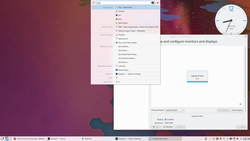 KDE Plasma desktop on Debian.
 -
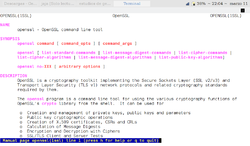 OpenSSL's manual page.
 -
 Creating a 3D car racing game using the Blender Game Engine.
 -
 Replicant smartphone OS, an Android-based system that is 100% free software.
 -
 LibreOffice is a free multi-platform office suite.


History
[edit]From the 1950s up until the early 1970s, it was normal for computer users to have the software freedoms associated with free software, which was typically public-domain software.[10] Software was commonly shared by individuals who used computers and by hardware manufacturers who welcomed the fact that people were making software that made their hardware useful. Organizations of users and suppliers, for example, SHARE, were formed to facilitate exchange of software. As software was often written in an interpreted language such as BASIC, the source code was distributed to use these programs. Software was also shared and distributed as printed source code (Type-in program) in computer magazines (like Creative Computing, SoftSide, Compute!, Byte, etc.) and books, like the bestseller BASIC Computer Games.[25] By the early 1970s, the picture changed: software costs were dramatically increasing, a growing software industry was competing with the hardware manufacturer's bundled software products (free in that the cost was included in the hardware cost), leased machines required software support while providing no revenue for software, and some customers able to better meet their own needs did not want the costs of "free" software bundled with hardware product costs. In United States vs. IBM, filed January 17, 1969, the government charged that bundled software was anti-competitive.[26] While some software might always be free, there would henceforth be a growing amount of software produced primarily for sale. In the 1970s and early 1980s, the software industry began using technical measures (such as only distributing binary copies of computer programs) to prevent computer users from being able to study or adapt the software applications as they saw fit. In 1980, copyright law was extended to computer programs.
In 1983, Richard Stallman, one of the original authors of the popular Emacs program and a longtime member of the hacker community at the MIT Artificial Intelligence Laboratory, announced the GNU Project, the purpose of which was to produce a completely non-proprietary Unix-compatible operating system, saying that he had become frustrated with the shift in climate surrounding the computer world and its users. In his initial declaration of the project and its purpose, he specifically cited as a motivation his opposition to being asked to agree to non-disclosure agreements and restrictive licenses which prohibited the free sharing of potentially profitable in-development software, a prohibition directly contrary to the traditional hacker ethic. Software development for the GNU operating system began in January 1984, and the Free Software Foundation (FSF) was founded in October 1985. He developed a free software definition and the concept of "copyleft", designed to ensure software freedom for all. Some non-software industries are beginning to use techniques similar to those used in free software development for their research and development process; scientists, for example, are looking towards more open development processes, and hardware such as microchips are beginning to be developed with specifications released under copyleft licenses (see the OpenCores project, for instance). Creative Commons and the free-culture movement have also been largely influenced by the free software movement.
1980s: Foundation of the GNU Project
[edit]In 1983, Richard Stallman, longtime member of the hacker community at the MIT Artificial Intelligence Laboratory, announced the GNU Project, saying that he had become frustrated with the effects of the change in culture of the computer industry and its users.[27] Software development for the GNU operating system began in January 1984, and the Free Software Foundation (FSF) was founded in October 1985. An article outlining the project and its goals was published in March 1985 titled the GNU Manifesto. The manifesto included significant explanation of the GNU philosophy, Free Software Definition and "copyleft" ideas.
1990s: Release of the Linux kernel
[edit]The Linux kernel, started by Linus Torvalds, was released as freely modifiable source code in 1991. The first licence was a proprietary software licence. However, with version 0.12 in February 1992, he relicensed the project under the GNU General Public License.[28] Much like Unix, Torvalds' kernel attracted the attention of volunteer programmers. FreeBSD and NetBSD (both derived from 386BSD) were released as free software when the USL v. BSDi lawsuit was settled out of court in 1993. OpenBSD forked from NetBSD in 1995. Also in 1995, The Apache HTTP Server, commonly referred to as Apache, was released under the Apache License 1.0.
Licensing
[edit]
All free-software licenses must grant users all the freedoms discussed above. However, unless the applications' licenses are compatible, combining programs by mixing source code or directly linking binaries is problematic, because of license technicalities. Programs indirectly connected together may avoid this problem.
The majority of free software falls under a small set of licenses. The most popular of these licenses are:[30][31]
- The MIT License
- The GNU General Public License v2 (GPLv2)
- The Apache License
- The GNU General Public License v3 (GPLv3)
- The BSD License
- The GNU Lesser General Public License (LGPL)
- The Mozilla Public License (MPL)
- The Eclipse Public License
The Free Software Foundation and the Open Source Initiative both publish lists of licenses that they find to comply with their own definitions of free software and open-source software respectively:
The FSF list is not prescriptive: free-software licenses can exist that the FSF has not heard about, or considered important enough to write about. So it is possible for a license to be free and not in the FSF list. The OSI list only lists licenses that have been submitted, considered and approved. All open-source licenses must meet the Open Source Definition in order to be officially recognized as open source software. Free software, on the other hand, is a more informal classification that does not rely on official recognition. Nevertheless, software licensed under licenses that do not meet the Free Software Definition cannot rightly be considered free software.
Apart from these two organizations, the Debian project is seen by some to provide useful advice on whether particular licenses comply with their Debian Free Software Guidelines. Debian does not publish a list of approved licenses, so its judgments have to be tracked by checking what software they have allowed into their software archives. That is summarized at the Debian web site.[32]
It is rare that a license announced as being in-compliance with the FSF guidelines does not also meet the Open Source Definition, although the reverse is not necessarily true (for example, the NASA Open Source Agreement is an OSI-approved license, but non-free according to FSF).
There are different categories of free software.
- Public-domain software: the copyright has expired, the work was not copyrighted (released without copyright notice before 1988), or the author has released the software onto the public domain with a waiver statement (in countries where this is possible). Since public-domain software lacks copyright protection, it may be freely incorporated into any work, whether proprietary or free. The FSF recommends the CC0 public domain dedication for this purpose.[33]
- Permissive licenses, also called BSD-style because they are applied to much of the software distributed with the BSD operating systems. The author retains copyright solely to disclaim warranty and require proper attribution of modified works, and permits redistribution and any modification, even closed-source ones.
- Copyleft licenses, with the GNU General Public License being the most prominent: the author retains copyright and permits redistribution under the restriction that all such redistribution is licensed under the same license. Additions and modifications by others must also be licensed under the same "copyleft" license whenever they are distributed with part of the original licensed product. This is also known as a viral, protective, or reciprocal license.
Proponents of permissive and copyleft licenses disagree on whether software freedom should be viewed as a negative or positive liberty. Due to their restrictions on distribution, not everyone considers copyleft licenses to be free.[34] Conversely, a permissive license may provide an incentive to create non-free software by reducing the cost of developing restricted software. Since this is incompatible with the spirit of software freedom, many people consider permissive licenses to be less free than copyleft licenses.[35]
Security and reliability
[edit]
There is debate over the security of free software in comparison to proprietary software, with a major issue being security through obscurity. A popular quantitative test in computer security is to use relative counting of known unpatched security flaws. Generally, users of this method advise avoiding products that lack fixes for known security flaws, at least until a fix is available.
Free software advocates strongly believe that this methodology is biased by counting more vulnerabilities for the free software systems, since their source code is accessible and their community is more forthcoming about what problems exist as a part of full disclosure,[39][40] and proprietary software systems can have undisclosed societal drawbacks, such as disenfranchising less fortunate would-be users of free programs. As users can analyse and trace the source code, many more people with no commercial constraints can inspect the code and find bugs and loopholes than a corporation would find practicable. According to Richard Stallman, user access to the source code makes deploying free software with undesirable hidden spyware functionality far more difficult than for proprietary software.[41]
Some quantitative studies have been done on the subject.[42][43][44][45]
Binary blobs and other proprietary software
[edit]In 2006, OpenBSD started the first campaign against the use of binary blobs in kernels. Blobs are usually freely distributable device drivers for hardware from vendors that do not reveal driver source code to users or developers. This restricts the users' freedom effectively to modify the software and distribute modified versions. Also, since the blobs are undocumented and may have bugs, they pose a security risk to any operating system whose kernel includes them. The proclaimed aim of the campaign against blobs is to collect hardware documentation that allows developers to write free software drivers for that hardware, ultimately enabling all free operating systems to become or remain blob-free.
The issue of binary blobs in the Linux kernel and other device drivers motivated some developers in Ireland to launch gNewSense, a Linux-based distribution with all the binary blobs removed. The project received support from the Free Software Foundation and stimulated the creation, headed by the Free Software Foundation Latin America, of the Linux-libre kernel.[46] As of October 2012[update], Trisquel is the most popular FSF endorsed Linux distribution ranked by Distrowatch (over 12 months).[47] While Debian is not endorsed by the FSF and does not use Linux-libre, it is also a popular distribution available without kernel blobs by default since 2011.[46]
The Linux community uses the term "blob" to refer to all nonfree firmware in a kernel whereas OpenBSD uses the term to refer to device drivers. The FSF does not consider OpenBSD to be blob free under the Linux community's definition of blob.[48]
Business model
[edit]Selling software under any free-software licence is permissible, as is commercial use. This is true for licenses with or without copyleft.[18][49][50]
Since free software may be freely redistributed, it is generally available at little or no fee. Free software business models are usually based on adding value such as customization, accompanying hardware, support, training, integration, or certification.[18] Exceptions exist however, where the user is charged to obtain a copy of the free application itself.[51]
Fees are usually charged for distribution on compact discs and bootable USB drives, or for services of installing or maintaining the operation of free software. Development of large, commercially used free software is often funded by a combination of user donations, crowdfunding, corporate contributions, and tax money. The SELinux project at the United States National Security Agency is an example of a federally funded free-software project.
Proprietary software, on the other hand, tends to use a different business model, where a customer of the proprietary application pays a fee for a license to legally access and use it. This license may grant the customer the ability to configure some or no parts of the software themselves. Often some level of support is included in the purchase of proprietary software, but additional support services (especially for enterprise applications) are usually available for an additional fee. Some proprietary software vendors will also customize software for a fee.[52]
The Free Software Foundation encourages selling free software. As the Foundation has written, "distributing free software is an opportunity to raise funds for development. Don't waste it!".[7] For example, the FSF's own recommended license (the GNU GPL) states that "[you] may charge any price or no price for each copy that you convey, and you may offer support or warranty protection for a fee."[53]
Microsoft CEO Steve Ballmer stated in 2001 that "open source is not available to commercial companies. The way the license is written, if you use any open-source software, you have to make the rest of your software open source."[54] This misunderstanding is based on a requirement of copyleft licenses (like the GPL) that if one distributes modified versions of software, they must release the source and use the same license. This requirement does not extend to other software from the same developer.[55] The claim of incompatibility between commercial companies and free software is also a misunderstanding. There are several large companies, e.g. Red Hat and IBM (IBM acquired RedHat in 2019),[56] which do substantial commercial business in the development of free software.[citation needed]
Economic aspects and adoption
[edit]Free software played a significant part in the development of the Internet, the World Wide Web and the infrastructure of dot-com companies.[57][58] Free software allows users to cooperate in enhancing and refining the programs they use; free software is a pure public good rather than a private good. Companies that contribute to free software increase commercial innovation.[59]
"We migrated key functions from Windows to Linux because we needed an operating system that was stable and reliable – one that would give us in-house control. So if we needed to patch, adjust, or adapt, we could."
The economic viability of free software has been recognized by large corporations such as IBM, Red Hat, and Sun Microsystems.[62][63][64][65][66] Many companies whose core business is not in the IT sector choose free software for their Internet information and sales sites, due to the lower initial capital investment and ability to freely customize the application packages. Most companies in the software business include free software in their commercial products if the licenses allow that.[18]
Free software is generally available at no cost and can result in permanently lower TCO (total cost of ownership) compared to proprietary software.[67] With free software, businesses can fit software to their specific needs by changing the software themselves or by hiring programmers to modify it for them. Free software often has no warranty, and more importantly, generally does not assign legal liability to anyone. However, warranties are permitted between any two parties upon the condition of the software and its usage. Such an agreement is made separately from the free software license.
A report by Standish Group estimates that adoption of free software has caused a drop in revenue to the proprietary software industry by about $60 billion per year.[68] Eric S. Raymond argued that the term free software is too ambiguous and intimidating for the business community. Raymond promoted the term open-source software as a friendlier alternative for the business and corporate world.[69]
See also
[edit]
- Definition of Free Cultural Works
- Digital rights
- Free content
- List of formerly proprietary software
- List of free software project directories
- List of free software for Web 2.0 Services
- Open format
- Open standard
- Open-source hardware
- Outline of free software
- Category:Free software lists and comparisons
- Appropriate Technology
- Sustainable Development
- Gratis versus libre
Notes
[edit]- ^ Access to source code is a necessary but insufficient condition, according to both the Free Software and Open Source definitions.
References
[edit]- ^ GNU Project. "What is free software?". Free Software Foundation. Archived from the original on Nov 15, 2023.
- ^ a b "Richard Stallman". Internet Hall of Fame. Retrieved 26 March 2017.
- ^ "Free Software Movement". GNU. Retrieved 2021-01-11.
- ^ "Philosophy of the GNU Project". GNU. Retrieved 2021-01-11.
- ^ a b "What is free software and why is it so important for society?". Free Software Foundation. Retrieved 2021-01-11.
- ^ Stallman, Richard M. (2015). Free Software Free Society: Selected Essays of Richard M. Stallman, 3rd Edition (PDF).
- ^ a b c Selling Free Software (GNU)
- ^ Stallman, Richard (27 September 1983). "Initial Announcement". GNU Project. Free Software Foundation.
- ^ Stallman, Richard. "Words to Avoid (or Use with Care) Because They Are Loaded or Confusing: Access". www.gnu.org.
- ^ a b c Shea, Tom (1983-06-23). "Free software - Free software is a junkyard of software spare parts". InfoWorld. Retrieved 2016-02-10.
"In contrast to commercial software is a large and growing body of free software that exists in the public domain. Public-domain software is written by microcomputer hobbyists (also known as "hackers") many of whom are professional programmers in their work life. [...] Since everybody has access to source code, many routines have not only been used but dramatically improved by other programmers."
- ^ Levi, Ran. "Richard Stallman and The History of Free Software and Open Source". Curious Minds Podcast.
- ^ "GNU". cs.stanford.edu. Retrieved 2017-10-17.
- ^ Rosen, David (May 16, 2010). "Open-source software is not always freeware". wolfire.com. Retrieved 2016-01-18.
- ^ "Definition of GRATIS". www.merriam-webster.com. Retrieved 2023-05-08.
- ^ Dixon, Rod (2004). Open Source Software Law. Artech House. p. 4. ISBN 978-1-58053-719-3. Retrieved 2009-03-16.
- ^ Graham, Lawrence D. (1999). Legal battles that shaped the computer industry. Greenwood Publishing Group. p. 175. ISBN 978-1-56720-178-9. Retrieved 2009-03-16.
- ^ Sullivan, John (17 July 2008). "The Last Mile is Always the Hardest". fsf.org. Archived from the original on 28 October 2014. Retrieved 29 December 2014.
- ^ a b c d Popp, Dr. Karl Michael (2015). Best Practices for commercial use of open source software. Norderstedt, Germany: Books on Demand. ISBN 978-3738619096.
- ^ Stallman, Richard. "Why "Open Source" misses the point of Free Software". GNU Project. Free Software Foundation.
- ^ Stallman, Richard (2013-05-14). "The advantages of free software". Free Software Foundation. Retrieved 2013-08-12.
- ^ Stallman, Richard. "What is the Free Software Foundation?". GNU's Bulletin. Vol. 1, no. 1. p. 8.
- ^ a b Free Software Foundation. "What is free software?". Retrieved 14 December 2011.
- ^ "Four Freedoms". fsfe.org. Retrieved March 22, 2022.
- ^ Perens, Bruce. "Debian's "Social Contract" with the Free Software Community". debian-announce mailing list.
- ^ Ahl, David. "David H. Ahl biography from Who's Who in America". Retrieved 2009-11-23.
- ^ Fisher, Franklin M.; McKie, James W.; Mancke, Richard B. (1983). IBM and the U.S. Data Processing Industry: An Economic History. Praeger. ISBN 0-03-063059-2.
- ^ Williams, Sam (2002). Free as in Freedom: Richard Stallman's Crusade for Free Software. O'Reilly Media. ISBN 0-596-00287-4.
- ^ "Release notes for Linux kernel 0.12". Kernel.org.
- ^ Carver, Brian W. (2005-04-05). "Share and Share Alike: Understanding and Enforcing Open Source and Free Software Licenses". Berkeley Technology Law Journal. 20: 39. SSRN 1586574.
- ^ "Top 20 licenses". Black Duck Software. 19 November 2015. Archived from the original on 19 July 2016. Retrieved 19 November 2015.
1. MIT license 24%, 2. GNU General Public License (GPL) 2.0 23%, 3. Apache License 16%, 4. GNU General Public License (GPL) 3.0 9%, 5. BSD License 2.0 (3-clause, New or Revised) License 6%, 6. GNU Lesser General Public License (LGPL) 2.1 5%, 7. Artistic License (Perl) 4%, 8. GNU Lesser General Public License (LGPL) 3.0 2%, 9. Microsoft Public License 2%, 10. Eclipse Public License (EPL) 2%
- ^ Balter, Ben (2015-03-09). "Open source license usage on GitHub.com". github.com. Retrieved 2015-11-21.
"1 MIT 44.69%, 2 Other 15.68%, 3 GPLv2 12.96%, 4 Apache 11.19%, 5 GPLv3 8.88%, 6 BSD 3-clause 4.53%, 7 Unlicense 1.87%, 8 BSD 2-clause 1.70%, 9 LGPLv3 1.30%, 10 AGPLv3 1.05%
- ^ "License information". Debian. 2020-09-03.
- ^ "Various Licenses and Comments about Them". GNU Operating System. 12 January 2022.
- ^ Palmer, Doug (2003-02-15). "Why Not Use the GPL? Thoughts on Free and Open-Source Software". www.charvolant.org. Archived from the original on 2020-01-24. Retrieved 2020-01-24.
- ^ Stallman, Richard (2021-12-25). "The BSD License Problem". Free Software Foundation. Retrieved 2024-03-29.
- ^ Toxen, Bob (2003). Real World Linux Security: Intrusion Prevention, Detection, and Recovery. Prentice Hall Professional. p. 365. ISBN 9780130464569.
- ^ Mookhey, K.K.; Burghate, Nilesh (2005). Linux: Security, Audit and Control Features. ISACA. p. 128. ISBN 9781893209787.
- ^ Noyes, Katherine (Aug 3, 2010). "Why Linux Is More Secure Than Windows". PCWorld. Archived from the original on 2013-09-01.
- ^ "Firefox more secure than MSIE after all". CNET. News.com.
- ^ "The Benefits of Open Source". Retrieved 19 March 2015.
- ^ "Transcript where Stallman explains about spyware". Fsfe - Free Software Foundation Europe.
- ^ David A. Wheeler: Why Open Source Software / Free Software (OSS/FS, FLOSS, or FOSS)? Look at the Numbers! 2007
- ^ Michelle Delio: Linux: Fewer Bugs Than Rivals Wired 2004
- ^ Barton P. Miller; David Koski; Cjin Pheow Lee; Vivekananda Maganty; Ravi Murthy; Ajitkumar Natarajan; Jeff Steidl (11 April 1995). Fuzz Revisited: A Re-examination of the Reliability of UNIX Utilities and Services (Report). Madison, WI: University of Wisconsin: Computer Sciences Department. Archived (PDF) from the original on 21 June 2010.
...The reliability of the basic utilities from GNU and Linux were noticeably better than those of the commercial systems
- ^ Miller, Barton P.; Cooksey, Gregory; Moore, Fredrick (2006). "An empirical study of the robustness of MacOS applications using random testing" (PDF). Proceedings of the 1st international workshop on Random testing - RT '06. New York, New York, USA: ACM Press. pp. 1, 2. doi:10.1145/1145735.1145743. ISBN 159593457X. Archived from the original (PDF) on 21 June 2010.
We are back again, this time testing... Apple's Mac OS X. [...] While the results were reasonable, we were disappointed to find that the reliability was no better than that of the Linux/GNU tools tested in 1995. We were less sure what to expect when testing the GUI- based applications; the results turned out worse than we expected.
- ^ a b "Links to Other Free Software Sites - GNU Project - Free Software Foundation". Retrieved 19 March 2015.
- ^ "DistroWatch Page Hit Ranking". DistroWatch. 30 October 2012. Archived from the original on 7 October 2011. Retrieved 30 October 2012.
- ^ "Explaining Why We Don't Endorse Other Systems".
- ^ "BSD license definition". Retrieved 19 March 2015.
- ^ "Why you should use a BSD style license for your Open Source Project". Retrieved 19 March 2015.
- ^ "[libreplanet-discuss] Is there any software that is libre but not gratis". lists.gnu.org.
- ^ Andy Dornan. "The Five Open Source Business Models". Archived from the original on October 10, 2009.
- ^ GNU General Public License, section 4. gnu.org
- ^ "Ballmer calling open source a 'cancer', saying it's 'not available to commercial companies'". Chicago Sun-Times. 1 June 2001. Archived from the original on 2001-06-15.
- ^ "Licenses". Choose a License. Retrieved 2022-10-19.
- ^ "IBM Closes Landmark Acquisition of Red Hat for $34 Billion; Defines Open, Hybrid Cloud Future". IBM Newsroom. Retrieved 2022-10-19.
- ^ Netcraft (14 March 2023). "Web Server Usage Survey".
- ^ The Apache Software Foundation. "Apache Strategy in the New Economy" (PDF). Archived from the original (PDF) on 2008-02-16.
- ^ Waring, Teresa; Maddocks, Philip (1 October 2005). "Open Source Software implementation in the UK public sector: Evidence from the field and implications for the future". International Journal of Information Management. 25 (5): 411–428. doi:10.1016/j.ijinfomgt.2005.06.002.
In addition OSS's development process is creating innovative products that are reliable, secure, practical and have high usability and performance ratings. Users are now not only benefiting from the OSS revolution but also from the improved proprietary software development that is being forced upon suppliers in order to maintain competitive advantage.
- ^ Gunter, Joel (May 10, 2013). "International Space Station to boldly go with Linux over Windows". The Telegraph. Archived from the original on 2022-01-11.
- ^ Bridgewater, Adrian (May 13, 2013). "International Space Station adopts Debian Linux, drops Windows & Red Hat into airlock". Computer Weekly. Archived from the original on November 19, 2018. Retrieved August 1, 2013.
- ^ "IBM launches biggest Linux lineup ever". IBM. 1999-03-02. Archived from the original on 1999-11-10.
- ^ Hamid, Farrah (2006-05-24). "IBM invests in Brazil Linux Tech Center". LWN.net.
- ^ "Interview: The Eclipse code donation". IBM. 2001-11-01. Archived from the original on 2009-12-18.
- ^ "Sun begins releasing Java under the GPL". Free Software Foundation. November 15, 2006. Retrieved 2007-09-23.
- ^ Rishab Aiyer Ghosh (November 20, 2006). "Study on the: Economic impact of open source software on innovation and the competitiveness of the Information and Communication Technologies (ICT) sector in the EU" (PDF). European Union. p. 51. Retrieved 2007-01-25.
- ^ "Total cost of ownership of open source software: a report for the UK Cabinet Office supported by OpenForum Europe". Retrieved 19 March 2015.
- ^ "Open Source". Standish Newsroom. Standishgroup.com. 2008-04-16. Archived from the original on 2012-01-18. Retrieved 2010-08-22.
- ^ Eric S. Raymond. "Eric S. Raymond's initial call to start using the term open source software, instead of free software".
Further reading
[edit]- Puckette, Miller. "Who Owns our Software?: A first-person case study." eContact (September 2009). Montréal: CEC
- Hancock, Terry. "The Jargon of Freedom: 60 Words and Phrases with Context". Free Software Magazine. 2010-20-24 Archived 2012-06-06 at the Wayback Machine
- Stallman, Richard M. (2010) [2002]. Free Software Free Society: Selected Essays of Richard M. Stallman, 2nd Edition. GNU Press. ISBN 978-0-9831592-0-9. Archived from the original on 2016-04-22. Retrieved 2012-12-21.
External links
[edit]

| General | |||
|---|---|---|---|
| Software packages | |||
| Community | |||
| Organisations | |||
| Licenses |
| ||
| Challenges | |||
| Related topics | |||


Free software
View on GrokipediaDefinition and Core Principles
The Four Essential Freedoms
A program qualifies as free software if it grants users the four essential freedoms, as defined by the Free Software Foundation: the freedom to run the program as desired for any purpose (freedom 0), the freedom to study how the program works and modify it to suit specific needs by accessing its source code (freedom 1), the freedom to redistribute copies to others (freedom 2), and the freedom to distribute copies of modified versions to others (freedom 3).[1] These criteria, first articulated by Richard Stallman in the context of the GNU Project, provide verifiable legal standards for software distribution rather than mere access permissions.[5] Freedom 0 ensures users can execute the program without limitations imposed by the developer, such as time-based restrictions or hardware-specific locks; for instance, digital rights management (DRM) systems often violate this by preventing unmodified runs on unauthorized devices or after license expirations, as seen in proprietary media players that enforce regional playback controls.[1][6] Freedom 1 requires the provision of human-readable source code, enabling inspection and adaptation; without it, users cannot independently verify functionality or fix defects, a requirement unmet in binary-only distributions that obscure implementation details.[1] Freedom 2 permits sharing exact copies in source or binary form, potentially for a fee, fostering dissemination without needing developer approval; this contrasts with licenses prohibiting resale or requiring tracking of recipients.[1] Freedom 3 mandates that modified versions be licensed under identical terms, preserving the chain of freedoms for downstream users and preventing "tivoization" where hardware restricts modified software execution despite source availability.[1] Violations, such as those embedding DRM that blocks altered binaries, nullify this by allowing distributors to curtail perpetual user control.[6]Philosophical Foundations and Ethical Assertions
The free software movement asserts that users possess an inherent ethical right to full control over the software tools they employ, emphasizing individual autonomy in computation as a fundamental good akin to control over personal property or instruments. This perspective frames proprietary software restrictions—such as binary-only distribution—as a form of subjugation, wherein developers impose terms that deny users the ability to adapt, repair, or extend their own systems, thereby prioritizing vendor interests over user agency.[7] Proponents argue this autonomy enables societal benefits like accelerated collective improvement, positing that unrestricted access to source code fosters innovation without artificial barriers.[8] Critics within the movement specifically decry practices like tivoization, where hardware manufacturers incorporate free software but employ digital locks to prevent user modifications, and non-disclosure agreements (NDAs) that conceal implementation details, claiming these mechanisms hinder broader technological progress by fragmenting knowledge and enforcement.[9] However, such ethical critiques warrant scrutiny through causal analysis: proprietary models often align incentives with intensive research and development, as property rights in code enable recoupment of upfront costs via exclusivity, driving outputs not replicable under pure sharing regimes. For example, Apple's iOS ecosystem, with its controlled distribution, facilitated $1.1 trillion in developer billings and sales in 2022 alone, catalyzing innovations in mobile computing that expanded market scale and user capabilities far beyond what uncoordinated free alternatives achieved contemporaneously.[10] The normative view that proprietary software is categorically unethical falters under empirical examination, as it conflates contractual restrictions with moral wrongs while ignoring interdependencies; major free software implementations, including GNU/Linux distributions, routinely depend on proprietary hardware elements like GPU firmware and wireless chipsets for operational viability, revealing practical limits to absolutist autonomy claims absent complementary hardware freedoms.[4] This reliance underscores that software control cannot be isolated from ecosystem realities, where proprietary components fill gaps in free alternatives due to higher barriers in hardware reverse-engineering. Counterarguments further contend that the movement's moral absolutism—labeling nonfree software an "injustice" irrespective of context—disregards how profit-driven incentives in proprietary development fund risk-laden R&D, yielding advancements (e.g., in performance-optimized silicon integration) that diffuse benefits society-wide, even if initial access is gated.[11] Thus, ethical assertions favoring unrestricted freedom must contend with evidence that blended models, balancing exclusivity and diffusion, better sustain long-term causal chains of innovation.Distinctions from Related Paradigms
Free Software Versus Open Source Software
The divergence between free software and open source software emerged in 1998 with the formation of the Open Source Initiative (OSI), co-founded by Eric S. Raymond and Bruce Perens to promote a pragmatic approach to software development that emphasized practical benefits like improved code quality and rapid innovation over ethical imperatives.[12] This split was catalyzed by Raymond's essay "The Cathedral and the Bazaar," initially presented in May 1997, which argued that decentralized, collaborative development—likened to a bazaar—produced superior software compared to centralized, cathedral-like models, without invoking moral obligations for user freedoms.[13] In contrast, free software, as defined by the Free Software Foundation (FSF) since 1985, prioritizes four essential freedoms as a matter of principle, viewing non-free software as inherently unjust regardless of its technical merits.[1] Ideologically, free software constitutes a social and ethical movement insisting on users' rights to control software through freedoms like modification and redistribution, often enforced via copyleft licenses that require derivative works to remain free; open source, however, frames software sharing as a methodology for efficiency and market appeal, accepting a broader range of licenses—including permissive ones that permit integration into proprietary systems—without mandating ethical conformity.[14] This distinction manifests practically in licensing choices: free software advocates like the FSF criticize permissive open source licenses for enabling "semi-free" hybrids, such as the Android Open Source Project (AOSP), which uses the Apache 2.0 license to allow manufacturers to add proprietary components and create closed forks, diverging from strict copyleft enforcement.[15] Raymond and OSI proponents counter that such flexibility attracts corporate investment, fostering ecosystems where code reuse drives progress unbound by ideological purity.[13] Empirically, open source's accommodation of proprietary elements has correlated with dominant adoption in enterprise and infrastructure contexts, powering the vast majority of cloud computing environments—where Linux-based distributions underpin over 90% of public cloud instances—while free software's uncompromising stance on freedoms has constrained its reach in consumer desktops, holding roughly 4% global market share as of mid-2024.[16] This disparity underscores a causal dynamic: open source's alignment with commercial incentives has accelerated innovation through widespread corporate contributions and hybrid models, empirically undercutting free software's assertion of moral superiority by demonstrating that pragmatic utility, rather than absolutist ethics, better scales technological advancement in competitive markets.[17]Free Software Versus Proprietary Software
Proprietary software development centralizes control under the vendor, restricting source code access to protect intellectual property and enable revenue streams via licensing, subscriptions, or hardware bundling, which in turn fund dedicated teams for iterative improvements and market-specific optimizations. This model contrasts with free software's decentralized, permissionless modification and redistribution, fostering broad collaboration but introducing coordination challenges that can fragment ecosystems and delay consensus on enhancements. Empirical market outcomes highlight these trade-offs: as of September 2025, Microsoft's Windows, a proprietary desktop OS, commands 72.3% global share, underscoring how commercial incentives drive polished user interfaces and seamless hardware integration absent in volunteer-led alternatives.[16] Conversely, free software distributions like those based on Linux hold roughly 4% desktop share worldwide, with growth to 5% in select regions like the US attributed partly to niche adoption rather than broad appeal, as fragmentation across variants impedes unified user experience advancements.[16][18] In server infrastructure, free software demonstrates dominance through cost efficiencies and scalability; Nginx and Apache, both free-licensed, collectively power over 50% of surveyed websites as of October 2025, enabling widespread deployment in resource-constrained environments without proprietary fees.[19][20] This prevalence stems from permissive modification freedoms that accelerate adaptations for high-load scenarios, though it relies on community or sponsored maintenance rather than guaranteed vendor support. Proprietary alternatives, such as certain enterprise servers, offer vendor-backed reliability contracts but at higher costs, limiting penetration in commoditized markets where free options suffice for operational needs. Security profiles reveal causal ambiguities without model superiority: free software's source transparency invites global auditing, potentially surfacing flaws faster, yet public exposure risks exploitation pre-patch, as in the 2014 Heartbleed vulnerability (CVE-2014-0160) in OpenSSL, which enabled remote memory disclosure affecting millions of servers before widespread remediation.[21] Proprietary obscurity can conceal issues longer, exemplified by zero-day exploits in closed systems like Microsoft Windows and VMware products, where undisclosed flaws persisted until post-exploitation disclosure in events such as the 2023 MOVEit and Citrix attacks.[22] Empirical analyses, including comparisons of web servers like Apache (free) versus proprietary equivalents, show mixed results dependent on auditing rigor and incentives—proprietary profits may expedite fixes for high-value customers, while free projects leverage crowd-sourced reviews but suffer under-resourcing in less-visible components.[23][24] Innovation dynamics hinge on incentives: proprietary models channel profits into targeted R&D, yielding tighter feature integration and rapid response to user demands in consumer segments, as evidenced by Windows' sustained dominance despite free alternatives. Free software, lacking direct monetization for core freedoms, depends on intrinsic motivations or indirect funding, enabling breakthroughs in collaborative domains like servers but constraining polish for end-user desktops where unified investment lags.[25] This disparity manifests in user outcomes—proprietary ecosystems often prioritize seamless control and support ecosystems, trading user freedoms for reliability, while free software empowers customization at the expense of occasional instability from uncoordinated forks.[26]Historical Development
Precursors Before 1983
In the 1960s and 1970s, academic and research institutions fostered a culture of software source code sharing driven by practical needs for collaboration and customization, rather than formalized ethical mandates. Computers from manufacturers like IBM and DEC often included source code for operating systems and utilities as part of hardware acquisitions, allowing researchers to modify and extend functionality for specific experiments.[27] This norm prevailed because software was viewed as a tool for scientific advancement, with distribution via physical media like tapes enabling iterative improvements among peers.[28] The launch of ARPANET in 1969 facilitated broader code dissemination across U.S. research sites, promoting distributed development of protocols and applications without proprietary barriers.[29] Concurrently, AT&T's UNIX, developed at Bell Labs from 1969 onward, exemplified this pragmatism: antitrust restrictions barred AT&T from commercial hardware sales, leading to low-cost source code licensing to universities and labs starting in the early 1970s, which spurred ports and enhancements like those for minicomputers.[30][31] By 1977, the University of California, Berkeley, released the first Berkeley Software Distribution (BSD), augmenting AT&T's Version 6 UNIX with TCP/IP networking code and utilities, distributed with source to academic users for collaborative refinement.[32] These efforts prioritized technical interoperability over restrictive controls, contrasting with emerging commercialization. In the late 1970s, as AT&T's 1982 divestiture loomed, licensing terms tightened, initiating "UNIX wars" where variants proliferated amid disputes over source access and modifications.[33] At MIT's Artificial Intelligence Laboratory, reliance on DEC PDP-10 systems with accessible source for the Incompatible Timesharing System (ITS) sustained hacker-driven modifications into the early 1980s, but shifts toward proprietary models—such as DEC's restricted releases—eroded this openness.[34] A pivotal frustration arose around 1982 when the lab installed a new Xerox 9700 laser printer with closed-source software, preventing Stallman from replicating user-notification fixes he had implemented on the prior modifiable system, underscoring the practical costs of withheld code.[35] These pre-1983 developments laid technical foundations through ad-hoc sharing, foreshadowing formalized responses to proprietary encroachments.Launch of the GNU Project and FSF (1983–1989)
In September 1983, Richard Stallman publicly announced the GNU Project with the goal of creating a complete, Unix-compatible operating system composed entirely of free software, to be released under terms ensuring users' freedoms to use, study, modify, and distribute it.[36] Development began in January 1984, driven by Stallman's reaction to the erosion of collaborative software sharing at MIT's Artificial Intelligence Laboratory, where companies like Symbolics commercialized Lisp machine software, withheld source code from users, and hired away key contributors, leaving the lab reliant on restricted updates that Stallman viewed as a betrayal of hacker culture's norms.[37] This incident, occurring around 1980–1983, underscored for Stallman the risks of proprietary control, prompting a shift toward systematic advocacy for software freedoms over ad-hoc resistance. The Free Software Foundation (FSF) was established on October 4, 1985, as a nonprofit to provide organizational and financial support for GNU, initially focusing on fundraising to sustain volunteer-driven work amid limited resources.[2] By 1985, early GNU components included a free version of Emacs, a extensible text editor originally developed in the MIT AI Lab.[38] Progress accelerated with the release of the GNU Compiler Collection (GCC) beta on March 22, 1987, which provided a portable C compiler supporting optimization and serving as a cornerstone for further tool development.[39] Other utilities, such as core GNU utilities (coreutils precursors) and libraries, followed, with the project targeting a fully functional system by 1990. The GNU General Public License version 1 (GPL v1) was introduced in February 1989, formalizing "copyleft" to require that derivative works remain free by mandating distribution of source code under compatible terms. Despite these advances, the project fell short of its 1990 completion goal, primarily due to delays in developing a kernel—initially based on TRIX and later pivoting to the Hurd microkernel—exacerbated by the challenges of coordinating unpaid volunteers against the rapid pace of proprietary, venture-funded efforts like those at Symbolics and other Unix vendors.[38] Critics have argued that the GNU team's uncompromising insistence on ideological purity, such as rejecting non-free tools even for bootstrapping, hindered efficiency and prolonged delivery of practical outputs compared to more pragmatic commercial rivals.[40] By 1989, GNU had produced a robust ecosystem of userland tools but lacked an operational kernel, highlighting the causal trade-offs of volunteerism and principle-driven development in an era dominated by resource-rich proprietary innovation.Linux Kernel and Ecosystem Maturation (1991–2000)
In September 1991, Linus Torvalds released the first version (0.01) of the Linux kernel, initially developed as a personal project to create a free Unix-like kernel for the Intel 80386 processor, leveraging GNU tools and libraries for compatibility.[41] The kernel's GPL licensing and modular design facilitated rapid contributions from developers worldwide, distinguishing it from the more centralized GNU Hurd project.[42] By 1993, the kernel's maturation enabled the emergence of complete Linux distributions, with Slackware releasing its version 1.00 on July 16 as one of the earliest, emphasizing simplicity and minimal dependencies.[43] Debian followed in August 1993, founded by Ian Murdock to prioritize free software principles while integrating the Linux kernel with GNU components for a fully functional operating system.[44] These distributions combined the kernel with GNU userland tools—such as the GNU C compiler (GCC), Bash shell, and coreutils—forming what became known as GNU/Linux systems, which provided essential utilities absent in the kernel alone.[42] The Linux kernel reached version 1.0 on March 14, 1994, marking its first stable release with support for multiprocessor systems and over 176,000 lines of code, signaling readiness for production use.[45] That year, Red Hat Linux debuted on November 3, introducing RPM packaging and commercial support models that accelerated enterprise experimentation.[46] Torvalds' governance emphasized pragmatic code quality over ideological purity, contrasting with the Free Software Foundation's (FSF) stricter ethical stance; this meritocratic approach, prioritizing functional improvements via public review, attracted diverse contributors and sidestepped FSF concerns over non-free modules.[47] [48] Throughout the late 1990s, Linux adoption surged in server environments due to its stability, cost-effectiveness, and scalability on commodity hardware, powering a growing share of internet infrastructure.[45] By 1996, the Apache HTTP Server—often deployed on Linux—had become the dominant web server, surpassing competitors like NCSA HTTPd and handling over 50% of web traffic by the early 2000s, underscoring the kernel's role in enabling robust, free software ecosystems for high-load applications.[49] This period's collaborations, including kernel enhancements for networking and filesystems, solidified Linux as a viable alternative to proprietary Unix variants, with distributions like Red Hat achieving commercial viability through services rather than software sales.[50]Expansion and Challenges (2001–Present)
The launch of Ubuntu on October 20, 2004, marked a pivotal expansion in free software's desktop accessibility, with its user-friendly interface and regular release cycle attracting broader adoption among non-technical users and contributing to Linux distributions' maturation.[51] This period also saw free software's kernel underpin massive server and cloud growth, as Linux-based systems powered platforms like Amazon Web Services, which by 2024 held over 30% of the global cloud market share, with Linux dominating hyperscale data centers due to its scalability and cost efficiency.[52] [53] Mobile computing presented both opportunity and friction, as Android—first commercially released in September 2008—leveraged a modified Linux kernel to achieve ubiquity, powering over 70% of global smartphones by 2025, yet incorporated nonfree binary blobs for hardware firmware, undermining full user freedoms as critiqued by the GNU Project.[54] The Free Software Foundation (FSF) addressed this in October 2025 by announcing the LibrePhone project, aimed at developing replacements for proprietary blobs to enable fully free Android-compatible operating systems on existing hardware.[55] In the 2010s and 2020s, free software ecosystems expanded into AI and machine learning, with frameworks like TensorFlow (released 2015 under Apache License 2.0) enabling widespread development, though permissive licensing and integration with proprietary models—such as closed large language models—raised concerns over copyleft erosion and user control.[56] Cloud and embedded systems further entrenched free software, with Linux variants in IoT devices and supercomputers achieving near-total dominance (over 90% by 2024), driven by empirical advantages in reliability and customization.[53] Challenges persisted, including stagnant desktop penetration at approximately 4% global market share in 2025, limited by hardware compatibility issues and proprietary driver dependencies, alongside community strains from maintainer burnout amid rising complexity and corporate co-option.[16] The FSF's April 2025 board review reaffirmed commitments to foundational principles like the GNU Manifesto amid perceptions of waning ideological influence against open-source pragmatism.[57] These hurdles underscore ongoing tensions between widespread practical adoption and strict adherence to the four essential freedoms.Licensing Mechanisms
Permissive Licensing Approaches
Permissive licenses in free software grant broad freedoms to use, modify, and redistribute code, including integration into proprietary products, without mandating that derivative works remain free or disclose their source code. Prominent examples include the MIT License, which requires only retention of the original copyright notice and disclaimer; the BSD licenses (two- and three-clause variants), which similarly emphasize minimal conditions like attribution while prohibiting endorsement claims in the three-clause version; and the Apache License 2.0, which adds explicit requirements for notice preservation and state changes in modified files.[58][59][60] These licenses facilitate pragmatic development by prioritizing flexibility over enforcement of ongoing openness, enabling seamless incorporation into commercial ecosystems. For instance, components of Apple macOS, such as launchd and Grand Central Dispatch, derive from BSD-licensed code, allowing proprietary extensions without reciprocal sharing obligations. Empirical data from a 2015 analysis of GitHub repositories indicates permissive licenses comprised approximately 55% of declared licenses, compared to 20% for copyleft variants, reflecting higher corporate uptake due to reduced barriers for proprietary reuse.[61][62] The Apache License 2.0, revised in 2004, uniquely incorporates an explicit patent grant, licensing contributors' relevant patents to users and downstream modifiers to mitigate litigation risks in patent-heavy domains.[63][64] Despite these benefits, permissive approaches carry risks of diluting free software principles, as code can be absorbed into closed-source products without community reciprocity, potentially limiting collaborative evolution. Critics, including free software advocates, contend this enables "embrace-extend-extinguish" tactics, where entities integrate permissive-licensed technology, extend it with incompatible proprietary features, and undermine competition—as Microsoft reportedly did with network protocols like SMB in the 1990s, complicating interoperability for rivals.[65] Such strategies exploit the absence of share-alike requirements, though empirical evidence of widespread extinguishment remains debated, with permissive licenses empirically driving broader initial adoption over time.[66]Copyleft and Strong Copyleft Variants
Copyleft licenses employ copyright mechanisms to mandate that derivative works and combinations with other software preserve the essential freedoms of use, modification, study, and redistribution granted by the original license. This "viral" propagation ensures that freedoms cannot be restricted in subsequent distributions, distinguishing copyleft from permissive licenses by enforcing reciprocal sharing. The Free Software Foundation (FSF) defines copyleft as the rule preventing added restrictions on freedoms when redistributing software. Strong copyleft variants, such as those in the GNU General Public License (GPL) family, extend these requirements to the entire resulting work when software is linked or combined, compelling disclosure of source code under identical terms even for proprietary integrations. The GNU GPL version 2, released in June 1991, exemplifies this by prohibiting proprietary derivatives and ensuring that any distributed modifications include complete source code.[67] Version 3, published on June 29, 2007, introduced provisions against "tivoization," where hardware restrictions prevent installation of modified GPL-covered software, thereby safeguarding users' modification rights on deployed devices.[68] The GNU Affero General Public License (AGPL), a variant of GPL version 3, addresses network deployment scenarios by requiring source code availability for modifications used in server-side applications accessible over a network, closing the "application service provider" loophole inherent in standard GPL.[69] This mechanism has empirically sustained freedom propagation in ecosystems like GNU, where GPL-licensed components form interconnected systems resistant to proprietary enclosure, as evidenced by studies showing developers' adaptations to create compliant derivatives without violating terms. However, strong copyleft's stringent reciprocity can deter integration into proprietary or enterprise environments, as firms risk exposing confidential code when combining with copyleft components, leading to observed preferences for permissive licenses in commercial contexts.[71] Critics contend this restrictiveness alters developer incentives, potentially reducing contributions from entities seeking competitive advantages through non-disclosure and thereby hindering broader innovation ecosystems reliant on mixed licensing.[66] From a causal perspective, while copyleft preserves ideological purity in core projects, its enforcement of universal sharing may limit adoption and upstream improvements in scenarios where proprietary value extraction drives investment.[72]License Compliance, Enforcement, and Conflicts
The Free Software Foundation (FSF) maintains a dedicated Licensing and Compliance Lab to enforce copyleft licenses such as the GNU General Public License (GPL) for GNU Project software, prioritizing negotiation and education over litigation to achieve compliance.[73] This approach involves investigating reports of violations, demanding source code release where required, and occasionally pursuing legal action when goodwill efforts fail.[73] Similarly, the Software Freedom Conservancy (SFC) coordinates GPL enforcement for projects like BusyBox, filing suits against distributors of embedded devices that fail to provide corresponding source code, as seen in multiple cases against consumer electronics firms in 2009.[74][75] Tools like the REUSE initiative, developed by the Free Software Foundation Europe (FSFE), facilitate proactive compliance by standardizing the inclusion of machine-readable copyright and licensing notices in source files, reducing inadvertent violations in collaborative projects.[76] REUSE compliance is verified via a dedicated tool that scans repositories and confirms adherence to recommendations, aiding developers in meeting obligations under free software licenses without exhaustive manual audits.[77] Such mechanisms underscore the reliance on community-driven practices for enforcement, contrasting with proprietary software's robust legal apparatuses backed by corporate resources. Notable enforcement actions include the FSF's 2008 lawsuit against Cisco Systems for failing to distribute source code for GPL-licensed components in Linksys products, resolved in a 2009 settlement requiring Cisco to appoint a Free Software Director, conduct ongoing audits, and donate to the FSF.[78] In a protracted dispute, Linux developer Christoph Hellwig sued VMware in 2015 via the SFC, alleging that VMware's ESXi hypervisor incorporated GPL-licensed Linux kernel code without complying with distribution terms; the German court dismissed the core claims in 2016 without addressing derivative work merits, highlighting jurisdictional and interpretive challenges in cross-border enforcement.[79][80] Emerging conflicts involve the use of GPL-licensed code in AI model training, where debates center on whether ingested code constitutes a derivative work triggering copyleft obligations for model outputs or weights; while training itself may not violate the GPL, generated code resembling GPL sources risks "taint" and compliance demands, prompting tools like GPL scanners for AI-assisted development.[81] Overall, free software enforcement depends heavily on violators' cooperation and limited litigation resources, often yielding settlements rather than injunctions, unlike the aggressive patent and copyright assertions common in proprietary ecosystems.[82] This goodwill-based model has secured compliance in thousands of cases but struggles against systemic non-compliance by large entities prioritizing proprietary interests.[83]Key Implementations and Ecosystems
Core Operating Systems and Distributions
The core operating systems in free software predominantly revolve around the GNU/Linux combination, where the Linux kernel, released in 1991 under the GNU General Public License (GPL), serves as a monolithic architecture providing efficient system calls and device management for high-performance workloads. This kernel integrates most services directly into its space, enabling faster inter-component communication compared to microkernel designs, though it increases the potential impact of faults. Major distributions such as Debian, initiated in 1993 as a community-driven project emphasizing stability and a vast package repository exceeding 60,000 software items, cater to servers, desktops, and embedded systems with long-term support releases spanning up to five years. Fedora, launched in 2003 and sponsored by Red Hat, prioritizes upstream innovation with frequent updates, positioning it as a testing ground for enterprise features in Red Hat Enterprise Linux while supporting diverse hardware through modular editions like Workstation and Server. Linux-based systems dominate server environments, powering 100% of the TOP500 supercomputers as of June 2025, leveraging their scalability for high-performance computing clusters via distributions optimized for parallel processing and resource management. However, desktop adoption faces challenges from fragmentation, with over 300 active distributions leading to divergent package management, configuration standards, and desktop environments, which duplicate development efforts and complicate software compatibility and user migration.[84] Alternatives include BSD-derived systems like FreeBSD, a complete operating system descended from the Berkeley Software Distribution with a monolithic kernel under a permissive BSD license, emphasizing reliability for network appliances, storage servers, and embedded devices through native ZFS filesystem support and jails for secure virtualization.[85] The GNU Hurd, developed since 1990 as a microkernel-based replacement for Unix components using the Mach microkernel, implements servers for filesystems and processes in user space to enhance modularity and fault isolation, but remains experimental with limited hardware support and no widespread production deployment despite a 2025 Debian port covering about 80% of the archive. Many distributions incorporate proprietary dependencies, such as NVIDIA's closed-source graphics drivers required for optimal GPU acceleration in compute-intensive tasks, highlighting ongoing interoperability gaps with non-free hardware firmware.[86]Prominent Applications, Tools, and Libraries
In software development, Git, a distributed version control system released in 2005, dominates usage, with 93.87% of developers preferring it as of 2025 according to surveys tracking version control preferences.[87] The GNU Compiler Collection (GCC), initiated in 1987, functions as the primary compiler for languages including C, C++, and Fortran in most GNU/Linux environments, underpinning the compilation of vast portions of free software ecosystems. Text editors like Vim, a highly configurable modal editor originating from vi in 1991, remain staples, with 24.3% of developers reporting its use in the 2025 Stack Overflow Developer Survey.[88] Productivity applications include LibreOffice, a fork of OpenOffice.org launched in 2010 by The Document Foundation, which serves tens of millions of users globally across homes, businesses, and governments as a multi-platform office suite for word processing, spreadsheets, and presentations.[89] By early 2025, it had accumulated over 400 million downloads, reflecting steady adoption amid shifts away from subscription-based alternatives.[90] Key libraries encompass glibc (GNU C Library), the standard C library for most general-purpose Linux distributions including Ubuntu, Debian, and Fedora, providing core system interfaces for POSIX compliance and dynamic linking.[91] FFmpeg, a comprehensive multimedia framework since 2000, handles decoding, encoding, and transcoding for audio and video, integrating into countless media tools and services for format conversion and streaming.[92] The Qt framework, available under the LGPL since 2008, facilitates cross-platform GUI and application development, supporting dynamic linking for proprietary software while powering interfaces in environments like KDE.[93]Contemporary Projects and Emerging Integrations
KDE Plasma 6.5, released on October 22, 2025, introduced enhancements such as rounded window corners, automatic dark mode adaptation, and improved clipboard management, refining the desktop experience within free software ecosystems.[94] Concurrently, GNOME has advanced toward GNOME OS, an immutable distribution leveraging Flatpak for application delivery to highlight GNOME's capabilities, with collaborative efforts alongside KDE emphasizing user-focused Linux distributions as of late 2024.[95] The Rust programming language has gained traction in free software for its memory safety guarantees, enabling safer systems programming; enterprise surveys indicate 45% organizational production use by early 2025, including integrations in projects like Linux kernel modules for reduced vulnerability risks.[96] In edge computing, initiatives such as EdgeX Foundry facilitate interoperability for IoT devices through a vendor-neutral, open source platform, supporting modular architectures for data processing at the network periphery.[97] Amid rising open-source AI tools from 2023 to 2025, free software integrations remain constrained, with local inference frameworks like Ollama enabling deployment of open-weight models on free stacks, yet purists criticize predominant permissive licensing for insufficient user freedoms compared to copyleft standards. The XZ Utils incident in March 2024 exemplified supply chain threats, as a compromised maintainer embedded a backdoor in library versions 5.6.0 and 5.6.1, potentially enabling remote code execution in affected SSH daemons after years of subtle contributions.[98][99] This event prompted heightened scrutiny of contributor trust models in collaborative free software development.Technical Characteristics and Evaluations
Empirical Security Comparisons
Empirical analyses of free software security reveal no consistent evidence of inherent superiority over proprietary alternatives, challenging claims rooted in the "many eyes" principle articulated by Eric Raymond, which posits that widespread code inspection inherently uncovers flaws more effectively.[100] Studies attempting to validate this empirically, such as those examining vulnerability disclosure timelines, find mixed outcomes; for instance, one analysis of six software categories showed open-source projects with shorter mean times between disclosures in three cases, but longer in the others, attributing differences to project maturity and contributor engagement rather than openness alone.[101] Causal factors like under-resourced maintenance in many free software projects often limit actual scrutiny, while proprietary software benefits from dedicated, incentivized auditing teams, though secrecy can delay external detection.[102] Defect density metrics provide further nuance, with Symantec's Coverity Scan reports from 2014 indicating open-source codebases averaged fewer defects per 1,000 lines (0.005 to 0.010) compared to proprietary equivalents (up to 0.020 in some samples), suggesting improved code quality through peer review in mature projects.[103] However, these scans focus on static defects rather than exploitable vulnerabilities, and Common Vulnerabilities and Exposures (CVE) data complicates direct comparisons: the Linux kernel accumulated over 20,000 CVEs by 2023, exceeding Windows components in raw count, though normalization by codebase size or deployment exposure remains contentious due to differing attack surfaces and reporting biases.[104] Proprietary systems like Windows often deploy patches faster post-disclosure—averaging days versus weeks for some Linux distributions—leveraging centralized resources, while free software's decentralized nature can delay upstream fixes in derivative projects.[105] Specific incidents highlight transparency's dual role: the 2014 Heartbleed vulnerability in OpenSSL (CVE-2014-0160), affecting memory handling in TLS heartbeat extensions, was disclosed on April 7 and patched within days via community efforts, enabling widespread mitigations despite prior undetected presence for two years.[106] Conversely, the 2021 Log4Shell flaw (CVE-2021-44228) in Apache Log4j allowed remote code execution via JNDI lookups; its public disclosure on December 9 triggered immediate global exploits, affecting millions of systems due to the library's ubiquity, underscoring how source availability accelerates both remediation and attacker weaponization before patches propagate.[107] These cases illustrate that while free software facilitates rapid post-disclosure responses, empirical security outcomes hinge more on active maintenance and incentives than license type, with no debunked myth of blanket superiority holding across datasets.[108]Reliability, Performance, and Usability Data
In high-performance computing, free software foundations, particularly Linux kernels, enable exceptional scalability and efficiency. The TOP500 list for June 2025 reports that all 500 leading supercomputers employ Linux-based systems, facilitating benchmarks where Linux clusters achieve up to 20% higher throughput in parallel workloads compared to proprietary alternatives on equivalent hardware. Phoronix benchmarks on AMD Ryzen processors further demonstrate Ubuntu Linux outperforming Windows 11 by a geometric mean of 15% across compute tasks like compilation and simulation in 2025 tests.[109] These advantages stem from optimized open-source toolchains and reduced overhead in server-oriented environments. Desktop performance for free software reveals gaps, particularly in hardware acceleration and driver integration. Phoronix evaluations of Intel Arc graphics in late 2024 showed Windows 11 yielding 10-20% better frame rates in select OpenGL/Vulkan workloads due to proprietary optimizations absent in fully free Linux drivers. Fragmentation exacerbates this, as varying distribution kernels lead to inconsistent support for peripherals, increasing latency in multimedia applications by up to 25% in cross-distro comparisons.[110] Enterprise reliability data underscores free software strengths in stability, with Linux servers routinely achieving 99.99% uptime over years, enabled by non-preemptive kernel scheduling and live patching mechanisms.[111] Red Hat Enterprise Linux reports in 2025 indicate mean time between failures exceeding 10,000 hours in production clusters, surpassing Windows Server equivalents in long-haul endurance tests.[112] However, distribution fragmentation introduces reliability risks, with over 300 active Linux variants fostering distro-specific bugs; for instance, package version discrepancies delay patches, contributing to 15-20% higher incident rates in heterogeneous deployments per Linux Foundation analyses.[113] Usability remains a constraint, evidenced by Linux's 4.06% global desktop market share as of September 2025, reflecting demands for manual configuration that deter non-technical users.[16] StatCounter data for mid-2025 shows U.S. penetration at 5.03%, yet growth stalls against proprietary systems' seamless hardware integration.[114] The 2025 Stack Overflow Developer Survey reveals 48% of respondents using Windows as primary OS versus 28% for Linux, citing ease of peripheral setup and software compatibility as factors favoring macOS's polished ecosystem over free software's customization overhead.[88]Interoperability Challenges and Proprietary Dependencies
Free software systems often encounter interoperability challenges when integrating with proprietary hardware or software, necessitating non-free components that compromise the four essential freedoms of software use, study, modification, and distribution. Binary blobs—opaque, proprietary firmware or drivers—are a primary friction point, as they are frequently required for hardware functionality in common devices. The Free Software Foundation (FSF) endorses only GNU/Linux distributions that exclude such blobs entirely, deeming systems with them incomplete in freedom despite operational viability.[115][116] NVIDIA graphics processing units (GPUs), prevalent in computing hardware, exemplify this dependency; their proprietary drivers consist of large binary blobs that handle core GPU operations, resisting full open-source replacement and causing integration issues with Linux kernels during updates or security patches. Similarly, Broadcom WiFi chips in many laptops demand proprietary firmware for wireless connectivity, as open-source alternatives like brcmfmac provide incomplete support without these blobs, leading users to install non-free packages from repositories like rpmfusion.[117] These necessities violate FSF criteria, as blobs prevent source inspection and modification, fostering hybrid systems where free software kernels run proprietary code without user recourse.[118] Document standards further illustrate format lock-in, where free software advocates promote the Open Document Format (ODF)—an ISO-standardized, open specification—for interoperability, yet proprietary Microsoft Office formats like DOCX dominate due to entrenched adoption. As of 2022, Microsoft 365 commanded approximately 47.9% of the office suite market, perpetuating reliance on closed formats that exhibit compatibility quirks when opened in free alternatives like LibreOffice, such as layout shifts or lost macros.[119][120] This dominance causally sustains proprietary ecosystems, as organizations standardize on DOCX for seamless exchange, marginalizing ODF despite its longevity advantages in avoiding vendor-specific obsolescence.[121] In mobile contexts, Android's Android Open Source Project (AOSP) core permits free software builds, but practical usability hinges on proprietary Google Mobile Services (GMS), including apps and APIs for push notifications and location, which are non-free and introduce dependencies that erode user freedoms by enforcing closed binaries and data flows.[122] Devices without GMS, such as those using /e/OS or LineageOS, face app incompatibilities and reduced functionality, compelling hybrid deployments that blend free kernels with proprietary layers, thus undermining the causal chain toward fully autonomous free systems.[123][124]Economic and Incentive Structures
Adoption Metrics and Market Penetration
In server and cloud environments, the Linux kernel—licensed under the GNU General Public License (GPL), a cornerstone of free software—powers the majority of deployments. As of October 2025, Unix-like operating systems, overwhelmingly Linux-based, underpin 90.1% of websites surveyed by W3Techs, reflecting dominance in web-facing infrastructure.[125] Independent analyses confirm Linux's hold at around 78-80% of web servers and cloud instances, driven by scalability and cost efficiency in hyperscale providers like AWS and Google Cloud.[126] Full free software adherence remains partial, as many enterprise distributions incorporate non-free binary blobs for hardware support, though the core codebase grants users the four essential freedoms.[127] Mobile operating systems exhibit high reliance on free software foundations but limited purity. Android, utilizing the free Linux kernel, commands 72.72% of the global mobile OS market in 2025, enabling widespread device deployment.[128] However, proprietary Google services, drivers, and apps comprise substantial portions, disqualifying stock Android from full free software status per Free Software Foundation criteria; alternatives like LineageOS or /e/OS achieve higher compliance but hold negligible shares under 1%. This hybrid model facilitates broad kernel-level adoption while restricting user freedoms in practice. Desktop and enterprise workstation penetration lags significantly. Globally, Linux distributions account for 4.06-4.09% of desktop OS usage in mid-2025, per StatCounter data, with fully free configurations—eschewing non-free components—estimated below 2% due to hardware compatibility demands.[16] In the United States, Linux reached a milestone of 5.03-5.38% market share by June 2025, fueled by gaming hardware improvements and remote work shifts, yet enterprise surveys from Gartner indicate pure free software desktops remain under 10% even in tech-forward sectors.[129] [130] Embedded systems show robust growth for free software kernels. Embedded Linux is used by 44% of developers in 2024-2025 surveys, powering IoT devices, routers, and automotive controls, with market projections estimating over 50% share in new deployments by 2030 due to customization advantages.[131] Overall trends in the 2020s indicate a plateau in consumer desktop adoption amid entrenched proprietary ecosystems, contrasted by sustained server and embedded expansion; the broader open source surge, encompassing permissive licenses, has accelerated component reuse but diluted strict free software metrics by enabling proprietary extensions.[132] Geographically, adoption skews toward developing nations, where cost barriers amplify free software's appeal. In regions like sub-Saharan Africa and parts of Asia, public sector migrations to Linux-based systems exceed 20-30% in some countries, motivated by zero licensing fees and sovereignty over code.[133] [134] Western consumer markets, however, sustain low penetration below 5%, prioritizing proprietary integration and vendor lock-in.[16]| Sector | Approximate Free Software Influence (2025) | Key Notes |
|---|---|---|
| Servers/Cloud | 80-90% Linux kernel usage | High core adoption; non-free add-ons common[125][126] |
| Mobile | 70%+ Android kernel base | Proprietary layers dominate; pure alternatives <1%[128] |
| Desktops | <5% globally (<10% enterprise pure free) | Hardware dependencies limit full compliance[16][130] |
| Embedded/IoT | 44% developer usage | Growth in customized, freedom-respecting kernels[131] |
Viable Business Models and Revenue Strategies
Free software projects sustain development through business models that capitalize on the software's copyleft licenses and freedoms, typically by monetizing complementary services, proprietary extensions, or licensing alternatives rather than direct sales of the code itself. These approaches contrast with proprietary software's reliance on exclusive control, enabling revenue from users who value stability, support, or integration without compromising the software's availability. Prominent strategies include subscription-based support, dual licensing, and revenue-sharing arrangements, though their success varies empirically based on market demand for enterprise-grade assurances.[135] A key model involves selling subscriptions for technical support, certified builds, and long-term maintenance of free software distributions, as practiced by Red Hat with its Enterprise Linux (RHEL) offering. Customers pay annual fees—often thousands per server—for indemnification against patent risks, security patches, and expert assistance, while the underlying code remains freely modifiable and redistributable under GPL terms. This approach generated $3.4 billion in revenue for Red Hat in fiscal year 2019, demonstrating scalability in enterprise environments where reliability trumps cost savings alone. Similar models appear in companies like SUSE, which derives income from support contracts atop openSUSE, though Red Hat's dominance highlights how network effects and brand trust drive adoption over pure volunteer efforts.[135] Dual licensing permits distributors to offer the same codebase under a free software license (e.g., GPL) for open use and a proprietary commercial license for embedders seeking to avoid copyleft obligations in closed products. MySQL AB pioneered this for its database server, allowing hardware vendors and SaaS providers to integrate it without releasing modifications, in exchange for fees that funded development until Oracle's 2010 acquisition.[136] [137] This model thrives where free software's viral sharing would otherwise deter commercial bundling, but it risks alienating purists if commercial terms erode freedoms; empirical evidence shows it supported MySQL's growth to millions of installations before shifting dynamics post-acquisition.[138] Revenue from donations, grants, and partnerships supplements core development, particularly for browser and foundation-led projects like Mozilla's Firefox. While public donations totaled $7.8 million in 2023, the primary stream derives from royalties on default search engine deals (e.g., with Google), which accounted for the bulk of Mozilla Corporation's funding and enabled sustained engineering without direct code sales.[139] This hybrid incentivizes user growth as leverage for partnerships, though over-reliance on a single partner introduces vulnerability, as seen in Mozilla's diversification efforts amid shifting ad revenues. Volunteer-dependent projects, by contrast, often falter without such mechanisms; studies identify funding shortages as a leading cause of deprecation, with many initiatives stagnating due to contributor burnout after initial enthusiasm wanes.[140] Critiques of these models center on "freeloading," where corporations deploy free software at scale—profiting from its stability in cloud infrastructure or products—without commensurate upstream contributions, straining volunteer maintainers. For instance, large tech firms have been accused of underfunding foundational tools they rely on, prompting campaigns like OpenSSF's 2025 billboards urging payment for open source infrastructure used without reciprocity.[141] [142] This dynamic enables hybrid profitability via hosted services or custom integrations (e.g., Canonical's Ubuntu Advantage subscriptions), but it underscores causal tensions: while free software's openness invites broad usage, asymmetric incentives can undermine long-term viability absent enforced reciprocity or market-driven contributions.[143]Incentive Critiques and Investment Dynamics
The reliance on volunteer contributions in free software development creates inherent instabilities, as contributors often experience burnout from sustained unpaid labor and high demands for maintenance and feature requests. A 2023 Google survey of open source contributors found that a significant portion reported burnout, attributed to workload imbalances and lack of compensation. Similarly, Intel's annual open source community survey indicated that 45% of respondents identified maintainer burnout as their top challenge, exacerbated by the absence of structured incentives for long-term commitment. This volunteer-driven model contrasts with proprietary development, where salaried teams mitigate such attrition through financial motivation. Free-riding further undermines investment in free software, as non-contributors benefit from publicly available code without bearing development costs, reducing incentives for comprehensive research and development, particularly in areas requiring intensive user experience refinement. Economic analyses highlight this as a classic public goods problem, where firms and users appropriate value from open contributions without proportional reciprocation, leading to underinvestment in polished interfaces and usability enhancements. For instance, free desktop environments have historically lagged in intuitive design and performance optimization compared to proprietary counterparts, due to fragmented volunteer efforts prioritizing backend functionality over consumer-facing polish. Proprietary software firms, by contrast, allocate substantial resources to sustained innovation, exemplified by Microsoft's approximately $31.9 billion in R&D spending for 2024, enabling rapid iteration and high-quality outputs. Free software projects often depend on corporate sponsorship or talent poaching by these same firms, which contribute selectively to open codebases while directing primary investments toward proprietary extensions that capture market returns. This dynamic reveals a causal disparity: while free software accelerates certain modular advancements through sharing, it underperforms in resource-intensive domains without mechanisms to internalize benefits. Property rights in proprietary models causally support superior long-term innovation by allowing creators to recoup investments via exclusive commercialization, avoiding the dilution of returns inherent in communal disclosure. Weak or absent intellectual property protections, as argued in economic critiques, diminish incentives for risky, high-cost R&D, whereas enforceable exclusivity aligns private efforts with broader technological progress. Empirical patterns in software markets substantiate this, with proprietary ecosystems demonstrating higher aggregate R&D intensity and deployment of advanced features, underscoring the limitations of incentive structures that prioritize unrestricted access over reward-based motivation.Criticisms, Controversies, and Limitations
Ideological and Ethical Critiques
The free software movement asserts that proprietary software is inherently immoral, as it restricts users' freedoms to run, study, copy, modify, and redistribute programs, effectively enabling developers to impose control that tempts users into betraying shared interests.[144] This ethical absolutism, rooted in Richard Stallman's philosophy since 1985, frames non-free software as a violation of user autonomy akin to social injustice.[1] Critics argue it demonstrates an anti-property bias by dismissing intellectual property incentives that fund innovation, including the proprietary hardware—such as x86 processors from Intel—that free software systems like GNU/Linux predominantly rely upon for deployment.[145] Such views exhibit political naivete, prioritizing redistribution of existing code through copyleft licenses like the GPL without robust mechanisms to incentivize initial creation, resembling critiques of socialism where demands for sharing eclipse productive motivations.[146] Robert M. Lefkowitz contends the movement's focus on litigation and boycotts over legislative engagement fails to address creators' rights, as users often prefer contractual freedoms from source disclosure—evidenced by IBM's pre-1983 Object Code Only program, which satisfied enterprise demands for reliability without code access.[146] The rhetoric's moral intensity, equating proprietary development with ethical wrongdoing, has alienated pragmatists seeking collaborative benefits without ideological mandates, empirically contributing to the 1998 schism that birthed the Open Source Initiative.[14] Formed to appeal to commercial interests by emphasizing practical advantages like code reuse over ethical imperatives, the OSI decoupled from free software's absolutism, enabling broader adoption but diluting the original movement's user-freedom focus.[147][148] Despite these flaws, the ideology achieves ethical gains in user empowerment by codifying freedoms that enhance transparency and control, countering proprietary opacity.[4] Yet it overreaches by mandating these freedoms universally via tools like the GPL, which paradoxically enforces sharing through the copyright mechanisms it ideologically opposes, creating legal complexities that burden developers and users alike.[145]Practical and Developmental Shortcomings
The GNU Hurd kernel, initiated in 1990 as a component of the GNU operating system, remains in an experimental state more than 35 years later, with no stable production release as of 2025, illustrating developmental stagnation in certain free software projects. This prolonged delay stems from architectural complexities in its microkernel design and insufficient resources, compounded by the copyleft requirements of the GNU General Public License (GPL), which mandate that modifications and derivatives remain open-source, deterring contributions from entities preferring proprietary control.[149] For instance, proprietary hardware vendors have historically avoided deep integration with GPL-licensed components to prevent obligatory disclosure of their code, limiting collaborative advancements in areas like device drivers.[150] Copyleft's viral nature further constrains ecosystem flexibility, as companies often opt for permissive licenses to enable hybrid models, reducing overall momentum in strictly copylefted initiatives.[151] This has manifested in fragmented development, where free software projects struggle to achieve unified progress compared to proprietary counterparts with streamlined decision-making. Empirical evidence includes the low desktop market penetration of free software operating systems, such as Linux distributions holding approximately 4.06% of the global desktop share in 2025, largely attributable to inconsistent user experiences and delayed feature maturation.[16] Volunteer-dependent projects frequently exhibit slower iteration cycles, with bug resolution and usability enhancements lagging behind proprietary software's dedicated, funded teams that prioritize rapid user-centric refinements.[152] Quality inconsistencies persist in some free software implementations, where reliance on community contributions without rigorous, centralized quality assurance leads to variability in reliability; for example, analyses highlight higher susceptibility to defects in open-source systems due to decentralized testing and maintenance.[152] Early Linux distributions, such as those in the 1990s, were notorious for instability, including frequent crashes under load, contrasting with the polished stability of contemporaneous proprietary systems like Windows NT, which benefited from professional engineering resources.[153] While advancements have mitigated many such issues, proprietary software often outpaces free alternatives in delivering seamless, intuitive interfaces tailored to non-technical users, underscoring that free software does not inherently surpass closed-source in execution or developmental efficiency.[154]Leadership and Organizational Controversies
In September 2019, Richard Stallman, founder of the Free Software Foundation (FSF) and the GNU Project, resigned as FSF president and board member following public backlash over email comments defending Marvin Minsky in relation to Jeffrey Epstein's sex trafficking case, where Stallman argued against presuming criminality without evidence of non-consent.[155][156] The remarks, which questioned media narratives and emphasized legal standards for consent, were interpreted by critics as minimizing victim experiences, prompting petitions and pressure from academic and tech communities, including his simultaneous resignation from MIT.[157] Stallman's reinstatement to the FSF board in March 2021 intensified divisions, with over 3,000 signatories to a petition demanding his removal, citing his history of controversial statements on topics like sexual ethics and ableism.[158] This led to high-profile exits, including FSF board members like Terry Lambert and Zoë Kooyman, and corporate pullbacks such as Red Hat suspending associate membership, arguing the decision undermined efforts to address past harms.[159] Debian developers voted against issuing a formal condemnation but highlighted Stallman's stances as divisive, with some internal critiques labeling them misogynistic or obstructive to community collaboration.[160] A 2025 FSF board review, concluded in April, reaffirmed sitting members amid ongoing scrutiny of the organization's direction, including critiques of the GNU Manifesto's enduring emphasis on proprietary software as a moral threat rather than pragmatic technical challenges, which some analysts view as politically charged and disconnected from modern developer priorities.[57][161] Leadership under Stallman's influence has been accused of prioritizing ideological purity—such as rejecting non-free firmware despite user hardware constraints—over practical adoption, contributing to empirical losses like reduced endorsements and donor engagement post-2021 controversies.[162] These rigid positions, exemplified by FSF campaigns ignoring end-user impacts from compatibility issues, have alienated potential supporters, as evidenced by widespread developer forum discussions on the movement's waning relevance.[163]Societal and Innovative Impacts
Drivers of Technological Innovation
The collaborative "bazaar" model of free software development, as articulated by Eric S. Raymond in his 1997 essay contrasting it with proprietary "cathedral" approaches, facilitates rapid iteration through distributed contributions from numerous developers, leading to accelerated bug detection and feature enhancement.[164] This model underpinned the Apache HTTP Server's evolution from 1995 patches to NCSA's httpd code, resulting in a robust, modular web server that by 2023 powered over 30% of websites globally due to community-driven improvements in performance and security.[165] Similarly, Git, initiated by Linus Torvalds in April 2005 to manage Linux kernel changes, introduced efficient distributed version control, enabling parallel development branches and reducing coordination overhead, which has since become the de facto standard for software projects worldwide.[166] Empirical evidence of free software's innovation drivers includes its foundational role in scalable systems like Android, where the Android Open Source Project leverages the Linux kernel and other free components to support billions of devices, fostering ecosystem growth through modifiable codebases despite proprietary overlays by Google.[167] In cloud infrastructure, projects such as OpenStack, launched in 2010 as a collaborative platform for managing compute, storage, and networking, and Kubernetes, open-sourced by Google in 2014 for container orchestration, have enabled hybrid cloud deployments by allowing operators to customize and extend core functionalities without vendor lock-in.[168] However, these advances often emerge from hybrid dynamics, where free software provides modularity and transparency for forking—such as community adaptations when upstream development lags—but core stability relies on proprietary investments, as seen in corporate sponsorships funding over 80% of Linux kernel patches via entities like Intel, Red Hat, and Google.[169] Causally, the transparency of free software source code promotes innovation by permitting inspection and derivative works, reducing reinvention risks through accessible audits, yet it can incur duplicated efforts across fragmented communities lacking centralized incentives, contrasting proprietary development's focused resource allocation.[170] For instance, while modularity in free software ecosystems like the Linux kernel allows targeted enhancements in areas such as drivers or networking, parallel implementations in competing projects may dilute efficiency compared to proprietary firms' streamlined R&D pipelines.[171] This duality underscores free software's strength in leveraging voluntary collaboration for niche breakthroughs but highlights dependencies on commercial funding for sustained, high-impact core advancements.[172]Effects on Education, Accessibility, and Policy
Free software has facilitated greater access to computing resources in educational settings by eliminating licensing costs, enabling deployments in resource-constrained environments. For instance, the Raspberry Pi Foundation promotes the use of its low-cost hardware running free Linux-based operating systems like Raspberry Pi OS, providing free curricula and professional development resources that have supported computing education in schools worldwide since 2012.[173] Similarly, initiatives like the One Laptop per Child (OLPC) project, which deployed free software on affordable hardware, impacted approximately 6 million students and 200,000 teachers annually through open-source-based ICT education by 2017.[174] These efforts have reduced educational technology costs significantly, with studies indicating open-source solutions can lower expenses and redirect funds to other resources.[175] However, free software's adoption in education faces challenges from steeper learning curves and usability issues compared to proprietary alternatives, often requiring additional training that strains under-resourced institutions. Research on free and open-source software (FOSS) communities highlights perceptions of lower polish and intuitive interfaces, leading to higher initial user friction in non-technical learner environments.[176] [177] Empirical evaluations of FOSS in learning environments note that while it fosters technical skill-building, implementation hurdles like customization demands can hinder widespread effectiveness without dedicated support.[178] In terms of accessibility, free software enhances availability in low-income regions by providing no-cost alternatives that mitigate financial barriers to digital tools, partially addressing the global digital divide where internet access stands at only 27% in low-income countries as of 2024.[179] Projects leveraging FOSS, such as GIS applications in developing economies, have expanded technical access and local expertise without proprietary fees.[180] Yet, usability gaps persist, as free software often demands greater technical proficiency, excluding non-expert users and limiting its reach among populations lacking IT support, in contrast to more streamlined proprietary options.[177] Policy influences reveal mixed outcomes for free software mandates, with governments weighing cost savings against practical inefficiencies. The European Commission’s open-source strategy, updated as of 2024, encourages public sector use to promote digital autonomy and resource sharing, influencing procurement preferences across member states.[181] However, cases like Munich's LiMux project illustrate reversals: initiated in 2003 to migrate 15,000 desktops to a custom Linux distribution for cost and independence reasons, it was abandoned in 2017 due to escalating maintenance expenses, compatibility issues with enterprise software, and user dissatisfaction, prompting a return to Microsoft products by 2020.[182] Critics argue that enforced free software policies overlook total ownership costs and integration challenges, leading to inefficiencies in bureaucratic environments reliant on standardized proprietary ecosystems.[183] Despite this, recent EU trends, including 2025 proposals for sovereign tech funds, signal renewed policy support for FOSS to reduce dependencies on U.S. vendors.[184]Long-Term Global Influence and Dependencies
Free software has profoundly shaped global internet infrastructure, with the Linux kernel— a cornerstone of the free software ecosystem— powering approximately 80% of web servers as of 2025.[185] This dominance stems from the kernel's reliability, customizability, and deployment in cloud environments by major providers, enabling scalable services that underpin much of the world's data centers and web hosting. Beyond technical domains, free software's copyleft model influenced cultural licensing frameworks, notably Creative Commons' ShareAlike provisions, which mirror the GNU General Public License's requirement for derivative works to remain freely modifiable and distributable, fostering collaborative content creation in media and academia.[186] Despite these advances, free software maintains critical dependencies on proprietary elements, particularly hardware ecosystems like ARM processors prevalent in smartphones, servers, and embedded devices, where non-free firmware blobs are often required for full functionality, limiting pure free software stacks.[187] In 2025, trends indicate that permissive open source models are eclipsing stricter free software principles, as enterprises prioritize flexibility and integration over absolute user freedoms, with open source adoption driven by cost savings and security enhancements rather than ideological commitments.[188] Empirically, free software's desktop penetration has stagnated post-2010s, hovering around 3-6% market share globally despite incremental gains in niche regions, attributable to persistent barriers like hardware compatibility and user familiarity with proprietary alternatives.[189] Causally, this plateau reflects overreliance on volunteer labor, leading to maintainer fatigue from uncompensated demands for maintenance, security patches, and feature requests, as developers grapple with burnout amid scaling project complexities without sustainable economic incentives.[190] On the balance, free software's competitive pressure has compelled proprietary firms to adapt, exemplified by Microsoft's contributions of over 20,000 lines of Linux kernel code since the mid-2010s and open-sourcing of components like .NET to counter Linux's enterprise inroads, thereby accelerating broader software innovation through hybrid models.[191]References
- https://www.[researchgate](/page/ResearchGate).net/publication/225124499_An_Empirical_Study_of_the_Reuse_of_Software_Licensed_under_the_GNU_General_Public_License