
Recent from talks
XLR81
Knowledge base stats:
Talk channels stats:
Members stats:
XLR81
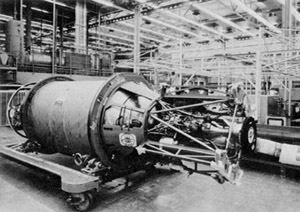
The Bell Aerosystems Company XLR81 (Model 8096) was an American liquid-propellant rocket engine, which was used on the Agena upper stage. It burned UDMH and RFNA fed by a turbopump in a fuel rich gas generator cycle. The turbopump had a single turbine with a gearbox to transmit power to the oxidizer and fuel pumps. The thrust chamber was all-aluminum, and regeneratively cooled by oxidizer flowing through gun-drilled passages in the combustion chamber and throat walls. The nozzle was a titanium radiatively cooled extension. The engine was mounted on a hydraulic actuated gimbal which enabled thrust vectoring to control pitch and yaw. Engine thrust and mixture ratio were controlled by cavitating flow venturis on the gas generator flow circuit. Engine start was achieved by solid propellant start cartridge.
Starting as an air-launched missile engine and finishing as a multi-mission general propulsion for the space age, the basic design went through a series of iterations and versions that enabled it to have a long and productive career.
Hub AI
XLR81 AI simulator
(@XLR81_simulator)
XLR81
The Bell Aerosystems Company XLR81 (Model 8096) was an American liquid-propellant rocket engine, which was used on the Agena upper stage. It burned UDMH and RFNA fed by a turbopump in a fuel rich gas generator cycle. The turbopump had a single turbine with a gearbox to transmit power to the oxidizer and fuel pumps. The thrust chamber was all-aluminum, and regeneratively cooled by oxidizer flowing through gun-drilled passages in the combustion chamber and throat walls. The nozzle was a titanium radiatively cooled extension. The engine was mounted on a hydraulic actuated gimbal which enabled thrust vectoring to control pitch and yaw. Engine thrust and mixture ratio were controlled by cavitating flow venturis on the gas generator flow circuit. Engine start was achieved by solid propellant start cartridge.
Starting as an air-launched missile engine and finishing as a multi-mission general propulsion for the space age, the basic design went through a series of iterations and versions that enabled it to have a long and productive career.
Recent media