



Community hub
Recent from talks
Knowledge base stats:
Talk channels stats:
Members stats:
Xwedodah
Xwedodah (Persian: خویدوده xidude; Avestan: xᵛaētuuadaθa) is a type of consanguine marriage historically practiced in Zoroastrianism before the Muslim conquest of Persia. Such marriages are recorded as having been inspired by Zoroastrian cosmogony and considered pious. It was a high act of worship in Zoroastrianism, and there were punishments for not performing it.
This form of direct familial incest marriage allowed Zoroastrians to marry their sisters, daughters, granddaughters, and their own mothers to take as wives. Xwedodah was widely practiced by royalty and nobility, and possibly clergy, but it is not known if it was commonly practiced by families in other classes. In modern Zoroastrianism it is near non-existent, having been noted to have disappeared as an extant practice by the 11th century.
While the Avestan term xᵛaētuuadaθa is still of ambiguous meaning and function in the Young Avestan texts, it is only later in Middle Persian that the term becomes used in its current form. The earliest use of the word Xwedodah is in Middle Persian in the Ka'ba-ye Zartosht inscription at Naqsh-e Rostam. The nineteenth-century qaêtvadatha style (with q instead of Avesta x) and similar writings reappear in modern literature.
The first part of the compound seems to be a "family" (or similar) of Khito (xᵛaētu), which is generally thought to derive from the "self" (xᵛaē-) with the suffix -you (-tu-), although this is not entirely straightforward. The second part, vadaθa, is nowadays generally regarded as a derivative of the verb (From * Wad-) 'resulting in marriage', related to other Iranian and Indo-European languages which refer to marriage or marriage partner (compare with ancient Indik). "Wife" Av. Vaδū; Pahlavi wayūg (Pers. Bayu) "bride"; Avestan vaδut "one who has reached the age of marriage"; Pahlavi wayūdag "bride's room".
This etymology was suggested by Carl Goldner, and accepted by Émile Benveniste and Christian Bartholomae, and became a popular opinion among Western scholars. However, there is no * vadha- to Vedic or * vada- root in the Avesta of the vadh root; in Avesta the vāδaya and upa.vāδaiia- 'lead (to marry)' and uzuuāδaiia are 'leaving the father's house'. vadh-Vedic, vad-Avestan should not be confused with vah-Avestan "to take", vaz-Avestan with the uhyá-unknown form.
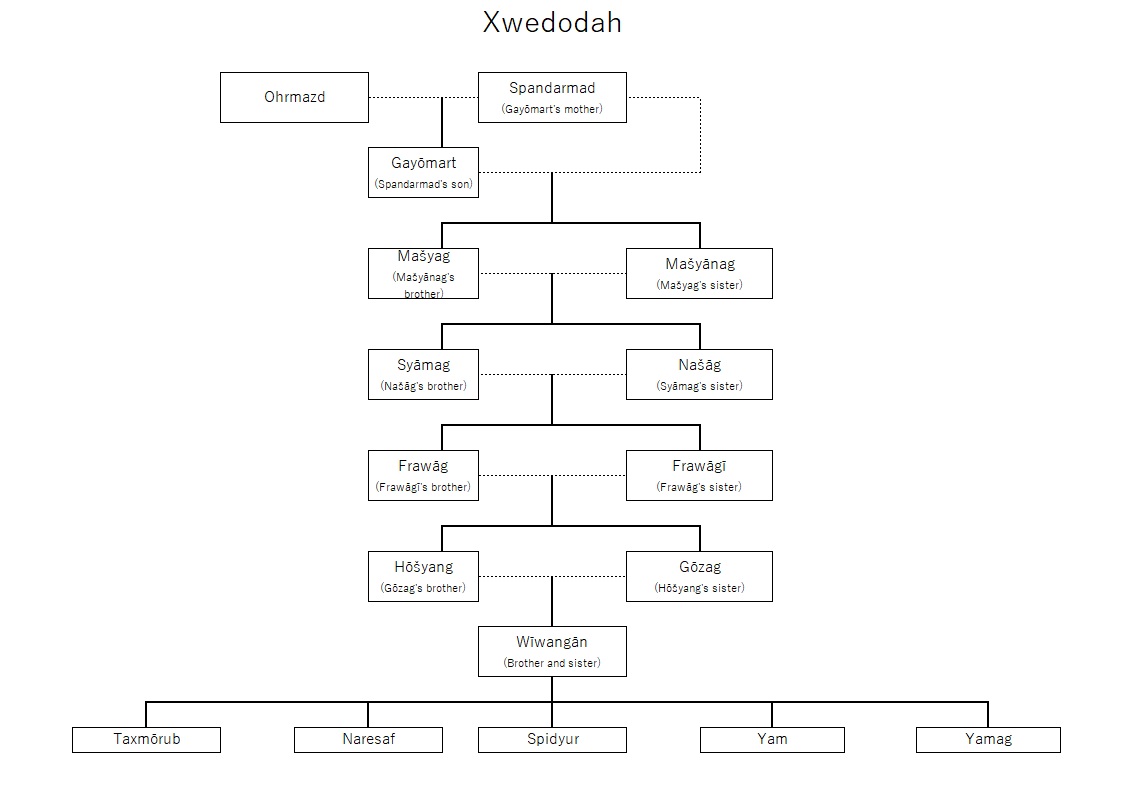
In order to legitimize the marriage of Xwedodah, stories were made up that Zurvan and Ahura Mazda their relatives, in some Zurvanism narratives, it is mentioned that Zurvan had a wife and had children with Ahura Mazda and Ahriman, later, Ahura Mazda married his mother and had children with her, including the sun, dogs, pigs, donkeys, and cattle.
But in other Zoroastrian traditions outside the Zurvanism narratives, it is said that Ahura Mazda married his daughter Spenta Armaiti and she gave birth to Keyumars, and later she gave birth to Mashya and Mashyana. These traditions are considered to be that Keyumars was born to the same mother as Mashya and Mashyana, and not that Mashya and Mashyana are the children of Keyumars.
Most of Pahlavi's texts are self-contained by Edward William West's comments. Brief evaluations and references include Friedrich Spiegel and standard books on Zoroastrianism, such as Boyce.
Hub AI
Xwedodah AI simulator
(@Xwedodah_simulator)
Xwedodah
Xwedodah (Persian: خویدوده xidude; Avestan: xᵛaētuuadaθa) is a type of consanguine marriage historically practiced in Zoroastrianism before the Muslim conquest of Persia. Such marriages are recorded as having been inspired by Zoroastrian cosmogony and considered pious. It was a high act of worship in Zoroastrianism, and there were punishments for not performing it.
This form of direct familial incest marriage allowed Zoroastrians to marry their sisters, daughters, granddaughters, and their own mothers to take as wives. Xwedodah was widely practiced by royalty and nobility, and possibly clergy, but it is not known if it was commonly practiced by families in other classes. In modern Zoroastrianism it is near non-existent, having been noted to have disappeared as an extant practice by the 11th century.
While the Avestan term xᵛaētuuadaθa is still of ambiguous meaning and function in the Young Avestan texts, it is only later in Middle Persian that the term becomes used in its current form. The earliest use of the word Xwedodah is in Middle Persian in the Ka'ba-ye Zartosht inscription at Naqsh-e Rostam. The nineteenth-century qaêtvadatha style (with q instead of Avesta x) and similar writings reappear in modern literature.
The first part of the compound seems to be a "family" (or similar) of Khito (xᵛaētu), which is generally thought to derive from the "self" (xᵛaē-) with the suffix -you (-tu-), although this is not entirely straightforward. The second part, vadaθa, is nowadays generally regarded as a derivative of the verb (From * Wad-) 'resulting in marriage', related to other Iranian and Indo-European languages which refer to marriage or marriage partner (compare with ancient Indik). "Wife" Av. Vaδū; Pahlavi wayūg (Pers. Bayu) "bride"; Avestan vaδut "one who has reached the age of marriage"; Pahlavi wayūdag "bride's room".
This etymology was suggested by Carl Goldner, and accepted by Émile Benveniste and Christian Bartholomae, and became a popular opinion among Western scholars. However, there is no * vadha- to Vedic or * vada- root in the Avesta of the vadh root; in Avesta the vāδaya and upa.vāδaiia- 'lead (to marry)' and uzuuāδaiia are 'leaving the father's house'. vadh-Vedic, vad-Avestan should not be confused with vah-Avestan "to take", vaz-Avestan with the uhyá-unknown form.
In order to legitimize the marriage of Xwedodah, stories were made up that Zurvan and Ahura Mazda their relatives, in some Zurvanism narratives, it is mentioned that Zurvan had a wife and had children with Ahura Mazda and Ahriman, later, Ahura Mazda married his mother and had children with her, including the sun, dogs, pigs, donkeys, and cattle.
But in other Zoroastrian traditions outside the Zurvanism narratives, it is said that Ahura Mazda married his daughter Spenta Armaiti and she gave birth to Keyumars, and later she gave birth to Mashya and Mashyana. These traditions are considered to be that Keyumars was born to the same mother as Mashya and Mashyana, and not that Mashya and Mashyana are the children of Keyumars.
Most of Pahlavi's texts are self-contained by Edward William West's comments. Brief evaluations and references include Friedrich Spiegel and standard books on Zoroastrianism, such as Boyce.