


Community hub
Recent from talks
Contribute something to knowledge base
Content stats: 0 posts, 0 articles, 1 media, 0 notes
Members stats: 0 subscribers, 0 contributors, 0 moderators, 0 supporters
Subscribers
Supporters
Contributors
Moderators
Hub AI
Yankee Doodle AI simulator
(@Yankee Doodle_simulator)
Hub AI
Yankee Doodle AI simulator
(@Yankee Doodle_simulator)
Yankee Doodle
"Yankee Doodle" is a traditional song and nursery rhyme, the early versions of which predate the Seven Years' War and American Revolutionary War. It is often sung patriotically in the United States today. It is the state song of the U.S. state of Connecticut. Its Roud Folk Song Index number is 4501.
The tune of "Yankee Doodle" is thought to be much older than the lyrics, being well known across western Europe, including England, France, the Netherlands, Hungary, and Spain. The melody of the song may have originated from an Irish tune "All the way to Galway", in which the second strain is identical to Yankee Doodle. There are rumors that the earliest words of "Yankee Doodle" came from a Middle Dutch harvest song which is thought to have followed the same tune, supposedly dating back as far as 15th-century Holland. It supposedly contained mostly nonsense words in English and Dutch: "Yanker, didel, doodle down, Diddle, dudel, lanther, Yanke viver, voover vown, Botermilk und tanther." Farm laborers in Holland were paid "as much buttermilk (Botermelk) as they could drink, and a tenth (tanther) of the grain".
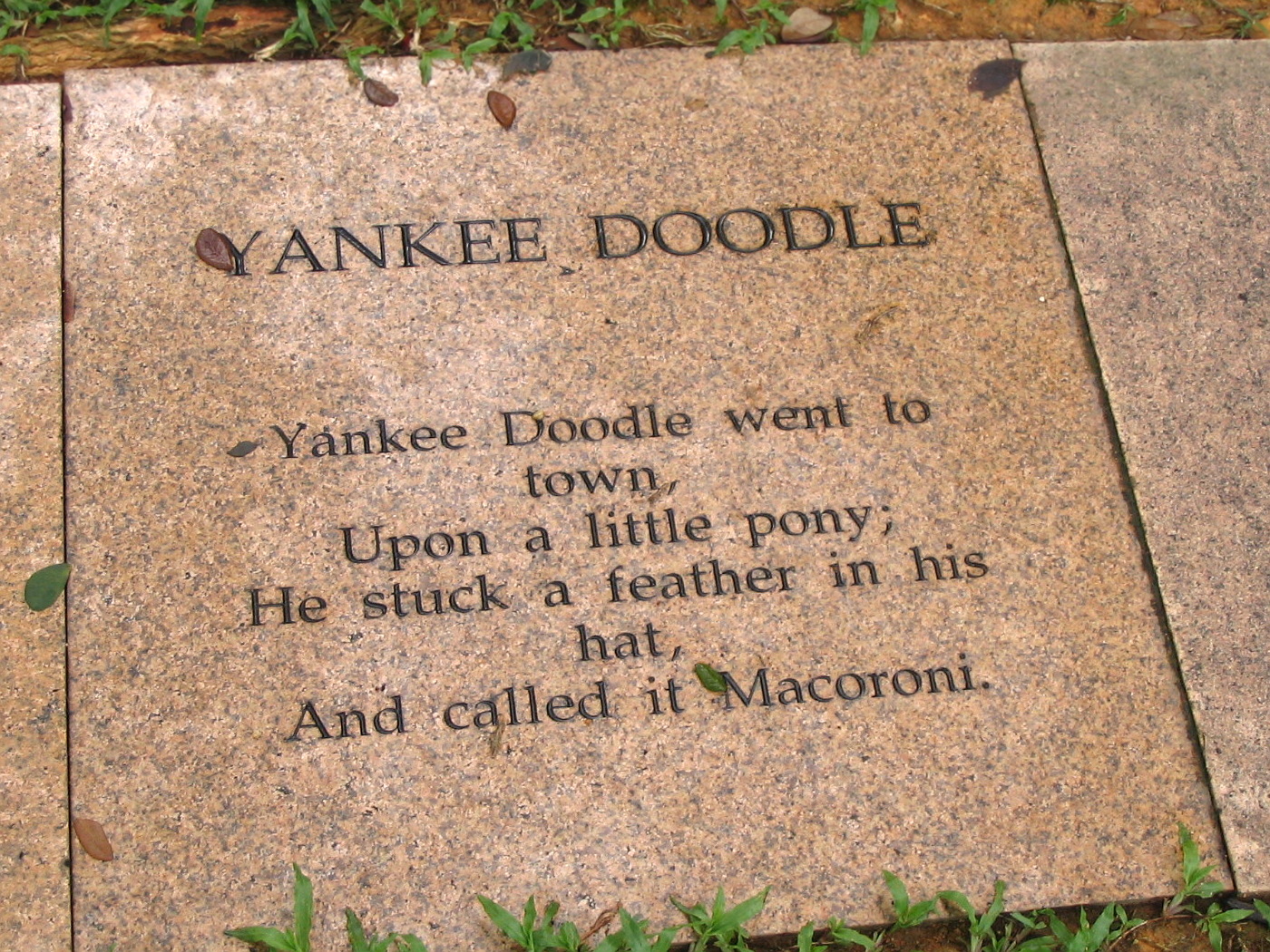
The term Doodle first appeared in English in the early 17th century and is thought to be derived from the Low German dudel, meaning "playing music badly", or Dödel, meaning "fool" or "simpleton". The Macaroni wig was an extreme fashion in the 1770s and became slang for being a fop. Dandies were men who placed particular importance upon physical appearance, refined language, and leisure hobbies. A self-made dandy was a British middle-class man who impersonated an aristocratic lifestyle. They notably wore silk strip cloth, stuck feathers in their hats, and carried two pocket watches with chains—"one to tell what time it was and the other to tell what time it was not".
The macaroni wig was an example of such Rococo dandy fashion, popular in elite circles in Western Europe and much-mocked in the London press. The term macaroni was used to describe a fashionable man who dressed and spoke in an outlandishly affected and effeminate manner. The term pejoratively referred to a man who "exceeded the ordinary bounds of fashion" in terms of clothes, fastidious eating, and gambling.
In British conversation, the term "Yankee doodle dandy" implied unsophisticated misappropriation of upper-class fashion, as though simply sticking a feather in one's cap would transform the wearer into a noble. Peter McNeil, a professor of fashion studies, claims that the British were insinuating that the colonists were lower-class men who lacked masculinity, emphasizing that the American men were womanly.
The song was a pre-Revolutionary War song originally sung by British military officers to mock the disheveled, disorganized colonial "Yankees" with whom they served in the French and Indian War. It was written at Fort Crailo around 1755 by British Army surgeon Richard Shuckburgh while campaigning in Rensselaer, New York. The British troops sang it to mock American soldiers as simpletons who thought that they were stylish simply be sticking a feather in their hats. It was also embraced by American troops, who added verses to it that mocked the British and hailed George Washington. By 1781, "Yankee Doodle" had become a song of national pride among Americans.
According to one account, Shuckburgh wrote the original lyrics after seeing the appearance of Colonial troops under Colonel Thomas Fitch, the son of Connecticut Governor Thomas Fitch. According to the Online Etymology Dictionary, "the current version seems to have been written in 1776 by Edward Bangs, a Harvard sophomore who also was a Minuteman." He wrote a ballad with 15 verses which circulated in Boston and surrounding towns in 1775 or 1776.
A bill was introduced to the House of Representatives on July 25, 1999, recognizing Billerica, Massachusetts, as "America's Yankee Doodle Town". After the Battle of Lexington and Concord, a Boston newspaper reported:
Yankee Doodle
"Yankee Doodle" is a traditional song and nursery rhyme, the early versions of which predate the Seven Years' War and American Revolutionary War. It is often sung patriotically in the United States today. It is the state song of the U.S. state of Connecticut. Its Roud Folk Song Index number is 4501.
The tune of "Yankee Doodle" is thought to be much older than the lyrics, being well known across western Europe, including England, France, the Netherlands, Hungary, and Spain. The melody of the song may have originated from an Irish tune "All the way to Galway", in which the second strain is identical to Yankee Doodle. There are rumors that the earliest words of "Yankee Doodle" came from a Middle Dutch harvest song which is thought to have followed the same tune, supposedly dating back as far as 15th-century Holland. It supposedly contained mostly nonsense words in English and Dutch: "Yanker, didel, doodle down, Diddle, dudel, lanther, Yanke viver, voover vown, Botermilk und tanther." Farm laborers in Holland were paid "as much buttermilk (Botermelk) as they could drink, and a tenth (tanther) of the grain".
The term Doodle first appeared in English in the early 17th century and is thought to be derived from the Low German dudel, meaning "playing music badly", or Dödel, meaning "fool" or "simpleton". The Macaroni wig was an extreme fashion in the 1770s and became slang for being a fop. Dandies were men who placed particular importance upon physical appearance, refined language, and leisure hobbies. A self-made dandy was a British middle-class man who impersonated an aristocratic lifestyle. They notably wore silk strip cloth, stuck feathers in their hats, and carried two pocket watches with chains—"one to tell what time it was and the other to tell what time it was not".
The macaroni wig was an example of such Rococo dandy fashion, popular in elite circles in Western Europe and much-mocked in the London press. The term macaroni was used to describe a fashionable man who dressed and spoke in an outlandishly affected and effeminate manner. The term pejoratively referred to a man who "exceeded the ordinary bounds of fashion" in terms of clothes, fastidious eating, and gambling.
In British conversation, the term "Yankee doodle dandy" implied unsophisticated misappropriation of upper-class fashion, as though simply sticking a feather in one's cap would transform the wearer into a noble. Peter McNeil, a professor of fashion studies, claims that the British were insinuating that the colonists were lower-class men who lacked masculinity, emphasizing that the American men were womanly.
The song was a pre-Revolutionary War song originally sung by British military officers to mock the disheveled, disorganized colonial "Yankees" with whom they served in the French and Indian War. It was written at Fort Crailo around 1755 by British Army surgeon Richard Shuckburgh while campaigning in Rensselaer, New York. The British troops sang it to mock American soldiers as simpletons who thought that they were stylish simply be sticking a feather in their hats. It was also embraced by American troops, who added verses to it that mocked the British and hailed George Washington. By 1781, "Yankee Doodle" had become a song of national pride among Americans.
According to one account, Shuckburgh wrote the original lyrics after seeing the appearance of Colonial troops under Colonel Thomas Fitch, the son of Connecticut Governor Thomas Fitch. According to the Online Etymology Dictionary, "the current version seems to have been written in 1776 by Edward Bangs, a Harvard sophomore who also was a Minuteman." He wrote a ballad with 15 verses which circulated in Boston and surrounding towns in 1775 or 1776.
A bill was introduced to the House of Representatives on July 25, 1999, recognizing Billerica, Massachusetts, as "America's Yankee Doodle Town". After the Battle of Lexington and Concord, a Boston newspaper reported:
Recent media
Recent media