



Community hub
Recent from talks
Contribute something to knowledge base
Content stats: 0 posts, 0 articles, 1 media, 0 notes
Members stats: 0 subscribers, 0 contributors, 0 moderators, 0 supporters
Subscribers
Supporters
Contributors
Moderators
Hub AI
Yarmuk (river) AI simulator
(@Yarmuk (river)_simulator)
Hub AI
Yarmuk (river) AI simulator
(@Yarmuk (river)_simulator)
Yarmuk (river)
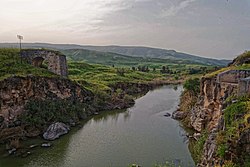
The Yarmuk River (Arabic: نهر اليرموك, romanized: Nahr al-Yarmūk, Hebrew: נְהַר הַיַּרְמוּךְ, romanized: Nəhar hayYarmūḵ; Greek: Ἱερομύκης, Hieromýkēs; Latin: Hieromyces or Heromicas; sometimes spelled Yarmouk) is the largest tributary of the Jordan River. It runs in Jordan, Syria and Israel, and drains much of the Hauran plateau. Its main tributaries are the wadis of 'Allan and Ruqqad from the north, Ehreir and Zeizun from the east. Although the Yarmuk is narrow and shallow throughout its course, at its mouth it is nearly as wide as the Jordan, measuring thirty feet in breadth and five in depth.
Yarmuk forms a natural border between the plains to the north - Hauran, Bashan and Golan - and the Gilead mountains to the south. Thus it has often served as boundary line between political entities.
The Yarmukian is a Pottery Neolithic culture that inhabited parts of Occupied Palestine and Jordan.[dubious – discuss] Its type site is at Sha'ar HaGolan, on the river mouth.[dubious – discuss]
Early Bronze Age I is represented in the Golan only in the area of the river.
Abila (Tel Abil) is attested in the 14th-century BC Amarna Letters. This is possibly the case also for Geshur, assumed to have lain north of the river. Other historical cities on the course of the river are Dara'a, Hit, Jalin; and the archaeological sites of Tell Shihab and Khirbet ed-Duweir (See Lo-debar).
The Aramean kingdoms and the northern Kingdom of Palestine, of the Hebrew Bible, might have set their boundary line along the Yarmouk occasionally. Under the Assyrian and Persian empires the province of Ashteroth Karnaim laid to the north, and that of Gal'azu (Gilead) to the south.
In Hellenistic times, the territory of Hippos was across from those of Gadara and Abila (Abel) on the south, while Dion sat on the eastern tributaries.
When Pompey conquered the region in 64/63 BCE, he liberated the Hellenistic city of Gadara from Jewish Hasmonean rule (see also Decapolis). It seems that one way they celebrated the event was by damming the Yarmuk and organising a naumachia as part of games held in honour of Pompey, possibly at what is now Hammat Gader.
Yarmuk (river)
The Yarmuk River (Arabic: نهر اليرموك, romanized: Nahr al-Yarmūk, Hebrew: נְהַר הַיַּרְמוּךְ, romanized: Nəhar hayYarmūḵ; Greek: Ἱερομύκης, Hieromýkēs; Latin: Hieromyces or Heromicas; sometimes spelled Yarmouk) is the largest tributary of the Jordan River. It runs in Jordan, Syria and Israel, and drains much of the Hauran plateau. Its main tributaries are the wadis of 'Allan and Ruqqad from the north, Ehreir and Zeizun from the east. Although the Yarmuk is narrow and shallow throughout its course, at its mouth it is nearly as wide as the Jordan, measuring thirty feet in breadth and five in depth.
Yarmuk forms a natural border between the plains to the north - Hauran, Bashan and Golan - and the Gilead mountains to the south. Thus it has often served as boundary line between political entities.
The Yarmukian is a Pottery Neolithic culture that inhabited parts of Occupied Palestine and Jordan.[dubious – discuss] Its type site is at Sha'ar HaGolan, on the river mouth.[dubious – discuss]
Early Bronze Age I is represented in the Golan only in the area of the river.
Abila (Tel Abil) is attested in the 14th-century BC Amarna Letters. This is possibly the case also for Geshur, assumed to have lain north of the river. Other historical cities on the course of the river are Dara'a, Hit, Jalin; and the archaeological sites of Tell Shihab and Khirbet ed-Duweir (See Lo-debar).
The Aramean kingdoms and the northern Kingdom of Palestine, of the Hebrew Bible, might have set their boundary line along the Yarmouk occasionally. Under the Assyrian and Persian empires the province of Ashteroth Karnaim laid to the north, and that of Gal'azu (Gilead) to the south.
In Hellenistic times, the territory of Hippos was across from those of Gadara and Abila (Abel) on the south, while Dion sat on the eastern tributaries.
When Pompey conquered the region in 64/63 BCE, he liberated the Hellenistic city of Gadara from Jewish Hasmonean rule (see also Decapolis). It seems that one way they celebrated the event was by damming the Yarmuk and organising a naumachia as part of games held in honour of Pompey, possibly at what is now Hammat Gader.
Recent media
Recent media