



Community hub
Recent from talks
Contribute something to knowledge base
Content stats: 0 posts, 0 articles, 1 media, 0 notes
Members stats: 0 subscribers, 0 contributors, 0 moderators, 0 supporters
Subscribers
Supporters
Contributors
Moderators
Hub AI
Yaylak AI simulator
(@Yaylak_simulator)
Hub AI
Yaylak AI simulator
(@Yaylak_simulator)
Yaylak
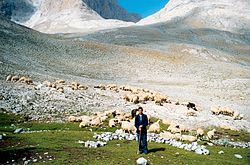
Yaylak (Turkish: yaylak or yayla; Azerbaijani: yaylaq; South Azerbaijani: یایلاق; Kazakh: жайлау; Kyrgyz: жайлоо; Persian: ییلاق; Russian: яйлаг) is a summer highland pasture associated with transhumance pastoralism in several Central and West Asian Turkic communities. There are different variants of yaylak pastoralism forms of alpine transhumance, some of which are similar to seminomadic pastoralism, although most are similar to herdsman husbandry (such as in mountainous areas of Europe and the Caucasus). However, in the Eurasian steppes, the Middle East and North Africa, yaylak pastoralism often coexists with seminomadic pastoralism and pastoral nomadism. The term had been commonly used in Soviet anthropology.
The converse term is gishlag (from Turkic kyshlag), a winter pasture. The word gave rise to the usage of the term kishlak for rural settlements in Central Asia.
Yaylak is a portmanteau which derived from Turkic roots yay "summer" and -lagh or -lağ, a deverbal plus denominal suffix. The converse term is gishlag (also spelled as kışlak or qhishloq), a winter pasture (from kış, qish or gish "winter"). The latter one gave rise to the term kishlak for rural settlements in Central Asia. Transcriptions of the term include yaylak, yaylaq, یایلاق, ailoq, jaylaw, or jayloo, and yeylāq.
The first recorded use of the word in a written source can be traced back to 9th century Old Turkic work Irk Bitig.
Anatoly Khazanov, an anthropologist and historian studying mobile pastoralism, notes: "The specific significance of pastoralism is usually at its most apparent in the specialized mountain variant of herdsman husbandry; in Soviet anthropology this is often referred to as yaylag pastoralism..." In Western anthropology yaylak pastoralism more or less corresponds to the notion of transhumance (Transhumanz).
According to Karl Heinrich Menges, who studied and witnessed the nomadic lifestyle of the Turkic Qashqai tribe in Iran, "[t]ribes in their summer encampments (jajłaγ), and not on the move (köç). They live, during the months May–August, in the region as designated above, and begin to move southward to the winter encampments (qyšłaγ) about the end of August."
In the description of another Western specialist on nomads and pastoralism, Khazanov's classification system is the most modern approach, "classifying nomadic forms according to a society’s extent of migratory mobility, the primacy of specific animals in producing their subsistence products, and the level of symbiosis between nomadic and settled agricultural societies. He categorizes pastoralists into five types, ranging from “pure pastoral nomadism” to “semi-nomadic pastoralism,” “semi-sedentary pastoralism,” and finally to “distant-pastures husbandry” and “seasonal transhumance” (Khazanov's yaylak – Khazanov 1994, 19–23)".
A number of scholars have suggested that yaylak pastoralism has ancient roots in Neolithic West Asia, alleging that already in the seventh millennium B.C. the pastoralism of the inhabitants of the Zagros Mountains had taken on a yaylak form, and that besides their permanent settlements these people also had seasonal camps in the mountains. Flannery, 1965: 1254-5, Narr, 1959: 85, Masson 1976: 39. Although, "recent research has demonstrated, however, that yaylak pastoralism in the Zagros Mountains can be dated no earlier than the second half of the fourth millennium B.C. (Mortensen, 1975: 23f., 32-3). However, as yet there is insufficient data for this question to be finally resolved."
Yaylak
Yaylak (Turkish: yaylak or yayla; Azerbaijani: yaylaq; South Azerbaijani: یایلاق; Kazakh: жайлау; Kyrgyz: жайлоо; Persian: ییلاق; Russian: яйлаг) is a summer highland pasture associated with transhumance pastoralism in several Central and West Asian Turkic communities. There are different variants of yaylak pastoralism forms of alpine transhumance, some of which are similar to seminomadic pastoralism, although most are similar to herdsman husbandry (such as in mountainous areas of Europe and the Caucasus). However, in the Eurasian steppes, the Middle East and North Africa, yaylak pastoralism often coexists with seminomadic pastoralism and pastoral nomadism. The term had been commonly used in Soviet anthropology.
The converse term is gishlag (from Turkic kyshlag), a winter pasture. The word gave rise to the usage of the term kishlak for rural settlements in Central Asia.
Yaylak is a portmanteau which derived from Turkic roots yay "summer" and -lagh or -lağ, a deverbal plus denominal suffix. The converse term is gishlag (also spelled as kışlak or qhishloq), a winter pasture (from kış, qish or gish "winter"). The latter one gave rise to the term kishlak for rural settlements in Central Asia. Transcriptions of the term include yaylak, yaylaq, یایلاق, ailoq, jaylaw, or jayloo, and yeylāq.
The first recorded use of the word in a written source can be traced back to 9th century Old Turkic work Irk Bitig.
Anatoly Khazanov, an anthropologist and historian studying mobile pastoralism, notes: "The specific significance of pastoralism is usually at its most apparent in the specialized mountain variant of herdsman husbandry; in Soviet anthropology this is often referred to as yaylag pastoralism..." In Western anthropology yaylak pastoralism more or less corresponds to the notion of transhumance (Transhumanz).
According to Karl Heinrich Menges, who studied and witnessed the nomadic lifestyle of the Turkic Qashqai tribe in Iran, "[t]ribes in their summer encampments (jajłaγ), and not on the move (köç). They live, during the months May–August, in the region as designated above, and begin to move southward to the winter encampments (qyšłaγ) about the end of August."
In the description of another Western specialist on nomads and pastoralism, Khazanov's classification system is the most modern approach, "classifying nomadic forms according to a society’s extent of migratory mobility, the primacy of specific animals in producing their subsistence products, and the level of symbiosis between nomadic and settled agricultural societies. He categorizes pastoralists into five types, ranging from “pure pastoral nomadism” to “semi-nomadic pastoralism,” “semi-sedentary pastoralism,” and finally to “distant-pastures husbandry” and “seasonal transhumance” (Khazanov's yaylak – Khazanov 1994, 19–23)".
A number of scholars have suggested that yaylak pastoralism has ancient roots in Neolithic West Asia, alleging that already in the seventh millennium B.C. the pastoralism of the inhabitants of the Zagros Mountains had taken on a yaylak form, and that besides their permanent settlements these people also had seasonal camps in the mountains. Flannery, 1965: 1254-5, Narr, 1959: 85, Masson 1976: 39. Although, "recent research has demonstrated, however, that yaylak pastoralism in the Zagros Mountains can be dated no earlier than the second half of the fourth millennium B.C. (Mortensen, 1975: 23f., 32-3). However, as yet there is insufficient data for this question to be finally resolved."
Recent media
Recent media