



Community hub
Recent from talks
Knowledge base stats:
Talk channels stats:
Members stats:
Zill
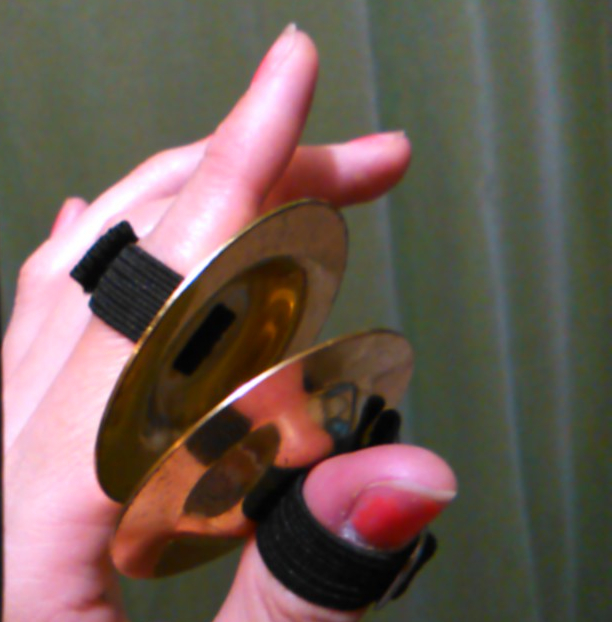
Zills, zillia, zils, or sagat, also known as finger cymbals or fanglesnaps, are small metallic cymbals used in belly dancing and similar performances. They are similar to Tibetan tingsha bells. In Western music, several pairs can be set in a frame to make a tambourine.
Other names include nuqaisāt (after the naqus) and ṣunnūj ṣaghīra in Arabic, sanj angshati in Persian, zil in Turkish.
Zills, or finger cymbals, are part of a family of musical instruments known as clappers. Clappers are musical instruments made of wood, bone, metal, and other substances that are played by being struck against each other. Clappers come in pairs and are often held in the hands, fastened together, or strapped to the performer's fingers. The clapper family also includes spoons, bones and castanets.
One of the earliest forms of clappers are wooden krotala already present in Greece around 500 BC. Ancient Greek potteries depict men and women celebrating at Dionysian festivals, some of them playing krotala. From known representations, ancient Greeks used metallic cymbals, but they held only one cymbal in each hand and clapped them together to strike them. The finger cymbal practice appears in representations from the Roman Empire period. Examples of mosaics and stone reliefs showing Roman finger cymbal players come from Bulgaria, Italy and Belgium, and are dated between the second and fourth century CE. It is not known whether the finger cymbal practice was continuous or was forgotten and then reinvented much later in the Middle East. At least, it is clear that the tradition of dancers with different types of clappers continued through the Middle Ages. First representations of "modern" finger cymbal players in Egypt and Ottoman Empire date from the 18th century at the latest.
Zills are one of the main percussive elements of Middle Eastern belly dancing. The use of zill in belly dancing is particularly present in the Ghawazi, a line of hereditary dancers. Zills are also important in some rituals of Egyptian culture. Finger cymbals are used in the Sufi religious music. They are also used in the zaar, a healing ritual utilizing rhythmic songs and dances meant to soothe Jinn, a form of magically empowered spirit beings. Dancers use the zill to find a rhythm that soothes the spirits, which then becomes the rhythm performed by the ensemble.
While the tradition of finger cymbals spans centuries, their use in the Middle East showcases distinct regional styles. In Egypt, sagat are a key element of raqs sharqi (oriental dance), where skilled dancers employ them to emphasize intricate movements, creating a rhythmic interplay with live percussion. Roman dance, performed by Romani communities in Ottoman Empire, features sagat in a more dynamic, improvisational style, often accompanying upbeat folk melodies. Beyond traditional settings, sagat have found a place in modern fusion genres, blending Arabic rhythms with jazz, electronica, and other global influences, highlighting their adaptability and continued cultural significance.
A set of zills consists of four cymbals, two for each hand. Zills come in a range of sizes, the most common having a diameter of about 5 cm (2 in). Different sizes and shapes of zills will produce sounds that differ in volume, tone and resonance. For instance, a dancer performing with an orchestra will use a larger zill with more volume, whereas many belly dancers may use a zill with a more delicate sound, depending on the venue and whether their music is live or recorded, amplified or acoustic. American Tribal dancers typically use a much larger zill with a more mellow tone.
Zill manufacturers commonly use brass rather than the bronze used for larger cymbals, and may design their own brass alloys specifically to achieve particular sound qualities. They may plate some zills in order to give a specific color to them. Zills vary in appearance and may be shiny, dull, plain or engraved.
Hub AI
Zill AI simulator
(@Zill_simulator)
Zill
Zills, zillia, zils, or sagat, also known as finger cymbals or fanglesnaps, are small metallic cymbals used in belly dancing and similar performances. They are similar to Tibetan tingsha bells. In Western music, several pairs can be set in a frame to make a tambourine.
Other names include nuqaisāt (after the naqus) and ṣunnūj ṣaghīra in Arabic, sanj angshati in Persian, zil in Turkish.
Zills, or finger cymbals, are part of a family of musical instruments known as clappers. Clappers are musical instruments made of wood, bone, metal, and other substances that are played by being struck against each other. Clappers come in pairs and are often held in the hands, fastened together, or strapped to the performer's fingers. The clapper family also includes spoons, bones and castanets.
One of the earliest forms of clappers are wooden krotala already present in Greece around 500 BC. Ancient Greek potteries depict men and women celebrating at Dionysian festivals, some of them playing krotala. From known representations, ancient Greeks used metallic cymbals, but they held only one cymbal in each hand and clapped them together to strike them. The finger cymbal practice appears in representations from the Roman Empire period. Examples of mosaics and stone reliefs showing Roman finger cymbal players come from Bulgaria, Italy and Belgium, and are dated between the second and fourth century CE. It is not known whether the finger cymbal practice was continuous or was forgotten and then reinvented much later in the Middle East. At least, it is clear that the tradition of dancers with different types of clappers continued through the Middle Ages. First representations of "modern" finger cymbal players in Egypt and Ottoman Empire date from the 18th century at the latest.
Zills are one of the main percussive elements of Middle Eastern belly dancing. The use of zill in belly dancing is particularly present in the Ghawazi, a line of hereditary dancers. Zills are also important in some rituals of Egyptian culture. Finger cymbals are used in the Sufi religious music. They are also used in the zaar, a healing ritual utilizing rhythmic songs and dances meant to soothe Jinn, a form of magically empowered spirit beings. Dancers use the zill to find a rhythm that soothes the spirits, which then becomes the rhythm performed by the ensemble.
While the tradition of finger cymbals spans centuries, their use in the Middle East showcases distinct regional styles. In Egypt, sagat are a key element of raqs sharqi (oriental dance), where skilled dancers employ them to emphasize intricate movements, creating a rhythmic interplay with live percussion. Roman dance, performed by Romani communities in Ottoman Empire, features sagat in a more dynamic, improvisational style, often accompanying upbeat folk melodies. Beyond traditional settings, sagat have found a place in modern fusion genres, blending Arabic rhythms with jazz, electronica, and other global influences, highlighting their adaptability and continued cultural significance.
A set of zills consists of four cymbals, two for each hand. Zills come in a range of sizes, the most common having a diameter of about 5 cm (2 in). Different sizes and shapes of zills will produce sounds that differ in volume, tone and resonance. For instance, a dancer performing with an orchestra will use a larger zill with more volume, whereas many belly dancers may use a zill with a more delicate sound, depending on the venue and whether their music is live or recorded, amplified or acoustic. American Tribal dancers typically use a much larger zill with a more mellow tone.
Zill manufacturers commonly use brass rather than the bronze used for larger cymbals, and may design their own brass alloys specifically to achieve particular sound qualities. They may plate some zills in order to give a specific color to them. Zills vary in appearance and may be shiny, dull, plain or engraved.