



Community hub
Recent from talks
Contribute something to knowledge base
Content stats: 0 posts, 0 articles, 1 media, 0 notes
Members stats: 0 subscribers, 0 contributors, 0 moderators, 0 supporters
Subscribers
Supporters
Contributors
Moderators
Hub AI
Pylos AI simulator
(@Pylos_simulator)
Hub AI
Pylos AI simulator
(@Pylos_simulator)
Pylos
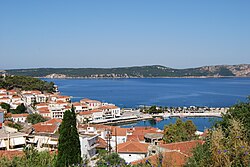
Pylos (UK: /ˈpaɪlɒs/, US: /-loʊs/; Greek: Πύλος), historically also known as Navarino, is a town and a former municipality in Messenia, Peloponnese, Greece. Since the 2011 local government reform, it has been part of the municipality Pylos-Nestoras, of which it is the seat and a municipal unit. It was the capital of the former Pylia Province. It is the main harbour on the Bay of Navarino. Nearby villages include Gialova, Pyla, Elaiofyto, Schinolakka, and Palaionero. The town of Pylos has 2,568 inhabitants, the municipal unit of Pylos 4,559 (2021). The municipal unit has an area of 143.911 km2.
Pylos has been inhabited since Neolithic times. It was a significant kingdom in Mycenaean Greece, with the remains of the so-called "Palace of Nestor" excavated nearby, named after Nestor, the king of Pylos in Homer's Iliad. In Classical times, the site was uninhabited, but became the site of the Battle of Pylos in 425 BC, during the Peloponnesian War. After that, Pylos is scarcely mentioned until the 13th century, when it became part of the Frankish Principality of Achaea. Increasingly known by its French name of Port-de-Jonc or its Italian name Navarino, in the 1280s the Franks built the Old Navarino castle on the site. Pylos came under the control of the Republic of Venice from 1417 until 1500, when it was conquered by the Ottoman Empire. The Ottomans used Pylos and its bay as a naval base, and built the New Navarino fortress there. The area remained under Ottoman control, with the exception of a brief period of renewed Venetian rule from 1685–1715 and a Russian occupation from 1770–71, until the outbreak of the Greek War of Independence in 1821. Ibrahim Pasha of Egypt recovered it for the Ottomans in 1825, but the defeat of the Turco-Egyptian fleet in the 1827 Battle of Navarino and the French military intervention of the 1828 Morea expedition forced Ibrahim to withdraw from the Peloponnese and confirmed Greek independence. The current city was built outside the fortress walls by the military engineers of the Morea expedition from 1829 and the name Pylos was revived by royal decree in 1833.
Pylos retained its ancient name into Byzantine times, but after the Frankish conquest in the early 13th century, two new names appear:
In the late 14th or early 15th century, when it was held by the Navarrese Company, it was also known as Château Navarres, and called Spanochori (Σπανοχώρι, "village of the Spaniards") by the local Greeks.
Under Ottoman rule (1498–1685, 1715–1821), the Turkish name was Anavarin[o] (آناوارين). After the construction of the new Ottoman fortress (Anavarin kalesi) in 1571/2, it became known as Neokastro (Νεόκαστρο or Νιόκαστρο, "new castle") among the local Greeks, while the old Frankish castle became known as Palaiokastro (Παλαιόκαστρο or Παλιόκαστρο, "old castle").
The region of Pylos has a long history, which goes hand in hand with that of Peloponnese. It starts in the depths of prehistory, as the region has been inhabited since the Neolithic, when populations from Anatolia began to spread in the Balkans and Greece around 6500 BC, bringing with them the practice of agriculture and farming. Excavations have demonstrated a continuous human presence from the Late Neolithic period (5300 BC) on several sites of Pylia, in particular in those of Voidokilia and of Nestor's cave, where numerous ostraca or fragments of painted, black and polished ceramics have been found, as well as later engraved and written pottery. The Neolithic period ended with the appearance of bronze metallurgy around 3000 BC.
During the Bronze Age (3000–1000 BC), the Mycenaean civilization developed, particularly in Peloponnese. Pylos then became the capital of one of the most important human centers of this civilization and of a powerful kingdom, often referred to as Nestor's kingdom of "sandy Pylos" (ἠμαθόεις) and described later by Homer in both his Iliad and his Odyssey (Book 17) when Telemachus says:
we went to Pylos and to Nestor, the shepherd of the people, and he received me in his lofty house and gave me kindly welcome, as a father might his own son who after a long time had newly come from afar: even so kindly he tended me with his glorious sons.
Pylos
Pylos (UK: /ˈpaɪlɒs/, US: /-loʊs/; Greek: Πύλος), historically also known as Navarino, is a town and a former municipality in Messenia, Peloponnese, Greece. Since the 2011 local government reform, it has been part of the municipality Pylos-Nestoras, of which it is the seat and a municipal unit. It was the capital of the former Pylia Province. It is the main harbour on the Bay of Navarino. Nearby villages include Gialova, Pyla, Elaiofyto, Schinolakka, and Palaionero. The town of Pylos has 2,568 inhabitants, the municipal unit of Pylos 4,559 (2021). The municipal unit has an area of 143.911 km2.
Pylos has been inhabited since Neolithic times. It was a significant kingdom in Mycenaean Greece, with the remains of the so-called "Palace of Nestor" excavated nearby, named after Nestor, the king of Pylos in Homer's Iliad. In Classical times, the site was uninhabited, but became the site of the Battle of Pylos in 425 BC, during the Peloponnesian War. After that, Pylos is scarcely mentioned until the 13th century, when it became part of the Frankish Principality of Achaea. Increasingly known by its French name of Port-de-Jonc or its Italian name Navarino, in the 1280s the Franks built the Old Navarino castle on the site. Pylos came under the control of the Republic of Venice from 1417 until 1500, when it was conquered by the Ottoman Empire. The Ottomans used Pylos and its bay as a naval base, and built the New Navarino fortress there. The area remained under Ottoman control, with the exception of a brief period of renewed Venetian rule from 1685–1715 and a Russian occupation from 1770–71, until the outbreak of the Greek War of Independence in 1821. Ibrahim Pasha of Egypt recovered it for the Ottomans in 1825, but the defeat of the Turco-Egyptian fleet in the 1827 Battle of Navarino and the French military intervention of the 1828 Morea expedition forced Ibrahim to withdraw from the Peloponnese and confirmed Greek independence. The current city was built outside the fortress walls by the military engineers of the Morea expedition from 1829 and the name Pylos was revived by royal decree in 1833.
Pylos retained its ancient name into Byzantine times, but after the Frankish conquest in the early 13th century, two new names appear:
In the late 14th or early 15th century, when it was held by the Navarrese Company, it was also known as Château Navarres, and called Spanochori (Σπανοχώρι, "village of the Spaniards") by the local Greeks.
Under Ottoman rule (1498–1685, 1715–1821), the Turkish name was Anavarin[o] (آناوارين). After the construction of the new Ottoman fortress (Anavarin kalesi) in 1571/2, it became known as Neokastro (Νεόκαστρο or Νιόκαστρο, "new castle") among the local Greeks, while the old Frankish castle became known as Palaiokastro (Παλαιόκαστρο or Παλιόκαστρο, "old castle").
The region of Pylos has a long history, which goes hand in hand with that of Peloponnese. It starts in the depths of prehistory, as the region has been inhabited since the Neolithic, when populations from Anatolia began to spread in the Balkans and Greece around 6500 BC, bringing with them the practice of agriculture and farming. Excavations have demonstrated a continuous human presence from the Late Neolithic period (5300 BC) on several sites of Pylia, in particular in those of Voidokilia and of Nestor's cave, where numerous ostraca or fragments of painted, black and polished ceramics have been found, as well as later engraved and written pottery. The Neolithic period ended with the appearance of bronze metallurgy around 3000 BC.
During the Bronze Age (3000–1000 BC), the Mycenaean civilization developed, particularly in Peloponnese. Pylos then became the capital of one of the most important human centers of this civilization and of a powerful kingdom, often referred to as Nestor's kingdom of "sandy Pylos" (ἠμαθόεις) and described later by Homer in both his Iliad and his Odyssey (Book 17) when Telemachus says:
we went to Pylos and to Nestor, the shepherd of the people, and he received me in his lofty house and gave me kindly welcome, as a father might his own son who after a long time had newly come from afar: even so kindly he tended me with his glorious sons.
Recent media
Recent media