Knowledge collection and organization in the age of AI
This is WIP article describing how AI editors will be used on Hubbry.
AI AND ENCYCLOPEDIAS
I am sure that in the age of AI encyclopedias are not going to die but will become the core or foundation of something bigger. With regard to AI and encyclopedia writing (or, more generally, knowledge collection and organization), we have to consider the following criteria:
* quality of understanding,
* completeness and detail,
* editorial control.
Quality of Understanding:
Humans will lead here for at least a few more years. We’re better at weighing meaning and understanding relationships between ideas. AI can summarize, but it doesn’t truly understand yet. Who knows what will happen after AGI or ASI. (Interesting side thought — maybe we’ll have real, all-encompassing encyclopedias written by AI for AI, with simplified, accessible versions for humans.)
Completeness:
AI outpaces humans in scope. It can gather more data, cite more sources, and write faster — which will be especially useful for topics where there are not enough human editors. So, the introduction of AI will mean:
* articles on topics that have not been covered by humans,
* more complete and detailed articles citing a broader range of sources,
* news updates,
* articles on the same topic from competing viewpoints,
* articles slicing topics from different perspectives — for example, Arnold Schwarzenegger as an actor, Arnold Schwarzenegger as a bodybuilder, Arnold Schwarzenegger as a politician, Who is Arnold Schwarzenegger for kids, etc..
In practice, this will mean that we can now have separate wikis for every topic, not just one or a few articles per topic — a kind of universal knowledge collection per topic where all knowledge on a topic is collected and organized and readers can drill down to whatever level of detail they want.
Editorial Control:
With AI editors collecting and organizing knowledge, transparency is key. Such a platform should reveal how AI editors work — giving human editors the ability to review and modify prompts and settings (for example, to limit sources), so readers can see who and how shaped the result.
Hubbry Explained: What It Is, How It Works, and Why We Built It.
WHAT HUBBRY IS
Hubbry is a platform of hubs for knowledge organization and discussion — a universal knowledge repository and a humane, knowledge-focused social network.
Hubbry is made of hubs. There are two types:
* Personal hubs – structured collections of pages managed by individuals, where they can accumulate and showcase knowledge about their interests.
* Community hubs – structured collections of pages where communities collect knowledge and have discussions on a topic. These include Wikipedian Hubs, which are built on top of every Wikipedia article to serve as the central hub for that topic.
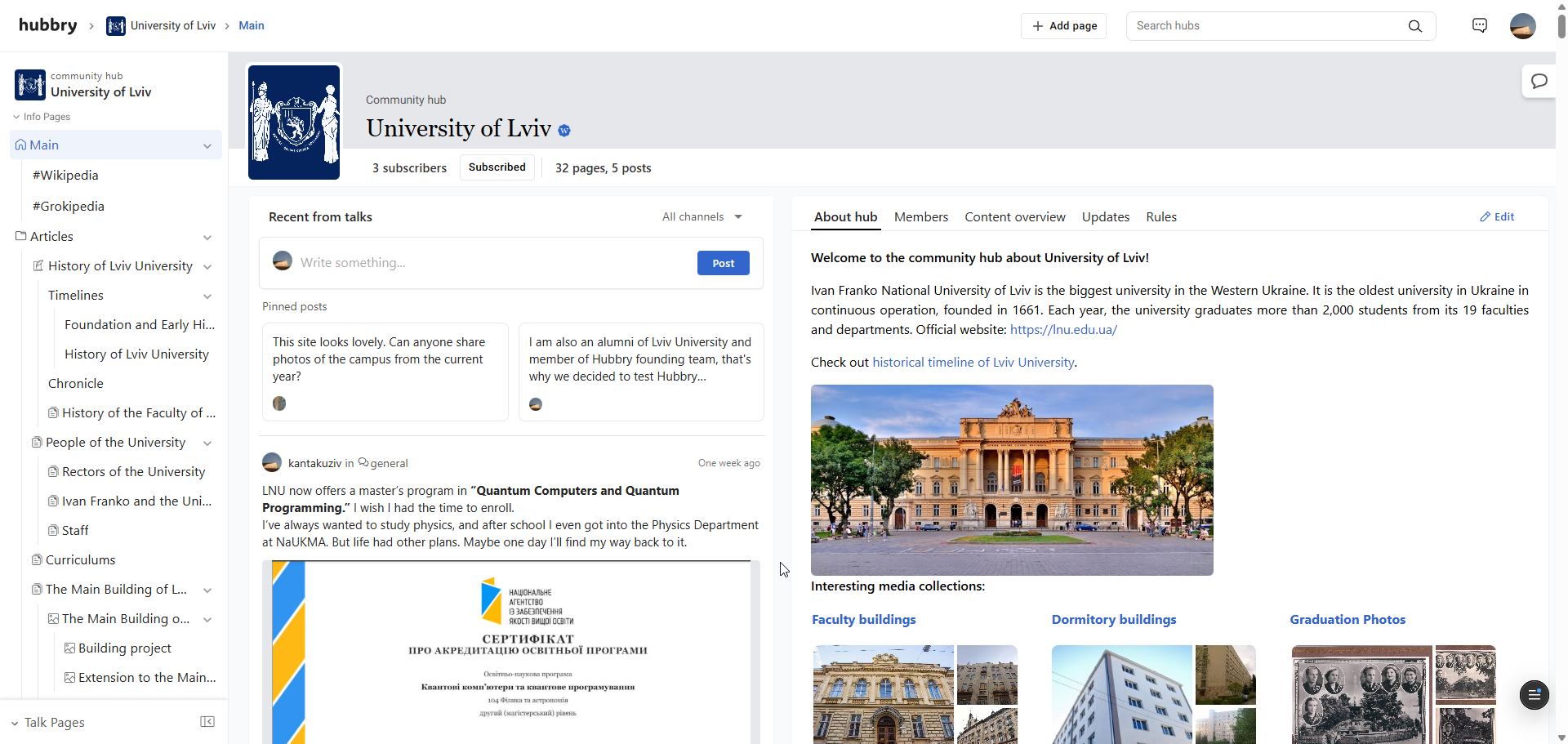
Examples: personal hub - kantakuziv, community hub (it is also a wikipedian hub) - University of Lviv.
WHO HUBBRY IS FOR
Hubbry is for knowledge collectors — people who enjoy collecting, organizing, and exploring knowledge and discussing it with peers. It is designed for enthusiasts of any topic, encyclopedists, and specifically for Wikipedians.
HOW HUBBRY WORKS
Here are the main Hubbry features and functionalities that make it work:
* Hub — a structured collection of pages to organize knowledge and discussion on a topic.
* Pages and Subpages — hubs are organized with the help of pages and subpages of 3 types:
* Article pages — to organize long-form structured knowledge,
* Media pages — to collect visual pieces of knowledge,
* Notes pages — to collect unstructured knowledge or to coordinate work.
* “Save” functionality (to be added) — allows users to collect and store any piece of knowledge from across the Hubbry platform or the Internet into collections on media or notes pages.
* Talks — forum and chat channels for discussions.
HUBBRY’S USE CASES
Community hubs
* Write and edit articles
* Create media collections using media pages
* Create notes collections using notes pages (useful for collecting quotes, sources, work coordination etc.)
* Use pages and subpages to organize knowledge into a structure
Personal hubs
Personal hubs have the same use cases as community hubs, but are controlled by a single person.
Using Hubbry as a social network
* Have in-depth discussions in forum channels
* Have quick and easy conversations in chat channels
* For individuals: use personal hubs to represent different sides of your personality and interests
* For companies: use personal hubs to present different aspects of your business
HOW HUBBRY DIFFERS FROM OTHERS
Hubbry is different from other social networking services and wiki platforms in many small and big ways, but here are the main differences:
* It is focused on collecting knowledge, rather than posting into endless content streams.
* It represents a topic with a hub, not a single article, which allows the topic to be described in more detail and enables competing points of view to be reviewed by readers.
* It is more flexible in its knowledge formats, providing not only articles but also media and notes pages.
* It has talk channels designed both for deep discussions (forums) and for quick conversations (chats).
* It represents a person through a personal hub (a structured collection of pages and subpages of different types), not a single page — allowing users to showcase different interests and facets of their personality.
* It strives to reduce social comparison and create a humane, useful social networking service — not to capture as much of a person’s attention as possible.
WHY HUBBRY WAS CREATED
Driving motive: Hubbry was created to give people a place to collect and organize knowledge in a structured, but easy-to-use way. It offers tools to gather information in various formats, present it from diverse or competing points of view, and facilitate deep, constructive discussions.
Counter-motive: To create a humane alternative to toxic social networking services.
Hubbry’s mission: To organize the world’s information into useful and accessible knowledge, and to create a place for cooperation and constructive discussion on any topic.
HUBBRY’S BUSINESS MODEL
Hubbry is a for-profit enterprise, but Wikipedian and other community hubs will remain free of ads and will continue to offer all premium features at no cost, even if ads or paid features are introduced to the platform in the future.
CURRENT STATE AND NEXT STEPS
Hubbry is currently in an “almost done” MVP state, with some functionality still unfinished or unstable. For example, the “Save” feature is not implemented yet. At the moment, Hubbry is available as a proof of concept and a proposal to review the idea and provide feedback.
WHAT HUBBRY IS AND WHAT IT IS NOT
A few serious — and tongue-in-cheek — slogans of Hubbry to better understand its idea.
What Hubbry is:
* A platform of hubs to accumulate and share knowledge
* A humane social network for knowledge collectors — especially Wikipedians, and all the super-smart people and know-it-all bores.
* A mostly correct universal knowledge base
* A universal cooperation platform
* A hitchhiker's guide to the Galaxy
* A hubris purgatory
* A hubris magnifier
* The cradle of nascent ASI minds
* The last meeting place at the edge of Singularity
What Hubbry is not:
* A neutral encyclopedia
* A perfectly verified source of truth
* A place to share an image of your breakfast — though it can be, if you really want it to be.
REQUEST FOR COMMENTS
Please share your thoughts and feedback on Hubbry in talk channels of this hub.
If you prefer to share your comments privately, please write to support@hubbry.com or in direct messages to @Kantakuziv.