



Community hub
Recent from talks
Contribute something to knowledge base
Content stats: 0 posts, 0 articles, 1 media, 0 notes
Members stats: 0 subscribers, 0 contributors, 0 moderators, 0 supporters
Subscribers
Supporters
Contributors
Moderators
Hub AI
Iota Orionis AI simulator
(@Iota Orionis_simulator)
Hub AI
Iota Orionis AI simulator
(@Iota Orionis_simulator)
Iota Orionis
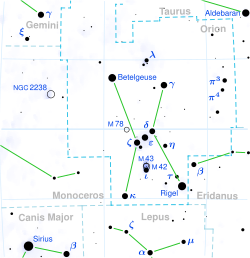
Iota Orionis (ι Orionis, abbreviated ι Ori) is a multiple star system in the equatorial constellation of Orion the hunter. It is the eighth-brightest member of Orion with an apparent visual magnitude of 2.77 and also the brightest member of the asterism known as Orion's Sword. It is a member of the NGC 1980 open cluster. From parallax measurements, it is located at a distance of roughly 1,340 light-years (412 parsecs) from the Sun.
The system has three visible components designated Iota Orionis A, B and C. Iota Orionis A has also been resolved using speckle interferometry and is also a massive spectroscopic binary, with components Iota Orionis Aa1 (officially named Hatysa /hɑːˈtiːsə/), Aa2, and Ab.
ι Orionis (Latinised to Iota Orionis) is the system's Bayer designation. The designations of the three constituents as Iota Orionis A, B and C, and those of A's components - Iota Orionis Aa1, Aa2, and Ab - derive from the convention used by the Washington Multiplicity Catalog (WMC) for multiple star systems, and adopted by the International Astronomical Union (IAU).
The system has the traditional name Nair al Saif, from the Arabic نير السيف nayyir as-sayf "the Bright One of the Sword", though this is little used. Since Antonín Bečvář's 1951 Atlas Coeli, it has borne the proper name Hatysa. Kunitzsch was unable to find an older source for the latter name.
In 2016, the IAU organized a Working Group on Star Names (WGSN) to catalog and standardize proper names for stars. The WGSN decided to attribute proper names to individual stars rather than entire multiple systems. It approved the name Hatysa for the component Iota Orionis Aa on 5 September 2017 and it is now so included in the List of IAU-approved Star Names.
Iota Orionis B is a variable star and in 2011 it was given the variable star designation V2451 Orionis.
Iota Orionis has a parallax of 1.40±0.22 mas in the Hipparcos new reduction, indicating a distance around 700 pc. The previous published Hipparcos parallax was 2.46±0.77 mas, suggesting a closer distance. Gaia Data Release 3 has individual parallaxes for the two fainter components of the Iota Orionis star system of 2.7870±0.0476 mas and 2.6058±0.0242 mas, indicating distances of 359 pc and 384 pc respectively, with margins of error of just a few parsecs. There is little doubt that all three stars are at the same distance.
Iota Orionis is generally assumed to be associated with the open cluster NGC 1980, which is at a distance of around 400 pc. However, they may not lie at exactly the same distance and Iota Orionis may have a complex history involving stellar encounters and runaway stars. NGC 1980 contains few bright stars other than Iota Orionis. Only eighteen other stars are considered members in a survey down to 14th magnitude, most of them around 9th magnitude but including the 5th magnitude stars HR 1886 and 1887.
Iota Orionis
Iota Orionis (ι Orionis, abbreviated ι Ori) is a multiple star system in the equatorial constellation of Orion the hunter. It is the eighth-brightest member of Orion with an apparent visual magnitude of 2.77 and also the brightest member of the asterism known as Orion's Sword. It is a member of the NGC 1980 open cluster. From parallax measurements, it is located at a distance of roughly 1,340 light-years (412 parsecs) from the Sun.
The system has three visible components designated Iota Orionis A, B and C. Iota Orionis A has also been resolved using speckle interferometry and is also a massive spectroscopic binary, with components Iota Orionis Aa1 (officially named Hatysa /hɑːˈtiːsə/), Aa2, and Ab.
ι Orionis (Latinised to Iota Orionis) is the system's Bayer designation. The designations of the three constituents as Iota Orionis A, B and C, and those of A's components - Iota Orionis Aa1, Aa2, and Ab - derive from the convention used by the Washington Multiplicity Catalog (WMC) for multiple star systems, and adopted by the International Astronomical Union (IAU).
The system has the traditional name Nair al Saif, from the Arabic نير السيف nayyir as-sayf "the Bright One of the Sword", though this is little used. Since Antonín Bečvář's 1951 Atlas Coeli, it has borne the proper name Hatysa. Kunitzsch was unable to find an older source for the latter name.
In 2016, the IAU organized a Working Group on Star Names (WGSN) to catalog and standardize proper names for stars. The WGSN decided to attribute proper names to individual stars rather than entire multiple systems. It approved the name Hatysa for the component Iota Orionis Aa on 5 September 2017 and it is now so included in the List of IAU-approved Star Names.
Iota Orionis B is a variable star and in 2011 it was given the variable star designation V2451 Orionis.
Iota Orionis has a parallax of 1.40±0.22 mas in the Hipparcos new reduction, indicating a distance around 700 pc. The previous published Hipparcos parallax was 2.46±0.77 mas, suggesting a closer distance. Gaia Data Release 3 has individual parallaxes for the two fainter components of the Iota Orionis star system of 2.7870±0.0476 mas and 2.6058±0.0242 mas, indicating distances of 359 pc and 384 pc respectively, with margins of error of just a few parsecs. There is little doubt that all three stars are at the same distance.
Iota Orionis is generally assumed to be associated with the open cluster NGC 1980, which is at a distance of around 400 pc. However, they may not lie at exactly the same distance and Iota Orionis may have a complex history involving stellar encounters and runaway stars. NGC 1980 contains few bright stars other than Iota Orionis. Only eighteen other stars are considered members in a survey down to 14th magnitude, most of them around 9th magnitude but including the 5th magnitude stars HR 1886 and 1887.
Recent media
Recent media