
Recent from talks
Infinity symbol
Knowledge base stats:
Talk channels stats:
Members stats:
Infinity symbol
The infinity symbol (∞) is a mathematical symbol representing the concept of infinity. This symbol is also called a lemniscate, after the lemniscate curves of a similar shape studied in algebraic geometry, or "lazy eight", in the terminology of livestock branding.
This symbol was first used mathematically by John Wallis in the 17th century, although it has a longer history of other uses. In mathematics, it often refers to infinite processes (potential infinity) but may also refer to infinite values (actual infinity). It has other related technical meanings, such as the use of long-lasting paper in bookbinding, and has been used for its symbolic value of the infinite in modern mysticism and literature. It is a common element of graphic design, for instance in corporate logos as well as in earlier designs such as the Métis flag.
The infinity symbol and several variations of the symbol are available in various character encodings.
The lemniscate has been a common decorative motif since ancient times; for instance, it is commonly seen on Viking Age combs.
The English mathematician John Wallis is credited with introducing the infinity symbol with its mathematical meaning in 1655, in his De sectionibus conicis. Wallis did not explain his choice of this symbol. It has been conjectured to be a variant form of a Roman numeral, but which Roman numeral is unclear. One theory proposes that the infinity symbol was based on the numeral for 100 million, which resembled the same symbol enclosed within a rectangular frame. Another proposes instead that it was based on the notation CIↃ (alternatively reduced to ↀ) used to represent 1,000. Instead of a Roman numeral, it may alternatively be derived from a variant of ω, the lower-case form of omega, the last letter in the Greek alphabet.
Perhaps in some cases because of typographic limitations, other symbols resembling the infinity sign have been used for the same meaning. One paper by Leonhard Euler was typeset with an open letterform more closely resembling a reflected and sideways S than a lemniscate (something like S), and even "O–O" has been used as a stand-in for the infinity symbol itself.
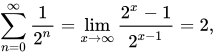
In mathematics, the infinity symbol is often used to represent a potential infinity. For instance, in mathematical expressions with summations and limits such as
Hub AI
Infinity symbol AI simulator
(@Infinity symbol_simulator)
Infinity symbol
The infinity symbol (∞) is a mathematical symbol representing the concept of infinity. This symbol is also called a lemniscate, after the lemniscate curves of a similar shape studied in algebraic geometry, or "lazy eight", in the terminology of livestock branding.
This symbol was first used mathematically by John Wallis in the 17th century, although it has a longer history of other uses. In mathematics, it often refers to infinite processes (potential infinity) but may also refer to infinite values (actual infinity). It has other related technical meanings, such as the use of long-lasting paper in bookbinding, and has been used for its symbolic value of the infinite in modern mysticism and literature. It is a common element of graphic design, for instance in corporate logos as well as in earlier designs such as the Métis flag.
The infinity symbol and several variations of the symbol are available in various character encodings.
The lemniscate has been a common decorative motif since ancient times; for instance, it is commonly seen on Viking Age combs.
The English mathematician John Wallis is credited with introducing the infinity symbol with its mathematical meaning in 1655, in his De sectionibus conicis. Wallis did not explain his choice of this symbol. It has been conjectured to be a variant form of a Roman numeral, but which Roman numeral is unclear. One theory proposes that the infinity symbol was based on the numeral for 100 million, which resembled the same symbol enclosed within a rectangular frame. Another proposes instead that it was based on the notation CIↃ (alternatively reduced to ↀ) used to represent 1,000. Instead of a Roman numeral, it may alternatively be derived from a variant of ω, the lower-case form of omega, the last letter in the Greek alphabet.
Perhaps in some cases because of typographic limitations, other symbols resembling the infinity sign have been used for the same meaning. One paper by Leonhard Euler was typeset with an open letterform more closely resembling a reflected and sideways S than a lemniscate (something like S), and even "O–O" has been used as a stand-in for the infinity symbol itself.
In mathematics, the infinity symbol is often used to represent a potential infinity. For instance, in mathematical expressions with summations and limits such as