Hubbry Logo
1621 conclave1621 conclaveMain
Open search
1621 conclave
Community hub
1621 conclave
logo
8 pages, 0 posts
0 subscribers
Be the first to start a discussion here.
1621 conclave
1621 conclave
from Wikipedia

Papal conclave
February 1621
Dates and location
8–9 February 1621
Apostolic Palace, Papal States
Elected pope
Alessandro Ludovisi
Name taken: Gregory XV
1623 →

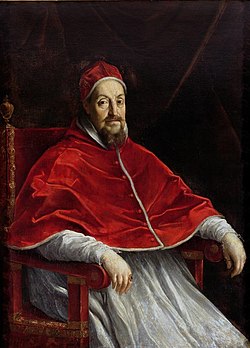
The 1621 papal conclave held from 8 to 9 February 1621, Cardinal Alessandro Ludovisi was elected to succeed Paul V as pope. Ludovisi took the name Gregory XV. It was the shortest conclave in the seventeenth century.[1]

Death of Paul V

[edit]

Pope Paul V died on January 28, 1621, in the 16th year of his pontificate. At the time of his death, there were seventy cardinals in the Sacred College, but only sixty nine were valid electors. Fifty one of them participated in the election of the new Pope.

Factions in the Sacred College

[edit]

There were three main parties in the Sacred College, with cardinal-nephews of the deceased Popes as leaders:[2]

  • Borghesian party – the faction of Cardinal Borghese, nephew of Pope Paul V. It grouped twenty nine cardinals created by this Pontiff.
  • Clementine party – It grouped thirteen cardinals of Clement VIII. Formally their leader was Camerlengo Pietro Aldobrandini, nephew of Clement VIII.
  • Sixtine party – small party of Vice-Chancellor Alessandro Montalto, cardinal-nephew of Sixtus V. It grouped six cardinals.

Three cardinals of the Italian ruling families (d'Este, Medici and Sforza) were not counted among the members of these factions.

It was generally thought that the next Pope would be the candidate chosen by Cardinal Borghese, because he was the most influential person in the Sacred College. He wanted to elect his friend Cardinal Campori, and already before opening the conclave he had obtained twenty four declarations in his favor. Although Campori had two significant opponents (Republic of Venice and Cardinal Orsini), Borghese was sure that he would be able to achieve his election on the first day of voting, by acclamation.[2]

The election of Pope Gregory XV

[edit]

The conclave began in the evening of February 8. On the next day, Cardinal Borghese tried to elect Campori by acclamation, but failed because many of his friends defected and aligned themselves with Orsini, who had secured French support for his action against Campori. Facing such strong opposition, Campori withdrew his candidature.[2]

In the subsequent scrutiny (the only one during this conclave), the greatest number of votes received (fifteen) were for Jesuit Cardinal Robert Bellarmine,[2] but he had already declared in the previous conclave that he would not accept papal dignity in the case of his election. Now, at the age of 78, Bellarmine did not change his mind.[3]

The rest of the day the most influential cardinals: Borghese, Orsini, Zapata, Capponi, d'Este and Medici, spent on looking for a compromise candidature.[2] Finally, the leaders of factions agreed to elect aged and ill Cardinal Alessandro Ludovisi of Bologna, who seemed to have been the ideal candidate for a temporary pontificate.

On that same day, at about 11 o’clock in the evening, all the cardinals assembled in the Capella Paolina and by acclamation elected Alessandro Ludovisi to the papacy.[4] He accepted his election and took the name of Gregory XV.

Legacy

[edit]

Pope Gregory XV in his Bull Aeterni Patris Filius (November 15, 1621) prescribed that in the future only three modes of papal election were to be allowed: scrutiny, compromise, and quasi-inspiration. His Bull "Decet Romanum Pontificem" (March 12, 1622) contains a ceremonial that regulates these three modes of election in every detail. The ordinary mode of election was to be election by scrutiny, which required that the vote be secret, that each cardinal give his vote to only one candidate and that no one vote for himself. Most of the papal elections during the sixteenth century were influenced by political conditions and by party considerations in the College of Cardinals. By introducing secrecy of vote, Pope Gregory XV intended to abolish these abuses. The rules and ceremonies prescribed by Gregory XV were kept substantially the same until Pope John Paul II issued the constitution "Universi Dominici Gregis" in 1996.[5]

Notes

[edit]

References

[edit]
Revisions and contributorsEdit on WikipediaRead on Wikipedia
from Grokipedia
The 1621 papal conclave was the election of a new pope by the College of Cardinals following the death of Pope Paul V on 28 January 1621, convening from 8 to 9 February and culminating in the near-unanimous selection of Cardinal Alessandro Ludovisi, who took the name Gregory XV. Of the 70 cardinals eligible, 51 participated amid factions aligned with Spanish, French, Italian "Elders," and Borghese interests, yet the gathering achieved remarkable brevity, resolving in under 24 hours after initial scrutiny votes favored the elderly Jesuit scholar Robert Bellarmine—who declined due to health—shifted decisively to Ludovisi via viva voce acclamation by 50 electors. This oral method marked the final papal election by spontaneous acclamation, supplanting prior public voting prone to external pressures, before Gregory XV's own bull Aeterni Patris mandated secret written ballots later in 1621 to enhance procedural integrity. The swift consensus on the 67-year-old Ludovisi, a Bolognese jurist and diplomat seen as a neutral compromise, underscored the conclave's role in navigating post-Renaissance curial politics without prolonged deadlock.

Background

Death of Pope Paul V

Pope Paul V, born Camillo Borghese on 17 September 1550, had reigned as pope since 16 May 1605 when his health began to deteriorate in late 1620. He experienced prolonged illness over the subsequent three months, marked by declining vitality that confined him increasingly to the Quirinal Palace. On 28 January 1621, Paul V succumbed to a stroke at age 70 in the Quirinal Palace, Rome, after suffering two such episodes within the prior three months. His death created the sede vacante, necessitating the convening of the College of Cardinals to elect a successor and initiating the 1621 conclave. Paul V was interred in the Basilica of Santa Maria Maggiore in Rome.

Geopolitical and Ecclesiastical Context

In early 1621, Europe faced escalating religious and dynastic conflicts that framed the papal election, particularly the nascent Thirty Years' War triggered by the 1618 Defenestration of Prague and the Bohemian Revolt against Habsburg authority. Catholic forces under Holy Roman Emperor Ferdinand II, bolstered by Spanish troops dispatched from the Netherlands under Ambrosio Spinola, decisively crushed Protestant resistance at the Battle of White Mountain on November 8, 1620, securing Bohemia for the Habsburgs and advancing Counter-Reformation aims. Spain's occupation of the Valtelline valley—a key alpine route linking Milan to Habsburg territories—following the massacre of approximately 400 Protestants on July 20, 1620, intensified rivalries with France, Savoy, and Venice, as France perceived a Habsburg encirclement threatening its interests amid internal Huguenot rebellions. Pope Paul V (r. 1605–1621), who died on January 28, 1621, after a series of strokes, had pursued a pro-Habsburg policy, mediating a 1616 truce between Savoy and Spain while prioritizing Catholic alliances over Venetian or French influences, leaving the conclave to select a successor amid demands from Madrid for continued Spanish leverage in Italian affairs. Ecclesiastically, the Church grappled with the imperatives of the Counter-Reformation, emphasizing doctrinal enforcement, Jesuit expansion, and suppression of Protestantism, yet burdened by internal abuses such as nepotism under Paul V, who elevated his nephew Scipione Borghese to cardinal-nephew with vast influence over Church patronage. The College of Cardinals, at full strength of seventy members but limited to fifty-one electors due to illnesses and absences—including the ailing Camerlengo Pietro Aldobrandini—reflected geopolitical fissures through factions: a dominant Borghese bloc of twenty-nine cardinals aligned with recent papal policy, a Spanish party favoring Habsburg interests, a weaker French contingent, and independent Italian groups like the Florentines under Carlo de' Medici. External powers exerted influence via exclusivae (vetoes requiring eighteen votes), with Spain seeking to bar French sympathizers and Venice's foes, while procedural debates over election methods—such as Borghese's push for acclamation—highlighted vulnerabilities in the sede vacante process, underscoring the need for reforms to insulate papal selection from secular interference.

The College of Cardinals

Composition and Eligibility

At the death of Pope Paul V on January 28, 1621, the College of Cardinals comprised 70 members, of whom 69 were eligible electors, representing the full prescribed strength established by prior papal regulations limiting the number of cardinals. Eligibility hinged solely on cardinalatial status in good standing, excluding any under ecclesiastical censure, though none such were reported in 1621, with no formal age restrictions or residency requirements imposed. The college's composition reflected the hierarchical divisions of cardinal bishops, priests, and deacons, with the seven cardinal bishops holding the suburban sees around Rome (Ostia, Velletri, Porto e Santa Rufina, Albano, Frascati, Palestrina, and Sabina). Cardinal priests formed the largest group, assigned to titular churches in Rome, while cardinal deacons were linked to the city's ancient deaconries; precise breakdowns varied slightly due to recent promotions, but priests and deacons together outnumbered bishops significantly. Nationally, Italians dominated, comprising the vast majority from regions like Rome, Genoa, Florence, Naples, and Bologna, with a small contingent of non-Italians including Spaniards (e.g., Antonio Zapata y Cisneros, Gaspar Borja y Velasco), a Frenchman (Jean de Bonsi), and Habsburg representatives from the Holy Roman Empire (e.g., Franz von Dietrichstein). Despite the eligibility of 69, only 51 cardinals actively participated in the conclave, convened from February 8 to 9; absences stemmed from distance, illness (e.g., Camerlengo Pietro Aldobrandini bedridden), or diplomatic duties, particularly affecting distant or empire-based members like Melchior Klesl. This participation rate underscored practical barriers to universal attendance in pre-modern conclaves, though the presence of key figures like Dean Antonio Maria Sauli ensured procedural continuity.

Factions and External Influences

The College of Cardinals in the 1621 conclave was divided into several factions primarily aligned by familial, national, and political ties, reflecting the patronage networks established under previous popes. The largest group was the Borghese faction, comprising 29 cardinals and led by Scipione Caffarelli Borghese, nephew of the deceased Pope Paul V, which sought to perpetuate Borghese influence by promoting candidates like Pietro Campori. This faction, however, suffered from internal divisions, with figures such as Alessandro Orsini and Roberto Ubaldini showing willingness to defect toward French-aligned interests. Other notable domestic factions included the Aldobrandini faction of 10 cardinals under Pietro Aldobrandini, which leaned toward French diplomacy despite Aldobrandini's illness limiting his role, and the Elders faction of 5 senior cardinals led by Alessandro Peretti de Montalto. Smaller groups, such as the Florentine faction under Carlo de' Medici, further fragmented voting blocs along regional lines. National factions underscored the conclave's geopolitical tensions, with the Spanish faction of 3 cardinals representing Habsburg interests and the French faction of 4 cardinals countering them. These groups drew on broader European rivalries, including disputes over the Valtellina and the Palatinate amid the early Thirty Years' War. External influences from Catholic monarchs exerted pressure through ambassadors and the informal jus exclusivae, whereby powers like Spain and France could threaten to exclude (excludere) unacceptable candidates via coordinated cardinal abstentions. Spain, under Philip IV, favored a continuation of Paul V's pro-Habsburg policies and supported figures like Campori or Scipione Cobelluzzi, leveraging its 3 cardinal votes and alliances with Austria to block French preferences. France, represented by Ambassador Marquis de Coeuvres under Louis XIII, actively opposed Spanish candidates like Campori—delaying the conclave's sealing until February 9, 1621, to lobby—and coordinated with Savoy and the Aldobrandini to enforce exclusions, drawing on 18 potential anti-Spanish votes. The Holy Roman Empire, via Emperor Ferdinand II, aligned with Spain to promote Catholic unity against Protestant threats, favoring candidates like Giovanni Millini, while Savoy's Carlo Emanuele I, allied with France, targeted exclusions such as Francesco Maria del Monte. No formal vetoes were issued, but these pressures contributed to deadlocks, culminating in the compromise election of Alessandro Ludovisi on February 9, 1621, as a neutral figure acceptable to major powers.

Conclave Proceedings

Opening and Seclusion

The papal conclave of 1621 opened on February 8 following the death of Pope Paul V on January 28, with proceedings held in the Apostolic Palace in Rome. Out of 70 members of the Sacred College, 52 cardinals entered the conclave, with 51 participating fully; notably, no French cardinals were present, while Spanish influence was evident through attendees such as Cardinals Zapata and Borgia. The initial ceremonies included a Mass of the Holy Ghost celebrated in St. Peter's Basilica, accompanied by a sermon, after which the electors processed into the conclave under the leadership of senior cardinals. A discourse on the papal election was delivered by the preacher Agostino Mascardi, emphasizing opposition to candidates like Cardinal Campori due to perceived continuations of Borghese dominance and other factional concerns. Upon entry, the cardinals took oaths pledging to adhere to the Apostolic Constitutions governing elections, ensuring votes would be cast freely without external interference. Cells within the palace were assigned by lot to maintain impartiality, and a muster of conclavists—each cardinal's permitted assistants—was conducted to verify their presence and eligibility, limited to those in at least deacon's orders. This step preceded the formal closure of the conclave in the evening, marking the onset of seclusion. Seclusion enforced strict isolation from the outside world, with the palace doors locked and sealed to prevent communication, under penalties including excommunication for violations. Conclavists were confined alongside the electors, subject to repeated musters to exclude unauthorized individuals, while provisions for meals and necessities were delivered through controlled channels. This regimen, rooted in longstanding traditions to curb factional pressures from powers like Spain and France, aimed to foster deliberate deliberation amid pre-conclave negotiations documented in contemporary accounts. The process underscored the conclave's validity, confining activities to prayer, discussion, and balloting within the enclosed spaces.

Balloting Process and Deadlocks

The balloting in the 1621 conclave followed the established papal election procedures of the era, which required a two-thirds majority of participating cardinals for election and permitted both secret scrutiny ballots and alternative methods such as viva voce voting or adoration if consensus emerged. With 51 cardinals participating, at least 34 votes were needed for a valid election. Voting commenced on the morning of February 9, 1621, after the conclave's formal seclusion the previous evening, with scrutinies typically held twice daily in the Pauline Chapel under oath-bound secrecy to prevent external influence. The initial morning scrutiny saw Cardinal Roberto Bellarmino receive the largest share of votes, though short of the requisite majority; he promptly declined the candidacy, citing age and health, and endorsed the absent Cardinal François de la Rochefoucauld instead. Cardinal Pietro Campori, initially promoted by the dominant Borghese faction (comprising 29 cardinals loyal to the late Pope Paul V's nephew, Scipione Borghese), garnered zero votes amid coordinated opposition from French, Venetian, and exclusionary groups accusing him of moral failings and past scandals. This outcome reflected factional divisions—Borghese supporters, Aldobrandini allies (10 cardinals), Spanish partisans (3), and smaller imperial or French blocs—but did not constitute a prolonged deadlock, as negotiations shifted rapidly without extended impasses. By evening, Cardinals Roberto Ubaldini and Alessandro Orsini orchestrated a consensus, leading to a viva voce ballot at 11:45 p.m. where Cardinal Alessandro Ludovisi secured 50 of 51 votes, with the lone dissenter absent due to illness. Ludovisi, a Borghese-aligned compromise figure aged 67 and known for administrative competence, had not led early ballots but benefited from the collapse of rival candidacies and cross-factional support to avert further delays. The swift resolution after just one full day of voting underscored the conclave's brevity, avoiding the multi-week deadlocks common in prior elections, though it highlighted vulnerabilities in the pre-reform system that Ludovisi would soon address via the bull Aeterni Patriarcharum.

Election of Gregory XV

The conclave's first scrutiny occurred on the morning of February 9, 1621, in the Pauline Chapel, where Cardinal Roberto Bellarmino received the largest number of votes, though he declined the tiara and expressed a preference for the absent François de la Rochefoucauld. Cardinal Pietro Campori, backed by Scipione Borghese's faction of 29 cardinals, failed to secure a two-thirds majority despite initial confidence in his prospects. Opposition arose from multiple quarters, including Cardinal Orsini's personal rivalry with Campori, Venetian prohibitions against his election via the Council of Ten, and interference by the French ambassador, Marquis de Coeuvres, who lingered overnight in violation of seclusion rules, invalidating any potential acclamation. The arrival of two cardinals previously exiled by Paul V bolstered the anti-Campori bloc, prompting Campori's withdrawal after failed recruitment efforts. With Campori out, Cardinal Carlo de' Medici mediated a compromise among faction leaders, proposing Cardinal Alessandro Ludovisi, the 67-year-old Archbishop of Bologna, as a neutral figure unaligned with major powers like Spain or France. Ludovisi, elevated to cardinal in 1616 by Paul V and known for diplomatic fairness in resolving Vatican-secular disputes, was viewed as a transitional pontiff due to his frail health and stomach ailments. This selection resolved tensions exacerbated by European conflicts, such as the Valtelline affair, positioning Ludovisi as capable of maintaining papal neutrality. By 11:45 p.m. on February 9, the cardinals proceeded to a viva voce election in the Pauline Chapel, beginning with Dean Antonio Maria Sauli; Ludovisi garnered 50 votes from the 51 participating electors (52 cardinals were present, but Ladislao d'Aquino, critically ill, abstained and died soon after). Ludovisi himself had voted for Sauli, underscoring the consensus-driven acclamation rather than scripted favoritism. He accepted the election, adopting the name Gregory XV, and was crowned on February 14, 1621, by Cardinal Andrea Baroni Peretti Montalto in St. Peter's Basilica. The rapid resolution—within less than 24 hours—reflected exhaustion from factional deadlock and the physical frailty of participants, including the dying Pietro Aldobrandini.

Post-Election Reforms

Aeterni Patris Bull

The papal bull Aeterni Patris Filius, issued by Pope Gregory XV on November 15, 1621, formalized key procedural rules for papal conclaves, drawing directly from the factional tensions and external interferences evident in the recent election that had elevated him to the papacy. This document responded to the protracted deadlocks and political manipulations in prior conclaves, such as those influenced by Spanish and French diplomatic pressures, by prioritizing secrecy and internal cardinal autonomy over overt bargaining or acclamation. It limited elections to three methods—scrutiny (secret ballot), compromise (delegation to a small group of cardinals), and quasi-inspiration (unanimous acclamation without prior discussion)—with scrutiny designated as the normative approach to minimize corruption and foreign sway. Central to the bull's reforms was the mandate for written, secret ballots, requiring each cardinal to inscribe a single candidate's name on a folded slip, deposit it in a chalice during designated scrutiny sessions (typically two per day: morning and afternoon), and swear oaths of secrecy under pain of excommunication. Self-voting was explicitly prohibited, and a two-thirds supermajority of participating cardinals was established as the threshold for validity, ensuring broad consensus while guarding against minority dominance or rushed decisions. Scrutineers—three cardinals appointed per session—were tasked with verifying ballots aloud without revealing names until the count, after which votes were burned: damp straw added to the fire for black smoke signaling no election, or dry for white smoke upon success. These measures aimed to shield deliberations from eavesdroppers, spies, or factional enforcers, as had plagued the 1621 conclave's early phases amid Borghese (pro-Spanish) and Medici (pro-French) rivalries. Aeterni Patris Filius also reinforced seclusion protocols, barring cardinals from communication with outsiders and invalidating any pre-conclave pledges or exclusions attempted by secular powers, thereby asserting the College's spiritual independence. Complemented by the follow-up bull Decet Romanum Pontificem on March 12, 1622, which detailed ceremonial and logistical minutiae like cell assignments and meal restrictions, the 1621 legislation curbed the chaotic negotiations that had extended previous sede vacante periods, sometimes lasting months. Though not eliminating all intrigue—subsequent conclaves still saw subtle lobbying—the bull's framework endured with minor adaptations, underpinning conclave stability for centuries by institutionalizing verifiable, insulated processes over ad hoc customs.

Procedural Innovations and Rationale

The bull Aeterni Patris Filius, promulgated by Pope Gregory XV on 15 November 1621, introduced several procedural innovations to standardize and secure papal elections. Central among these was the mandate for secret written ballots in every scrutiny, supplanting prior practices of oral voting or acclamation that had permitted overt negotiation and external pressure. Ballots were to be folded and deposited anonymously into a chalice, with strict protocols for counting by three scrutineers elected by lot, ensuring invalid or ambiguous votes were discarded without influencing outcomes. Additionally, the bull formalized a two-thirds supermajority requirement for election, calculated inclusively with the pontiff-elect, and prohibited accessus—post-scrutiny endorsements that could facilitate deal-making among cardinals. These measures extended seclusion rules, barring communication with outsiders and mandating oaths of secrecy under pain of excommunication. The rationale for these reforms stemmed from the vulnerabilities exposed in preceding conclaves, including the 1621 election itself, where factional divisions between Spanish- and French-aligned cardinals risked prolonged deadlocks and undue influence from Catholic monarchs. Gregory XV, drawing on his experience as a cardinal participant, sought to insulate the process from secular interference by noble families and foreign powers, which had historically manipulated outcomes through bribery, intimidation, or public lobbying. By codifying secrecy and majority thresholds, the bull aimed to expedite decisions—targeting resolution within 10-15 days—while preserving the College of Cardinals' autonomy as successors to the apostles, thereby prioritizing ecclesiastical independence over political expediency. This framework addressed inconsistencies in earlier ad hoc rules, such as those under Pius X's 1274 constitution Ubi periculum, promoting reliability amid the Counter-Reformation's geopolitical tensions. A supplementary constitution, Decet Romanum Pontificem of 12 March 1622, refined these by clarifying vote tabulation and reinforcing penalties for violations, underscoring Gregory's intent to preempt disputes that could undermine papal legitimacy. Collectively, the innovations reflected a pragmatic response to empirical failures in prior elections, favoring verifiable, tamper-resistant mechanisms over tradition-bound flexibility.

Legacy and Assessment

Immediate Impacts on the Papacy

The election of Gregory XV on 9 February 1621 addressed factional rivalries among Spanish, French, and Italian cardinals, enabling the papacy to redirect focus from internal divisions to external imperatives. This swift resolution restored operational continuity to the Holy See following the death of Paul V on 28 January 1621, averting prolonged uncertainty during a period of European upheaval marked by the Thirty Years' War. Gregory XV's selection as a compromise figure, backed by the influential Borghese faction yet independent in outlook, facilitated immediate administrative stabilization, with his diplomatic expertise—honed in prior roles such as nuncio to Savoy—proving instrumental in reasserting papal influence. In foreign policy, Gregory XV adopted an interventionist stance from the outset, prioritizing Catholic unity against Protestant advances. By mid-1621, he intervened in the Valtellina crisis, dispatching papal troops under his brother Orazio Ludovisi to occupy the strategically vital Alpine valley after a Catholic uprising against Protestant Grisons rule, thereby safeguarding Habsburg supply lines and preventing its exploitation by French or Venetian interests. This move, executed in coordination with Spain and the Empire, underscored the papacy's active role in bolstering the Catholic cause, including financial subsidies to Emperor Ferdinand II and exhortations to Philip IV of Spain for military support, which enhanced papal leverage in continental alliances without committing to direct belligerence. Domestically, Gregory XV employed nepotism to consolidate control, elevating his nephew Ludovico Ludovisi to the cardinalate in the consistory of 20 March 1621 at age 25, granting him oversight of papal finances, military affairs, and artistic patronage. This appointment, while emblematic of Renaissance-era practices, expedited decision-making and curbed factional interference, allowing for efficient resource allocation amid fiscal strains from prior administrations. Such measures yielded short-term gains in governance efficacy, though they perpetuated clientelistic networks within the curia, setting the stage for familial influence in subsequent papal endeavors.

Long-Term Influence on Conclave Practices

The papal bull Aeterni Patris Filius, promulgated by Gregory XV on November 15, 1621, established enduring procedural norms for future conclaves by mandating secret ballots via the scrutinium method, involving written votes tallied and verified by designated scrutineers, which minimized overt negotiations and external pressures observed in the 1621 deadlock. This reform, motivated by the factional strife between French and Spanish interests during the election, limited voting modes to scrutinium, compromise by a delegated committee, or rare acclamation under strict conditions, thereby standardizing elections and curbing ad hoc bargaining that had prolonged prior vacancies. These rules governed conclaves for over three centuries, influencing elections such as those of Urban VIII in 1623 and subsequent popes by enforcing isolation, daily voting quotas (up to four ballots), and oaths of secrecy, which collectively reduced the duration of sede vacante periods compared to medieval precedents. By formalizing a two-thirds supermajority requirement for election—absent in earlier informal practices—Aeterni Patris promoted consensus while preventing minority impositions, a threshold that persisted until modified by Pius XII in 1945 and John Paul II in 1996. The bull's emphasis on cardinal seclusion in the Sistine Chapel, with regulated access and communication bans, set a template for countering diplomatic vetoes, as France and Spain had attempted in 1621, fostering internal autonomy that shaped conclave secrecy in events like the 1799 election amid revolutionary turmoil. Although factionalism evolved rather than vanished, the structured framework diminished overt foreign interference, evidenced by smoother proceedings in 17th- and 18th-century conclaves, and informed later codifications such as Si sumus in 1904, which addressed veto abuses without overturning core voting mechanics. Complementing Aeterni Patris, the 1622 bull Decet Romanum Pontificem detailed ceremonial protocols, including fumata signals and post-election acceptance rites, which became fixtures in papal transitions, enhancing ritual predictability and public signaling of outcomes. These innovations collectively entrenched a bureaucratic ethos in conclave operations, prioritizing collegial deliberation over charismatic or negotiated selection, and their longevity underscores the 1621 reforms' role in transitioning the papacy toward institutionalized electoral integrity amid Counter-Reformation centralization.
Add your contribution
Related Hubs
User Avatar
No comments yet.