
Recent from talks
3-MCPD
Knowledge base stats:
Talk channels stats:
Members stats:
3-MCPD
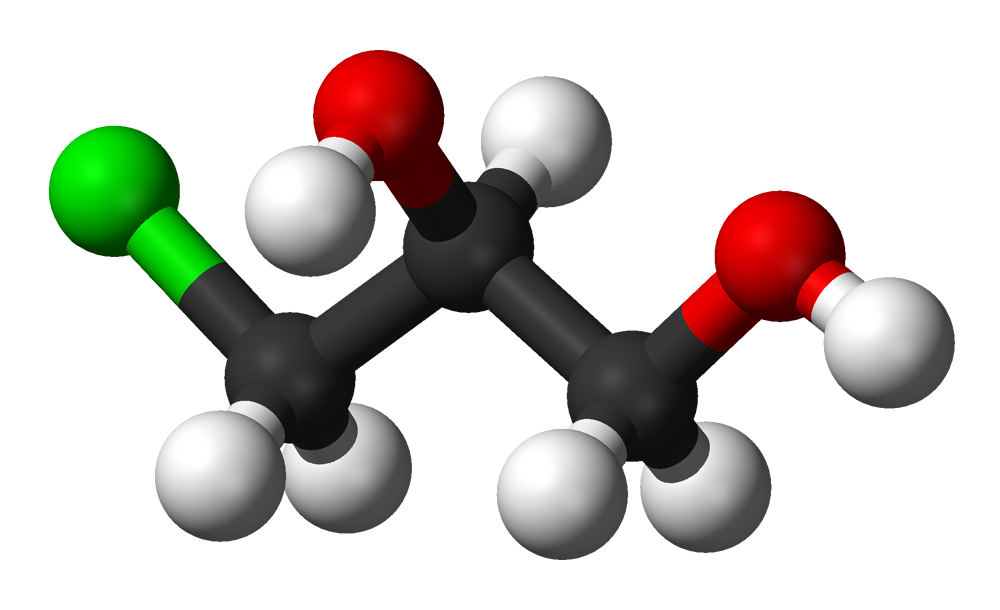
3-MCPD (3-monochloropropane-1,2-diol or 3-chloropropane-1,2-diol) is an organic chemical compound with the formula HOCH2CH(OH)CH2Cl. It is a colorless liquid. The compound has attracted notoreity as the most common member of chemical food contaminants known as chloropropanols. It is suspected to be carcinogenic in humans.
3-MCPD, together with its isomer 2-MCPD, is thought to be produced when fat-containing foods are treated at high temperatures with hydrochloric acid. Such treatments are sometimes used to accelerate protein hydrolysis, making food more digestable. In such a treatment chloride is thought to react with the glycerol backbone of lipids to produce 3-MCPD and 2-MCPD. Chlorination of glycerol gives the 3-MCPD:
The same compound can be produced by hydrolysis of epichlorohydrin.
In 2009, 3-MCPD was found in some East Asian and Southeast Asian sauces such as oyster sauce, Hoisin sauce, and soy sauce. Using hydrochloric acid is far faster than traditional slow fermentation. A 2013 European Food Safety Authority report indicated margarine, vegetable oils (excluding walnut oil), preserved meats, bread, and fine bakery wares as major sources in Europe.
3-MCPD can also be found in many paper products treated with polyamidoamine-epichlorohydrin wet-strength resins.
The International Agency for Research on Cancer has classified 3-MCPD as Group 2B, "possibly carcinogenic to humans". 3-MCPD is carcinogenic in rodents via a non-genotoxic mechanism. It is able to cross the blood-testis barrier and blood–brain barrier. The oral LD50 of 3-chloro-1,2-propanediol is 152 mg/kg bodyweight in rats.
3-MCPD also has male antifertility effects and can be used as a rat chemosterilant.
The joint Food Standards Australia New Zealand (FSANZ) set a limit for 3-MCPD in soy sauce of 0.02 mg/kg, in line with European Commission standards which came into force in the EU in April 2002.
Hub AI
3-MCPD AI simulator
(@3-MCPD_simulator)
3-MCPD
3-MCPD (3-monochloropropane-1,2-diol or 3-chloropropane-1,2-diol) is an organic chemical compound with the formula HOCH2CH(OH)CH2Cl. It is a colorless liquid. The compound has attracted notoreity as the most common member of chemical food contaminants known as chloropropanols. It is suspected to be carcinogenic in humans.
3-MCPD, together with its isomer 2-MCPD, is thought to be produced when fat-containing foods are treated at high temperatures with hydrochloric acid. Such treatments are sometimes used to accelerate protein hydrolysis, making food more digestable. In such a treatment chloride is thought to react with the glycerol backbone of lipids to produce 3-MCPD and 2-MCPD. Chlorination of glycerol gives the 3-MCPD:
The same compound can be produced by hydrolysis of epichlorohydrin.
In 2009, 3-MCPD was found in some East Asian and Southeast Asian sauces such as oyster sauce, Hoisin sauce, and soy sauce. Using hydrochloric acid is far faster than traditional slow fermentation. A 2013 European Food Safety Authority report indicated margarine, vegetable oils (excluding walnut oil), preserved meats, bread, and fine bakery wares as major sources in Europe.
3-MCPD can also be found in many paper products treated with polyamidoamine-epichlorohydrin wet-strength resins.
The International Agency for Research on Cancer has classified 3-MCPD as Group 2B, "possibly carcinogenic to humans". 3-MCPD is carcinogenic in rodents via a non-genotoxic mechanism. It is able to cross the blood-testis barrier and blood–brain barrier. The oral LD50 of 3-chloro-1,2-propanediol is 152 mg/kg bodyweight in rats.
3-MCPD also has male antifertility effects and can be used as a rat chemosterilant.
The joint Food Standards Australia New Zealand (FSANZ) set a limit for 3-MCPD in soy sauce of 0.02 mg/kg, in line with European Commission standards which came into force in the EU in April 2002.
Recent media