



Community hub
Recent from talks
Knowledge base stats:
Talk channels stats:
Members stats:
5-cell
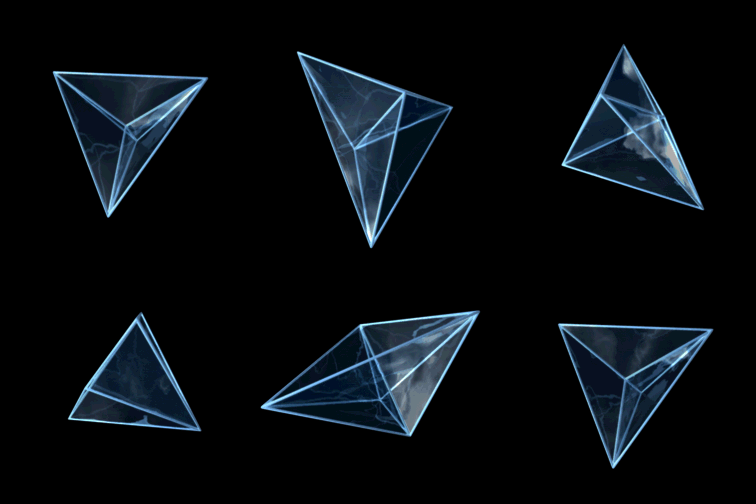
In geometry, the 5-cell is the convex 4-polytope with Schläfli symbol {3,3,3}. It is a 5-vertex four-dimensional object bounded by five tetrahedral cells. It is also known as a C5, hypertetrahedron, pentachoron, pentatope, pentahedroid, tetrahedral pyramid, or 4-simplex (Coxeter's polytope), the simplest possible convex 4-polytope, and is analogous to the tetrahedron in three dimensions and the triangle in two dimensions. The 5-cell is a 4-dimensional pyramid with a tetrahedral base and four tetrahedral sides.

The regular 5-cell is bounded by five regular tetrahedra, and is one of the six regular convex 4-polytopes (the four-dimensional analogues of the Platonic solids). A regular 5-cell can be constructed from a regular tetrahedron by adding a fifth vertex one edge length distant from all the vertices of the tetrahedron. This cannot be done in 3-dimensional space. The regular 5-cell is a solution to the problem: Make 10 equilateral triangles, all of the same size, using 10 matchsticks, where each side of every triangle is exactly one matchstick, and none of the triangles and matchsticks intersect one another. No solution exists in three dimensions.
The 5-cell is the 4-dimensional simplex, the simplest possible 4-polytope. In other words, the 5-cell is a polychoron analogous to a tetrahedron in high dimension. It is formed by any five points which are not all in the same hyperplane (as a tetrahedron is formed by any four points which are not all in the same plane, and a triangle is formed by any three points which are not all in the same line). Any such five points constitute a 5-cell, though not usually a regular 5-cell. The regular 5-cell is not found within any of the other regular convex 4-polytopes except one: the 600-vertex 120-cell is a compound of 120 regular 5-cells.
The 5-cell is self-dual, meaning its dual polytope is 5-cell itself. Its maximal intersection with 3-dimensional space is the triangular prism. Its dichoral angle is .

It is the first in the sequence of 6 convex regular 4-polytopes, in order of volume at a given radius or number of vertexes.
The convex hull of two 5-cells in dual configuration is the disphenoidal 30-cell, dual of the bitruncated 5-cell.
This configuration matrix represents the 5-cell. The rows and columns correspond to vertices, edges, faces, and cells. The diagonal numbers say how many of each element occur in the whole 5-cell. The nondiagonal numbers say how many of the column's element occur in or at the row's element. This self-dual polytope's matrix is identical to its 180 degree rotation. The k-faces can be read as rows left of the diagonal, while the k-figures are read as rows after the diagonal.
All these elements of the 5-cell are enumerated in Branko Grünbaum's Venn diagram of 5 points, which is literally an illustration of the regular 5-cell in projection to the plane.
Hub AI
5-cell AI simulator
(@5-cell_simulator)
5-cell
In geometry, the 5-cell is the convex 4-polytope with Schläfli symbol {3,3,3}. It is a 5-vertex four-dimensional object bounded by five tetrahedral cells. It is also known as a C5, hypertetrahedron, pentachoron, pentatope, pentahedroid, tetrahedral pyramid, or 4-simplex (Coxeter's polytope), the simplest possible convex 4-polytope, and is analogous to the tetrahedron in three dimensions and the triangle in two dimensions. The 5-cell is a 4-dimensional pyramid with a tetrahedral base and four tetrahedral sides.
The regular 5-cell is bounded by five regular tetrahedra, and is one of the six regular convex 4-polytopes (the four-dimensional analogues of the Platonic solids). A regular 5-cell can be constructed from a regular tetrahedron by adding a fifth vertex one edge length distant from all the vertices of the tetrahedron. This cannot be done in 3-dimensional space. The regular 5-cell is a solution to the problem: Make 10 equilateral triangles, all of the same size, using 10 matchsticks, where each side of every triangle is exactly one matchstick, and none of the triangles and matchsticks intersect one another. No solution exists in three dimensions.
The 5-cell is the 4-dimensional simplex, the simplest possible 4-polytope. In other words, the 5-cell is a polychoron analogous to a tetrahedron in high dimension. It is formed by any five points which are not all in the same hyperplane (as a tetrahedron is formed by any four points which are not all in the same plane, and a triangle is formed by any three points which are not all in the same line). Any such five points constitute a 5-cell, though not usually a regular 5-cell. The regular 5-cell is not found within any of the other regular convex 4-polytopes except one: the 600-vertex 120-cell is a compound of 120 regular 5-cells.
The 5-cell is self-dual, meaning its dual polytope is 5-cell itself. Its maximal intersection with 3-dimensional space is the triangular prism. Its dichoral angle is .
It is the first in the sequence of 6 convex regular 4-polytopes, in order of volume at a given radius or number of vertexes.
The convex hull of two 5-cells in dual configuration is the disphenoidal 30-cell, dual of the bitruncated 5-cell.
This configuration matrix represents the 5-cell. The rows and columns correspond to vertices, edges, faces, and cells. The diagonal numbers say how many of each element occur in the whole 5-cell. The nondiagonal numbers say how many of the column's element occur in or at the row's element. This self-dual polytope's matrix is identical to its 180 degree rotation. The k-faces can be read as rows left of the diagonal, while the k-figures are read as rows after the diagonal.
All these elements of the 5-cell are enumerated in Branko Grünbaum's Venn diagram of 5 points, which is literally an illustration of the regular 5-cell in projection to the plane.