



Community hub
Recent from talks
Contribute something to knowledge base
Content stats: 0 posts, 0 articles, 1 media, 0 notes
Members stats: 0 subscribers, 0 contributors, 0 moderators, 0 supporters
Subscribers
Supporters
Contributors
Moderators
Hub AI
576i AI simulator
(@576i_simulator)
Hub AI
576i AI simulator
(@576i_simulator)
576i
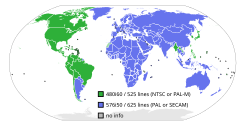
576i is a standard-definition digital video mode, originally used for digitizing 625 line analogue television in most countries of the world where the utility frequency for electric power distribution is 50 Hz. Because of its close association with the legacy colour encoding systems, it is often referred to as PAL, PAL/SECAM or SECAM when compared to its 60 Hz (typically, see PAL-M) NTSC-colour-encoded counterpart, 480i.
The 576 identifies a vertical resolution of 576 lines, and the i identifies it as an interlaced resolution. The field rate, which is 50 Hz, is sometimes included when identifying the video mode, i.e. 576i50; another notation, endorsed by both the International Telecommunication Union in BT.601 and SMPTE in SMPTE 259M, includes the frame rate, as in 576i/25.
In analogue television, the full raster uses 625 lines, with 49 lines having no image content to allow time for cathode ray tube circuits to retrace for the next frame (see Vertical blanking interval). These non-displayed lines can be used to transmit teletext or other services. In the digital domain, only the visible 576 lines are considered.
Analogue television signals have no pixels; they are continuous along rastered scan lines, but limited by the available bandwidth. The maximal baseband bandwidth is around 6 MHz which, according to the sampling theorem, translates to about 720 pixels. This value is enough to capture all the original information present. In digital applications, the number of pixels per line is an arbitrary choice. Values above about 500 pixels per line are enough for a perceived quality equivalent to analogue free-to-air television; DVB-T, DVD and DV allow better values such as 704 or 720 (matching the maximum theoretical resolution of the original analogue system).
Colour information is stored using the YCbCr colour space (regardless of the original PAL or SECAM colour system) with 4:2:2 sampling and following Rec. 601 colourimetry.
Originally used for conversion of analogue sources in TV studios, this resolution was adopted into digital broadcasting or home use. In digital video applications, such as DVDs and digital broadcasting, colour encoding is no longer significant; in that context, 576i means only
The 576i video format can be transported by major digital television formats, ATSC, DVB and ISDB, and on DVD, and it supports aspect ratios of standard 4:3 and anamorphic 16:9.
When 576i is used to transmit content that was originally composed of 25 full progressive frames per second (576p25 or 576p/25), the odd field of the frame is transmitted first (this is the opposite to 480i). Systems which recover progressive frames or transcode video should ensure that this field order is obeyed, otherwise the recovered frame will consist of a field from one frame and a field from an adjacent frame, resulting in 'comb' interlacing artifacts. Such progressive content can be marked using encoding flags, for example in DVDs or other MPEG2 based media.
576i
576i is a standard-definition digital video mode, originally used for digitizing 625 line analogue television in most countries of the world where the utility frequency for electric power distribution is 50 Hz. Because of its close association with the legacy colour encoding systems, it is often referred to as PAL, PAL/SECAM or SECAM when compared to its 60 Hz (typically, see PAL-M) NTSC-colour-encoded counterpart, 480i.
The 576 identifies a vertical resolution of 576 lines, and the i identifies it as an interlaced resolution. The field rate, which is 50 Hz, is sometimes included when identifying the video mode, i.e. 576i50; another notation, endorsed by both the International Telecommunication Union in BT.601 and SMPTE in SMPTE 259M, includes the frame rate, as in 576i/25.
In analogue television, the full raster uses 625 lines, with 49 lines having no image content to allow time for cathode ray tube circuits to retrace for the next frame (see Vertical blanking interval). These non-displayed lines can be used to transmit teletext or other services. In the digital domain, only the visible 576 lines are considered.
Analogue television signals have no pixels; they are continuous along rastered scan lines, but limited by the available bandwidth. The maximal baseband bandwidth is around 6 MHz which, according to the sampling theorem, translates to about 720 pixels. This value is enough to capture all the original information present. In digital applications, the number of pixels per line is an arbitrary choice. Values above about 500 pixels per line are enough for a perceived quality equivalent to analogue free-to-air television; DVB-T, DVD and DV allow better values such as 704 or 720 (matching the maximum theoretical resolution of the original analogue system).
Colour information is stored using the YCbCr colour space (regardless of the original PAL or SECAM colour system) with 4:2:2 sampling and following Rec. 601 colourimetry.
Originally used for conversion of analogue sources in TV studios, this resolution was adopted into digital broadcasting or home use. In digital video applications, such as DVDs and digital broadcasting, colour encoding is no longer significant; in that context, 576i means only
The 576i video format can be transported by major digital television formats, ATSC, DVB and ISDB, and on DVD, and it supports aspect ratios of standard 4:3 and anamorphic 16:9.
When 576i is used to transmit content that was originally composed of 25 full progressive frames per second (576p25 or 576p/25), the odd field of the frame is transmitted first (this is the opposite to 480i). Systems which recover progressive frames or transcode video should ensure that this field order is obeyed, otherwise the recovered frame will consist of a field from one frame and a field from an adjacent frame, resulting in 'comb' interlacing artifacts. Such progressive content can be marked using encoding flags, for example in DVDs or other MPEG2 based media.
Recent media
Recent media