Hubbry Logo
Alcohol proofAlcohol proofMain
Open search
Alcohol proof
Community hub
Alcohol proof
logo
8 pages, 0 posts
0 subscribers
Be the first to start a discussion here.
Alcohol proof
Alcohol proof
from Wikipedia

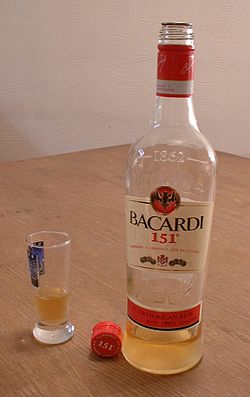
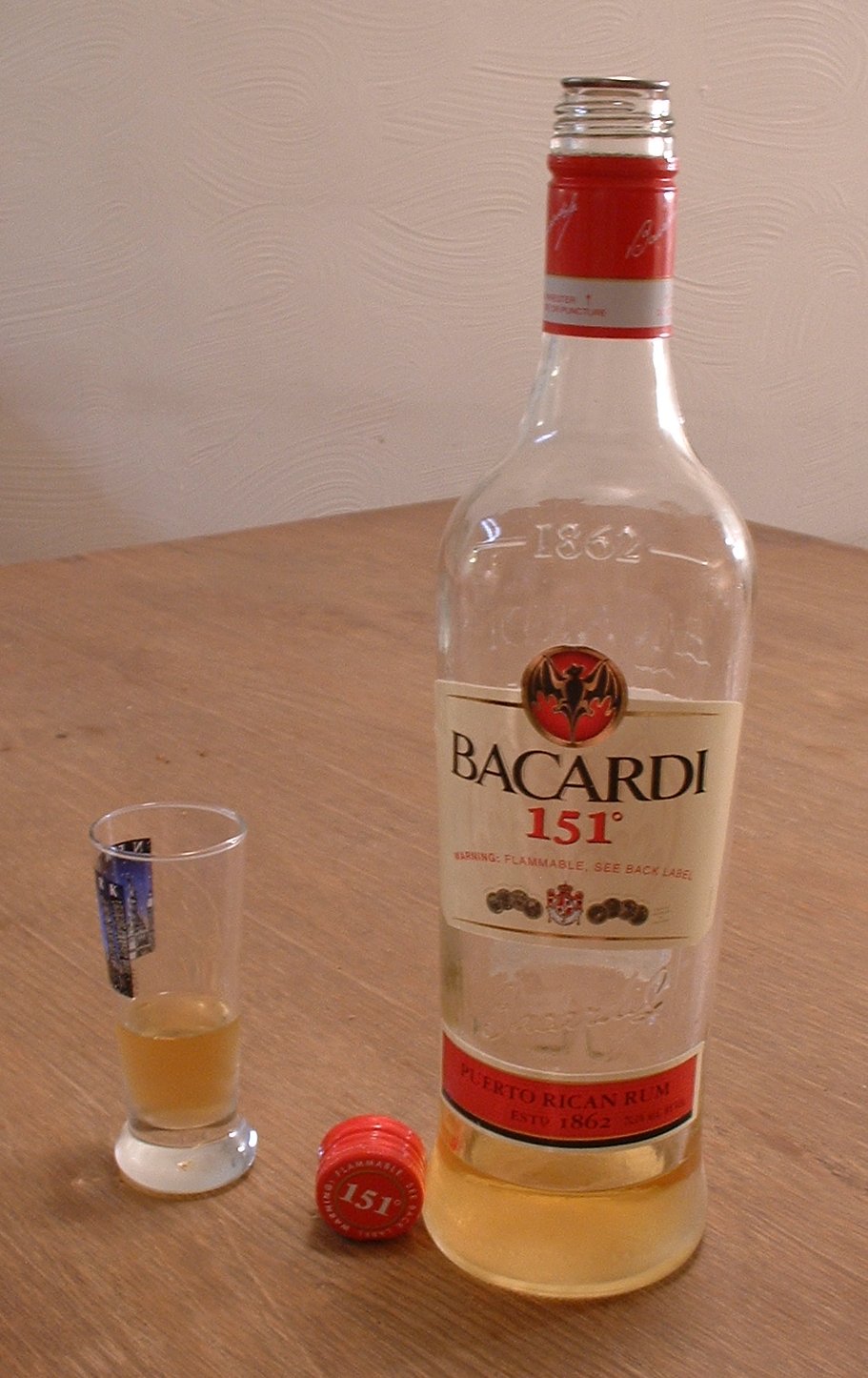
A bottle of 151 proof ("over-proof"[clarification needed]) rum, measured by the US system, with an ABV of 75.5%

Alcohol proof (usually termed simply "proof" in relation to a beverage) is a measure of the content of ethanol (alcohol) in an alcoholic beverage. The term was originally used in England and from 1816 was equal to about 1.75 times the percentage of alcohol by volume (ABV). The United Kingdom today uses ABV instead of proof. The definition of proof in terms of ABV varies from country to country, for example in the United States, alcohol proof is defined as twice the percentage of ABV.

The measurement of alcohol content and the statement of content on bottles of alcoholic beverages is regulated by law in many countries. In 1972, Canada phased out the use of "proof"; in 1973, the European Union followed suit; and the United Kingdom, where the concept originated, started using ABV instead in 1980. The United States Code mandates the use of ABV, but permits proof to be used also.

The degree symbol (°) is sometimes used to indicate alcohol proof, either alone (e.g. 10°) or after a space and joined to the letter P as a unit name (e.g. 13 °P).

History

[edit]

The term proof dates back to 16th century England, when spirits were taxed at different rates depending on their alcohol content. Similar terminology and methodology spread to other nations as spirit distillation, and taxation, became common. In England, spirits were originally tested with a basic "burn-or-no-burn" test, in which an alcohol-containing liquid that would ignite was said to be "above proof", and one which would not was said to be "under proof".[1] A liquid just alcoholic enough to maintain combustion was defined as 100 proof and was the basis for taxation. Because the flash point of alcohol is highly dependent on temperature, 100 proof defined this way ranges from 20% at 36 °C (97 °F) to 96% at 13 °C (55 °F) alcohol by weight (ABW); at 24 °C (75 °F) 100 proof would be 50% ABW.[2]

Another early method for testing liquor's alcohol content was the "gunpowder method". Gunpowder was soaked in a spirit, and if the gunpowder could still burn, the spirit was rated above proof. This test relies on the fact that potassium nitrate (a chemical in gunpowder) is significantly more soluble in water than in alcohol.[3] While less influenced by temperature than the simpler burn-or-no-burn test, gunpowder tests also lacked true reproducibility. Factors including the grain size of gunpowder and the time it sat in the spirit impact the dissolution of potassium nitrate and therefore what would be defined as 100 proof. However, the gunpowder method is significantly less variable than the burn-or-no-burn method, and 100 proof defined by it is traditionally defined as 57.15% ABV.

By the end of the 17th century, England had introduced tests based on specific gravity for defining proof. However, it was not until 1816 that a legal standard based on specific density was defined in England. 100 proof was defined as a spirit with 1213 the specific gravity of pure water at the same temperature.[4] From the 19th century until 1 January 1980, the UK officially measured alcohol content by proof spirit, defined as spirit with a gravity of 1213 that of water, or 923 kg/m3 (1,556 lb/cu yd), and equivalent to 57.15% ABV.[5]

The value 57.15% is very close to the fraction 47 ≈ 0.5714. This led to the approximation that 100-proof spirit has an ABV of 47. From this, it follows that to convert the ABV expressed as a percentage to degrees proof, it is only necessary to multiply the ABV by 74. Thus pure 100% alcohol will have 100×(74) = 175 proof, and a spirit containing 40% ABV will have 40×(74) = 70 proof.

The proof system in the United States was established around 1848 and was based on percent alcohol rather than specific gravity. Fifty percent alcohol by volume was defined as 100 proof.[4] This is different from 50% volume fraction (expressed as a percentage); the latter does not take into account change in volume on mixing, whereas the former does. To make 50% ABV from pure alcohol, one would take 50 parts of alcohol and dilute to 100 parts of solution with water, all the while mixing the solution. To make 50% alcohol by volume fraction, one would take 50 parts alcohol and 50 parts water, measured separately, and then mix them together. The resulting volume will not be 100 parts but between 96 and 97 parts, since the smaller water molecules can take up some of the space between the larger alcohol molecules (see volume change).

The use of proof as a measure of alcohol content is now mostly linguistic and historical. Today, liquor is sold in most locations with labels that state its percentage alcohol by volume.

Governmental regulation

[edit]

European Union

[edit]

The European Union (EU) follows recommendations of the International Organization of Legal Metrology (OIML). OIML's International Recommendation No. 22 (1973)[6] provides standards for measuring alcohol strength by volume and by mass. A preference for one method over the other is not stated in the document, but if alcohol strength by volume is used, it must be expressed as a percentage of total volume at a temperature of 20 °C (68 °F). The document does not address alcohol proof or the labeling of bottles.

United Kingdom

[edit]

On 1 January 1980, Britain adopted the ABV system of measurement prescribed by the European Union, of which it was then a member. The OIML recommendation for ABV used by the EU states the alcohol by volume in a mixture containing alcohol as a percentage of the total volume of the mixture at a temperature of 293.15 K [20.00 °C; 68.00 °F]. It replaced the Sikes hydrometer method of measuring the proof of spirits, which had been used in Britain for over 160 years.[5][7]

United States

[edit]

In the United States, alcohol content is legally mandated to be specified as an ABV percentage. For bottled spirits over 100 ml (3.5 imp fl oz; 3.4 US fl oz) containing no solids, actual alcohol content is allowed to vary by up to 0.15% of the ABV stated on the label. By contrast, bottled spirits which are less than 100 ml (as well as those which otherwise contain solids) may vary by up to 0.25%.[8] Proof (the term degrees proof is not used), defined as being twice the percentage of alcohol by volume, may be optionally stated in conjunction with the ABV. For example, whisky may be labeled as 50% ABV and as 100 proof; 86-proof whisky contains 43% ABV.[5] The most typical bottling proof for spirits in the United States is 80 US proof, and there is special legal recognition of 100-proof spirits in the bottled in bond category defined since 1897.

The Code of Federal Regulations[9] requires that liquor labels state the percentage of ABV at a temperature of 60 °F (16 °C). The regulation permits, but does not require, a statement of the proof, provided that it is printed close to the ABV number.[8] In practice, proof levels continue to be stated on nearly all spirits labels in the United States, and are more commonly used than ABV when describing spirits in journalism and informal settings.[citation needed]

Canada

[edit]

Beverages were labelled by alcohol proof in Canada until 1972,[10] then replaced by ABV.[11]

See also

[edit]

References

[edit]
Revisions and contributorsEdit on WikipediaRead on Wikipedia
from Grokipedia
Alcohol proof is a standardized measure of the ethanol content in distilled spirits and other alcoholic beverages, historically derived from a test assessing whether a spirit could ignite to confirm its potency for taxation and naval provisioning. , proof is defined as twice the (ABV) percentage, meaning a beverage labeled 80 proof contains 40% ethanol by volume at 60°F (15.6°C). This system persists in U.S. labeling and regulation, influencing consumer perception of strength, taxation rates, and production standards, while most other countries have transitioned to direct ABV reporting for international consistency. The term "proof" traces to 16th-century , where distillers and authorities soaked gunpowder pellets in spirits; ignition indicated sufficient alcohol concentration to prevent dilution, establishing a benchmark around 57% ABV for "proof spirit" under the British system. This empirical method ensured reliable supply for the Royal and revenue collection via duties scaled to strength, evolving by the into gravity-based measurements before standardization. In contrast, the U.S. adopted its doubled ABV scale in the early , reflecting simpler arithmetic for trade and bottling, though both systems aimed at verifiable potency amid widespread adulteration risks. Modern proof ratings underscore practical implications: higher proofs (e.g., over 100) denote greater flammability and intoxicating potential, correlating with faster absorption and elevated health risks like , while lower proofs suit milder beverages. Regulatory bodies, such as the Alcohol and Tax and Trade Bureau, mandate proof declarations for spirits exceeding certain thresholds, facilitating equitable taxation and informed consumption without endorsing overproof extremes once common in overproof rums. Though ABV has supplanted proof globally since the late for metric alignment, the U.S. retention highlights enduring cultural and fiscal traditions in alcohol gauging.

Fundamentals

Definition and Etymology

Alcohol proof denotes the alcoholic strength of a distilled spirit, with the term primarily retained in the United States as a scale where proof equals twice the (ABV) percentage; thus, 80 proof corresponds to 40% ABV. This system facilitates taxation, labeling, and regulatory compliance for beverages like whiskey, , and , where higher proof indicates greater concentration and potential potency. In contrast, ABV measures the direct volumetric proportion of to the total liquid volume, standardized at a reference temperature of 20°C to account for density variations. The etymology of "proof" traces to 16th-century England, deriving from an empirical test where spirits were deemed sufficiently strong if they could ignite gunpowder after saturation, providing literal "proof" of unadulterated ethanol content against dilution for taxation or naval supply. This gunpowder assay calibrated a "proof spirit" at roughly 57% ABV, reflecting the minimum concentration allowing combustion under ambient conditions of the era, before precise hydrometry supplanted such qualitative methods. The US later simplified the scale to exactly double the ABV for administrative consistency, diverging from the historical British benchmark while preserving the nomenclature.

Relation to Alcohol by Volume (ABV)

In the United States, alcohol proof is calculated as twice the (ABV), expressed as a . For instance, a distilled spirit with 50% ABV is labeled as 100 proof, while one at 40% ABV is 80 proof. This linear doubling provides a straightforward scalar multiple for regulatory purposes, though it originated from historical adjustments to an empirical strength test rather than a direct equivalence to volume . Historically, the employed a different scaling prior to its adoption of ABV, where 100 proof corresponded to 57.1% ABV, yielding an approximate multiplier of 1.75 (proof ≈ 1.75 × ABV). For example, a spirit at 40% ABV would equate to roughly 70 proof under this system (40 / 57.1 × 100 ≈ 70). These discrepancies highlight varying national calibrations, with the scale tied more closely to the density threshold for igniting in the original , around 57% by volume at prevailing temperatures. Both proof and ABV derive fundamentally from the of ethanol-water mixtures, where specific gravity decreases non-linearly with increasing concentration due to partial molar contraction (shrinkage) upon mixing—approximately 4% reduction for ideal solutions but varying empirically. Measurements rely on hydrometric tables correlating at standardized s (e.g., 60°F or 15.56°C for proof, 20°C for international ABV) to , but proof incorporates archaic adjustments for purity and that can subtly inflate perceived potency. This has fostered lay overestimation of strength, as consumers unfamiliar with the doubling may interpret high proof values (e.g., 100 proof) as nearing pure rather than 50% ABV. Proof endures in the for distilled spirits despite ABV's global prevalence—standardized by the 1979 directive and ISO—for its role in taxation via "proof gallons" (volume × proof/100), enabling precise verification against dilution for revenue protection, a legacy of ignition-based thresholds that ensured taxable strength empirically. In contrast, ABV's direct metric suits lower-alcohol beverages like (typically 4-6% ABV, unproofed), but proof's doubled scale underscores potency in spirits, where examples like 100 proof (50% ABV) exceed common labels of 40% vol. (80 proof equivalent).

Historical Development

Origins in Britain

The practice of determining alcohol proof in Britain originated in the as an empirical method to verify the potency of spirits, particularly to prevent adulteration with , which was a common means of for evading duties. The test involved saturating a small quantity of black with the spirit; if the powder could still ignite and sustain after evaporation of the alcohol, the spirit was deemed "proof" or stronger, indicating sufficient content to displace without rendering the powder inert. This rudimentary reflected first-principles : 's flammability and ability to inhibit gunpowder's ignition threshold when diluted below approximately 57% by volume, providing a binary pass-fail criterion grounded in rather than arbitrary standards. In the naval context, the Admiralty applied similar ignition tests to and other spirits issued to sailors, ensuring rations maintained minimum strength for practical utility—high alcohol concentrations preserved the liquid against spoilage in humid shipboard conditions and boosted amid contaminated water supplies, without contemporary regard for risks like overconsumption, which were not prioritized amid era-specific sanitary realities. Adulteration posed fiscal risks, as diluted spirits undermined from duties scaled to potency, prompting enforcement through such tests to safeguard government yields from distillers and importers. By the , as administration intensified under parliamentary acts, these informal methods evolved toward precision for taxation; the Sikes , developed by Bartholomew Sikes and mandated by the Spirits Act of (56 Geo. III c. 105), standardized proof spirit at a specific gravity of 0.920 relative to water at 51°F (10.6°C), corresponding to 57.15% under equivalents. This scale imposed penalties on "under-proof" spirits—those below 100 proof—escalating duties proportionally to strength, thereby incentivizing accurate production while curbing dilution for profit, with the system's causal emphasis on verifiable density measurements over ignition tests enabling scalable revenue collection amid Britain's expanding spirit trade. The framework prioritized empirical fiscal integrity, as weaker spirits not only evaded taxes but failed to deliver the preservative efficacy required for long-sea voyages.

Adoption in the United States

In 1848, the government established a standardized proof system for alcoholic spirits, defining 100 proof as equivalent to 50% (ABV), which doubled the ABV percentage to create a straightforward metric decoupled from the more intricate British specific gravity assessments. This approach facilitated revenue collection by enabling consistent gauging of distilled spirits' strength during an era of expanding domestic production and interstate trade, accommodating variations in processes through a volume-based benchmark rather than empirical flammability tests. The definition aligned with industrial necessities for taxable uniformity, as federal excise taxes on spirits—dating back to the Whiskey Act of 1791 and reinstated post-Civil War—relied on verifiable alcohol content to prevent underreporting by distillers. The proof system's retention into the 20th century stemmed from its integration into federal regulatory frameworks, with the (predecessor to the Alcohol Tax Unit) enforcing proof-based measurements for tax assessments and quality control under evolving revenue codes. By the mid-20th century, the Alcohol and Tobacco Tax and Trade Bureau (TTB, established in 2003 as successor to the Bureau of Alcohol, Tobacco and Firearms) codified proof as twice the ABV in labeling standards per 27 CFR Part 5, mandating its disclosure on distilled spirits bottles to ensure transparency in alcohol strength for commerce and consumer safety. This persistence reflected a preference for a dual ABV-proof over full metric alignment, prioritizing empirical consistency in readings calibrated to proof scales for high-ABV products where variances could affect volume estimates. The adoption supported precise interstate commerce by providing a uniform, enforceable standard that minimized disputes in bulk spirit transactions, as evidenced by reduced litigation over spirit potency in federal courts following standardization. While some critiques highlight potential consumer unfamiliarity with proof versus direct ABV percentages—potentially complicating comparisons to international beverages—regulatory oversight has maintained low incidence of labeling discrepancies, with TTB audits confirming compliance rates exceeding 99% in sampled facilities. This framework endures today, distinct from ABV-only systems elsewhere, underscoring the U.S. emphasis on proof for spirits taxation and trade integrity.

Transition to ABV in Other Countries

The United Kingdom phased out the alcohol proof system under the Weights and Measures Act 1980, replacing it with alcohol by volume (ABV) labeling effective January 1, 1980, as part of national metrication and alignment with European standards. This change eliminated references to proof spirit—defined historically as a spirit with a specific gravity of 12/13 that of water at 51°F, equivalent to approximately 57.1% ABV—for taxation and consumer labeling purposes. Canada similarly abandoned proof in 1972, adopting ABV to support its broader metric conversion initiative and facilitate consistent spirit strength declarations across domestic and imported products. These transitions were driven primarily by post-World War II international pressures for measurement standardization to ease cross-border trade and administrative uniformity, particularly within emerging economic blocs like the . However, the move offered negligible improvements in measurement precision, as volumetric alcohol tables developed by Joseph-Louis Gay-Lussac in the 1820s—correlating specific gravity to percentage at standardized temperatures—had long enabled direct ABV equivalents to proof long before the 20th-century shifts, allowing both systems to coexist without inherent superiority in empirical accuracy. The abandonment of proof has drawn scrutiny for eroding a grounded in direct empirical validation, such as the ignition test that ensured spirit potency for naval and purposes, in favor of metric-aligned abstraction that prioritizes regulatory simplicity over historical rigor. In the , ABV adoption coincided with regulatory minima of 37.5% ABV for many spirit categories (versus 40% for whisky and similar), permitting weaker formulations than traditional proof equivalents often exceeded 50% ABV, which some attribute to trade liberalization enabling diluted imports at lower production costs without commensurate strength assurances. This contrasts with retention of proof terminology elsewhere for its intuitive doubling of ABV, preserving a consumer-familiar benchmark tied to undiluted .

Measurement and Determination

Traditional Proof Testing

The gunpowder test, an empirical method originating in the 16th or for verifying spirit strength, involved saturating a sample of black with the alcoholic liquid and attempting to ignite it. If the powder ignited and burned steadily without leaving unburnt residue after the alcohol vapors dissipated, the spirit was deemed at or above proof strength; failure to ignite indicated underproof due to excessive content dampening the powder. This threshold corresponded empirically to approximately 57.15% by volume, the minimum concentration allowing reliable , as lower levels introduced sufficient to inhibit ignition post-vapor burn-off. The test's causal basis lay in the properties of ethanol-water mixtures interacting with 's ignition requirements, providing a direct check against dilution without abstract measurement tools. However, its limitations included subjectivity in observing burn completeness, variability from particle size, soaking duration, and environmental factors like humidity, yielding inconsistent results with potential thresholds shifting by several percentage points across trials. Another traditional approach, the Sikes hydrometer, introduced by Bartholomew Sikes circa 1803 and mandated by British Parliament in 1816 for excise duties, used a floating indicator to gauge proof relative to a standard spirit. The instrument's scale read zero for proof spirit (defined by specific gravity at standardized temperature), with positive degrees for over-proof (stronger, floating higher) and negative for under-proof, empirically calibrated against known thresholds tied to the gunpowder benchmark. Readings required cross-referencing temperature tables, as liquid varied significantly with heat, often necessitating adjustments from the reference 51–62°F range to avoid errors. While offering more granularity than the binary gunpowder method, the Sikes system suffered from operator-dependent visual interpretation of the meniscus and float position, compounded by temperature-induced variances that could misstate strength by 4–5% without precise correction, underscoring its foundational yet imperfect role in empirical fraud detection.

Modern Hydrometric and Densitometric Methods

Modern hydrometric methods for determining rely on measuring the specific gravity of ethanol-water mixtures using calibrated hydrometers, typically at a standard of 15.56°C (60°F) as specified in U.S. protocols. Hydrometers graduated on the Tralles scale indicate alcohol content by weight percentage, which is then converted to (ABV) via established tables derived from empirical density data for binary ethanol-water solutions. Proof is calculated by doubling the ABV value, ensuring traceability to reference standards that correct for variations between 0°C and 37.8°C (32°F and 100°F). These instruments provide sufficient accuracy for routine gauging but are limited by manual reading errors and sensitivity to minor non-ethanol components, or congeners, which can slightly alter apparent density without significantly affecting proof in high-purity spirits. Densitometric techniques advance precision through electronic density meters, including oscillating U-tube densitometers, which determine per unit by analyzing the vibrational of a sample-filled U-tube . These devices achieve resolutions of 0.0001 g/cm³, corresponding to ABV accuracies of approximately 0.1%, and are approved under protocols from the U.S. Alcohol and Tobacco Tax and Trade Bureau (TTB) for compliance gauging of distilled spirits. Measurements are performed on samples equilibrated to 20°C, with software applying corrections based on NIST-derived ethanol-water tables to compute true proof at 15.56°C, minimizing errors from . Unlike hydrometers, densitometers offer and , though they assume negligible congener interference for routine applications, with empirical validation confirming deviations under 0.2% ABV for typical spirit compositions. Spectroscopic methods, while available, are less common for standard proofing due to higher costs and needs for complex matrices.

Governmental Regulations

United States

In the , the Alcohol and Tobacco Tax and Trade Bureau (TTB) defines proof as twice the percentage of (ABV) in distilled spirits, with proof spirits standardized at 100 proof, equivalent to 50% ABV at 60°F (15.6°C). This metric underpins federal regulations for production, ation, and labeling, prioritizing verifiable alcohol strength to enforce compliance and deter adulteration in commercial transactions. The Federal Alcohol Administration Act of 1935 mandates alcohol content statements on labels of distilled spirits for interstate commerce, requiring disclosure in percent ABV, with proof optionally included in the same visual field to affirm consistency. These rules apply broadly to spirits exceeding trace alcohol levels, focusing on transparency in strength to support rather than prescriptive consumption limits. Category-specific minima reinforce commercial standards, such as —including bourbon—which must be bottled at no less than 80 proof (40% ABV) after aging without additives altering character. Rectified products, involving dilution or blending, incur additional oversight and historical rectification taxes to track modifications, ensuring proof-based integrity from through bottling. Taxation hinges on proof gallons—calculated as volume in gallons multiplied by proof divided by 100—yielding precise revenue from alcohol potency, which bolsters against underproofing in domestic and markets. Post-2020, regulations have remained stable without mandating exclusive ABV labeling, preserving proof's role amid global ABV norms, as dual disclosure accommodates trade while upholding U.S. verification protocols.

United Kingdom

In the , alcohol proof was replaced by (ABV) as the standard measure of spirit strength effective 1 January 1980, aligning with efforts and simplifying fiscal and labeling practices previously tied to proof spirit's specific gravity of 12/13 that of . ABV labeling became mandatory for alcoholic beverages exceeding 1.2% ABV under weights and measures regulations, though proof equivalents remain calculable via historical conversion factors, such as 57.15% ABV equating to 100 proof under the legacy British scale. No minimum proof threshold exists today; spirit drinks instead require a minimum of 15% ABV to qualify for the category, with certain subcategories like demanding at least 37.5% ABV. Excise duties continue to scale with alcoholic strength via ABV-based bands—such as £32.79 per litre of pure alcohol for products over 22% ABV—echoing proof's original role in revenue collection without reviving the terminology. This framework has drawn criticism for facilitating weaker formulations, as tiered taxation incentivizes reductions in ABV to access lower rates; post-2023 duty reforms, for instance, saw average strengths of spirits, beers, and ciders decline, with producers like lowering Carling's ABV from 4.0% to 3.9% to mitigate tax hikes. Industry reports attribute this trend partly to the ABV system's flexibility over proof's rigidity, potentially undermining established quality norms amid rising low-strength imports and domestic adjustments.

European Union

In the European Union, alcoholic strength is regulated exclusively in terms of (ABV), expressed as the percentage of volume at 20°C relative to the total beverage volume at the same temperature, per International Alcoholometric Tables adopted under OIML Recommendation R 22. This metric, determined via densitometric or hydrometric methods calibrated to OIML standards, ensures uniform measurement for fiscal, commercial, and labeling purposes across member states, with national agencies enforcing compliance through verified instruments. Regulation (EC) No 110/2008, governing spirit drinks, sets a minimum ABV of 37.5% for most categories, including , , whisky, and , to define legal authenticity and market standards while permitting higher strengths up to production limits. Exceptions apply to specific products, such as certain liqueurs (minimum 15% ABV) or genever (35% ABV), reflecting category-specific traditions within the harmonized framework. Imported spirits like are accepted at a minimum 35% ABV under protection of geographical indications, allowing variances (e.g., 38% ABV formulations) that comply with origin rules but exceed the general spirit minimum only where specified. Labeling requirements under Regulation (EU) No 1169/2011 mandate ABV declaration as "% vol" on all beverages over 1.2% ABV, superseding earlier directives and eliminating proof notations to streamline cross-border trade. This uniformity, prioritized in EU policies since the 1970s transition from national systems, accommodates production at levels below traditional 40% ABV norms in some cases, potentially reducing average potency compared to pre-harmonization practices, yet maintains fiscal equivalence through excise duties levied on pure alcohol volume (hectoliters at 100% ABV), yielding stable revenue regardless of dilution to minimums. Member states implement these via agencies like France's DGCCRF or Germany's customs authorities, with OIML-compliant tables used for volume-to-alcohol conversions at reference conditions.

Canada

In Canada, the use of alcohol proof as a standard measure was phased out in 1972 during the country's efforts led by the Metric Commission Canada, transitioning to (ABV) expressed as a . The Canadian Food Inspection Agency (CFIA) now mandates that all alcoholic beverages containing 1.1% ABV or more must declare the alcohol content as "% alc./vol." or equivalent bilingual phrasing on labels, rendering proof obsolete for consumer and regulatory purposes. Historically, Canadian proof aligned with the U.S. system where proof equals twice the ABV , such that a spirit at 40% ABV equates to 80 proof, though this conversion is now primarily for reference rather than official use. Under the Excise Act, duties on spirits are calculated based on litres of absolute ethyl alcohol content, irrespective of proof, with rates applied per litre of pure alcohol distilled or imported. Spirits, defined as distilled products typically at or above 40% ABV, face excise duties tied to this absolute alcohol metric, which facilitates taxation without reliance on proof. This approach harmonizes with U.S. partners under the USMCA, where alcohol content for duties and is measured in absolute terms to support cross-border commerce in distilled spirits, though labeling remains ABV-focused in . As of 2025, no regulatory shifts have reinstated proof, with industry practices emphasizing ABV for production, taxation, and alignment, bridging U.S. proof traditions and EU-style mandates while avoiding lower ABV thresholds common in . Provincial liquor boards enforce these federal standards, ensuring consistency in a market where spirits minimums hover around 40% ABV for and purposes.

International Standards and Implications

OIML Recommendations and Global Harmonization

The (OIML) Recommendation R 22, adopted in 1975, establishes international alcoholometric tables that standardize the determination of alcoholic strength by (ABV) through measurements of ethanol-water mixtures at a reference of 20°C. These tables provide precise conversions between , mass-based strength, and -based strength, enabling consistent empirical assessment across metrological laboratories worldwide. By focusing on verifiable physical properties like , R 22 prioritizes to fundamental standards, such as those maintained by national institutes including NIST, without prescribing specific labeling units like proof or ABV. OIML R 22 influences global proof conversions, as proof scales (e.g., 100 proof equating to 50% ABV) can be derived directly from its density-ABV correlations, supporting in international measurements. However, the recommendation does not mandate the replacement of entrenched systems like U.S. proof, recognizing that should enhance accuracy and resistance—evident in proof's historical linkage to empirical ignition tests—rather than impose uniformity. protocols outlined in OIML publications ensure that density-derived ABV values align with proof equivalents through calibrated hydrometers and densitometers, as validated in collaborative lab comparisons. Efforts toward broader global via OIML emphasize metrological equivalence over forced adoption of ABV exclusivity, aiding cross-border verification while preserving the anti-fraud of proof in jurisdictions where it correlates reliably with thresholds for ignition and taxation. Challenges arise in bilateral contexts where divergent declaration practices complicate declarations, though OIML's tables mitigate discrepancies by providing a common empirical foundation. NIST's alignment with OIML for alcoholometry further underscores this pragmatic approach, ensuring precision without undermining proven local utilities.

Taxation, Commerce, and Consumer Uses

In the , federal taxes on domestically produced or imported distilled spirits are imposed at a rate of $13.50 per proof , scaling directly with alcohol content to deter producers from diluting products below declared strength and thereby evading duties. This proof-based metric equates to taxation per unit of pure alcohol, yielding outcomes comparable to ABV-proportional systems in other nations; for instance, the applies graduated duties on spirits by ABV bands, with higher-strength products incurring elevated rates per liter of pure alcohol. Internationally, such alignments ensure revenue stability without systemic evasion, as proof gallons convert precisely to ABV equivalents (where 1 proof contains 0.5 gallons of pure ). In commercial contexts, proof enables precise bulk handling and of unfinished spirits, commonly shipped at 100 proof for blending or 190 proof for neutral grain spirits to optimize volume efficiency and reduce transport costs. Export regulations permit such high-proof bulk transfers without immediate bottling, with U.S. Customs and Border Protection calculating duties via proof-adjusted volumes, minimizing discrepancies when relabeling for ABV-focused markets. Trade data reveal limited barriers from proof-ABV variances, as the U.S. standard (proof equaling twice the ABV) supports straightforward conversions, with relabeling costs offset by standardized global alcohol content protocols. For consumers, proof serves as an accessible proxy for potency—e.g., 80 proof denotes 40% ABV—facilitating comparisons across spirits without mandating complex recalculations, as labels must disclose both metrics under federal rules. Claims of consumer confusion between proof and ABV lack substantiation in litigation records, which instead highlight unrelated issues like or non-alcoholic mimicry, underscoring effective disclosure and low deception rates that prioritize purchaser discernment over regulatory overreach.

References

Add your contribution
Related Hubs
User Avatar
No comments yet.