Hubbry Logo
Abyan GovernorateAbyan GovernorateMain
Open search
Abyan Governorate
Community hub
Abyan Governorate
logo
8 pages, 0 posts
0 subscribers
Be the first to start a discussion here.
Abyan Governorate
Abyan Governorate
from Wikipedia

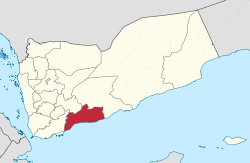
Abyan (Arabic: أَبْيَنْ ʾAbyan) is a governorate of Yemen. The Abyan region was historically part of the Fadhli Sultanate.[2] It was a base to the Aden-Abyan Islamic Army militant group.[2] Its capital is the city of Zinjibar. This governorate is noted for its agriculture, in particular the cultivation of date palms and animal husbandry.

Key Information

Recent history

[edit]

On 31 March 2011, Al Bawaba reported that Al-Qaeda in the Arabian Peninsula (AQAP) had declared Abyan an "Al-Qaeda Emirate in Yemen" after seizing control of the region.[3] The New York Times reported that those in control, while Islamic militants, are not in fact Al-Qaeda.[4] This takeover was confirmed on May 28.[5] Yemeni government forces launched an effort to re-establish control of the region, resulting in the Battle of Zinjibar.

In addition to Zinjibar, the towns of Jaʿār and Shuqrah were firmly under the control of the Islamists.[6] In early May 2012 the Yemeni Army and Southern Resistance began a major offensive to wrest control of the province from militants. Government forces captured Zinjibar and Jaar on 12 June after a month of heavy fighting. Militants reportedly retreated towards the town of Shuqrah.[7] In 2017, a military campaign led by Southern security forces and Southern resistance freed Abyan from the Islamist militants who escaped to their mountains in the Al Bayda and Marib Governorates.

Geography

[edit]

Adjacent governorates

[edit]

Districts

[edit]

Abyan Governorate is divided into the following 11 districts. These districts are further divided into sub-districts, and then further subdivided into villages:

Settlements

[edit]

Abu `amir  • Ad dirjaj • Ad diyyu • Ahl fashshash • Ahl fulays • Ahmad ash shaykh • Al `alam • Al bahitah • Al habil • Al hamam • Al hisn • Al jawl • Al kawd • Al kawr • Al khamilah • Al khawr • Al ma`ar • Al ma`jalah • Al mahal • Al mahlaj • Al makhzan al fawqi • Al makhzan al qa`i • Al masani` • Al qarn • Al qashabah • Al qurna`ah • An nashsh • Ar rawdah • Ar rawwa • As samn • As sarriyah • As suda' • Ash sha`bah • Ash sharaf • Ash sharqiyah • At tariyah • Ath thalib • `Ali hadi • `Amudiyah • `Arabah • `Arqub umm kubayr • `Aryab • `Aslan • `Awrumah • Ba tays • Ba zulayfah • Barkan • Bathan • Bayt samnah • Dor Salamah • Far`an • Faris • Ja`ar • Jahrah • Jawf umm maqbabah • Jiblat al faraj • Jiblat al waznah • Jiblat badr • Jirshab • Kabaran • Kadamat al faysh • Kawd al `abadil • Kawkab • Kawrat halimah • Khabt al aslum • Khanfar • Khuban • Kuwashi • Lawdar • Maghadih • Makrarah • Mansab • Maqasir • Maqdah • Marta`ah • Masadi`ah • Mishal • Mudiyah • Mukayras • Munab • Musaymir • Na`ab • Na`b • Namir • Naq`al • Qarn al wadi` • Qaryat ahl hidran • Qaryat husayn umm muhammad • Sakin ahl hidran • Sakin ahl mahathith • Sakin ahl sadah • Sakin ahl wuhaysh • Sakin hazm • Sakin wu`ays • Sayhan • Shams ad din • Shaykh `abdallah • Shaykh salim • Shubram • Shuqrah • Shurjan • Thirah • Wadibah • Zinjibar • Zughaynah

References

[edit]
Revisions and contributorsEdit on WikipediaRead on Wikipedia
from Grokipedia
Abyan Governorate is a province in southern situated along the coast of the , encompassing 11 districts with its administrative center at Zinjibar. Covering an area of approximately 16,943 square kilometers, the governorate features fertile valleys that support as the primary economic activity, including the cultivation of cereals, , date palms, and rearing, alongside . Despite its agricultural potential, which historically positioned Abyan as a key producer contributing about 5% of 's total agricultural output, the region has been repeatedly destabilized by jihadist insurgencies, particularly from (AQAP). AQAP exploited 's civil war vacuum to seize control of Zinjibar and surrounding areas in 2011, establishing a short-lived before Yemeni forces, backed by Saudi-led airstrikes, recaptured the territory in 2012. Ongoing AQAP operations, including suicide bombings and ambushes against government and separatist forces, persist as of 2025, perpetuating insecurity and hindering development in the governorate.

History

Pre-20th Century

The region encompassing modern Abyan Governorate hosted ancient settlements and cemeteries attributable to the Bronze and Stone Ages, underscoring early human habitation in its fertile delta and coastal zones. Archaeological excavations in al-Hasalah, identified as an early regional center, uncovered coins minted during the Sulayhid dynasty (1047–1138 CE), a period of Ismaili governance that extended influence across southern Yemen through administrative and military outposts. These findings reflect Abyan's integration into medieval Yemeni polities, where local rulers collected agrarian revenues from wadi-irrigated lands. A hoard of 16 late Roman solidi (dating circa 4th–5th centuries CE) and seven Aksumite gold coins recovered in Abyan attests to the area's role in transregional exchange networks linking the Roman Mediterranean, Aksumite Ethiopia, and South Arabian ports along the . Proximity to facilitated overland and maritime trade in commodities like and spices, with coastal settlements serving as waypoints for from interior highlands, though direct evidence of permanent trade depots in Abyan remains limited to numismatic traces rather than monumental . By the , tribal confederations solidified local authority, particularly under the Fadhli tribe, whose kinship-based structures governed land allocation in the Abyan Delta, where five prominent families held ownership over approximately one-quarter of arable territory. The emergent Fadhli Sultanate relied on alliances among sub-tribes for defense and resource control, maintaining autonomy amid nominal overlordship from broader Islamic entities like the Ottomans, whose influence in southern involved sporadic tribute demands rather than sustained administration. Fortifications such as Al-Qarah Castle in Yafa'a, originating in the early Islamic era and reinforced in the , exemplified these defensive priorities, overlooking strategic highland passes.

20th Century to Yemeni Unification

In the early , the Fadhli Sultanate, encompassing much of the Abyan region, signed protection treaties with Britain as one of the "Nine Cantons" within the Western Aden Protectorate, preserving local rulers' authority while securing British strategic interests along routes to the interior. The sultanate's strategic position bordering facilitated British control over trade and military access, with the Fadhli sheikhs retaining semi-autonomy in exchange for loyalty and suppression of raids. British administration emphasized economic exploitation of Abyan's fertile delta, launching the Abyan cotton project in 1943, which involved constructing irrigation systems, research centers like al-Koud, and access roads to boost long-staple production for export and amid demands. These developments, including dams and canals, transformed subsistence tribal into a semi-commercial sector but reinforced dependency on colonial oversight, with local sheikhs like those of the Fadhli tribe co-opted into management roles. After the withdrawal of British forces and the National Liberation Front's seizure of power, Abyan integrated into the People's Democratic Republic of Yemen (PDRY), where Marxist policies nationalized land and abolished sultanates, redistributing tribal holdings to state cooperatives and reducing Fadhli influence over agricultural resources. These reforms targeted Abyan's wadi-based farming, aiming to mechanize production but often disrupting customary water-sharing and tenancy systems, exacerbating rural discontent among tribes accustomed to autonomous control. By the late 1980s, amid PDRY economic decline and the 1986 intra-party clashes that killed thousands, Islamist opposition intensified against the regime's atheistic policies, including suppression of and promotion of secular , viewed by critics as eroding tribal-Islamic norms in areas like Abyan. Returnees from Afghan , including figures from Abyan, began organizing clandestinely, framing the PDRY as apostate and laying groundwork for militant responses to centralized control. Unification with on May 22, 1990, formally ended PDRY rule, designating Abyan a under the Republic of and shifting from socialist collectivism to a nominally unified tribal-federal framework.

Post-Unification Conflicts

Following Yemen's unification in 1990, the 1994 civil war between northern government forces and southern secessionists produced spillover effects in , which stayed under central control amid clashes involving tank battles in the . The conflict displaced approximately 8,000 residents in Abyan, contributing to localized humanitarian strains and movements. Post-war policies, including the forcible of thousands of southern civil and military personnel in Abyan and nearby areas, triggered protests that heightened tribal divisions and eroded trust in unified governance, as retirees faced economic marginalization without adequate reintegration support. These tensions intertwined with the rise of Islamist militancy, exemplified by the , a Sunni group formed in the mid-1990s that gained public notice in mid-1998 through statements pledging allegiance to and demanding implementation to topple the regime. Operating from rural Abyan bases, AAIA targeted perceived apostates, including attacks on Yemeni socialists ahead of parliamentary polls and a 1998 kidnapping of 16 Western tourists in the province, during which Yemeni forces' rescue operation resulted in four hostage deaths. Government responses escalated with raids and arrests; in December 2001, security forces killed AAIA leader Zein al-Abidine al-Mihdar near Abyan, fragmenting the group but underscoring underlying grievances over central authority's perceived favoritism toward northern elites. Compounding these dynamics were governance shortcomings, such as uneven resource distribution and weak local administration, which intensified disputes over water and land in Abyan's arid terrain. Annual violence tied to such conflicts claimed around 4,000 lives nationwide, with Abyan's tribal structures often mediating—or escalating—claims amid post-unification neglect of southern infrastructure. Agricultural shifts exacerbated scarcity: qat cultivation surged thirteenfold over decades, supplanting staple crops like , fruits, and vegetables while absorbing roughly 70% of , thereby straining food production and igniting inter-tribal rivalries over depleting aquifers. This economic distortion, driven by qat's quick profitability despite long-term unsustainability, amplified poverty and instability, setting causal pathways toward broader unrest by the late .

AQAP Insurgency and Civil War Era (2011–Present)

In spring 2011, (AQAP) capitalized on Yemen's political instability following protests against to seize territory in Abyan Governorate. Militants took control of Jaar in March, with AQAP's sharia official publicly claiming authority by mid-April, followed by a coordinated on Zinjibar, the provincial capital, on May 27 involving approximately 300 fighters. Operating as Ansar al-Shari'a, the group replaced fleeing government officials with local appointees, established courts to enforce strict Islamic law, and funded operations through rackets while providing subsidized goods and services to secure tentative local buy-in. Tribal responses varied, with some clans offering pragmatic cooperation amid , but others resisted; for instance, the Yemeni 25th Mechanized , bolstered by tribal elements, repelled an AQAP push near Zinjibar on 11. By mid-2011, AQAP had consolidated control over much of Abyan, using the territory for camps and plotting external attacks, though internal fractures and opportunistic alliances limited full depth. In June 2012, under President Abdrabbuh Mansur Hadi's direction, Yemeni army units allied with tribal militias launched a counteroffensive supported by U.S. drone strikes, recapturing Zinjibar and Jaar within weeks and forcing AQAP elements to withdraw to remote mountainous redoubts like al-Mahfad. The operations inflicted heavy militant casualties—U.S. estimated hundreds killed—and disrupted AQAP's urban foothold, though assessments noted incomplete eradication as fighters preserved weapons and regrouped, highlighting drones' tactical precision against leaders but limited strategic impact on the group's resilience. Post-2015, as the gripped northern Yemen, Abyan remained outside Houthi control, aligning instead with southern anti-Houthi factions initially tied to Hadi's government before the (STC), formed in 2017 with UAE backing, asserted dominance over local security belts. AQAP adapted by embedding in rural pockets, launching sporadic hits on STC targets, including a March 2022 bombing and suicide assault on a Security Belt in Jaar and a operation killing 27. Activity peaked in 2022—over 70% of AQAP's southern operations in Abyan and adjacent Shabwa—before declining amid STC sweeps and U.S. strikes on leaders in early 2023, yet resurgence persisted, as evidenced by an August 16, 2024, AQAP-claimed suicide bombing at an STC post that killed 16 soldiers and wounded 18.

Geography

Physical Features and Terrain

Abyan Governorate features a varied , beginning with narrow coastal plains fringing the that extend inland for roughly 30 to 50 kilometers before ascending into rugged, dissected mountains and highlands. These inland elevations rise from near along the coast to peaks exceeding 2,000 meters, with some summits reaching approximately 2,500 meters, creating steep gradients that channel seasonal runoff. The dominant hydrological element is Wadi Bana, a major ephemeral river system originating in the northern highlands and flowing southward to form an delta near the coast, which sustains intermittent oases through flood-deposited sediments. Soils in the wadi basins and delta primarily comprise alluvial fine sands and silts, which promote localized water infiltration but are susceptible to erosion and rapid saturation during rare intense rainfall events. This configuration heightens vulnerability to flash floods, as the steep funnels into high-velocity torrents that scour the alluvial plains and lowlands.

Climate and Environmental Conditions

Abyan Governorate is characterized by a hot desert climate (Köppen BWh), with average annual temperatures ranging from 24°C in to over 33°C in , and summer highs frequently reaching 35–40°C due to intense solar radiation and low humidity inland. Precipitation is extremely limited, averaging 50–100 mm annually, mostly occurring in short bursts during the kharif season from to , when southwesterly winds deliver sporadic moisture to coastal zones but fail to alleviate pervasive aridity. These kharif winds, while providing marginal coastal , intensify rates and exacerbate inland dryness, contributing to chronic water deficits that limit beyond wadi-dependent oases. Aquifers in the region, particularly in the Abyan Delta, face severe depletion from over-extraction for , with rates far outpaced by withdrawal—national trends show Yemen's aquifers dropping 1–2 meters annually in southern basins, rendering long-term precarious without recharge. Environmental pressures compound climatic harshness, including driven by fuelwood demand and , which has reduced vegetative cover and accelerated , as documented in assessments showing losing 3–5% of yearly to processes active in southern governorates like Abyan. Soil salinization from evaporative in low-rainfall deltas further degrades fertility, with satellite-derived analyses revealing expanding salt-affected areas tied to qat and crop monocultures, diminishing productive land and amplifying vulnerability to flash floods that erode during rare heavy rains.

Administrative Boundaries and Adjacent Areas

Abyan Governorate occupies a strategic position in southern , bordered to the north by Lahij and Dhale governorates, to the northeast by , to the east by , and to the west by , with its southern extent forming a coastline along the . These boundaries, established under 's post-unification administrative framework, lack significant natural barriers such as mountain ranges or rivers along much of the northern and eastern frontiers, consisting primarily of coastal plains transitioning to inland highlands. This topography has historically enabled fluid cross-border interactions, including tribal migrations and, in recent decades, the spillover of militant activities from adjacent regions like Shabwah, where (AQAP) has maintained footholds. The governorate's coastal access to the facilitates limited maritime , though its primary connectivity relies on the coastal highway linking Abyan to Port, approximately 50 kilometers westward. This route serves as a critical supply line for southern , transporting goods from Aden's import facilities to inland areas and supporting economic exchanges with Shabwah's oil and gas infrastructure to the east. However, the road's exposure in open terrain has rendered it susceptible to blockades and ambushes during conflicts, as documented in security incident logs from 2015 onward, exacerbating disruptions and enabling rapid militant incursions that affect stability across governorate lines. Abyan's adjacency to , Yemen's key economic hub, amplifies its role in regional trade networks, yet proximity to conflict-prone areas like Dhale and Shabwah heightens risks of diffusion, with armed groups exploiting porous borders for logistics and . Data from conflict monitoring indicates that over 40% of recorded events in Abyan since 2016 involved actors crossing from neighboring governorates, underscoring the boundaries' implications for both commercial flows and security challenges.

Administrative Divisions

Districts

Abyan Governorate comprises 11 districts, each administered by a district manager under the governorate's central and further subdivided into sub-districts (izlahs) and villages as per Yemen's official administrative mappings. These districts handle local functions including coordination, basic service delivery, and tribal dispute mediation, though effectiveness has been hampered by ongoing instability. The districts include Ahwar, Al Mahfad, Al Wade'a, Jayshan, Khanfir, Lawdar, Mudiyah, Rasad, Sarar, Sibah, and Zinjibar, with Zinjibar serving as the governorate capital and primary administrative hub. Coastal districts such as Ahwar, Khanfir, and Zinjibar occupy the flat alluvial plains along the , facilitating agriculture and trade routes, whereas interior districts like Al Mahfad and Mudiyah feature rugged mountainous terrain rising to elevations over 1,000 meters, supporting pastoral activities but limiting development. Population distributions vary significantly, with approximations from mid-2000s data indicating denser settlement in coastal areas; for instance, Khanfir recorded around 109,000 residents and Lawdar about 88,000 in the 2004 census, while sparser highland districts like Mudiyah had roughly 35,000. Conflict intensities differ across districts, with urban-coastal zones like Zinjibar and Ja'ar (associated with Jayshan in some mappings) experiencing high violence during the 2011–2012 AQAP offensive, when militants seized control of Ja'ar as a stronghold before counteroffensives with U.S. support reclaimed it by mid-2012; mountainous peripheries such as Al Mahfad saw comparatively lower direct combat but persistent low-level insurgent presence and tribal clashes amid the broader .

Major Settlements and Urban Centers

Zinjibar functions as the administrative capital and primary urban center of Abyan Governorate, situated on the southern coast along the approximately 55 kilometers east of . Captured by (AQAP) militants in late May 2011 after brief clashes with Yemeni security forces, the city served as a key base for the group's operations until its recapture by government troops in June 2012 during a coordinated offensive supported by local tribal militias and U.S. drone strikes. The battle resulted in significant destruction, with AQAP abandoning positions amid heavy fighting that displaced thousands, though hundreds of families began returning by July 2012 as stability partially returned. Jaar, positioned about 40 kilometers northeast of Zinjibar, emerged as a principal AQAP stronghold during the 2011 insurgency, hosting up to several hundred fighters who utilized the town's terrain for defensive operations and governance experiments, including the enforcement of strict interpretations such as public amputations and religious policing. AQAP maintained control for roughly one year before Yemeni forces, backed by airstrikes, drove out the militants in mid-June , marking a pivotal defeat for the group in southern . Post-liberation, Jaar saw gradual repopulation, with displaced residents returning alongside reports of lingering militant influence in surrounding rural pockets. Smaller settlements like Lawdar and Ahwar have played secondary roles as conflict-affected hubs, experiencing waves of internal displacement during the AQAP era and subsequent escalations. Lawdar, an inland district center, and Ahwar, near coastal districts, reported returns of displaced families after the 2012 offensives, though precise pre-war populations remain undocumented in available assessments; Abyan-wide figures indicate around 0.56 million residents circa , with urban nodes like these absorbing returnees amid ongoing insecurity. Urban-rural disparities persist, with centers such as Zinjibar and Jaar offering comparatively superior access to basic services like water and health facilities compared to peripheral villages, a pattern intensified by conflict damage and limited reconstruction.

Demographics

Population Statistics

As of April 2018, the total population of Abyan Governorate was estimated at 570,000, comprising host communities, internally displaced persons (IDPs), and returnees, with the figure reflecting net outflows from intensified conflict since 2011. This marked a reduction from earlier census-based projections around 500,000–600,000 prior to major escalations, driven by violence and displacement rather than natural decline. The governorate exhibits a pronounced youth bulge consistent with national patterns, where over 60% of Yemen's population is under age 25, exacerbating pressures on resources amid instability. rates, historically around 2–3% annually pre-war, have been curtailed by ongoing hostilities, with crude death rates elevated; Yemen's national stands at approximately 35 per 1,000 live births as of 2022, though conflict zones like Abyan likely experience higher rates due to disrupted healthcare and prevalence exceeding 20% among children under five in sampled districts. Displacement remains a key dynamic, with 34,176 IDPs recorded in 2018—about 6% of the total —primarily from adjacent conflict areas, alongside challenges for over 10,000 returnees facing reintegration barriers such as damaged . By 2020 assessments, IDP proportions held steady at around 6%, indicating tens of thousands affected into the mid-2020s, with IOM monitoring highlighting persistent mobility due to sporadic and returnee vulnerabilities in western districts. Yemen-wide, over 4.5 million remain internally displaced as of 2024, underscoring Abyan's role in broader patterns of protracted movement.

Ethnic, Tribal, and Social Composition

The population of Abyan Governorate consists predominantly of affiliated with , specifically the Shafi'i , with no significant ethnic minorities reported in the region. Major tribes include the Fadhli (also Fadhel), the largest in southern and centered in Zinjibar, alongside the Awalek confederation's lower Abyan subdivision, the Jadana tribe in northern areas like Mudiya, and the Awadhal (Audhalis) around Lawdar. Tribal organization revolves around sheikhdoms, where sheikhs—selected for mediation skills rather than strict heredity—resolve disputes via customary 'urf law, often incorporating shari'a elements and external guarantors to enforce verdicts through collective tribal accountability, thereby sustaining local order where state mechanisms falter. Such loyalties underpin stability by binding communities in mutual defense and resource pooling, as tribes comprise 70-80% of Yemen's rural populace reliant on indigenous conflict regulation, yet they also breed factionalism through sub-clan rivalries and uneven internal cohesion. Family and social norms derive from patrilineal descent, centering extended kin groups around male elders who uphold codes of honor and reciprocity, fostering resilience via informal welfare networks amid chronic insecurity, per analyses of southern tribal dynamics.

Economy

Agricultural Sector

Agriculture constitutes the primary economic activity in Abyan Governorate, with crop cultivation and rearing supporting rural livelihoods amid fertile delta soils and seasonal water flows. The region historically produced diverse staples such as , dates, , and , leveraging the Abyan Delta's alluvial plains for high-yield farming. At peak productivity, banana plantations alone generated 80 to 100 tons daily, employing numerous local workers before conflict escalation. remains a key , cultivated for in rain-fed and irrigated plots. Irrigation relies on spate systems channeling floodwaters from wadis like Hassan into the delta, supplemented by pumping for dry-season needs. The delta encompasses approximately 40,000 hectares of irrigable land, though over-extraction has strained aquifers, contributing to declining water tables. Proposed , such as the Hassan Dam with a 19.5 million cubic meter capacity, aims to capture wadi floods for controlled distribution, potentially boosting irrigated output. integration, including goats and camels for , , and draft power, enhances farm resilience, with herds grazing post-harvest residues. Pre-war cultivated area spanned about 60,684 hectares in 2010, representing roughly 4% of Yemen's total and underscoring Abyan's viability as a southern agricultural hub. However, ongoing conflict has undermined through landmine of fields, supply blockades restricting fertilizers and seeds, and disrupted labor markets, resulting in a 38% drop in cultivated land by 2024. data indicate widespread farm distress, with reduced input use exacerbating yield declines amid economic pressures. FAO-supported assessments confirm these trends, linking war-induced disruptions to below-average harvests and heightened food insecurity in rural Abyan.

Other Economic Activities and Challenges

Fishing constitutes a supplementary economic activity along Abyan's 100-kilometer coastline on the , where local communities in districts like Shuqrah rely on small-scale artisanal catches for subsistence and limited market sales, though production has declined due to fuel shortages and equipment degradation amid ongoing conflict. A dockyard facility in Abyan supports maintenance and distribution for regional fisheries, serving as a hub for coastal operators despite infrastructural constraints. activities are constrained but include intermittent overland routes connecting Abyan to the port of for goods exchange, hampered by security disruptions and poor road infrastructure. Remittances from , particularly in Gulf states, provide a critical economic buffer for Abyan households, supplementing local incomes amid depleted formal sectors, with national inflows estimated at over $2 billion annually pre-conflict but sustaining vulnerable populations through informal channels. in Abyan exceeds 30 percent among youth, surpassing national averages and intensified by protracted conflict that has displaced labor and destroyed opportunities since , according to modeled estimates reflecting war's impact on labor force participation. Porous maritime and land borders facilitate illicit economies, including of narcotics, arms, and , as documented in interceptions, with groups exploiting Abyan's proximity to unstable frontiers for revenue generation amid weak state oversight. These activities, while providing short-term livelihoods for some, perpetuate instability and undermine legitimate trade, per reports from international monitors.

Governance and Politics

Local Administration Structure

The local administration of Abyan Governorate is led by a governor appointed by the President of Yemen, who chairs the governorate's local council and supervises executive offices responsible for policy implementation and service coordination. The council comprises 22 members elected at the district level, plus the governor, though two seats have remained vacant since the last elections, and formal plenary meetings ceased after 2015 due to conflict disruptions. In their stead, an administrative board—including the governor, secretary general, and heads of standing committees—conducts irregular sessions to address urgent matters, reflecting a contraction in deliberative functions. Abyan is divided into 11 districts—Al Mahfad, Mudiyah, Jayshan, Lawdar, Sibah, Rasad, Sarar, Al Wade'a, Ahwar, Zinjibar (the capital), and Khanfir—each intended to have its own council of elected representatives overseeing local bylaws, budgeting, and development plans under the 2000 Local Authority Law. However, district councils have been effectively suspended since , with administrative boards assuming nominal control amid wartime fragmentation that has eroded central oversight and fiscal transfers from Sana'a. Local revenues, which constituted about 3% of the pre-war budget, have plummeted, forcing reliance on sporadic donor funding for basic operations. The civil war has amplified these gaps, with formal institutions struggling to maintain authority in a context of competing influences; official governors continue to be appointed, as with Saleh Ahmed Salem Al-Junaidi in June 2021 via presidential decree, but parallel southern entities have introduced local leadership layers that overlap with state functions. Where state mechanisms falter, tribal arbitration systems—rooted in customary ('urf) practices—predominate for dispute resolution, mediation, and resource allocation, often institutionalizing tribal sheikhs within residual council frameworks to bridge voids in law enforcement and social order. Service delivery underscores these deficiencies: health facilities, including public hospitals, operate at reduced capacity with shortages, covering needs for only a fraction of the estimated 88% of the (around 530,000 people as of recent assessments) requiring assistance, sustained primarily by international NGOs rather than local budgets. faces similar constraints, with 69 schools damaged by conflict as of 2018 per OCHA data, though partial continuity is maintained through donor-financed teacher salaries, highlighting the administration's dependence on external aid over endogenous capacity.

Role in Southern Yemeni Politics and Autonomy Movements

The (STC), established on May 11, 2017, has maintained predominant political influence in much of Abyan Governorate, particularly in districts like Ahwar, where its aligned forces hold security and administrative sway. This control underpins the STC's core platform of restoring independence or federal autonomy to the former People's Democratic Republic of Yemen territories, a position rooted in grievances over post-1990 unification marginalization, resource disparities, and perceived northern dominance. In contrast, the internationally recognized government under President Abd Rabbu Mansour , which includes pro-unity figures from Abyan itself, insists on preserving Yemen's through a federal framework, viewing STC as a threat to national cohesion amid the ongoing . Tensions have manifested in proxy disputes, with both sides criticized for governance shortcomings: the Hadi administration for and failure to address southern exclusion, and the STC for consolidating power at the expense of local pluralism. Tribal dynamics in Abyan reflect this divide, with some confederations forging pragmatic alliances with the STC to secure local stability against threats like Islamist militants, as seen in mediated truces that facilitated and prisoner exchanges. However, pro-unity tribal voices, often aligned with or loyalists, have resisted STC expansion, launching operations against its positions as recently as February 2023 and advocating integration within broader peace frameworks during UN- and Saudi-led talks. These pacts and counter-mobilizations highlight Abyan's role as a microcosm of southern fragmentation, where tribal has occasionally bridged divides but failed to resolve underlying claims. United Arab Emirates (UAE) patronage has been instrumental in bolstering STC capabilities in Abyan, providing financial, military, and logistical aid that enhanced local security against Houthi advances and rival factions since 2017. Analysts note this support yielded short-term stability gains, such as securing coastal areas and countering , yet it has exacerbated federalism erosion by sidelining Hadi-aligned structures and fueling Saudi-UAE divergences in policy. As of early 2025, UAE commitments continue to prioritize southern stabilization over unity restoration, complicating Riyadh Agreement implementations that aimed to integrate STC into a power-sharing cabinet.

Security and Conflicts

Historical Patterns of Violence

Tribal feuds in Abyan Governorate have long centered on disputes over scarce water and , exacerbated by the onset of deep-well drilling in the that rapidly depleted reserves across Yemen's agricultural regions, including Abyan's fertile wadis. These cycles of raids and retaliatory violence, documented in Yemen-wide analyses of , often arose from competing claims to rights and areas, with state subsidies for pumping further intensifying and inter-tribal tensions through the and . In Abyan specifically, such resource pressures manifested in protests against the extraction and piping of local to urban centers like , leading to acts of against pipelines as tribes asserted control over basin resources in violation of national water laws. The governorate's geography, characterized by narrow wadis such as Wadi Bana, facilitated these patterns by providing natural chokepoints and concealment for ambushes during raids, a dynamic evident in pre-unification southern conflicts involving entities like the Fadhli Sultanate and rival Al-Awaliq tribes. Post-1986 southern displacements and the 1990 unification amplified land encroachments, turning sporadic feuds into protracted cycles where initial water or boundary disputes escalated into blood vendettas, as seen in broader Yemeni tribal patterns where over 50% of conflicts originated from disagreements. These recurring conflicts have cumulatively undermined social trust within and between tribes, despite customary mechanisms resolving approximately 90% of local disputes nationally through and compensation (diya). In Abyan, incomplete resolutions—often due to unresolved killings or unequal resource access—perpetuated cycles of mistrust, as evidenced by persistent feuds over communal lands and points that hindered cooperative even before broader insurgencies. This erosion is reflected in lower effective rates for resource-linked , where geographic isolation of communities limited external mediation, fostering a legacy of over institutional trust.

Al-Qaeda in the Arabian Peninsula (AQAP) Presence and Operations

Al-Qaeda in the Arabian Peninsula (AQAP) established a significant foothold in Abyan Governorate during the 2011 Yemeni uprising, exploiting the power vacuum to capture key urban centers including Zinjibar and Jaar by mid-2012, where it imposed sharia-based governance and administrative controls over substantial rural and urban areas. The group leveraged tribal networks for , embedding operatives within clans disillusioned by corruption and neglect, while promoting rhetoric to frame itself as a purer alternative to Saleh-era , thereby gaining passive tolerance or active support from segments of the local population. This tribal integration enabled AQAP to sustain operations through familial ties and shared grievances, though alliances proved pragmatic and reversible based on local incentives rather than ideological alignment. AQAP financed its Abyan activities primarily through extortion rackets, localized taxation on commerce and agriculture in controlled zones, and high-value kidnappings of foreigners and aid workers, with the latter yielding ransoms funneled to weapons procurement and fighter stipends. In Jaar, for instance, the group operated quasi-governance extracting zakat-like levies from markets while using kidnapping proceeds—such as those from Western hostages—to bolster logistics, a model replicated in sporadic abductions like the February 2022 seizure of five UN personnel in Abyan. These revenue streams supported guerrilla tactics, including IED ambushes and assassinations targeting security outposts, which allowed AQAP to project control despite lacking full territorial dominance. Despite territorial losses in 2012, AQAP maintained resilient cells in Abyan's mountainous and rural districts, conducting persistent low-intensity attacks as tracked by event data through 2023, contradicting narratives of near-elimination by highlighting operational adaptability over outright defeat. U.S. assessments affirm this endurance, noting AQAP's exploitation of southern factional infighting to rebuild networks in Abyan amid the civil war. A notable demonstration occurred on August 16, 2024, when an AQAP suicide bomber struck a Southern Transitional Council (STC) base in Abyan, killing 16 fighters and underscoring the group's capacity for high-impact strikes against rivals. Such actions reflect strategic prioritization of survival through asymmetric warfare, with cells leveraging terrain familiarity and tribal safe havens to evade sweeps while probing for governance gaps.

Key Military Engagements and Counter-Terrorism Efforts

In May 2012, Yemeni government forces, bolstered by U.S. drone strikes and intelligence support alongside Saudi logistical aid, initiated a major offensive to reclaim territories in Abyan Governorate held by (AQAP) since mid-2011, including the provincial capital Zinjibar and the town of Jaar. The operation culminated in the retaking of Zinjibar on June 12, 2012, following intense urban combat that resulted in hundreds of AQAP fighters killed, alongside significant Yemeni military casualties estimated at over 100 soldiers. Despite these gains, AQAP remnants persisted in rural areas, exploiting local tribal networks and governance vacuums to evade full eradication, as evidenced by subsequent ambushes and IED attacks in the governorate. U.S. drone operations played a central role in the campaign, targeting AQAP leadership and operatives with precision strikes but incurring civilian in several instances. For example, a December 2013 strike in the Azan district of Abyan killed at least 14 civilians, including women and children, according to eyewitness accounts and investigations highlighting flawed intelligence and secondary explosions from stored munitions. In Jaar, multiple U.S. strikes during 2012-2015 disrupted AQAP camps and houses, yet AQAP exploited the 2015 Houthi advance to briefly recapture Jaar and Zinjibar in early December, underscoring the limits of airpower absent sustained ground presence. Yemeni and coalition claims of eliminations, such as AQAP's deputy emir Said al-Shihri in September 2012, were offset by AQAP's adaptive tactics, including dispersal into smaller cells that sustained operational capacity. Following the Southern Transitional Council's (STC) consolidation of influence in Abyan after , STC-affiliated security forces intensified patrols and clearing operations against AQAP hideouts, particularly along the governorate's wadis and coastal routes, asserting a reduction in militant mobility and attack frequency through enhanced local intelligence. STC reports highlighted operations in 2018-2020 that neutralized dozens of AQAP fighters and disrupted logistics, correlating with a temporary dip in high-profile assaults from prior peaks of over 20 annual incidents in 2016- to fewer than 10 in some subsequent years. However, AQAP demonstrated resilience via asymmetric tactics, including IEDs and suicide bombings targeting STC checkpoints, with data indicating persistent low-level violence—such as the 2022 uptick in ambushes—that undermined claims of comprehensive suppression and reflected ongoing insurgent recruitment amid factional rivalries.

Current Security Dynamics (as of 2025)

As of early 2025, Al-Qaeda in the Arabian Peninsula (AQAP) maintains a persistent presence in Abyan Governorate through hit-and-run tactics and suicide operations, exploiting frictions between Southern Transitional Council (STC)-affiliated forces and Yemeni government-aligned units to conduct targeted attacks on security personnel. In August 2024, AQAP claimed responsibility for a suicide bombing in Abyan that killed 16 STC fighters, demonstrating the group's ability to infiltrate checkpoints amid local power struggles. A more complex assault in October 2025, involving car bombs and suicide bombers, resulted in four Yemeni soldiers killed, underscoring AQAP's operational resilience in rural and transitional zones despite counter-pressure. These incidents reflect AQAP's strategy of asymmetric warfare, with over 250 political violence events recorded in southern Yemen since 2015, many concentrated in Abyan, according to ACLED data expansions through September 2025. Local militias, including the UAE-backed Security Belt Forces, have demonstrated variable effectiveness in containing threats, securing tribal hinterlands through patrols and intelligence but struggling against urban vulnerabilities where AQAP blends into civilian populations. ACLED territorial control maps as of January 2024 indicate fragmented control in Abyan, with STC forces dominating key districts like Zinjibar while AQAP retains influence in remote wadis, a persisting into 2025 amid 700 recorded violence-against-civilians events nationwide in 2024. Ongoing STC-government tensions, including disputes over and command structures, have hindered unified responses, allowing AQAP to regroup and launch sporadic raids, as noted in Sana'a Center analyses of southern dynamics through late 2024. Houthi incursions pose minimal direct threats to Abyan, limited to occasional drone overflights or indirect support for local proxies, as their primary focus remains northern fronts and Red Sea disruptions rather than southern expansion. No major Houthi ground advances into Abyan were reported in 2024-2025, with threats confined to border skirmishes in adjacent . Foreign interventions, particularly U.S. strikes, have shifted away from AQAP targets in Abyan toward Houthi infrastructure in northern , with no verified drone operations in the governorate since prior years; analysts debate their past utility in degrading AQAP leadership—evidenced by temporary operational pauses post-strikes—against risks of civilian casualties fueling , though 2024-2025 data shows sustained AQAP activity without corresponding U.S. action in the south.

References

Add your contribution
Related Hubs
User Avatar
No comments yet.