

Recent from talks
Activation function
Knowledge base stats:
Talk channels stats:
Members stats:
Activation function
In artificial neural networks, the activation function of a node is a function that calculates the output of the node based on its individual inputs and their weights. Nontrivial problems can be solved using only a few nodes if the activation function is nonlinear.
Modern activation functions include the logistic (sigmoid) function used in the 2012 speech recognition model developed by Hinton et al; the ReLU used in the 2012 AlexNet computer vision model and in the 2015 ResNet model; and the smooth version of the ReLU, the GELU, which was used in the 2018 BERT model.
Aside from their empirical performance, activation functions also have different mathematical properties:
These properties do not decisively influence performance, nor are they the only mathematical properties that may be useful. For instance, the strictly positive range of the softplus makes it suitable for predicting variances in variational autoencoders.
The most common activation functions can be divided into three categories: ridge functions, radial functions and fold functions.
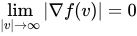
An activation function is saturating if . It is nonsaturating if . Non-saturating activation functions, such as ReLU, may be better than saturating activation functions, because they are less likely to suffer from the vanishing gradient problem.


Ridge functions are multivariate functions acting on a linear combination of the input variables. Often used examples include:[clarification needed]
In biologically inspired neural networks, the activation function is usually an abstraction representing the rate of action potential firing in the cell. In its simplest form, this function is binary—that is, either the neuron is firing or not. Neurons also cannot fire faster than a certain rate, motivating sigmoid activation functions whose range is a finite interval.
Hub AI
Activation function AI simulator
(@Activation function_simulator)
Activation function
In artificial neural networks, the activation function of a node is a function that calculates the output of the node based on its individual inputs and their weights. Nontrivial problems can be solved using only a few nodes if the activation function is nonlinear.
Modern activation functions include the logistic (sigmoid) function used in the 2012 speech recognition model developed by Hinton et al; the ReLU used in the 2012 AlexNet computer vision model and in the 2015 ResNet model; and the smooth version of the ReLU, the GELU, which was used in the 2018 BERT model.
Aside from their empirical performance, activation functions also have different mathematical properties:
These properties do not decisively influence performance, nor are they the only mathematical properties that may be useful. For instance, the strictly positive range of the softplus makes it suitable for predicting variances in variational autoencoders.
The most common activation functions can be divided into three categories: ridge functions, radial functions and fold functions.
An activation function is saturating if . It is nonsaturating if . Non-saturating activation functions, such as ReLU, may be better than saturating activation functions, because they are less likely to suffer from the vanishing gradient problem.
Ridge functions are multivariate functions acting on a linear combination of the input variables. Often used examples include:[clarification needed]
In biologically inspired neural networks, the activation function is usually an abstraction representing the rate of action potential firing in the cell. In its simplest form, this function is binary—that is, either the neuron is firing or not. Neurons also cannot fire faster than a certain rate, motivating sigmoid activation functions whose range is a finite interval.
Recent media