



Community hub
Recent from talks
Knowledge base stats:
Talk channels stats:
Members stats:
Advanced Tactical Fighter
The Advanced Tactical Fighter (ATF) was a program undertaken by the United States Air Force to develop a next-generation air superiority fighter to replace the F-15 Eagle. The proposed fighter was intended to counter emerging worldwide threats in the 1980s, including Soviet Sukhoi Su-27 and Mikoyan MiG-29 fighters under development, Beriev A-50 airborne warning and control systems (AWACS), and increasingly sophisticated surface-to-air missile systems. The program resulted in the F-22 Raptor.
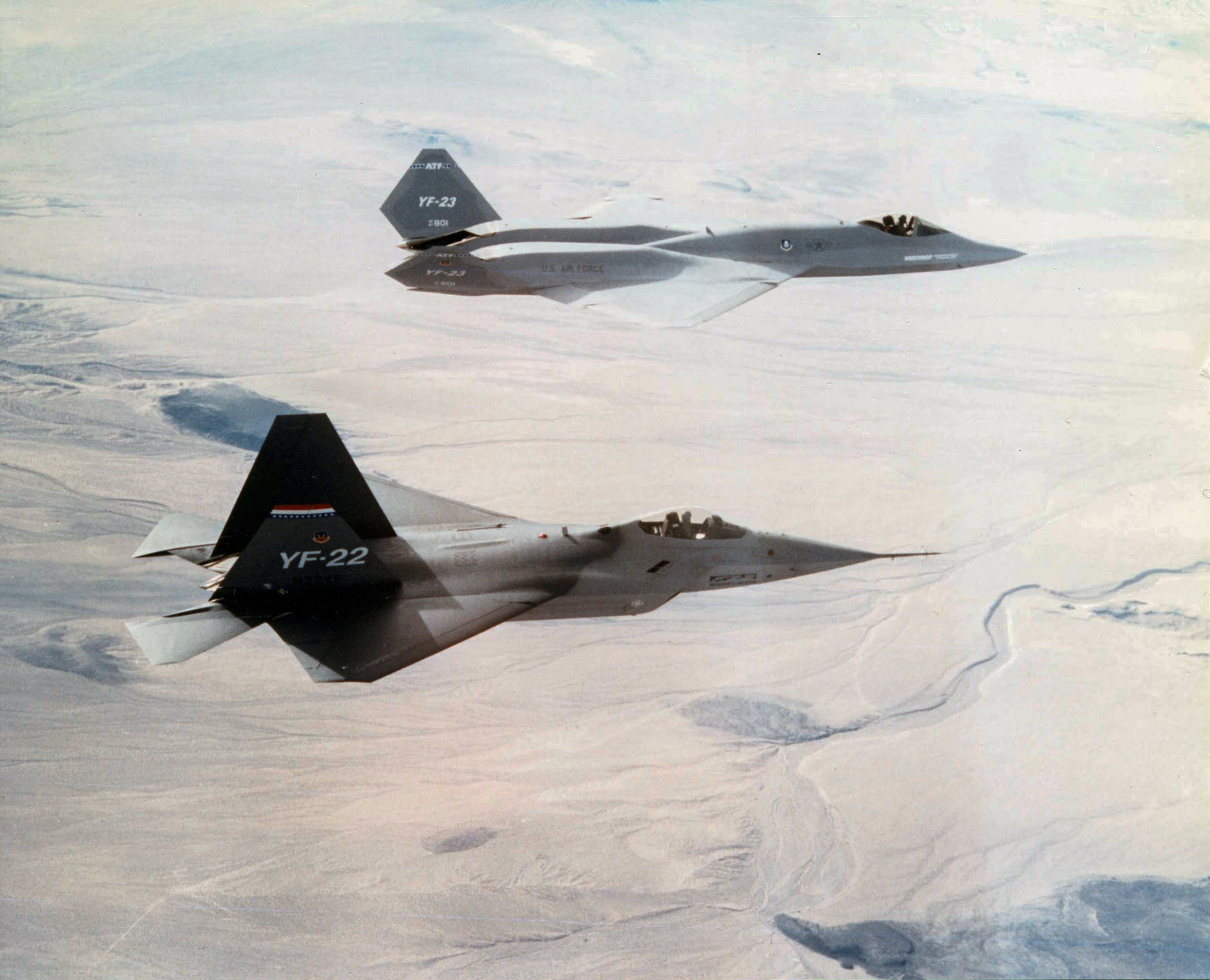
The ATF would make a leap in performance and capability by taking advantage of emerging technologies, including advanced avionics and flight control systems, more powerful propulsion systems, and stealth technology. Lockheed and Northrop were selected in 1986 as finalists for the program's Demonstration and Validation (Dem/Val) phase. They would be the lead contractors to respectively develop the YF-22 and YF-23 technology demonstrator prototypes, the associated avionics prototypes, and the system specification; the prototype aircraft were flight tested in 1990.
After evaluations, the Lockheed team was selected in 1991 for ATF full-scale development, or Engineering and Manufacturing Development (EMD). The Lockheed team developed their design into the F-22 Raptor, which first flew in 1997, for production and operational service; a naval version of the ATF (called NATF) was considered as an F-14 Tomcat replacement but was later canceled due to costs.
Although the term "Advanced Tactical Fighter" (ATF) appeared in U.S. Air Force (USAF) parlance as far back as 1971 to describe potential future tactical aircraft – initially an air-to-surface strike aircraft, the program that would eventually result in the F-22 began in 1981. This was motivated by the shift in U.S. military doctrine towards striking the enemy's rear echelons as eventually outlined in the AirLand Battle concept, as well as intelligence reports of multiple emerging worldwide threats emanating from the Soviet Union. Between 1977 and 1979, American satellite photographs of the "Ram-K" and "Ram-L" fighter prototypes at Ramenskoye air base in Zhukovsky—later identified as the Su-27 "Flanker" and the MiG-29 "Fulcrum" respectively—indicated that a new generation of Soviet fighter aircraft comparable to the recently introduced F-15 Eagle and F-16 Fighting Falcon would soon enter service.
Also concerning were Soviet reports of "look-down/shoot-down" capability being introduced on an advanced MiG-25 derivative, later revealed to be the MiG-31 "Foxhound", as well as the appearance of an Il-76-based airborne warning and control system (AWACS) aircraft called the A-50 "Mainstay". These systems, revealed in 1978, greatly reduced the effectiveness and survivability of low-altitude penetration. Furthermore, experience and data from the Vietnam War and the more recent 1973 Arab-Israeli war demonstrated the increasing lethality and sophistication of Soviet surface-to-air missile systems.
In 1981, the USAF began forming requirements for the ATF, eventually codenamed "Senior Sky". In May, a request for information (RFI) to the aerospace industry was published by the USAF Aeronautical Systems Division (ASD), followed by another RFI for the ATF propulsion systems in June. In response, a number of aerospace defense contractors provided design concepts for analysis by the ASD, which released their final report in December 1982. During this time, the ASD also established an internal ATF Concept Development Team (CDT) in October 1982 to manage concept development studies. As the ATF was still early in its requirements definition, including whether the aircraft should be focused on air-to-air or air-to-surface, there was great variety in the RFI responses; the submitted designs generally fell into four concepts.
Further analysis by ASD would indicate that the best air-to-surface concept was SLO, while the best air-to-air concept was SCM; neither N nor HI were rated highly, and responses from contractors also broadly agreed on avoiding either extremes of the quality-versus-quantity spectrum. Even with the variety of the submitted designs in the responses, the common areas among some or all the concepts were reduced observability, or stealth (though not to the extent of the final requirements), short takeoff and landing (STOL) and sustained supersonic cruise without afterburners, or supercruise. It was envisioned that the ATF would incorporate emerging technologies to include advanced alloys and composite material, advanced avionics and fly-by-wire flight control systems, higher power propulsion systems, and low-observable, or stealth technology.
By October 1983, the ATF Concept Development Team had become the System Program Office (SPO) led by Colonel Albert C. Piccirillo at Wright-Patterson Air Force Base. After discussions with Tactical Air Command (TAC), the CDT/SPO determined that the ATF should focus on air-to-air missions. The air-to-surface missions would be handled by the upgraded F-111 variants, the upcoming Dual-Role Fighter (DRF) (which would result in the F-15E Strike Eagle) as well as the then-classified F-117 Nighthawk ("Senior Trend"), while the air-to-air threat from the new Soviet fighters and AWACS remained. Additionally, a multirole aircraft designed to effectively perform both air-to-air and air-to-surface missions was considered too costly; as with ASD and industry responses, TAC did not want the ATF to be at either extremes of the quality-versus-quantity spectrum. The ATF would thus be a new air superiority fighter in the vein of the SCM concept with outstanding aerodynamic performance, and intended to replace the capability of the F-15 Eagle by the 1990s. In the potential scenario of a Soviet and Warsaw Pact invasion in Central Europe, the ATF was envisaged to launch from bases in central England and support the air-land battle by performing offensive and defensive counter-air missions against the Soviet air-to-air threats. This would then allow the DRF and other strike aircraft to perform air interdiction against ground targets.
Hub AI
Advanced Tactical Fighter AI simulator
(@Advanced Tactical Fighter_simulator)
Advanced Tactical Fighter
The Advanced Tactical Fighter (ATF) was a program undertaken by the United States Air Force to develop a next-generation air superiority fighter to replace the F-15 Eagle. The proposed fighter was intended to counter emerging worldwide threats in the 1980s, including Soviet Sukhoi Su-27 and Mikoyan MiG-29 fighters under development, Beriev A-50 airborne warning and control systems (AWACS), and increasingly sophisticated surface-to-air missile systems. The program resulted in the F-22 Raptor.
The ATF would make a leap in performance and capability by taking advantage of emerging technologies, including advanced avionics and flight control systems, more powerful propulsion systems, and stealth technology. Lockheed and Northrop were selected in 1986 as finalists for the program's Demonstration and Validation (Dem/Val) phase. They would be the lead contractors to respectively develop the YF-22 and YF-23 technology demonstrator prototypes, the associated avionics prototypes, and the system specification; the prototype aircraft were flight tested in 1990.
After evaluations, the Lockheed team was selected in 1991 for ATF full-scale development, or Engineering and Manufacturing Development (EMD). The Lockheed team developed their design into the F-22 Raptor, which first flew in 1997, for production and operational service; a naval version of the ATF (called NATF) was considered as an F-14 Tomcat replacement but was later canceled due to costs.
Although the term "Advanced Tactical Fighter" (ATF) appeared in U.S. Air Force (USAF) parlance as far back as 1971 to describe potential future tactical aircraft – initially an air-to-surface strike aircraft, the program that would eventually result in the F-22 began in 1981. This was motivated by the shift in U.S. military doctrine towards striking the enemy's rear echelons as eventually outlined in the AirLand Battle concept, as well as intelligence reports of multiple emerging worldwide threats emanating from the Soviet Union. Between 1977 and 1979, American satellite photographs of the "Ram-K" and "Ram-L" fighter prototypes at Ramenskoye air base in Zhukovsky—later identified as the Su-27 "Flanker" and the MiG-29 "Fulcrum" respectively—indicated that a new generation of Soviet fighter aircraft comparable to the recently introduced F-15 Eagle and F-16 Fighting Falcon would soon enter service.
Also concerning were Soviet reports of "look-down/shoot-down" capability being introduced on an advanced MiG-25 derivative, later revealed to be the MiG-31 "Foxhound", as well as the appearance of an Il-76-based airborne warning and control system (AWACS) aircraft called the A-50 "Mainstay". These systems, revealed in 1978, greatly reduced the effectiveness and survivability of low-altitude penetration. Furthermore, experience and data from the Vietnam War and the more recent 1973 Arab-Israeli war demonstrated the increasing lethality and sophistication of Soviet surface-to-air missile systems.
In 1981, the USAF began forming requirements for the ATF, eventually codenamed "Senior Sky". In May, a request for information (RFI) to the aerospace industry was published by the USAF Aeronautical Systems Division (ASD), followed by another RFI for the ATF propulsion systems in June. In response, a number of aerospace defense contractors provided design concepts for analysis by the ASD, which released their final report in December 1982. During this time, the ASD also established an internal ATF Concept Development Team (CDT) in October 1982 to manage concept development studies. As the ATF was still early in its requirements definition, including whether the aircraft should be focused on air-to-air or air-to-surface, there was great variety in the RFI responses; the submitted designs generally fell into four concepts.
Further analysis by ASD would indicate that the best air-to-surface concept was SLO, while the best air-to-air concept was SCM; neither N nor HI were rated highly, and responses from contractors also broadly agreed on avoiding either extremes of the quality-versus-quantity spectrum. Even with the variety of the submitted designs in the responses, the common areas among some or all the concepts were reduced observability, or stealth (though not to the extent of the final requirements), short takeoff and landing (STOL) and sustained supersonic cruise without afterburners, or supercruise. It was envisioned that the ATF would incorporate emerging technologies to include advanced alloys and composite material, advanced avionics and fly-by-wire flight control systems, higher power propulsion systems, and low-observable, or stealth technology.
By October 1983, the ATF Concept Development Team had become the System Program Office (SPO) led by Colonel Albert C. Piccirillo at Wright-Patterson Air Force Base. After discussions with Tactical Air Command (TAC), the CDT/SPO determined that the ATF should focus on air-to-air missions. The air-to-surface missions would be handled by the upgraded F-111 variants, the upcoming Dual-Role Fighter (DRF) (which would result in the F-15E Strike Eagle) as well as the then-classified F-117 Nighthawk ("Senior Trend"), while the air-to-air threat from the new Soviet fighters and AWACS remained. Additionally, a multirole aircraft designed to effectively perform both air-to-air and air-to-surface missions was considered too costly; as with ASD and industry responses, TAC did not want the ATF to be at either extremes of the quality-versus-quantity spectrum. The ATF would thus be a new air superiority fighter in the vein of the SCM concept with outstanding aerodynamic performance, and intended to replace the capability of the F-15 Eagle by the 1990s. In the potential scenario of a Soviet and Warsaw Pact invasion in Central Europe, the ATF was envisaged to launch from bases in central England and support the air-land battle by performing offensive and defensive counter-air missions against the Soviet air-to-air threats. This would then allow the DRF and other strike aircraft to perform air interdiction against ground targets.