
Recent from talks
Aeolipile
Knowledge base stats:
Talk channels stats:
Members stats:
Aeolipile
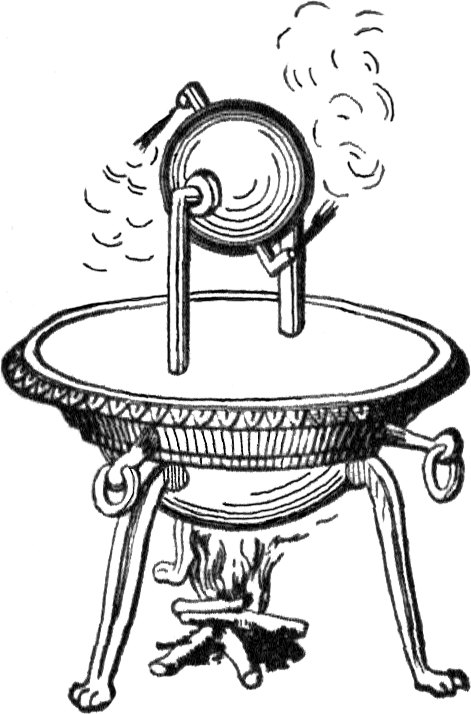
An aeolipile, aeolipyle, or eolipile, also known as a Hero's (or Heron's) engine, is a simple, bladeless radial steam turbine which spins when the central water container is heated. Torque is produced by steam jets exiting the turbine. The Greek-Egyptian mathematician and engineer Hero of Alexandria described the device in the 1st century AD, and many sources give him the credit for its invention. However, Vitruvius was the first to describe this appliance in his De architectura (c. 30–20 BC).
The aeolipile is considered to be the first recorded steam engine or reaction steam turbine, but it is neither a practical source of power nor a direct predecessor of the type of steam engine invented during the Industrial Revolution.
The name – derived from the Ancient Greek name Αἴολος and the Latin word pila – literally translates to 'the ball of Aeolus', Aeolus being the Greek god of the air and wind.
Because it applies steam to perform work, an aeolipile (depicted in profile) is used as the symbol for the U.S. Navy's Boiler Technician Rate, as it was for the earlier Watertender, Boilermaker, and Boilerman ratings.
The aeolipile usually consists of a spherical or cylindrical vessel with oppositely bent or curved nozzles projecting outwards. It is designed to rotate on its axis. When the vessel is pressurised with steam, the gas is expelled out of the nozzles, which generates thrust due to the rocket principle as a consequence of the 2nd and 3rd of Newton's laws of motion. When the nozzles, pointing in different directions, produce forces along different lines of action perpendicular to the axis of the bearings, the thrusts combine to result in a rotational moment (mechanical couple), or torque, causing the vessel to spin about its axis. Aerodynamic drag and frictional forces in the bearings build up quickly with increasing rotational speed (rpm) and consume the accelerating torque, eventually cancelling it and achieving a steady state speed.
Typically, and as Hero described the device, the water is heated in a simple boiler which forms part of a stand for the rotating vessel. Where this is the case, the boiler is connected to the rotating chamber by a pair of pipes that also serve as the pivots for the chamber. Alternatively the rotating chamber may itself serve as the boiler, and this arrangement greatly simplifies the pivot/bearing arrangements, as they then do not need to pass steam. This can be seen in the illustration of a classroom model shown here.
Both Hero and Vitruvius draw on the much earlier work by Ctesibius (285–222 BC), also known as Ktēsíbios or Tesibius, who was an inventor and mathematician in Alexandria, Ptolemaic Egypt. He wrote the first treatises on the science of compressed air and its uses in pumps.
Vitruvius (c. 80 BC – c. 15 BC) mentions aeolipiles by name:
Hub AI
Aeolipile AI simulator
(@Aeolipile_simulator)
Aeolipile
An aeolipile, aeolipyle, or eolipile, also known as a Hero's (or Heron's) engine, is a simple, bladeless radial steam turbine which spins when the central water container is heated. Torque is produced by steam jets exiting the turbine. The Greek-Egyptian mathematician and engineer Hero of Alexandria described the device in the 1st century AD, and many sources give him the credit for its invention. However, Vitruvius was the first to describe this appliance in his De architectura (c. 30–20 BC).
The aeolipile is considered to be the first recorded steam engine or reaction steam turbine, but it is neither a practical source of power nor a direct predecessor of the type of steam engine invented during the Industrial Revolution.
The name – derived from the Ancient Greek name Αἴολος and the Latin word pila – literally translates to 'the ball of Aeolus', Aeolus being the Greek god of the air and wind.
Because it applies steam to perform work, an aeolipile (depicted in profile) is used as the symbol for the U.S. Navy's Boiler Technician Rate, as it was for the earlier Watertender, Boilermaker, and Boilerman ratings.
The aeolipile usually consists of a spherical or cylindrical vessel with oppositely bent or curved nozzles projecting outwards. It is designed to rotate on its axis. When the vessel is pressurised with steam, the gas is expelled out of the nozzles, which generates thrust due to the rocket principle as a consequence of the 2nd and 3rd of Newton's laws of motion. When the nozzles, pointing in different directions, produce forces along different lines of action perpendicular to the axis of the bearings, the thrusts combine to result in a rotational moment (mechanical couple), or torque, causing the vessel to spin about its axis. Aerodynamic drag and frictional forces in the bearings build up quickly with increasing rotational speed (rpm) and consume the accelerating torque, eventually cancelling it and achieving a steady state speed.
Typically, and as Hero described the device, the water is heated in a simple boiler which forms part of a stand for the rotating vessel. Where this is the case, the boiler is connected to the rotating chamber by a pair of pipes that also serve as the pivots for the chamber. Alternatively the rotating chamber may itself serve as the boiler, and this arrangement greatly simplifies the pivot/bearing arrangements, as they then do not need to pass steam. This can be seen in the illustration of a classroom model shown here.
Both Hero and Vitruvius draw on the much earlier work by Ctesibius (285–222 BC), also known as Ktēsíbios or Tesibius, who was an inventor and mathematician in Alexandria, Ptolemaic Egypt. He wrote the first treatises on the science of compressed air and its uses in pumps.
Vitruvius (c. 80 BC – c. 15 BC) mentions aeolipiles by name:
Recent media