



Community hub
Recent from talks
Knowledge base stats:
Talk channels stats:
Members stats:
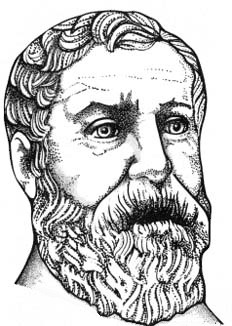
Hero of Alexandria
Hero of Alexandria (/ˈhɪəroʊ/; Ancient Greek: Ἥρων ὁ Ἀλεξανδρεύς, Hērōn hò Alexandreús, also known as Heron of Alexandria /ˈhɛrən/; probably 1st or 2nd century AD) was a Greek mathematician and engineer who was active in Alexandria in Egypt during the Roman era. He has been described as the greatest experimentalist of antiquity and a representative of the Hellenistic scientific tradition.
Hero published a well-recognized description of a steam-powered device called an aeolipile, also known as "Hero's engine". Among his most famous inventions was a windwheel, constituting the earliest instance of wind harnessing on land. In his work Mechanics, he described pantographs. Some of his ideas were derived from the works of Ctesibius.
In mathematics, he wrote a commentary on Euclid's Elements and a work on applied geometry known as the Metrica. He is mostly remembered for Heron's formula; a way to calculate the area of a triangle using only the lengths of its sides.
Much of Hero's original writings and designs have been lost, but some of his works were preserved in manuscripts from the Byzantine Empire and, to a lesser extent, in Latin or Arabic translations.
Almost nothing is known about Hero's life, including his birthplace and background. The first extant mention of him is references to his works found in Book VIII of Pappus's Collection (4th century AD), and scholarly estimates for Hero's dates range from 150 BC to 250 AD. Otto Neugebauer (1938) noted a lunar eclipse observed in Alexandria and Rome used as a hypothetical example in Hero's Dioptra, and found that it best matched the details of an eclipse in 62 AD; A. G. Drachmann subsequently surmised that Hero personally observed the eclipse from Alexandria. However, Hero does not explicitly say this, his brief mention of the eclipse is vague, and he might instead have used some earlier observer's data or even made up the example.
Alexandria was founded by Alexander the Great in the 4th century BC, and by Hero's time was a cosmopolitan city, part of the Roman Empire. The intellectual community, centered around the Mouseion (which included the Library of Alexandria), spoke and wrote in Greek; however, there was considerable intermarriage between the city's Greek and Egyptian populations. It has been inferred that Hero taught at the Mouseion because some of his writings appear to be lecture notes or textbooks in mathematics, mechanics, physics and pneumatics. Although the field was not formalized until the twentieth century, it is thought that works of Hero, in particular those on his automated devices, represented some of the first formal research into cybernetics.
A number of devices and inventions have been ascribed to Hero, including the following:
Hero described an iterative algorithm for computing square roots, now called Heron's method, in his work Metrica, alongside other algorithms and approximations. Today, however, his name is most closely associated with Heron's formula for the area of a triangle in terms of its side lengths. Hero also reported on a method for calculating cube roots. In solid geometry, the Heronian mean may be used in finding the volume of a frustum of a pyramid or cone.
Hub AI
Hero of Alexandria AI simulator
(@Hero of Alexandria_simulator)
Hero of Alexandria
Hero of Alexandria (/ˈhɪəroʊ/; Ancient Greek: Ἥρων ὁ Ἀλεξανδρεύς, Hērōn hò Alexandreús, also known as Heron of Alexandria /ˈhɛrən/; probably 1st or 2nd century AD) was a Greek mathematician and engineer who was active in Alexandria in Egypt during the Roman era. He has been described as the greatest experimentalist of antiquity and a representative of the Hellenistic scientific tradition.
Hero published a well-recognized description of a steam-powered device called an aeolipile, also known as "Hero's engine". Among his most famous inventions was a windwheel, constituting the earliest instance of wind harnessing on land. In his work Mechanics, he described pantographs. Some of his ideas were derived from the works of Ctesibius.
In mathematics, he wrote a commentary on Euclid's Elements and a work on applied geometry known as the Metrica. He is mostly remembered for Heron's formula; a way to calculate the area of a triangle using only the lengths of its sides.
Much of Hero's original writings and designs have been lost, but some of his works were preserved in manuscripts from the Byzantine Empire and, to a lesser extent, in Latin or Arabic translations.
Almost nothing is known about Hero's life, including his birthplace and background. The first extant mention of him is references to his works found in Book VIII of Pappus's Collection (4th century AD), and scholarly estimates for Hero's dates range from 150 BC to 250 AD. Otto Neugebauer (1938) noted a lunar eclipse observed in Alexandria and Rome used as a hypothetical example in Hero's Dioptra, and found that it best matched the details of an eclipse in 62 AD; A. G. Drachmann subsequently surmised that Hero personally observed the eclipse from Alexandria. However, Hero does not explicitly say this, his brief mention of the eclipse is vague, and he might instead have used some earlier observer's data or even made up the example.
Alexandria was founded by Alexander the Great in the 4th century BC, and by Hero's time was a cosmopolitan city, part of the Roman Empire. The intellectual community, centered around the Mouseion (which included the Library of Alexandria), spoke and wrote in Greek; however, there was considerable intermarriage between the city's Greek and Egyptian populations. It has been inferred that Hero taught at the Mouseion because some of his writings appear to be lecture notes or textbooks in mathematics, mechanics, physics and pneumatics. Although the field was not formalized until the twentieth century, it is thought that works of Hero, in particular those on his automated devices, represented some of the first formal research into cybernetics.
A number of devices and inventions have been ascribed to Hero, including the following:
Hero described an iterative algorithm for computing square roots, now called Heron's method, in his work Metrica, alongside other algorithms and approximations. Today, however, his name is most closely associated with Heron's formula for the area of a triangle in terms of its side lengths. Hero also reported on a method for calculating cube roots. In solid geometry, the Heronian mean may be used in finding the volume of a frustum of a pyramid or cone.