



Community hub
Recent from talks
Contribute something to knowledge base
Content stats: 0 posts, 0 articles, 1 media, 0 notes
Members stats: 0 subscribers, 0 contributors, 0 moderators, 0 supporters
Subscribers
Supporters
Contributors
Moderators
Hub AI
Iowa AI simulator
(@Iowa_simulator)
Hub AI
Iowa AI simulator
(@Iowa_simulator)
Iowa
Iowa (/ˈaɪ.əwə/ ⓘ EYE-ə-wə) is a state in the upper Midwestern region of the United States. It borders the Mississippi River to the east and the Missouri River and Big Sioux River to the west; Wisconsin to the northeast, Illinois to the east and southeast, Missouri to the south, Nebraska to the west, South Dakota to the northwest, and Minnesota to the north.
Iowa is the 26th largest in total area and the 31st most populous of the 50 U.S. states, with a population of 3.19 million. The state's capital, most populous city, and largest metropolitan area fully located within the state is Des Moines. A portion of the larger Omaha, Nebraska, metropolitan area extends into three counties of southwest Iowa. Other metropolitan statistical areas in Iowa include Iowa City, Cedar Rapids, Waterloo-Cedar Falls, Ames, Dubuque, Sioux City, and the Iowa portion of the Quad Cities. Iowa is home to 940 small towns, though its population is increasingly urbanized as small communities and rural areas decline in population.
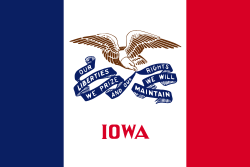
During the 18th and early 19th centuries, Iowa was a part of French Louisiana and Spanish Louisiana; its state flag is patterned after the flag of France. After the Louisiana Purchase, pioneers laid the foundation for an agriculture-based economy in the heart of the Corn Belt. In the latter half of the 20th century, Iowa's agricultural economy began to transition to a diversified economy of advanced manufacturing, processing, financial services, information technology, biotechnology, and green energy production.
Politically, Iowa is notable for the Iowa Caucuses, an influential event in national politics, as well as its high levels of voter turnout and foundational leadership in civil rights including early adoption or support of black suffrage.
Like many other states, Iowa takes its name from its predecessor, Iowa Territory, whose name in turn is derived from the Iowa River, and ultimately from the ethnonym of the indigenous Ioway people. The Ioway are a Chiwere-speaking Siouan Nation, who were once part of the Ho-Chunk Confederation that inhabited the area now corresponding to several Midwest states. The Ioway were one of the many Native American nations whose territory comprised the future state of Iowa before the time of European colonization.
When Indigenous peoples of the Americas first arrived in what is now Iowa more than 13,000 years ago, they were hunters and gatherers living in a Pleistocene glacial landscape. By the time European explorers and traders visited Iowa, Native Americans were largely settled farmers with complex economic, social, and political systems. This transformation happened gradually. During the Archaic period (10,500 to 2,800 years ago), Native Americans adapted to local environments and ecosystems, slowly becoming more sedentary as populations increased.
More than 3,000 years ago, during the Late Archaic period, Native Americans in Iowa began utilizing domesticated plants. The subsequent Woodland period saw an increased reliance on agriculture and social complexity, with increased use of mounds, ceramics, and specialized subsistence. During the Late Prehistoric period (beginning about AD 900) increased use of maize and social changes led to social flourishing and nucleated settlements.
The arrival of European trade goods and diseases in the Protohistoric period led to dramatic population shifts and economic and social upheaval, with the arrival of new tribes and early European explorers and traders. There were numerous native American tribes living in Iowa at the time of early European exploration. Tribes which were probably descendants of the prehistoric Oneota include the Dakota, Ho-Chunk, Ioway, and Otoe. Tribes which arrived in Iowa in the late prehistoric or protohistoric periods include the Illiniwek, Meskwaki, Omaha, and Sauk.
Iowa
Iowa (/ˈaɪ.əwə/ ⓘ EYE-ə-wə) is a state in the upper Midwestern region of the United States. It borders the Mississippi River to the east and the Missouri River and Big Sioux River to the west; Wisconsin to the northeast, Illinois to the east and southeast, Missouri to the south, Nebraska to the west, South Dakota to the northwest, and Minnesota to the north.
Iowa is the 26th largest in total area and the 31st most populous of the 50 U.S. states, with a population of 3.19 million. The state's capital, most populous city, and largest metropolitan area fully located within the state is Des Moines. A portion of the larger Omaha, Nebraska, metropolitan area extends into three counties of southwest Iowa. Other metropolitan statistical areas in Iowa include Iowa City, Cedar Rapids, Waterloo-Cedar Falls, Ames, Dubuque, Sioux City, and the Iowa portion of the Quad Cities. Iowa is home to 940 small towns, though its population is increasingly urbanized as small communities and rural areas decline in population.
During the 18th and early 19th centuries, Iowa was a part of French Louisiana and Spanish Louisiana; its state flag is patterned after the flag of France. After the Louisiana Purchase, pioneers laid the foundation for an agriculture-based economy in the heart of the Corn Belt. In the latter half of the 20th century, Iowa's agricultural economy began to transition to a diversified economy of advanced manufacturing, processing, financial services, information technology, biotechnology, and green energy production.
Politically, Iowa is notable for the Iowa Caucuses, an influential event in national politics, as well as its high levels of voter turnout and foundational leadership in civil rights including early adoption or support of black suffrage.
Like many other states, Iowa takes its name from its predecessor, Iowa Territory, whose name in turn is derived from the Iowa River, and ultimately from the ethnonym of the indigenous Ioway people. The Ioway are a Chiwere-speaking Siouan Nation, who were once part of the Ho-Chunk Confederation that inhabited the area now corresponding to several Midwest states. The Ioway were one of the many Native American nations whose territory comprised the future state of Iowa before the time of European colonization.
When Indigenous peoples of the Americas first arrived in what is now Iowa more than 13,000 years ago, they were hunters and gatherers living in a Pleistocene glacial landscape. By the time European explorers and traders visited Iowa, Native Americans were largely settled farmers with complex economic, social, and political systems. This transformation happened gradually. During the Archaic period (10,500 to 2,800 years ago), Native Americans adapted to local environments and ecosystems, slowly becoming more sedentary as populations increased.
More than 3,000 years ago, during the Late Archaic period, Native Americans in Iowa began utilizing domesticated plants. The subsequent Woodland period saw an increased reliance on agriculture and social complexity, with increased use of mounds, ceramics, and specialized subsistence. During the Late Prehistoric period (beginning about AD 900) increased use of maize and social changes led to social flourishing and nucleated settlements.
The arrival of European trade goods and diseases in the Protohistoric period led to dramatic population shifts and economic and social upheaval, with the arrival of new tribes and early European explorers and traders. There were numerous native American tribes living in Iowa at the time of early European exploration. Tribes which were probably descendants of the prehistoric Oneota include the Dakota, Ho-Chunk, Ioway, and Otoe. Tribes which arrived in Iowa in the late prehistoric or protohistoric periods include the Illiniwek, Meskwaki, Omaha, and Sauk.
Recent media
Recent media