


Community hub
Recent from talks
Contribute something
Nothing was collected or created yet.
Agrimonia
View on Wikipedia
| Agrimonia | |
|---|---|

| |
| Agrimonia eupatoria | |
Scientific classification 
| |
| Kingdom: | Plantae |
| Clade: | Tracheophytes |
| Clade: | Angiosperms |
| Clade: | Eudicots |
| Clade: | Rosids |
| Order: | Rosales |
| Family: | Rosaceae |
| Subfamily: | Rosoideae |
| Tribe: | Sanguisorbeae |
| Subtribe: | Agrimoniinae |
| Genus: | Agrimonia Tourn. ex L. |
| Species | |
|
About 15 species; see text | |
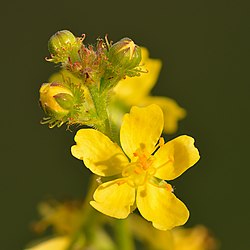
Agrimonia (from the Greek ἀργεμώνη),[1] commonly known as agrimony, is a genus of 12–15 species of perennial herbaceous flowering plants in the family Rosaceae,[1] native to the temperate regions of the Northern Hemisphere, with one species also in Africa. The species grow to between 0.5–2 m (1.6–6.6 ft) tall, with interrupted pinnate leaves, and tiny yellow flowers borne on a single (usually unbranched) spike.
Agrimonia species are used as food plants by the larvae of some Lepidoptera species including grizzled skipper (recorded on A. eupatoria) and large grizzled skipper.
Species
[edit]- Agrimonia eupatoria – Common agrimony (Europe, Asia, Africa)
- Agrimonia gryposepala – Common agrimony, tall hairy agrimony (North America)
- Agrimonia incisa – Incised agrimony (North America)
- Agrimonia coreana – Korean agrimony (eastern Asia)
- Agrimonia microcarpa – Smallfruit agrimony (North America)
- Agrimonia nipponica – Japanese agrimony (eastern Asia)
- Agrimonia parviflora – Harvestlice agrimony (North America)
- Agrimonia pilosa – Hairy agrimony (eastern Europe, Asia)
- Agrimonia procera – Fragrant agrimony (Europe)
- Agrimonia pubescens – Soft or downy agrimony (North America)
- Agrimonia repens – Short agrimony (southwest Asia)
- Agrimonia rostellata – Beaked agrimony (North America)
- Agrimonia striata – Roadside agrimony (North America)
Uses
[edit]In ancient times, it was used for foot baths and tired feet.[2] Agrimony has a long history of medicinal use. The English poet Michael Drayton once hailed it as an "all-heal" and through the ages it was considered a panacea.[citation needed] The ancient Greeks used agrimony to treat eye ailments, and it was made into brews for diarrhea and disorders of the gallbladder, liver, and kidneys.[3] The Anglo-Saxons boiled agrimony in milk and used it to improve erectile performance.[4] They also made a solution from the leaves and seeds for healing wounds; this use continued through the Middle Ages and afterward, in a preparation called eau d'arquebusade, or "musket-shot water".[5] It has been added to tea as a spring tonic.[2] According to the German Federal Commission E (Phytotherapy)-Monograph "Agrimony", published 1990, the internal application area is "mild, nonspecific, acute diarrhea" and "inflammation of oral and pharyngeal mucosa" and the external application "mild, superficial inflammation of the skin".[6]
Folklore
[edit]Traditional British folklore states that if a sprig of Agrimonia eupatoria was placed under a person's head, they would sleep until it was removed.[7]
See also
[edit]- Aremonia agrimonoides (Bastard-agrimony, of the related genus Aremonia)
- Eupatorium cannabinum (Hemp-agrimony)
References
[edit]- ^ a b Chisholm, Hugh, ed. (1911). . Encyclopædia Britannica. Vol. 1 (11th ed.). Cambridge University Press. p. 424.
- ^ a b C. F. Leyel (1946). Compassionate Herbs. Faber and Faber Limited.
- ^ Galen (Κλαύδιος Γαληνός), De methodo medendi 13.920K. doi:10.4159/DLCL.galen-method_medicine.2011.
- ^ Lacey, R. and Danziger, D. (1999) In The Year 1000 London: Little, Brown & Co, p. 126
- ^ Grieve, Margaret (1931). A Modern Herbal (Hypertext version ed.). Hafner Pub. pp. Agrimony. Retrieved 14 December 2021.
- ^ German Federal Commission E Monographs (Phytotherapy): Monograph Agrimony (Agrimoniae herba). Bundesanzeiger. March 13, 1990. – www.heilpflanzen-welt.de.
- ^ Encyclopedia of Folk Medicine: Old World and New World Traditions by Gabrielle Hatfield, p.310
- Eriksson, Torsten; Hibbs, Malin S.; Yoder, Anne D.; Delwiche, Charles F.; Donoghue, Michael J. (2003). "The Phylogeny of Rosoideae (Rosaceae) Based on Sequences of the Internal Transcribed Spacers (ITS) of Nuclear Ribosomal DNA and the TRNL/F Region of Chloroplast DNA". International Journal of Plant Sciences. 164 (2): 197–211. Bibcode:2003IJPlS.164..197E. doi:10.1086/346163. S2CID 22378156.
External links
[edit]

Agrimonia
View on GrokipediaTaxonomy
Etymology
The genus name Agrimonia derives from the Greek word argemōnē (ἀργεμώνη), which referred to plants believed to heal eye ailments, such as cataracts, or to those with properties resembling the medicinal prickly poppy (Papaver argemone).[8][9] This etymology traces back to ancient herbalists like Dioscorides, who in his 1st-century De Materia Medica described a similar plant under the name eupatorion for its therapeutic uses, though the argemōnē association specifically linked it to ocular remedies.[10] In Latin texts, the name evolved as agrimonia, with Pliny the Elder referencing it in his Natural History (circa 77 CE) as a plant of "princely authority" valued for its broad medicinal properties, including treatments for various ailments, though eye-related uses were implied through Greek traditions.[9]80027-6.pdf) The common name "agrimony" entered English via Old English agrimonia, a direct borrowing from Latin, and was documented in early European herbals like those of the 16th-century physician William Turner, where it was praised for its astringent and healing qualities in folk medicine.[8][9] One species, Agrimonia eupatoria, bears the specific epithet eupatoria in reference to Mithridates VI Eupator, the king of Pontus who reportedly used the plant in an antidote against poisons.[9]Classification
Agrimonia is classified within the kingdom Plantae, phylum Tracheophyta, class Magnoliopsida, order Rosales, family Rosaceae, subfamily Rosoideae, tribe Sanguisorbeae, and subtribe Agrimoniinae.[11] [2] Historically, Agrimonia was distinguished from related genera such as Potentilla within Rosaceae based on morphological differences, particularly fruit structure; while Potentilla species typically produce achenes, Agrimonia features distinctive bur-like fruits with hooked bristles that aid in dispersal, leading to its separation into a distinct genus early in taxonomic history.[12] This separation was reinforced as classifications evolved from broad morphological groupings to more refined tribal arrangements in the 20th century.[13] Phylogenetic analyses using molecular data, including sequences from the internal transcribed spacer (ITS) region of nuclear ribosomal DNA (rDNA) and the trnL/trnF region of chloroplast DNA, confirm Agrimonia's placement in Sanguisorbeae and reveal close relationships to genera like Sanguisorba and Poterium.[13] These studies demonstrate that Agrimonia forms a well-supported clade within the tribe, with Sanguisorba and Poterium branching early in the Sanguisorbinae subtribe, highlighting shared evolutionary history driven by polyploidization events.[14] [13]Description
Morphology
Agrimonia species exhibit a perennial herbaceous growth habit, producing erect or ascending stems that typically measure 0.3–2 meters in height and are often covered with a mix of eglandular and glandular hairs, giving them a pubescent appearance.[1][15] The leaves are alternate and pinnately compound, with blades narrowly obovate to elliptic and featuring 3–19 major leaflets that are serrate to dentate along the margins; stipules are adnate to the petiole base, often forming a sheathing or winged structure around the stem.[1][15][16] The inflorescence is a terminal raceme, often spicate and 9–120-flowered, bearing small yellow blooms 5–10 mm in diameter; each flower has five obovate to oval petals, five triangular sepals, and 5–20 stamens inserted on a glandular disk, with the hypanthium being stipitate and hemispheric to obconic.[1][15] Following pollination, the hypanthium persists and enlarges into a bur-like fruit structure enclosing one or two top-shaped achenes, armed with hooked bristles in 2–5 rows that facilitate animal dispersal by adhering to fur or clothing.[1][15][16] The root system is rhizomatous, consisting of slender fibrous roots that may include thickened fusiform or oblong portions, providing structural support and nutrient absorption.[1] While morphological traits are generally consistent across the genus, variations in stem height and leaflet number occur among species, such as taller forms in A. gryposepala reaching up to 2 meters.[1]Reproduction
Agrimonia species produce hermaphroditic flowers that typically bloom during the summer period from June to August in the Northern Hemisphere. These small, yellow blooms are arranged in slender, terminal racemes and offer nectar to attract a variety of insect pollinators, including bees, butterflies, and flies. The floral structure, featuring five petals and numerous stamens, facilitates effective pollen transfer by these visitors.[17][18][1] Pollination in Agrimonia is primarily entomophilous, relying on insects for cross-pollination, though the genus is self-compatible, permitting facultative autogamy when pollinators are scarce. Self-incompatibility has been noted in certain species within the Rosaceae family, which can promote outcrossing in related taxa, but Agrimonia generally supports both self- and cross-fertilization to ensure reproductive success. Following successful pollination, fruits develop as achenes, each enclosed in a persistent, bristly hypanthium.[1][19] The mature fruits form distinctive burrs with hooked sepals that enable epizoochory as the primary seed dispersal mechanism; these structures readily adhere to animal fur, feathers, or human clothing, allowing seeds to be transported over distances up to several kilometers depending on the mobility of the dispersal agent. This adaptation enhances gene flow across fragmented habitats. Agrimonia propagation occurs mainly through sexual reproduction via these seeds, which exhibit dormancy and require stratification for germination, but some species also spread vegetatively through rhizomes, supporting clonal colony formation.[1][20][17]Distribution and Habitat
Geographic Range
The genus Agrimonia is primarily native to the temperate and subtropical zones of the Northern Hemisphere, with additional native distributions in parts of the Southern Hemisphere including southern Africa, South America, and Indonesia; its range spans Europe, Asia, North America, Africa, and South America.[2] In Europe, it occurs from northern regions including Scandinavia (Denmark, Finland, Norway, Sweden) to southern Mediterranean areas (Greece, Italy, Portugal, Spain).[2] The genus extends across Asia from Siberia (Altay, Krasnoyarsk, Yakutiya regions) eastward to Japan and southward through the Himalayas (East and West Himalaya, Nepal).[2] In North America, species are found primarily in the eastern and central United States (from Maine to Texas) and extend into Mexico (central, gulf, and southeastern regions).[2] In the Southern Hemisphere, native species occur in southern Africa (e.g., Cape Provinces, KwaZulu-Natal) and South America (e.g., South Brazil).[2] The genus includes approximately 20 species, with notable diversity in eastern Asia, including species such as A. pilosa, A. asiatica, and A. nipponica.[2] Some species, including A. eupatoria, have been introduced outside their native range, notably to Australia (New South Wales) and New Zealand, where they occasionally establish in disturbed habitats.[2] Fossil records indicate historical range expansions for Agrimonia species following post-glacial periods, with macrofossils and pollen evidence from middle Pleistocene deposits in central Europe, such as the Schöningen site in Germany, documenting their presence in steppe-like vegetation during interglacial phases.[21] As of 2025, the geographic range of Agrimonia faces threats from habitat fragmentation due to agricultural expansion and urbanization, particularly in temperate grasslands and forest edges; however, no widespread extinctions have been reported, and most species are assessed as Least Concern by the IUCN.[22][6]Ecological Preferences
Agrimonia species typically inhabit open to semi-open environments, including grasslands, roadsides, woodland edges, and disturbed sites, where they experience full sun to partial shade. These conditions support their growth as perennial herbs adapted to a range of light levels, from direct sunlight in prairies and ditches to dappled shade in forest understories.[23][5][24] They favor well-drained soils, such as sandy loams, silts, gravels, or clays, with neutral to alkaline pH levels (approximately 6.5–8.0), though some species tolerate mildly acidic conditions down to pH 6.0; examples include calcareous loams in mesic forests for woodland agrimony (A. rostellata) and loamy substrates in wetlands for swamp agrimony (A. parviflora). These plants exhibit tolerance to nutrient-poor and depleted soils, often colonizing nitrogen-limited substrates like waste grounds and rocky margins, but they are generally sensitive to prolonged waterlogging, preferring sites with minimal seasonal flooding except in moisture-adapted species.[23][25][26][24][5] In ecosystems, Agrimonia functions as a pioneer species in disturbed habitats, such as roadsides and crop field margins, where it helps stabilize soil and facilitate early succession by occupying open, stressed niches. It provides nectar and pollen resources for pollinators, including small bees, syrphid flies, and butterflies, while offering habitat for small invertebrates, such as larvae of midges, aphids, sawflies, and moths. The burr-like fruits enhance seed dispersal by attaching to the fur or feathers of mammals and birds, promoting colonization across fragmented landscapes.[23][27][5]Species Diversity
Accepted Species
The genus Agrimonia comprises 22 accepted species worldwide, according to the Plants of the World Online (POWO) database as of 2025, with this tally incorporating the resolution of numerous synonyms through advances in molecular taxonomy. The U.S. Department of Agriculture's Germplasm Resources Information Network (GRIN) and PLANTS Database recognize approximately 9-12 species, primarily those of agronomic or North American relevance, reflecting a more conservative approach focused on cultivated germplasm.[28] Species delineation within the genus relies on a combination of morphological traits, cytological data, and genetic markers; key criteria include variations in fruit morphology—such as the size, shape, and arrangement of hooks on the persistent hypanthium—and chromosome counts. Cytogenetic studies show variation, with some species exhibiting a base number of x=14 (e.g., 2n=56 as tetraploid in A. eupatoria) and others x=7 (e.g., 2n=28 as tetraploid in A. pilosa), highlighting polyploidy and potential allopolyploid origins that complicate taxonomy.[29][30] DNA barcoding using chloroplast regions like matK and rbcL, along with whole chloroplast genome comparisons, has further clarified distinctions among closely related taxa, revealing intraspecific variations and supporting phylogenetic relationships.[2][29][30] Recent taxonomic updates have refined species boundaries, notably through the elevation of certain varieties to full species status based on integrated morphological and molecular evidence. Such revisions, often informed by phylogenetic analyses, have increased the recognized diversity in Asian and African lineages since the early 2010s, though debates persist on polyploid complexes and synonymy. The following table summarizes key accepted species, highlighting their distributions and distinguishing morphological features related to taxonomy (e.g., fruit and stem traits). These represent major lineages across continents, with full global diversity encompassing additional taxa primarily in temperate and subtropical regions.| Species | Authority | Native Range | Brief Characterization |
|---|---|---|---|
| A. eupatoria | L. | Macaronesia, Europe to Afghanistan, NW. Africa | Type species; fruits with straight to slightly curved beak, glandular stems; widespread in temperate grasslands.[31] |
| A. procera | Wallr. | Europe, South Africa | Tall habit; elongated, hooked hypanthium aiding animal dispersal; adapted to Mediterranean and temperate zones.[32] |
| A. pilosa | Ledeb. | N. & E. Central Europe to Japan, N. Indo-China | Variable infraspecific taxa; densely hairy fruits and stems; chromosome counts include 2n=28–70 variants.[33][34] |
| A. gryposepala | Wallr. | SE. Canada to N. Central & E. U.S.A. | Hooked fruits with hooked sepals; upright stems; common in eastern North American woodlands. |
| A. striata | Michx. | Eastern and central North America, from Canada to n. Mexico | Grooved stems; small, beaked fruits; prefers moist, open habitats like woodlands and meadows; 2n=56.[35][36] |
| A. pubescens (syn. A. mollis) | Wallr. | SE. Canada to N. Central & E. U.S.A. | Pubescent stems and leaves; compact fruit clusters; distinguished from A. gryposepala by softer hairs and shorter beak.[37] |