
Recent from talks
Airboy
Knowledge base stats:
Talk channels stats:
Members stats:
Airboy
Airboy is a fictional Golden Age aviator hero of an American comic book series initially published by Hillman Periodicals during the World War II, before ending his initial run in 1953. The hero was the costumed identity of crack pilot Davy Nelson II, and created by writers Charles Biro and Dick Wood with artist Al Camy.
The character disappeared from publications until a 1980s revival under Chuck Dixon that lasted for several years, focusing on the original Airboy's son, Davy Nelson III, and reviving much of the Hillman library of supporting characters before ending in 1989.
Since then the original Hillman creations and stories have fallen into the public domain; as a result Airboy and his supporting cast have appeared intermittently since under multiple publishers, sometimes updating his story to the present day or continuing previous adventures.
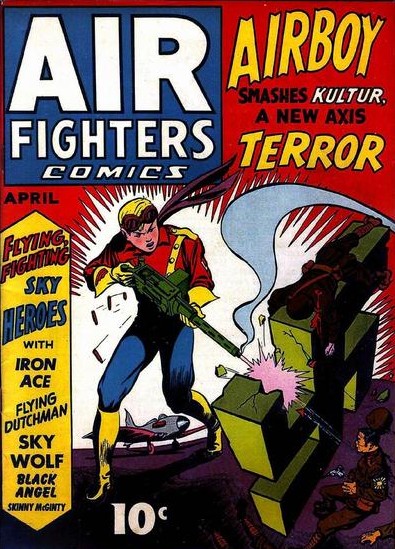
Airboy debuted in Air Fighters Comics #2 (cover-date Nov. 1942), an anthology series featuring a variety of aviator heroes; the first issue of the title had been published a year before, featuring a completely different cast of characters who were never seen again. The series was renamed Airboy Comics with the twenty-third issue, vol. 2, #11 (Dec. 1945), and ran 89 issues, through vol. 10, #4 (May 1953).
In the early issues, Biro wrote the scripts with Dave Wood and drew the covers, Al Camy was the initial story artist. He was followed by Tony DiPreta and, beginning with Air Fighters #10 (July 1943), Fred Kida, who would become closely associated with the series. Ernie Schroeder became the regular artist with Airboy Comics vol. 5, #11 (Dec. 1948), through the end of the series' run, with Dan Barry, Maurice Del Bourgo, Carmine Infantino, and others supplying an occasional story.
One of Airboy's most frequently recurring supporting characters was the German aviator Valkyrie, who fought on the side of the Axis as one of the Airmaidens but then defected to the Allies. The cleavage-baring aviatrix was one of the most popular characters in the series, making numerous appearances. Chuck Dixon, writer of the 1980s revival, would describe Valkyrie as "a cross between a Milton Caniff siren and Veronica Lake", and declare her the "sexiest character of Golden Age comics bar none".
An unusual feature of the series was that Airboy broadly aged in real-time, starting out as a young teenager at the start of his adventures; Kida credited the idea for this development to Terry and the Pirates. Following the Allies' victory in World War II in 1945, the series re-orientated and featured Airboy battling against the new terror, Communists.
The two consecutive series also contained backup stories about other aviators, including Skywolf, Iron Ace, the Black Angel, the Bald Eagle, the Flying Dutchman and the Flying Fool, before Hillman stopped publishing comics in 1953 due to the fall-out from Fredric Wertham's infamous Seduction of the Innocent, the incoming oversight of the Comics Code Authority and a general downturn in the market. Hillman subsequently left the publishing business altogether in 1961. Two issues were reprinted in 1973 by Don Maris' Nostalgia Inc. Comic Reprints, and a trade paperback entitled Valkyrie!: From the Pages of Air Fighters and the Airboy was published in 1982 by Ken Pierce Books with five stories featuring the femme fatale.
Hub AI
Airboy AI simulator
(@Airboy_simulator)
Airboy
Airboy is a fictional Golden Age aviator hero of an American comic book series initially published by Hillman Periodicals during the World War II, before ending his initial run in 1953. The hero was the costumed identity of crack pilot Davy Nelson II, and created by writers Charles Biro and Dick Wood with artist Al Camy.
The character disappeared from publications until a 1980s revival under Chuck Dixon that lasted for several years, focusing on the original Airboy's son, Davy Nelson III, and reviving much of the Hillman library of supporting characters before ending in 1989.
Since then the original Hillman creations and stories have fallen into the public domain; as a result Airboy and his supporting cast have appeared intermittently since under multiple publishers, sometimes updating his story to the present day or continuing previous adventures.
Airboy debuted in Air Fighters Comics #2 (cover-date Nov. 1942), an anthology series featuring a variety of aviator heroes; the first issue of the title had been published a year before, featuring a completely different cast of characters who were never seen again. The series was renamed Airboy Comics with the twenty-third issue, vol. 2, #11 (Dec. 1945), and ran 89 issues, through vol. 10, #4 (May 1953).
In the early issues, Biro wrote the scripts with Dave Wood and drew the covers, Al Camy was the initial story artist. He was followed by Tony DiPreta and, beginning with Air Fighters #10 (July 1943), Fred Kida, who would become closely associated with the series. Ernie Schroeder became the regular artist with Airboy Comics vol. 5, #11 (Dec. 1948), through the end of the series' run, with Dan Barry, Maurice Del Bourgo, Carmine Infantino, and others supplying an occasional story.
One of Airboy's most frequently recurring supporting characters was the German aviator Valkyrie, who fought on the side of the Axis as one of the Airmaidens but then defected to the Allies. The cleavage-baring aviatrix was one of the most popular characters in the series, making numerous appearances. Chuck Dixon, writer of the 1980s revival, would describe Valkyrie as "a cross between a Milton Caniff siren and Veronica Lake", and declare her the "sexiest character of Golden Age comics bar none".
An unusual feature of the series was that Airboy broadly aged in real-time, starting out as a young teenager at the start of his adventures; Kida credited the idea for this development to Terry and the Pirates. Following the Allies' victory in World War II in 1945, the series re-orientated and featured Airboy battling against the new terror, Communists.
The two consecutive series also contained backup stories about other aviators, including Skywolf, Iron Ace, the Black Angel, the Bald Eagle, the Flying Dutchman and the Flying Fool, before Hillman stopped publishing comics in 1953 due to the fall-out from Fredric Wertham's infamous Seduction of the Innocent, the incoming oversight of the Comics Code Authority and a general downturn in the market. Hillman subsequently left the publishing business altogether in 1961. Two issues were reprinted in 1973 by Don Maris' Nostalgia Inc. Comic Reprints, and a trade paperback entitled Valkyrie!: From the Pages of Air Fighters and the Airboy was published in 1982 by Ken Pierce Books with five stories featuring the femme fatale.
Recent media