
Recent from talks
Airway obstruction
Knowledge base stats:
Talk channels stats:
Members stats:
Airway obstruction
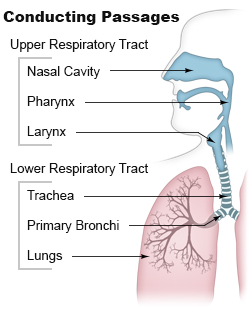
Airway obstruction is a blockage of respiration in the airway that hinders the free flow of air. Airway obstructions can occur either in the upper airway or lower airway. The upper airway consists of the nose, throat, and larynx. The lower airway comprises the trachea, bronchi, and bronchioles.[page needed]
Airway obstruction is a life-threatening condition and requires urgent attention.
The causes of upper airway obstructions can be acute or chronic. Acute causes of upper airway obstruction include foreign body aspiration, blunt trauma to the neck, infection, and swelling due to allergies or other inflammatory conditions. In children, viral infections such as croup or epiglottitis are frequent causes. Adults are more likely to experience obstruction from enlargement of the tonsils or vocal cord paralysis. Obstructive sleep apnea is the most common chronic cause of upper airway obstruction.
Stridor is a high-pitched sound which occurs during breathing and is associated with obstruction at the level of the larynx. Difficulty swallowing and changes in voice are common symptoms. If there is total obstruction, severe respiratory distress or cyanosis due to hypoxia (lack of oxygen in the blood) can occur.
With acute upper airway obstruction, respiratory distress can rapidly lead to respiratory failure without appropriate management necessitating urgent and comprehensive assessment of ABCs (airway, breathing, and circulation).
Imaging studies, including x-rays and CT scans, can aid diagnosis and quickly assess the obstruction's extent. For children, ultrasound or MRI are preferred as they do not involve radiation. Flexible laryngoscopy or bronchoscopy can directly visualize the airway.
Treatment depends on how severe the patient's condition is and the cause of the obstruction. If the patient is choking on a foreign body, the Heimlich maneuver can be used. More invasive methods, such as intubation, may be necessary to secure the airway. In severe cases, intubation may be difficult and a cricothyrotomy or tracheostomy may be necessary.
Infections typically cause obstruction by swelling and are usually treated with antibiotics or corticosteroids to reduce inflammation. For causes like tumors or abscesses, surgical removal may be required.
Hub AI
Airway obstruction AI simulator
(@Airway obstruction_simulator)
Airway obstruction
Airway obstruction is a blockage of respiration in the airway that hinders the free flow of air. Airway obstructions can occur either in the upper airway or lower airway. The upper airway consists of the nose, throat, and larynx. The lower airway comprises the trachea, bronchi, and bronchioles.[page needed]
Airway obstruction is a life-threatening condition and requires urgent attention.
The causes of upper airway obstructions can be acute or chronic. Acute causes of upper airway obstruction include foreign body aspiration, blunt trauma to the neck, infection, and swelling due to allergies or other inflammatory conditions. In children, viral infections such as croup or epiglottitis are frequent causes. Adults are more likely to experience obstruction from enlargement of the tonsils or vocal cord paralysis. Obstructive sleep apnea is the most common chronic cause of upper airway obstruction.
Stridor is a high-pitched sound which occurs during breathing and is associated with obstruction at the level of the larynx. Difficulty swallowing and changes in voice are common symptoms. If there is total obstruction, severe respiratory distress or cyanosis due to hypoxia (lack of oxygen in the blood) can occur.
With acute upper airway obstruction, respiratory distress can rapidly lead to respiratory failure without appropriate management necessitating urgent and comprehensive assessment of ABCs (airway, breathing, and circulation).
Imaging studies, including x-rays and CT scans, can aid diagnosis and quickly assess the obstruction's extent. For children, ultrasound or MRI are preferred as they do not involve radiation. Flexible laryngoscopy or bronchoscopy can directly visualize the airway.
Treatment depends on how severe the patient's condition is and the cause of the obstruction. If the patient is choking on a foreign body, the Heimlich maneuver can be used. More invasive methods, such as intubation, may be necessary to secure the airway. In severe cases, intubation may be difficult and a cricothyrotomy or tracheostomy may be necessary.
Infections typically cause obstruction by swelling and are usually treated with antibiotics or corticosteroids to reduce inflammation. For causes like tumors or abscesses, surgical removal may be required.
Recent media