Hubbry Logo
search
logo

Algebraic geometry code

logo
Community Hub0 Subscribers

Wikipedia

from Wikipedia

Algebraic geometry codes, often abbreviated AG codes, are a type of linear code that generalize Reed–Solomon codes. The Russian mathematician V. D. Goppa constructed these codes for the first time in 1982.[1]

History

[edit]

The name of these codes has evolved since the publication of Goppa's paper describing them. Historically these codes have also been referred to as geometric Goppa codes;[2] however, this is no longer the standard term used in coding theory literature. This is due to the fact that Goppa codes are a distinct class of codes which were also constructed by Goppa in the early 1970s.[3][4][5]

These codes attracted interest in the coding theory community because they have the ability to surpass the Gilbert–Varshamov bound; at the time this was discovered, the Gilbert–Varshamov bound had not been broken in the 30 years since its discovery.[6] This was demonstrated by Tfasman, Vladut, and Zink in the same year as the code construction was published, in their paper "Modular curves, Shimura curves, and Goppa codes, better than Varshamov-Gilbert bound".[7] The name of this paper may be one source of confusion affecting references to algebraic geometry codes throughout 1980s and 1990s coding theory literature.

Construction

[edit]

In this section the construction of algebraic geometry codes is described. The section starts with the ideas behind Reed–Solomon codes, which are used to motivate the construction of algebraic geometry codes.

Reed–Solomon codes

[edit]

Algebraic geometry codes are a generalization of Reed–Solomon codes. Constructed by Irving Reed and Gustave Solomon in 1960, Reed–Solomon codes use univariate polynomials to form codewords, by evaluating polynomials of sufficiently small degree at the points in a finite field .[8]

Formally, Reed–Solomon codes are defined in the following way. Let . Set positive integers . Let The Reed–Solomon code is the evaluation code

Codes from algebraic curves

[edit]

Goppa observed that can be considered as an affine line, with corresponding projective line . Then, the polynomials in (i.e. the polynomials of degree less than over ) can be thought of as polynomials with pole allowance no more than at the point at infinity in .[6]

With this idea in mind, Goppa looked toward the Riemann–Roch theorem. The elements of a Riemann–Roch space are exactly those functions with pole order restricted below a given threshold,[9] with the restriction being encoded in the coefficients of a corresponding divisor. Evaluating those functions at the rational points on an algebraic curve over (that is, the points in on the curve ) gives a code in the same sense as the Reed-Solomon construction.

However, because the parameters of algebraic geometry codes are connected to algebraic function fields, the definitions of the codes are often given in the language of algebraic function fields over finite fields.[10] Nevertheless, it is important to remember the connection to algebraic curves, as this provides a more geometrically intuitive method of thinking about AG codes as extensions of Reed-Solomon codes.[9]

Formally, algebraic geometry codes are defined in the following way.[10] Let be an algebraic function field, be the sum of distinct places of of degree one, and be a divisor with disjoint support from . The algebraic geometry code associated with divisors and is defined as More information on these codes may be found in both introductory texts[6] as well as advanced texts on coding theory.[10][11]


Examples

[edit]

Reed-Solomon codes

[edit]

One can see that

where is the point at infinity on the projective line and is the sum of the other -rational points.


One-point Hermitian codes

[edit]

The Hermitian curve is given by the equationconsidered over the field .[2] This curve is of particular importance because it meets the Hasse–Weil bound with equality, and thus has the maximal number of affine points over .[12] With respect to algebraic geometry codes, this means that Hermitian codes are long relative to the alphabet they are defined over.[13]
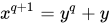
The Riemann–Roch space of the Hermitian function field is given in the following statement.[2] For the Hermitian function field given by and for , the Riemann–Roch space iswhere is the point at infinity on .

With that, the one-point Hermitian code can be defined in the following way. Let be the Hermitian curve defined over .

Let be the point at infinity on , and be a divisor supported by the distinct -rational points on other than .

The one-point Hermitian code is

References

[edit]

Grokipedia

from Grokipedia
Algebraic geometry codes, often abbreviated as AG codes, are a class of linear error-correcting codes defined over finite fields Fq\mathbb{F}_q by evaluating sections of line bundles (or rational functions) on the rational points of an algebraic curve, generalizing classical constructions like Reed-Solomon and Goppa codes to achieve superior asymptotic performance.[1][2] These codes were first conceptualized by V.D. Goppa in his 1981 paper "Codes on algebraic curves," where he proposed using the function field of an algebraic curve to construct codes with parameters determined by divisors and evaluation maps at rational points.[3][2] In the construction, for a smooth projective curve XX of genus gg over Fq\mathbb{F}_q, a divisor D=i=1nPiD = \sum_{i=1}^n P_i supported on nn distinct rational points PiP_i, and another divisor GG with support disjoint from DD, the code CL(D,G)C_\mathcal{L}(D, G) is the image of the evaluation map ev:L(G)Fqn\text{ev}: \mathcal{L}(G) \to \mathbb{F}_q^n, where L(G)\mathcal{L}(G) is the Riemann-Roch space of GG.[2] The dual code CΩ(D,G)C_\Omega(D, G) is similarly defined using differentials.[1] The dimension kk of CL(D,G)C_\mathcal{L}(D, G) satisfies k=(G)(GD)k = \ell(G) - \ell(G - D) by the Riemann-Roch theorem, often approximating deg(G)g+1\deg(G) - g + 1 for large deg(G)\deg(G), while the minimum distance dd obeys the designed distance bound dndeg(G)d \geq n - \deg(G).[2] These parameters satisfy the Singleton bound k+dn+1k + d \leq n + 1, but AG codes excel asymptotically: in 1982, M.A. Tsfasman, S.G. Vlăduţ, and Th. Zink constructed families of codes attaining the Tsfasman-Vlăduţ-Zink (TVZ) bound, stating that for qq a perfect square and relative distance δ=d/n\delta = d/n, the asymptotic rate R=k/nR = k/n satisfies R1δ1q1R \geq 1 - \delta - \frac{1}{\sqrt{q-1}}, surpassing the Gilbert-Varshamov bound for q49q \geq 49.[1][4] Notable examples include Hermitian codes from the curve xq+1+yq+1+zq+1=0x^{q+1} + y^{q+1} + z^{q+1} = 0 over Fq2\mathbb{F}_{q^2}, which provide explicit constructions with efficient decoding algorithms up to roughly half the designed distance using methods like list decoding or the Feng-Rao bound.[2][4] AG codes have influenced applications in cryptography, storage systems, and quantum error correction, with ongoing research extending them to higher-dimensional varieties and generalized constructions.[1]

Introduction and Fundamentals

Definition and basic concepts

Algebraic geometry codes, often abbreviated as AG codes, are linear error-correcting codes over a finite field Fq\mathbb{F}_q constructed as evaluation codes using points and functions on algebraic varieties, particularly nonsingular projective curves, thereby generalizing classical codes like Reed–Solomon codes.[5] These codes leverage the structure of the function field of the variety to achieve parameters that surpass certain bounds for random linear codes, especially for large lengths.[5] Consider a nonsingular projective curve XX of genus gg defined over Fq\mathbb{F}_q, with rational points P1,,PnP_1, \dots, P_n on XX.[5] Let D=P1++PnD = P_1 + \cdots + P_n be an effective divisor of degree nn, representing the evaluation points, and let GG be another divisor of degree mm with support disjoint from that of DD.[5] The Riemann–Roch space L(G)L(G) is the Fq\mathbb{F}_q-vector space of all rational functions ff in the function field of XX (including the zero function) such that the principal divisor (f)(f) satisfies (f)+G0(f) + G \geq 0, meaning the poles of ff are controlled by GG.[5] By the Riemann–Roch theorem, the dimension k=(G)=dimFqL(G)k = \ell(G) = \dim_{\mathbb{F}_q} L(G) equals mg+1m - g + 1 when m2g1m \geq 2g - 1.[5] The AG code CL(D,G)C_L(D, G) is the image of the Fq\mathbb{F}_q-linear evaluation map
evD ⁣:L(G)Fqn,f(f(P1),,f(Pn)), \mathrm{ev}_D \colon L(G) \to \mathbb{F}_q^n, \quad f \mapsto (f(P_1), \dots, f(P_n)),
so the codewords are precisely these evaluations of basis functions from L(G)L(G) at the points in the support of DD.[5] Thus, CL(D,G)C_L(D, G) forms a linear [n,k,d]q[n, k, d]_q code, where the generator matrix has rows given by the evaluations of a basis of L(G)L(G) at P1,,PnP_1, \dots, P_n.[5] The minimum distance dd satisfies the designed distance bound dnm=ndeg(G)d \geq n - m = n - \deg(G), derived from the fact that any nonzero fL(G)f \in L(G) vanishes at at most deg(G)\deg(G) points.[5] Reed–Solomon codes correspond to the special case where XX is the projective line (of genus g=0g = 0) over Fq\mathbb{F}_q.[5] For higher-dimensional varieties, the construction extends analogously by evaluating sections of line bundles (or sheaves) at rational points, using higher-codimension divisors and appropriate cohomology spaces in place of L(G)L(G).[5]

Mathematical prerequisites

Algebraic geometry codes build upon foundational concepts from coding theory. A linear code over the finite field Fq\mathbb{F}_q is defined as a kk-dimensional subspace CC of the vector space Fqn\mathbb{F}_q^n.[6] Such codes are characterized by the parameters [n,k,d][n, k, d], where nn denotes the length (dimension of the ambient space), kk the dimension of the code (number of information symbols), and dd the minimum Hamming distance between any two distinct codewords.[6] The generator matrix GG is a k×nk \times n matrix whose rows form a basis for CC, while the parity-check matrix HH is an (nk)×n(n-k) \times n matrix satisfying cHT=0cH^T = 0 for all codewords cCc \in C.[7] A fundamental limitation is given by the Singleton bound, which asserts that dnk+1d \leq n - k + 1 for any block code.[6] Key elements from algebraic geometry are also essential. Projective varieties over Fq\mathbb{F}_q are the common zero loci of homogeneous polynomials in projective space Pm(Fq)\mathbb{P}^m(\mathbb{F}_q).[8] Algebraic curves are irreducible projective varieties of dimension one, each associated with a genus g0g \geq 0, an invariant that quantifies the curve's topological complexity; for example, the projective line has genus 0, while elliptic curves have genus 1.[9] The function field Fq(X)\mathbb{F}_q(X) of a curve XX consists of all rational functions on XX, which are quotients of polynomials regular away from finitely many poles.[9] Divisors on XX are formal Z\mathbb{Z}-linear combinations PXnPP\sum_{P \in X} n_P P of points PP on the curve, with the degree of a divisor DD defined as deg(D)=nP\deg(D) = \sum n_P.[9] The Riemann-Roch theorem relates the geometry of the curve to the dimensions of spaces of functions with controlled poles. For a divisor DD on a curve of genus gg with deg(D)2g2\deg(D) \geq 2g - 2,
dimL(D)=deg(D)g+1+i(D), \dim L(D) = \deg(D) - g + 1 + i(D),
where L(D)L(D) is the vector space of rational functions ff such that div(f)+D0\operatorname{div}(f) + D \geq 0 (the Riemann-Roch space) and i(D)i(D) is the index of specialty.[9] The theorem holds in a more general form as
l(D)l(KD)=deg(D)g+1, l(D) - l(K - D) = \deg(D) - g + 1,
where KK is a canonical divisor, l(E)=dimL(E)l(E) = \dim L(E) for any divisor EE, and the difference l(D)l(KD)l(D) - l(K - D) captures the adjustment from the naive degree-genus relation.[9] This result will later help bound the dimensions of spaces used in code constructions. A crucial quantity is the number of Fq\mathbb{F}_q-rational points on a curve XX of genus gg, denoted #X(Fq)\#X(\mathbb{F}_q), which counts the solutions to the defining equations over Fq\mathbb{F}_q. The Weil bound provides an estimate:
#X(Fq)(q+1)2gq. \left| \#X(\mathbb{F}_q) - (q + 1) \right| \leq 2g \sqrt{q}.
This inequality limits how many points a curve can have over Fq\mathbb{F}_q, influencing the potential length of associated codes.[10]

Historical Development

Origins and Goppa codes

The origins of algebraic geometry codes trace back to the work of V. D. Goppa in the early 1980s, building on his earlier invention of classical Goppa codes. In 1970, Goppa introduced classical Goppa codes as a class of linear error-correcting codes constructed using polynomials over finite fields, specifically leveraging the rational function field Fq(t)\mathbb{F}_q(t) where places correspond to the zeros and poles of rational functions.[11] These codes generalized earlier constructions like Reed–Solomon codes by employing more flexible polynomial structures to achieve good error-correcting capabilities.[12] Seeking to improve code parameters beyond the limitations of the rational function field, Goppa extended this framework in his 1981 paper by incorporating algebraic curves over finite fields, using Riemann surfaces and function fields of general curves to define a broader class of codes now known as geometric Goppa codes.[12] This generalization allowed for the evaluation of functions at more rational points on the curve compared to the single-variable case, motivated by the goal of constructing codes that surpass the Gilbert-Varshamov bound through the geometric properties of curves with higher genus. Unlike classical Goppa codes, which are confined to the places of Fq(t)\mathbb{F}_q(t) and thus limited in the number of evaluation points, geometric Goppa codes exploit the richer structure of arbitrary algebraic curves, enabling potentially superior asymptotic performance. In a follow-up 1982 paper, Goppa specifically demonstrated the construction of such codes using hyperelliptic curves, further illustrating how the divisor-based approach on these curves yields linear codes with parameters tied to the curve's geometry. Over time, the terminology evolved from "geometric Goppa codes," emphasizing their connection to Goppa's classical work, to the more general "algebraic geometry codes," reflecting their reliance on broader tools from algebraic geometry beyond just curves.[13]

Key breakthroughs and advancements

A landmark advancement in the theory of algebraic geometry codes occurred in 1982 with the work of Tsfasman, Vlăduţ, and Zink, who constructed sequences of codes from modular curves that exceed the asymptotic Gilbert-Varshamov bound, attaining the TVZ bound R1δ1q1R \geq 1 - \delta - \frac{1}{\sqrt{q-1}} for relative distance δ=d/n<11q1ϵ\delta = d/n < 1 - \frac{1}{\sqrt{q-1}} - \epsilon for any ϵ>0\epsilon > 0, where R=k/nR = k/n is the rate, marking the first time codes outperformed the GV bound using geometric constructions for square q49q \geq 49. This result highlighted the potential of algebraic curves to yield asymptotically good codes, particularly for square field sizes q=p2q = p^2. The TVZ construction's impact extended to the study of asymptotic optimality, where Ihara's constant A(q)=lim supgNq(X)/g(X)A(q) = \limsup_{g \to \infty} N_q(X)/g(X)—the supremum ratio of rational points Nq(X)N_q(X) to genus g(X)g(X) over curves XX—plays a central role. For fixed qq, as block length nn \to \infty, algebraic geometry codes achieve rates and distances approaching the Drinfeld-Vlăduţ upper bound on A(q)11/qA(q) \leq 1 - 1/\sqrt{q}, with TVZ providing explicit families attaining near-optimal values and demonstrating asymptotic optimality in this regime.[14] In the 1990s, further progress focused on explicit constructions, notably using Drinfeld modular curves as analogues of classical modular towers for general finite fields, enabling polynomial-time computable codes with parameters matching or approaching TVZ bounds without relying on square qq. These developments, building on Drinfeld modules, facilitated practical implementations and extended the applicability of algebraic geometry codes to diverse field characteristics. The 2000s saw extensions to higher-dimensional varieties, such as surfaces and abelian varieties, where codes from ideals in coordinate rings of higher-genus objects offered improved trade-offs in dimension and minimum distance, though with increased computational complexity. Concurrently, list-decoding algorithms for algebraic geometry codes emerged, adapting interpolation-based methods to decode up to a constant fraction of errors beyond half the minimum distance, significantly enhancing error-correcting capabilities over unique decoding.[15] By the 2020s, algebraic geometry codes integrated with quantum error correction, providing asymptotically good stabilizer codes for fault-tolerant quantum computing, including applications in magic state distillation with optimal scaling and decoded quantum interferometry protocols that leverage their geometric structure for robust phase estimation.[16]

Construction Principles

General framework for evaluation codes

The general framework for evaluation codes establishes a paradigm for constructing linear codes over a finite field $ \mathbb{F}_q $ by evaluating functions from a vector space at a finite set of points on an algebraic variety. Consider a smooth projective variety $ X $ defined over $ \mathbb{F}_q $, a finite set of distinct $ \mathbb{F}_q $-rational points $ Z = {P_1, \dots, P_n} \subset X(\mathbb{F}_q) $, and a finite-dimensional $ \mathbb{F}_q $-vector space $ V $ of $ \mathbb{F}_q $-rational functions on $ X $. The evaluation map $ \ev_Z: V \to \mathbb{F}_q^n $ is defined by $ \ev_Z(f) = (f(P_1), \dots, f(P_n)) $ for $ f \in V $, and the resulting code $ C $ is the image of this map, a linear subspace of $ \mathbb{F}_q^n $ with length $ n $. This construction captures a broad class of codes, including generalizations of Reed-Solomon codes where $ V $ consists of polynomials of bounded degree evaluated on field elements viewed as points on the projective line.[17] In algebraic geometry codes, this framework is formalized using divisors to specify both the evaluation points and the function space. Let $ D = \sum_{i=1}^n P_i $ be the effective divisor supported on $ Z $, so $ n = \deg D $. Choose a rational divisor $ G $ on $ X $ such that $ \supp(G) \cap Z = \emptyset $, and set $ V = \mathcal{L}(G) = { f \in k(X) \mid \div(f) + G \geq 0 } \cup { 0 } $, the Riemann-Roch space of global sections of the line bundle associated to $ G $, where $ k(X) $ is the function field of $ X $. The code is then $ C(D, G) = \ev_Z(\mathcal{L}(G)) $, with dimension $ k = \dim_{\mathbb{F}_q} \mathcal{L}(G) $. By the Riemann-Roch theorem, for varieties where it applies (such as curves), $ k \geq \deg G + 1 - g $, with $ g $ denoting the genus or an analogous irregularity measure.[17] The parameters of such codes follow from geometric properties: the length is $ n = \deg D $, the dimension is approximately $ k \approx \deg G - g + 1 $, and the minimum distance satisfies $ d \geq n - \deg G $, known as the designed distance $ \delta = n - \deg G $. This distance bound arises because any nonzero $ f \in \mathcal{L}(G) $ has at most $ \deg G $ zeros (counting multiplicity), ensuring that $ \ev_Z(f) $ has weight at least $ n - \deg G $. A refinement of the Singleton bound, accounting for the geometry, gives $ d \geq n - k + 1 - g $, reflecting the overhead due to the variety's complexity compared to one-dimensional cases like Reed-Solomon codes. These parameters position algebraic geometry codes as powerful constructions exceeding classical bounds in certain regimes.[17]

Codes from algebraic curves

Algebraic geometry codes from algebraic curves are constructed using a nonsingular projective algebraic curve XX of genus gg defined over a finite field Fq\mathbb{F}_q. A set of nn distinct rational points P1,,PnX(Fq)P_1, \dots, P_n \in X(\mathbb{F}_q) is selected, and the divisor D=P1++PnD = P_1 + \dots + P_n is formed. A divisor GG on XX is chosen such that its support is disjoint from the support of DD, ensuring that the evaluation map is well-defined. The code CL(D,G)C_L(D, G) is then defined as the image of the evaluation map evD:L(G)Fqn\mathrm{ev}_D: L(G) \to \mathbb{F}_q^n, where L(G)={fFq(X)div(f)+G0}{0}L(G) = \{ f \in \mathbb{F}_q(X) \mid \mathrm{div}(f) + G \geq 0 \} \cup \{0\} is the Riemann-Roch space associated to GG, consisting of rational functions on XX with poles controlled by GG. This construction generalizes classical evaluation codes by incorporating the geometry of the curve, allowing for improved parameters through the interplay of points and function spaces.[18] The dimension kk and minimum distance dd of the code CL(D,G)C_L(D, G) are determined via the Riemann-Roch theorem applied to the curve. Specifically, the dimension satisfies k=(G)(GD)k = \ell(G) - \ell(G - D), where ()\ell(\cdot) denotes the dimension of the corresponding Riemann-Roch space; if deg(G)<n\deg(G) < n, then (GD)=0\ell(G - D) = 0, yielding k=(G)k = \ell(G). For deg(G)2g1\deg(G) \geq 2g - 1, the Riemann-Roch theorem gives (G)=deg(G)g+1\ell(G) = \deg(G) - g + 1. The minimum distance follows a designed bound analogous to the BCH bound, dndeg(G)d \geq n - \deg(G), which arises because any function in L(G)L(G) can vanish at most deg(G)\deg(G) points unless identically zero. These parameters enable codes that surpass certain classical bounds for sufficiently large nn relative to qq.[18] A common specialization is the one-point code, where G=mPG = m P_\infty for some rational point PP_\infty not among the PiP_i and integer m>2g2m > 2g - 2. Here, (G)=mg+1\ell(G) = m - g + 1, so the code has dimension k=mg+1k = m - g + 1 and designed distance dnmd \geq n - m. This setup simplifies the choice of GG while leveraging the full strength of Riemann-Roch for large mm, and it is particularly effective on curves with many rational points.[18] An illustrative example is provided by the Hermitian curve, defined over Fq2\mathbb{F}_{q^2} by the equation xq+1+yq+y=0x^{q+1} + y^q + y = 0, which has genus g=q(q1)/2g = q(q-1)/2. This curve admits exactly q3+1q^3 + 1 rational points over Fq2\mathbb{F}_{q^2}; for one-point Hermitian codes, n=q3n = q^3 points are typically selected, excluding the point at infinity P=(0:1:0)P_\infty = (0:1:0), with DD their sum and G=mPG = m P_\infty. The resulting codes achieve dimension k=mg+1k = m - g + 1 and distance dq3md \geq q^3 - m for m2g1m \geq 2g - 1, demonstrating asymptotic optimality in certain regimes.[18] For hyperelliptic curves, given by an affine model y2=f(x)y^2 = f(x) of degree 2g+12g+1 or 2g+22g+2 over Fq\mathbb{F}_q (with projective closure), an explicit basis for L(G)L(G) can be constructed using the structure of the function field. For G=mPG = m P_\infty where PP_\infty is the hyperelliptic branch point at infinity, the basis consists of monomials xix^i for i=0,,m/2i = 0, \dots, \lfloor m/2 \rfloor and xiyx^i y for i=0,,(m1)/2i = 0, \dots, \lfloor (m-1)/2 \rfloor, respecting the pole orders determined by the valuation at PP_\infty; this extends to differentials for dual code constructions, where Ω(GD)\Omega(G - D) uses holomorphic differentials adjusted by GDG - D. Such bases facilitate efficient encoding and decoding for these codes.[18]

Codes from higher-dimensional varieties

Algebraic geometry codes from higher-dimensional varieties extend the evaluation code framework to projective varieties XX of dimension r2r \geq 2 defined over the finite field Fq\mathbb{F}_q. The construction involves selecting a set SX(Fq)S \subseteq X(\mathbb{F}_q) of rational points on XX and a line bundle OX(D)\mathcal{O}_X(D) associated to an effective divisor DD. The code is then the image of the evaluation map evS:H0(X,OX(D))Fqnev_S: H^0(X, \mathcal{O}_X(D)) \to \mathbb{F}_q^n, where n=Sn = |S|, yielding a linear code over Fq\mathbb{F}_q of length nn.[15] A primary challenge in these constructions arises from the scarcity of Fq\mathbb{F}_q-rational points on higher-dimensional varieties compared to curves, with the Lang-Weil estimate bounding the number of points by approximately qr+O(qr1/2)q^r + O(q^{r-1/2}). To address this, methods such as adjunction—intersecting XX with curves to apply one-dimensional techniques—or the use of complete linear systems for divisors are employed; additional approaches include deriving codes from Grassmannians, which parameterize subspaces and yield MDS codes with parameters [(m)q,(m)+1,q(m)][ \binom{m}{\ell}_q, \ell(m - \ell) + 1, q^{\ell(m - \ell)} ], and from toric varieties, linking to lattice-based toric codes.[15][19] The dimension kk of the code equals dimH0(X,OX(D))\dim H^0(X, \mathcal{O}_X(D)), computed via the Hirzebruch-Riemann-Roch theorem, which expresses it in terms of the Chern character of OX(D)\mathcal{O}_X(D) and the Todd class of XX:
χ(OX(D))=Xch(OX(D))td(TX), \chi(\mathcal{O}_X(D)) = \int_X \operatorname{ch}(\mathcal{O}_X(D)) \cdot \operatorname{td}(T_X),
where χ\chi approximates kk under vanishing higher cohomology. Distance bounds are generally weaker than those for curve codes due to the more complex geometry, analogous to higher-genus effects; volume-based estimates from the Weil conjectures refine this to forms like dncdeg(D)r/(r+1)d \geq n - c \cdot \deg(D)^{r/(r+1)} for suitable constants cc.[15][19] In the 1990s, seminal constructions on Hermitian surfaces provided concrete examples with improved performance. Consider the surface XP3X \subset \mathbb{P}^3 defined over Fr2\mathbb{F}_{r^2} by the equation x0r+1+x1r+1+x2r+1+x3r+1=0x_0^{r+1} + x_1^{r+1} + x_2^{r+1} + x_3^{r+1} = 0; evaluating sections of OX(1)\mathcal{O}_X(1) at all rational points yields a code with parameters [n=(r2+1)(r3+1),k=4,d=r5+r2][n = (r^2 + 1)(r^3 + 1), k = 4, d = r^5 + r^2], achieving relative rates superior to those from algebraic curves for certain square q=r2q = r^2.[19]

Key Properties

Code parameters and bounds

Algebraic geometry (AG) codes are evaluation codes defined on the rational points of an algebraic variety, typically a curve of genus g>0g > 0 over a finite field Fq\mathbb{F}_q. The length nn of an AG code CL(D,G)C_L(D, G) is the number of Fq\mathbb{F}_q-rational points in the support of the divisor DD, so degD=n\deg D = n. The dimension kk is given by k=(G)(GD)k = \ell(G) - \ell(G - D), where \ell denotes the dimension of the Riemann-Roch space; when degG<n\deg G < n, this simplifies to k=(G)k = \ell(G). By the Riemann-Roch theorem, (G)=degGg+1+(KG)\ell(G) = \deg G - g + 1 + \ell(K - G) for a canonical divisor KK, yielding kdegGg+1k \approx \deg G - g + 1 when degG2g1\deg G \geq 2g - 1 and (KG)=0\ell(K - G) = 0.[20] The designed minimum distance δ\delta for CL(D,G)C_L(D, G) is δ=ndegG\delta = n - \deg G, reflecting the maximum number of zeros a non-zero function in L(G)L(G) can have at points in the support of DD. The actual minimum distance dd satisfies dndegGd \geq n - \deg G, a bound derived from the fact that any non-constant fL(G)f \in L(G) can vanish at most degG\deg G points in the support of DD, as the degree of its zero divisor equals the degree of its pole divisor (bounded by degG\deg G). Tighter values of dd can be obtained from weight enumerators, which count codewords of each weight, or from advanced algebraic geometry bounds such as the order bound or Feng-Rao bound.[20][21] A fundamental bound is the geometric Singleton bound, dnk+1gd \geq n - k + 1 - g, which refines the classical Singleton bound dnk+1d \geq n - k + 1 by incorporating the genus gg. This improvement arises from applying the Riemann-Roch theorem to the effective divisors associated with codewords and is particularly effective for high-genus curves, where g>0g > 0 allows AG codes to outperform Reed-Solomon codes in asymptotic rate-distance tradeoffs. For instance, when the Riemann-Roch space achieves its generic dimension, the geometric Singleton bound aligns with the designed bound dndegGd \geq n - \deg G.[21] Proofs of the minimum distance often rely on geometric invariants like the gonality γ\gamma of the curve—the minimal degree of a rational map to P1\mathbb{P}^1—or adjoint conditions tied to the canonical system. The gonality provides lower bounds via the characterization d=min{ndegEE effective,(GE)>0}d = \min \{ n - \deg E \mid E \text{ effective}, \ell(G - E) > 0 \}, where low-gonality curves limit the degrees of such EE. Adjoint conditions for the dual code CΩ(D,G)C_\Omega(D, G) involve the failure of linear equivalence to a canonical divisor plus an effective divisor disjoint from evaluation points, yielding ddegG2g+2d^* \geq \deg G - 2g + 2 for the designed distance of the dual. A related bound is dnδ+1gd \geq n - \delta + 1 - g, adjusting the designed distance for geometric effects.[20][22] For one-point AG codes, where D=(n1)PD = (n-1)P_\infty for a rational point PP_\infty and G=mPG = m P_\infty, explicit formulas for kk and dd stem from the Weierstrass gap theorem at PP_\infty. The theorem states there are exactly gg gaps—integers rr with (rP)=((r1)P)\ell(r P_\infty) = \ell((r-1) P_\infty)—and the dimension is k=m+1#{gaps m}k = m + 1 - \#\{\text{gaps } \leq m\}, precisely counting basis functions with poles up to order mm at PP_\infty. The minimum distance follows from analyzing the zero multiplicities at affine rational points, often yielding d=nνmd = n - \nu_m, where νm\nu_m is the largest non-gap at or below mm, enabling exact computation for specific curves like elliptic or hyperelliptic ones.[23]

Asymptotic performance

In the asymptotic regime of algebraic geometry (AG) codes, one considers families of codes where the block length nn tends to infinity. The relative distance is defined as δ=d/n\delta = d/n, where dd is the minimum distance, and the rate is R=k/nR = k/n, where kk is the dimension. The optimal asymptotic performance is captured by the function Aq(δ)=sup{R:there exists a family of [n,k,d]q codes with k/nR,d/nδ}A_q(\delta) = \sup \{ R : \text{there exists a family of } [n, k, d]_q \text{ codes with } k/n \to R, d/n \to \delta \}, representing the maximum achievable rate for a given relative distance over the finite field Fq\mathbb{F}_q. The Tsfasman-Vlăduţ-Zink (TVZ) bound provides a fundamental lower bound on Aq(δ)A_q(\delta). Specifically, if the Ihara constant A(q)>1A(q) > 1, then Aq(δ)1δ1/A(q)A_q(\delta) \geq 1 - \delta - 1/A(q) for 0δ11/A(q)0 \leq \delta \leq 1 - 1/A(q). For q49q \geq 49 a perfect square, this bound exceeds the Gilbert-Varshamov bound Aq(δ)1Hq(δ)A_q(\delta) \geq 1 - H_q(\delta), where Hq(x)=xlogq(q1)xlogqx(1x)logq(1x)H_q(x) = x \log_q (q-1) - x \log_q x - (1-x) \log_q (1-x) is the qq-ary entropy function, particularly for δ<11/q\delta < 1 - 1/\sqrt{q}. This superiority holds because the TVZ construction yields families of codes with rates strictly greater than 1Hq(δ)ϵ1 - H_q(\delta) - \epsilon for any ϵ>0\epsilon > 0 in that range.[24][2] The Ihara constant A(q)=lim supgNq(g)gA(q) = \limsup_{g \to \infty} \frac{N_q(g)}{g}, where Nq(g)N_q(g) is the maximum number of Fq\mathbb{F}_q-rational points on an algebraic curve of genus gg, directly influences AG code performance. For families of curves yielding good AG codes, the number of evaluation points nn scales asymptotically with the genus gg as nA(q)gn \approx A(q) g, while the designed distance relates to gg, enabling rates and distances tied to A(q)A(q). The Drinfeld-Vladut bound states that A(q)q1A(q) \leq \sqrt{q} - 1 for all qq.[14][25] Modular tower constructions achieve the optimal A(q)=q1A(q) = \sqrt{q} - 1 when qq is a perfect square, as shown using Drinfeld modular curves, which realize the TVZ bound explicitly. These towers provide sequences of function fields with the required point-genus growth, leading to AG code families that are asymptotically optimal in the specified regime. Advancements from 2017 have extended explicit tower constructions to block-transitive AG codes, attaining the TVZ bound over Fq2\mathbb{F}_{q^2}.[26][27][28] As of 2025, AG codes have been applied to decoded quantum interferometry, enhancing fault-tolerant quantum computing protocols.[29]

Decoding Methods

Algorithms up to half the minimum distance

Standard decoding algorithms for algebraic geometry (AG) codes correct up to $ t = \lfloor (d-1)/2 \rfloor $ errors, where $ d $ is the minimum distance, relying on syndrome computations and solutions to key equations derived from the geometry of the underlying variety. These methods extend the Patterson algorithm originally developed for Goppa codes, which computes syndromes $ S_i = \sum y_j \alpha_j^i $ for received vector $ y $ and distinct points $ \alpha_j $, then solves for the error locator polynomial via square-root computations in the rational function field modulo the Goppa polynomial. This approach was generalized to AG codes from arbitrary curves by Ehrhard, who formulated a key equation solvable through linear algebra over Riemann-Roch spaces, enabling error location and evaluation without explicit square roots.[30] For AG codes defined on curves, the decoding process begins by computing syndromes from the received word $ y $, typically as residues or evaluations in the space of differentials or adjoints associated with the code's divisor. The core step involves solving a generalized key equation relating the syndrome to the error evaluator and locator within the Riemann-Roch space $ L((2t-2)P_\infty) $, where $ P_\infty $ is the point at infinity.[31] Once solved, the roots of the error locator identify error positions via interpolation on the curve, and the error evaluator yields error values, achieving unique decoding up to the designed distance. The Reed-Solomon code serves as a special case where the curve degenerates to the projective line, reducing to the Berlekamp-Massey algorithm. The computational complexity of these syndrome-based decoders is generally $ O(n^2) $ operations in the base field, where $ n $ is the code length, arising from syndrome calculation and linear system solves over spaces of dimension roughly $ 2t $; improvements to $ O(n \log^2 n) $ are possible using fast multiplication and Fourier-like transforms adapted to the curve's Jacobian or residue maps.[32] For Hermitian codes over $ \mathbb{F}_{q^2} $, defined on the curve $ x^{q+1} + y^{q+1} + z^{q+1} = 0 $, explicit algorithms leverage the curve's symmetry to compute q-ary syndromes directly from evaluations at rational points, solving the key equation via Newton identities or Gröbner bases for error locators in polynomial time up to half the distance.[33]

Advanced and list decoding techniques

Advanced decoding techniques for algebraic geometry (AG) codes extend beyond the unique decoding radius of half the minimum distance, enabling correction of a larger fraction of errors at the cost of potentially outputting a list of candidate codewords rather than a unique one. The seminal Guruswami-Sudan algorithm generalizes the Sudan interpolation-based list decoding from Reed-Solomon codes to AG codes defined on algebraic curves of arbitrary genus, achieving a list-decoding radius up to the Johnson bound while producing a polynomial-sized list in the block length nn.[34] In this framework, decoding involves finding a nonzero bivariate polynomial Q(x,y)Q(x, y) over the function field, with degree at most (1R)n(1 - R)n in xx and kn\sqrt{kn} in yy (where R=k/nR = k/n is the design rate and kk the dimension), such that Q(Pi,yi)=0Q(P_i, y_i) = 0 for all received symbols yiy_i at evaluation points PiP_i, followed by factorization to recover possible messages.[34] For Hermitian codes, a prominent class of AG codes on curves over Fq2\mathbb{F}_{q^2}, this approach corrects up to $ n - \sqrt{k n} $ errors, approaching the theoretical limit for list decoding.[34] For one-point AG codes, the Feng-Rao decoding algorithm improves upon standard methods by exploiting the structure of the dual code to correct errors up to the designed minimum distance d=nk+1gd = n - k + 1 - g (where gg is the genus), which exceeds half the distance for low-rate codes, achieving up to nnkn - \sqrt{nk} errors in certain regimes through majority-logic decoding of unknown syndromes. An algebraic-geometric adaptation of the Koetter-Vardy soft-decision decoding algorithm further enhances performance by incorporating reliability information from the channel, constructing a tree of interpolation polynomials on the curve to list-decode beyond hard-decision limits, with complexity polynomial in nn.[35] Post-2010 advancements include adaptations of Chase decoding algorithms to AG codes on curves, particularly Hermitian codes, where low-complexity variants generate test vectors from the most unreliable positions and apply list decoding to each, yielding significant gains over Koetter-Vardy with reduced computational overhead.[36] In 2025, decoded quantum interferometry emerged as a novel application, leveraging the algebraic structure of AG codes—such as Hermitian codes—for error correction in quantum optimization tasks, mapping decoding problems to quantum Fourier transform-based interferometry protocols that reduce qubit requirements by one-third compared to Reed-Solomon-based approaches.[29]

Examples

Reed–Solomon codes

Reed–Solomon codes provide a foundational example of algebraic geometry codes, specifically evaluation codes derived from the projective line over a finite field Fq\mathbb{F}_q. In this construction, the underlying curve is the projective line PFq1\mathbb{P}^1_{\mathbb{F}_q}, which is a smooth projective curve of genus 0. The code is defined by selecting n=q1n = q-1 distinct evaluation points α1,,αnFq{0}\alpha_1, \dots, \alpha_n \in \mathbb{F}_q \setminus \{0\}, corresponding to the divisor D=i=1nPiD = \sum_{i=1}^n P_i where PiP_i is the point at αi\alpha_i. The code space is then the Riemann–Roch space L(G)L(G) for the divisor G=(k1)G = (k-1) \infty, where \infty denotes the point at infinity on P1\mathbb{P}^1, yielding functions that are polynomials of degree less than kk. The codewords are obtained via evaluation: for fL(G)f \in L(G), the codeword is ev(f)=(f(α1),,f(αn))Fqn\mathrm{ev}(f) = (f(\alpha_1), \dots, f(\alpha_n)) \in \mathbb{F}_q^n.[37][38] These codes achieve length n=q1n = q-1, dimension kk, and minimum distance d=nk+1d = n - k + 1, saturating the Singleton bound for maximum distance separable (MDS) codes. The generator matrix GG for the Reed–Solomon code has entries Gi,j=αji1G_{i,j} = \alpha_j^{i-1} for i=1,,ki = 1, \dots, k and j=1,,nj = 1, \dots, n, reflecting the monomial basis of polynomials of degree less than kk. This structure ensures optimal error-correcting capability up to (nk)/2\lfloor (n-k)/2 \rfloor errors, making them ideal for applications requiring high reliability over finite fields.[38][37] An extension of Reed–Solomon codes incorporates the point at infinity, increasing the length to n=qn = q while preserving the MDS property, with evaluation now including a suitable value at \infty (often defined via homogeneous coordinates). This extended version maintains the parameters [q,k,qk+1][q, k, q - k + 1] and is particularly useful in scenarios demanding full field utilization.[38][37]

Hermitian codes

Hermitian codes are a family of algebraic geometry codes constructed from the Hermitian curve, providing a non-trivial example beyond Reed–Solomon codes due to the positive genus of the underlying curve. The Hermitian curve is defined by the affine equation yq+y=xq+1y^q + y = x^{q+1} over the finite field Fq2\mathbb{F}_{q^2}, where qq is a prime power. This curve has genus g=q(q1)2g = \frac{q(q-1)}{2} and exactly q3q^3 affine Fq2\mathbb{F}_{q^2}-rational points, which serve as the evaluation points for the code. The point at infinity PP_\infty is the unique hyperflex at infinity, with pole orders vP(x)=qv_{P_\infty}(x) = -q and vP(y)=(q+1)v_{P_\infty}(y) = -(q+1).[39] The one-point Hermitian code is the evaluation code at the affine rational points, with evaluation divisor consisting of these q3q^3 points and pole divisor G=mPG = m P_\infty for a positive integer mm. The codewords are formed by evaluating a basis of the Riemann–Roch space L(G)L(G), which is spanned by monomials xiyjx^i y^j satisfying iq+j(q+1)mi q + j (q+1) \leq m. By the Riemann–Roch theorem, the dimension is k=mg+1k = m - g + 1 when m2g2m \geq 2g - 2. The designed minimum distance satisfies dndegG=q3md \geq n - \deg G = q^3 - m, reflecting the bound from the geometry of the curve, though the true distance can be larger in certain ranges. The rate of the code is approximately Rm/q3R \approx m / q^3.[39][40] This family achieves more rational points than curves of genus zero while maintaining good relative distance, making it suitable for applications requiring longer codes over Fq2\mathbb{F}_{q^2}.[41]

Other notable codes

Hyperelliptic codes are constructed from hyperelliptic curves defined by the equation $ y^2 + h(x) y = f(x) $, where $ h(x) $ and $ f(x) $ are polynomials over a finite field $ \mathbb{F}_q $ with $ q $ even, and the degree of $ f(x) $ is $ 2g + 1 $ for genus $ g = (\deg f - 1)/2 $. These codes are particularly suitable for even characteristic fields and offer parameters comparable to those from Hermitian curves, while providing explicit bases for the Riemann-Roch spaces that facilitate computational efficiency. Codes from modular curves, such as towers of $ X_0(N) $ for increasing $ N $, yield asymptotically good constructions that achieve the Tsfasman-Vlăduţ-Zink (TVZ) bound on the tradeoff between code rate and relative minimum distance.[42] These towers over finite fields of size $ q_0^2 $ produce codes with length $ n \approx q^{1 + 1/(2 \lfloor \log_q N \rfloor)} $, enabling high rates for large genus while maintaining strong error-correcting capabilities.[42] The Garcia-Stichtenoth codes arise from explicit towers of function fields over finite fields of square cardinality $ q = r^2 $ with $ r > 2 $, constructed recursively to attain the optimal asymptotic bound $ A(q) = 1/(\sqrt{q} - 1) $, where $ A(q) $ denotes the limit of the maximal code rate as genus tends to infinity. This tower provides a concrete family of curves yielding algebraic geometry codes that surpass the Gilbert-Varshamov bound for sufficiently large parameters. Two-point codes on the Hermitian curve, using divisors of the form $ aP + bQ $ where $ P $ and $ Q $ are distinct rational points, achieve minimum distances strictly larger than those of the corresponding one-point codes for a range of designed distances, thereby improving error-correcting performance without increasing redundancy.[43]

Applications

Error correction and storage

Algebraic geometry (AG) codes have found practical applications in classical error correction for communications systems, particularly where high-rate, long-length codes are required. Their asymptotic goodness allows them to outperform BCH and Reed-Solomon (RS) codes for extended code lengths, enabling more efficient data transmission over noisy channels. For instance, AG codes based on algebraic curves achieve better relative minimum distances as the field size $ q $ grows, making them suitable for scenarios demanding robust performance without exponentially increasing the alphabet size.[44] In deep-space probes and satellite links, AG codes support high-rate error correction by leveraging their superior parameters for reliable transmission of telemetry data across vast distances with low signal-to-noise ratios. These codes provide enhanced error-detecting and correcting capabilities compared to traditional block codes, contributing to the integrity of mission-critical communications. NASA evaluations have demonstrated that certain AG codes surpass RS codes in coding gain, such as achieving approximately 1/3 dB better performance than RS(511,127) for specific parameters.[44][45] For data storage systems, AG codes enhance reliability in flash memory and RAID configurations, where they effectively mitigate burst errors—clusters of consecutive errors arising from physical wear or interference—outperforming turbo codes in certain operational regimes due to their structured algebraic properties. This burst-error resilience stems from the geometric construction, allowing targeted decoding without excessive overhead. In optical storage applications, Hermitian codes, a prominent class of AG codes derived from the Hermitian curve over $ \mathbb{F}_{q^2} $, correct up to 10-15% errors for code lengths $ n \approx 10^6 $, offering scalable protection for high-density media.[44] Comparatively, AG codes outperform random linear codes even at finite lengths when $ q $ is large, as their minimum distance exceeds the Gilbert-Varshamov bound through explicit curve-based constructions, providing deterministic guarantees absent in probabilistic random ensembles. This advantage is particularly evident in storage contexts requiring predictable error thresholds.[44]

Cryptography and secret sharing

Algebraic geometry (AG) codes have been adapted to variants of the McEliece public-key cryptosystem, where the generator matrix of an AG code, such as a Hermitian code, serves as the basis for encryption, with security relying on the hardness of the syndrome decoding problem.[46] In this setup, the public key consists of a scrambled generator matrix $ G_{\text{pub}} = S G P $, where $ G $ is the generator matrix of the AG code, $ S $ is an invertible scrambling matrix, and $ P $ is a permutation matrix, while encryption appends an error vector of weight up to half the minimum distance to a codeword.[47] The syndrome decoding problem for general linear codes is NP-complete, providing the foundational security assumption for these systems.[47] Constructions of such AG-based McEliece variants emerged in the 1990s, leveraging the efficient decoding algorithms available for AG codes up to half their minimum distance, with security grounded in the NP-hardness of decoding linear codes and related problems like finding minimum-weight codewords.[46][47] Hermitian codes, as a prominent class of AG codes defined over the Hermitian curve $ x^{q+1} + y^{q+1} + z^{q+1} = 0 $ in projective space over $ \mathbb{F}_{q^2} $, have been particularly used due to their good parameters, such as length $ n = q^3 $ and dimension scaling favorably with the genus.[48] Post-2009 developments include quantum-resistant variants employing structured subfield subcodes of Hermitian AG codes to enhance efficiency while preserving security against known attacks on the syndrome decoding problem.[49] In secret sharing protocols, AG codes enable ramp schemes that support complex access structures, allowing reconstruction of a secret from $ t $ shares out of $ n $ while providing privacy against fewer than $ t $ shares, with information rates exceeding $ 1/2 $.[50] These schemes distribute shares $ s_i = f(P_i) $ for distinct points $ P_i $ on an algebraic curve and a random function $ f $ drawn from the Riemann-Roch space $ L(G) $ associated with a divisor $ G $, such that the secret can be reconstructed via interpolation when sufficiently many points are available.
si=f(Pi),fL(G) s_i = f(P_i), \quad f \in L(G)
Reconstruction is possible if the number of shares meets or exceeds the degree threshold implicit in the divisor, enabling high-rate ramp schemes over constant-sized fields using constructions like Garcia-Stichtenoth towers.[50] List decoding techniques can enhance robustness in these schemes by allowing recovery even with some corrupted shares.[50]

Recent developments and emerging uses

In recent advancements, algebraic geometry (AG) codes have been applied to quantum error correction, particularly in enabling fault-tolerant measurements through decoded quantum interferometry. A 2025 study demonstrates the use of Hermitian codes—a class of AG codes—for this purpose, achieving efficient decoding that supports quantum speedups in polynomial regression tasks over Hermitian curves. This approach leverages list recovery techniques on the duals of Hermitian codes to solve the Hermitian Optimal Polynomial Intersection problem, outperforming classical algorithms like Prange's method in large parameter regimes. AG codes have also seen integration into network coding for distributed storage systems, where they facilitate reduced repair bandwidth through locality properties. Constructions based on elliptic curves, a subclass of AG codes, yield maximum distance separable (MDS) codes suitable for erasure coding in such systems, approaching optimal lengths of (q + 1 + ⌊2√q⌋)/2 while supporting efficient node repairs. These codes enhance reliability in large-scale storage, though direct deployments vary. In machine learning applications, AG codes inspire secure distributed computing frameworks, particularly for matrix multiplication tasks central to data processing. A 2025 IEEE paper proposes AG codes for secure distributed matrix multiplication, ensuring privacy and efficiency in computationally intensive algorithms used in signal processing and model training.[51] Additionally, 2020s research incorporates AG codes with secret sharing to bolster data privacy in federated learning, enabling cross-subspace alignment for private information retrieval without revealing objectives. To address post-quantum cryptography needs, explicit constructions of rank-metric codes from Drinfeld modules have emerged as high-impact contributions since 2020. A 2024 NSF CAREER award funds research on these codes, deriving new primitives for code-based encryption resistant to quantum attacks by analogizing elliptic curve methods over function fields.[52]

References

User Avatar
No comments yet.



