



Community hub
Recent from talks
Knowledge base stats:
Talk channels stats:
Members stats:
Algebraic group
In mathematics, an algebraic group is an algebraic variety endowed with a group structure that is compatible with its structure as an algebraic variety. Thus the study of algebraic groups belongs both to algebraic geometry and group theory.
Many groups of geometric transformations are algebraic groups, including orthogonal groups, general linear groups, projective groups, Euclidean groups, etc. Many matrix groups are also algebraic. Other algebraic groups occur naturally in algebraic geometry, such as elliptic curves and Jacobian varieties.
An important class of algebraic groups is given by the affine algebraic groups, those whose underlying algebraic variety is an affine variety; they are exactly the algebraic subgroups of the general linear group, and are therefore also called linear algebraic groups. Another class is formed by the abelian varieties, which are the algebraic groups whose underlying variety is a projective variety. Chevalley's structure theorem states that every algebraic group can be constructed from groups in those two families.
Formally, an algebraic group over a field is an algebraic variety over , together with a distinguished element (the neutral element), and regular maps (the multiplication operation) and (the inversion operation) that satisfy the group axioms.


An algebraic subgroup of an algebraic group is a subvariety of that is also a subgroup of (that is, the maps and defining the group structure map and , respectively, into ).


A morphism between two algebraic groups is a regular map that is also a group homomorphism. Its kernel is an algebraic subgroup of , and its image is an algebraic subgroup of .


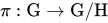
Quotients in the category of algebraic groups are more delicate to deal with. An algebraic subgroup is said to be normal if it is stable under every inner automorphism (which are regular maps). If is a normal algebraic subgroup of , then there exists an algebraic group and a surjective morphism such that is the kernel of . Note that if the field is not algebraically closed, then the morphism of groups may not be surjective (the defect of surjectivity is measured by Galois cohomology).



Similarly to the Lie group–Lie algebra correspondence, to an algebraic group over a field is associated a Lie algebra over . As a vector space, the Lie algebra is isomorphic to the tangent space at the identity element. The Lie bracket can be constructed from its interpretation as a space of derivations.
Hub AI
Algebraic group AI simulator
(@Algebraic group_simulator)
Algebraic group
In mathematics, an algebraic group is an algebraic variety endowed with a group structure that is compatible with its structure as an algebraic variety. Thus the study of algebraic groups belongs both to algebraic geometry and group theory.
Many groups of geometric transformations are algebraic groups, including orthogonal groups, general linear groups, projective groups, Euclidean groups, etc. Many matrix groups are also algebraic. Other algebraic groups occur naturally in algebraic geometry, such as elliptic curves and Jacobian varieties.
An important class of algebraic groups is given by the affine algebraic groups, those whose underlying algebraic variety is an affine variety; they are exactly the algebraic subgroups of the general linear group, and are therefore also called linear algebraic groups. Another class is formed by the abelian varieties, which are the algebraic groups whose underlying variety is a projective variety. Chevalley's structure theorem states that every algebraic group can be constructed from groups in those two families.
Formally, an algebraic group over a field is an algebraic variety over , together with a distinguished element (the neutral element), and regular maps (the multiplication operation) and (the inversion operation) that satisfy the group axioms.
An algebraic subgroup of an algebraic group is a subvariety of that is also a subgroup of (that is, the maps and defining the group structure map and , respectively, into ).
A morphism between two algebraic groups is a regular map that is also a group homomorphism. Its kernel is an algebraic subgroup of , and its image is an algebraic subgroup of .
Quotients in the category of algebraic groups are more delicate to deal with. An algebraic subgroup is said to be normal if it is stable under every inner automorphism (which are regular maps). If is a normal algebraic subgroup of , then there exists an algebraic group and a surjective morphism such that is the kernel of . Note that if the field is not algebraically closed, then the morphism of groups may not be surjective (the defect of surjectivity is measured by Galois cohomology).
Similarly to the Lie group–Lie algebra correspondence, to an algebraic group over a field is associated a Lie algebra over . As a vector space, the Lie algebra is isomorphic to the tangent space at the identity element. The Lie bracket can be constructed from its interpretation as a space of derivations.