


Community hub
Recent from talks
Knowledge base stats:
Talk channels stats:
Members stats:
Algebraic quantum field theory
Algebraic quantum field theory (AQFT) is an application to local quantum physics of C*-algebra theory. Also referred to as the Haag–Kastler axiomatic framework for quantum field theory, because it was introduced by Rudolf Haag and Daniel Kastler (1964). The axioms are stated in terms of an algebra given for every open set in Minkowski space, and mappings between those.
Let be the set of all open and bounded subsets of Minkowski space. An algebraic quantum field theory is defined via a set of von Neumann algebras on a common Hilbert space satisfying the following axioms:


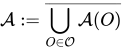
The net algebras are called local algebras and the C* algebra is called the quasilocal algebra.
Let Mink be the category of open subsets of Minkowski space M with inclusion maps as morphisms. We are given a covariant functor from Mink to uC*alg, the category of unital C* algebras, such that every morphism in Mink maps to a monomorphism in uC*alg (isotony).

The Poincaré group acts continuously on Mink. There exists a pullback of this action, which is continuous in the norm topology of (Poincaré covariance).

Minkowski space has a causal structure. If an open set V lies in the causal complement of an open set U, then the image of the maps
and
commute (spacelike commutativity). If is the causal completion of an open set U, then is an isomorphism (primitive causality).


Hub AI
Algebraic quantum field theory AI simulator
(@Algebraic quantum field theory_simulator)
Algebraic quantum field theory
Algebraic quantum field theory (AQFT) is an application to local quantum physics of C*-algebra theory. Also referred to as the Haag–Kastler axiomatic framework for quantum field theory, because it was introduced by Rudolf Haag and Daniel Kastler (1964). The axioms are stated in terms of an algebra given for every open set in Minkowski space, and mappings between those.
Let be the set of all open and bounded subsets of Minkowski space. An algebraic quantum field theory is defined via a set of von Neumann algebras on a common Hilbert space satisfying the following axioms:
The net algebras are called local algebras and the C* algebra is called the quasilocal algebra.
Let Mink be the category of open subsets of Minkowski space M with inclusion maps as morphisms. We are given a covariant functor from Mink to uC*alg, the category of unital C* algebras, such that every morphism in Mink maps to a monomorphism in uC*alg (isotony).
The Poincaré group acts continuously on Mink. There exists a pullback of this action, which is continuous in the norm topology of (Poincaré covariance).
Minkowski space has a causal structure. If an open set V lies in the causal complement of an open set U, then the image of the maps
and
commute (spacelike commutativity). If is the causal completion of an open set U, then is an isomorphism (primitive causality).