
Hubbry Logo
Algebraic independenceAlgebraic independenceMain
Open search
Algebraic independence
Community hub
Algebraic independence
logo
7 pages, 0 posts
0 subscribers
Be the first to start a discussion here.
Algebraic independence
from Wikipedia

In abstract algebra, a subset of a field is algebraically independent over a subfield if the elements of do not satisfy any non-trivial polynomial equation with coefficients in .

In particular, a one element set is algebraically independent over if and only if is transcendental over . In general, all the elements of an algebraically independent set over are by necessity transcendental over , and over all of the field extensions over generated by the remaining elements of .

Example

[edit]

The real numbers and are transcendental numbers: they are not the roots of any nontrivial polynomial whose coefficients are rational numbers. Thus, the sets and are both algebraically independent over the rational numbers.

However, the set is not algebraically independent over the rational numbers , because the nontrivial polynomial
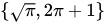
is zero when and .

Algebraic independence of known constants

[edit]

Although π and e are transcendental, it is not known whether is algebraically independent over .[1] In fact, it is not even known whether is irrational.[2] Nesterenko proved in 1996 that:

  • the numbers , , and , where is the gamma function, are algebraically independent over ;[3]
  • the numbers and are algebraically independent over ;
  • for all positive integers , the number is algebraically independent over .[4][clarification needed]

Results and open problems

[edit]

The Lindemann–Weierstrass theorem can often be used to prove that some sets are algebraically independent over . It states that whenever are algebraic numbers that are linearly independent over , then are also algebraically independent over .

The Schanuel conjecture would establish the algebraic independence of many numbers, including π and e, but remains unproven:

Let be any set of complex numbers that are linearly independent over . The field extension has transcendence degree at least over .

Algebraic matroids

[edit]

Given a field extension that is not algebraic, Zorn's lemma can be used to show that there always exists a maximal algebraically independent subset of over . Further, all the maximal algebraically independent subsets have the same cardinality, known as the transcendence degree of the extension.

For every finite set of elements of , the algebraically independent subsets of satisfy the axioms that define the independent sets of a matroid. In this matroid, the rank of a set of elements is its transcendence degree, and the flat generated by a set of elements is the intersection of with the field . A matroid that can be generated in this way is called an algebraic matroid. No good characterization of algebraic matroids is known, but certain matroids are known to be non-algebraic; the smallest is the Vámos matroid.[5]

Many finite matroids may be represented by a matrix over a field , in which the matroid elements correspond to matrix columns, and a set of elements is independent if the corresponding set of columns is linearly independent. Every matroid with a linear representation of this type may also be represented as an algebraic matroid, by choosing an indeterminate for each row of the matrix, and by using the matrix coefficients within each column to assign each matroid element a linear combination of these transcendentals. The converse is false: not every algebraic matroid has a linear representation.[6]

See also

[edit]

References

[edit]
[edit]
Revisions and contributorsEdit on WikipediaRead on Wikipedia
from Grokipedia
In abstract algebra, particularly within the theory of field extensions, a subset SS of a field extension L/kL/k is algebraically independent over the base field kk if, for every finite subcollection {s1,,sn}S\{s_1, \dots, s_n\} \subseteq S and every nonzero polynomial fk[x1,,xn]f \in k[x_1, \dots, x_n], the evaluation f(s1,,sn)0f(s_1, \dots, s_n) \neq 0. Equivalently, the natural evaluation homomorphism from the polynomial ring k[xssS]k[x_s \mid s \in S] to LL is injective, meaning no nontrivial polynomial relation with coefficients in kk holds among the elements of SS. This notion generalizes linear independence from vector spaces to the setting of polynomial rings, capturing the absence of algebraic dependencies beyond the base field. Algebraic independence plays a foundational role in classifying field extensions, distinguishing algebraic extensions—where every element satisfies a polynomial equation over kk—from transcendental ones, where some elements do not. A key structure is the transcendence basis of L/kL/k, defined as a maximal algebraically independent subset BLB \subseteq L such that LL is algebraic over k(B)k(B), the field generated by BB and kk. Every admits a transcendence basis, and all such bases have the same , known as the transcendence degree of L/kL/k, which quantifies the "dimension" of the transcendental part of the extension. For instance, the field of rational functions k(t)k(t) over kk has transcendence degree 1, with {t}\{t\} as a transcendence basis. Beyond field theory, algebraic independence has profound applications in and , where it underpins results on the independence of special values of functions like exponentials, logarithms, and periods. For example, the Lindemann-Weierstrass theorem establishes the algebraic independence of ea1,,eane^{a_1}, \dots, e^{a_n} over the algebraic numbers when the aia_i are algebraic and linearly independent over . In , it relates to the of rings via transcendence degree, influencing studies of ideals and varieties. These concepts enable the decomposition of arbitrary extensions into algebraic and purely transcendental parts, facilitating deeper analysis of infinite extensions.

Definitions and Basic Concepts

Formal Definition

In field theory, a field extension L/KL/K consists of a field LL that contains a subfield KK, where LL is viewed as a vector space over KK. The polynomial ring K[X1,,Xn]K[X_1, \dots, X_n] over KK in nn indeterminates is the ring formed by all finite formal sums ai1inX1i1Xnin\sum a_{i_1 \dots i_n} X_1^{i_1} \cdots X_n^{i_n} with coefficients ai1inKa_{i_1 \dots i_n} \in K, equipped with the usual addition and multiplication of polynomials. Let L/KL/K be a field extension and let SLS \subseteq L be a subset with S=n<|S| = n < \infty. The set S={s1,,sn}S = \{s_1, \dots, s_n\} is said to be algebraically independent over KK if the only polynomial PK[X1,,Xn]P \in K[X_1, \dots, X_n] satisfying P(s1,,sn)=0P(s_1, \dots, s_n) = 0 is the zero polynomial P=0P = 0. Equivalently, the evaluation homomorphism φ:K[X1,,Xn]L\varphi: K[X_1, \dots, X_n] \to L defined by φ(f)=f(s1,,sn)\varphi(f) = f(s_1, \dots, s_n) for all fK[X1,,Xn]f \in K[X_1, \dots, X_n] is injective, meaning no nonzero polynomial maps to zero in LL. For infinite subsets SS, algebraic independence requires that every finite subset of SS is algebraically independent over KK. In the case of a single element, an αL\alpha \in L is algebraically independent over KK if and only if α\alpha is transcendental over KK, meaning there exists no nonzero PK[X]P \in K[X] such that P(α)=0P(\alpha) = 0. The notation K(S)K(S) denotes the field extension of KK generated by SS, which is the smallest subfield of LL containing both KK and SS.

Transcendence Degree

The transcendence degree of a field extension L/KL/K, denoted trdeg(L/K)\operatorname{trdeg}(L/K), is defined as the of any transcendence basis for LL over KK. A transcendence basis is a SLS \subseteq L that is algebraically independent over KK and maximal with respect to this property, meaning that LL is algebraic over the purely K(S)K(S). Equivalently, trdeg(L/K)\operatorname{trdeg}(L/K) measures the "transcendental " of the extension, distinguishing it from purely algebraic extensions where the degree is zero. A key property is that all transcendence bases for a given extension L/KL/K have the same cardinality, ensuring the transcendence degree is well-defined regardless of the choice of basis. If SLS \subseteq L is an algebraically independent set over KK, then trdeg(L/K)=S+trdeg(L/K(S))\operatorname{trdeg}(L/K) = |S| + \operatorname{trdeg}(L/K(S)), where the second term accounts for any additional transcendental elements beyond SS. This holds for both finite and infinite cardinalities, with the degree being finite if and only if there exists a transcendence basis of finite size. In the special case where LL is algebraic over K(S)K(S), the transcendence degree simplifies to trdeg(L/K)=S\operatorname{trdeg}(L/K) = |S|. For towers of field extensions KMLK \subseteq M \subseteq L, the transcendence degree exhibits additivity: trdeg(L/K)=trdeg(L/M)+trdeg(M/K)\operatorname{trdeg}(L/K) = \operatorname{trdeg}(L/M) + \operatorname{trdeg}(M/K). This formula generalizes the behavior in finite towers and extends naturally to infinite cases via cardinal arithmetic, providing a foundational tool for analyzing composite extensions.

Examples and Illustrations

Introductory Examples

A fundamental example of algebraic independence arises in the field of rational functions Q(x)\mathbb{Q}(x), which is the quotient field of the Q\mathbb{Q} where xx serves as an indeterminate. The singleton set {x}\{x\} is algebraically independent over Q\mathbb{Q}, meaning no non-zero fQ[X]f \in \mathbb{Q}[X] satisfies f(x)=0f(x) = 0. This independence reflects the fact that xx is transcendental over Q\mathbb{Q}, allowing Q(x)\mathbb{Q}(x) to function as a purely of degree 1. In contrast, algebraic dependence is illustrated by the set {2,2}\{\sqrt{2}, 2\}
Add your contribution
Related Hubs
User Avatar
No comments yet.
