



Community hub
Recent from talks
Contribute something
Nothing was collected or created yet.
GCD domain
View on Wikipedia| Algebraic structures |
|---|
In mathematics, a GCD domain is an integral domain R with the property that any two elements have a greatest common divisor (GCD); i.e., there is a unique minimal principal ideal containing the ideal generated by two given elements. Equivalently, any two elements of R have a least common multiple (LCM).[1]
A GCD domain generalizes a unique factorization domain (UFD) to a non-Noetherian setting in the following sense: an integral domain is a UFD if and only if it is a GCD domain satisfying the ascending chain condition on principal ideals (and in particular if it is Noetherian).
GCD domains appear in the following chain of class inclusions:
- rngs ⊃ rings ⊃ commutative rings ⊃ integral domains ⊃ integrally closed domains ⊃ GCD domains ⊃ unique factorization domains ⊃ principal ideal domains ⊃ euclidean domains ⊃ fields ⊃ algebraically closed fields
Properties
[edit]Every irreducible element of a GCD domain is prime. A GCD domain is integrally closed, and every nonzero element is primal. In other words, every GCD domain is a Schreier domain.
For every pair of elements x, y of a GCD domain R, a GCD d of x and y and an LCM m of x and y can be chosen such that dm = xy, or stated differently, if x and y are nonzero elements and d is any GCD d of x and y, then xy/d is an LCM of x and y, and vice versa. It follows that the operations of GCD and LCM make the quotient R/~ into a distributive lattice, where "~" denotes the equivalence relation of being associate elements. The equivalence between the existence of GCDs and the existence of LCMs is not a corollary of the similar result on complete lattices, as the quotient R/~ need not be a complete lattice for a GCD domain R.[citation needed]
If R is a GCD domain, then the polynomial ring R[X1,...,Xn] is also a GCD domain.[2]
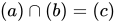
R is a GCD domain if and only if finite intersections of its principal ideals are principal. In particular, , where is the LCM of and .


For a polynomial in X over a GCD domain, one can define its content as the GCD of all its coefficients. Then the content of a product of polynomials is the product of their contents, as expressed by Gauss's lemma, which is valid over GCD domains.
Examples
[edit]- A unique factorization domain is a GCD domain. Among the GCD domains, the unique factorization domains are precisely those that are also atomic domains (which means that at least one factorization into irreducible elements exists for any nonzero nonunit).
- A Bézout domain (i.e., an integral domain where every finitely generated ideal is principal) is a GCD domain. Unlike principal ideal domains (where every ideal is principal), a Bézout domain need not be a unique factorization domain; for instance the ring of entire functions is a non-atomic Bézout domain, and there are many other examples. An integral domain is a Prüfer GCD domain if and only if it is a Bézout domain.[3]
- If R is a non-atomic GCD domain, then R[X] is an example of a GCD domain that is neither a unique factorization domain (since it is non-atomic) nor a Bézout domain (since X and a non-invertible and non-zero element a of R generate an ideal not containing 1, but 1 is nevertheless a GCD of X and a); more generally any ring R[X1,...,Xn] has these properties.
- A commutative monoid ring is a GCD domain iff is a GCD domain and is a torsion-free cancellative GCD-semigroup. A GCD-semigroup is a semigroup with the additional property that for any and in the semigroup , there exists a such that . In particular, if is an abelian group, then is a GCD domain iff is a GCD domain and is torsion-free.[4]
- The ring is not a GCD domain for all square-free integers .[5]
![{\displaystyle R[X;S]}](https://wikimedia.org/api/rest_v1/media/math/render/svg/c74516ec75e51074f16c62f48499adae2129d6db)




![{\displaystyle R[X;G]}](https://wikimedia.org/api/rest_v1/media/math/render/svg/dadcd6f59adfdfd6f36e3295434ac33725dd98c8)
![{\displaystyle \mathbb {Z} [{\sqrt {-d}}]}](https://wikimedia.org/api/rest_v1/media/math/render/svg/692e5dbf23d9a1a818bdf6a358be08ba03796c5b)

G-GCD domains
[edit]Many of the properties of GCD domain carry over to Generalized GCD domains,[6] where principal ideals are generalized to invertible ideals and where the intersection of two invertible ideals is invertible, so that the group of invertible ideals forms a lattice. In GCD rings, ideals are invertible if and only if they are principal, meaning the GCD and LCM operations can also be treated as operations on invertible ideals.
Examples of G-GCD domains include GCD domains, polynomial rings over GCD domains, Prüfer domains, and π-domains (domains where every principal ideal is the product of prime ideals), which generalizes the GCD property of Bézout domains and unique factorization domains.
References
[edit]- ^ Anderson, D. D. (2000). "GCD domains, Gauss' lemma, and contents of polynomials". In Chapman, Scott T.; Glaz, Sarah (eds.). Non-Noetherian Commutative Ring Theory. Mathematics and its Application. Vol. 520. Dordrecht: Kluwer Academic Publishers. pp. 1–31. doi:10.1007/978-1-4757-3180-4_1. MR 1858155.
- ^ Robert W. Gilmer, Commutative semigroup rings, University of Chicago Press, 1984, p. 172.
- ^ Ali, Majid M.; Smith, David J. (2003), "Generalized GCD rings. II", Beiträge zur Algebra und Geometrie, 44 (1): 75–98, MR 1990985. P. 84: "It is easy to see that an integral domain is a Prüfer GCD-domain if and only if it is a Bezout domain, and that a Prüfer domain need not be a GCD-domain".
- ^ Gilmer, Robert; Parker, Tom (1973), "Divisibility Properties in Semigroup Rings", Michigan Mathematical Journal, 22 (1): 65–86, MR 0342635.
- ^ Mihet, Dorel (2010), "A Note on Non-Unique Factorization Domains (UFD)", Resonance, 15 (8): 737–739.
- ^ Anderson, D. (1980), "Generalized GCD domains.", Commentarii Mathematici Universitatis Sancti Pauli., 28 (2): 219–233
GCD domain
View on GrokipediaDefinition and preliminaries
Definition
A GCD domain (greatest common divisor domain) is an integral domain—a commutative ring with multiplicative identity and no zero divisors—in which every pair of nonzero elements possesses a greatest common divisor .[3][2] The element is defined such that divides both and , and any other common divisor of and divides ; moreover, such a is unique up to multiplication by units of .[2][4] In a GCD domain, the existence of GCDs for any two nonzero elements implies the existence of a least common multiple for the same pair, where is an element divided by both and , such that divides any common multiple of and , and is unique up to units.[5][6] Furthermore, these satisfy the relation up to association (multiplication by units).[7]Divisibility concepts
In an integral domain , the divisibility relation is fundamental to the arithmetic structure. For nonzero elements , divides , denoted , if there exists some such that .[8] This relation captures the notion of one element generating another through multiplication, analogous to the integers, and forms a partial order on the nonzero elements when considering associates. Two nonzero elements are associates if for some unit , where a unit is an element with a multiplicative inverse in .[9] Associates are essentially equivalent up to scaling by invertible elements, and the divisibility relation respects this equivalence: if , then any associate of also divides any associate of . In the context of greatest common divisors, which arise in certain domains, this means GCDs are defined only up to multiplication by units, allowing normalization to a canonical representative within associate classes.[10] Integral domains, being commutative rings with identity and no zero divisors, ensure that the product of two nonzero elements is nonzero, which preserves the integrity of the divisibility relation without cancellation issues from zero divisors.[11] Units play a key role here, as they enable the associate relation to "normalize" elements, facilitating comparisons in factorization and common divisor computations. For polynomial rings over an integral domain , the content of a polynomial is the greatest common divisor of its coefficients , assuming admits GCDs.[12] This notion extends divisibility from the base ring to polynomials, where a polynomial is primitive if its content is 1 (up to units), setting the stage for factorization properties like Gauss's lemma in unique factorization domains.Properties
Fundamental properties
In a GCD domain, every irreducible element is prime. To see this, suppose is irreducible and for some in the domain. Then is an associate of , so it properly divides only if it is a unit, which it is not. Thus, either or is an associate of , implying divides or .[13][14] A key consequence of the GCD condition is that finite intersections of principal ideals are principal. In particular, for any two nonzero elements and , the intersection is the principal ideal generated by the least common multiple , where exists and is unique up to association as . This property extends to any finite collection of principal ideals, making their intersection principal.[15][14] The existence of GCDs extends naturally to any finite set of elements. For a finite collection , the GCD is defined iteratively: , and it is unique up to association as the generator of the minimal principal ideal containing all common divisors. This iterative construction preserves the GCD properties, such as divisibility and coprimality relations.[14] GCD domains exhibit a form of chain stabilization for principal ideals through divisibility relations induced by GCDs, but they do not necessarily satisfy the full ascending chain condition on principal ideals (ACCP). Specifically, an ascending chain of principal ideals corresponds to a descending chain of divisors , where GCD computations can identify stabilization points in terms of associate classes, though infinite chains may occur without ACCP. Imposing ACCP on a GCD domain yields a unique factorization domain.[14]Structural properties
Every GCD domain is integrally closed in its field of fractions, meaning that its integral closure coincides with itself. This property follows from the existence of greatest common divisors, which ensures that any element satisfying a monic polynomial equation over the domain must already belong to it. A prototypical example is the ring of integers , which exemplifies both the GCD structure and integral closure in .[16][17] GCD domains are Schreier domains, i.e., integrally closed domains where every finitely generated ideal can be expressed as a finite intersection of principal ideals. This ideal-theoretic characterization highlights the structural simplicity of GCD domains, as it implies that their ideals behave in a controlled manner relative to principal ideals, even without assuming Noetherian conditions. For instance, in a GCD domain, the intersection of two principal ideals equals where , extending the divisibility properties to ideals.[18][19] The class of GCD domains is closed under formation of polynomial rings: if is a GCD domain, then so is for any positive integer . In such polynomial rings, the gcd of two polynomials and is determined by the gcd of their contents (the gcd of their coefficients) and the gcd of their primitive parts (after factoring out the content), facilitated by Gauss's lemma, which preserves primitivity under multiplication. This closure property underscores the robustness of the GCD structure under polynomial extensions.[16][17] GCD domains relate to Krull domains through specific conditions on ideal class groups and dimension: a Krull domain is a GCD domain if and only if it is a unique factorization domain. Consequently, while every unique factorization domain (a special case of GCD domain) is a Krull domain, there exist GCD domains, such as certain valuation domains of infinite rank, that fail to be Krull, and conversely, many Krull domains, like polynomial rings over Dedekind domains with nontrivial class group, are not GCD domains. This distinction illustrates that GCD domains form a subclass of Krull domains only when the latter satisfy unique factorization, but the inclusion does not hold generally.[20][21]Relations to other domains
Unique factorization and atomicity
In GCD domains, the presence of greatest common divisors for any two elements ensures that every irreducible element is prime. This fundamental property stems from the fact that if an irreducible divides a product , then or must be an associate of , forcing to divide one of or . A GCD domain need not be atomic, as there exist elements that cannot be expressed as finite products of irreducibles. However, if a GCD domain is atomic, the primality of irreducibles guarantees that every factorization into irreducibles is unique up to the order and associates of the factors, making it a unique factorization domain (UFD).[22][23] Equivalently, a GCD domain is a UFD if and only if it satisfies the ascending chain condition on principal ideals (ACCP). The ACCP ensures atomicity by preventing infinite descending chains of principal ideals, thus bounding the length of factorizations, while the GCD structure provides uniqueness.[24][14] When a GCD domain is atomic, factorizations into irreducibles can be constructed iteratively by exploiting GCDs to extract common factors. Specifically, suppose with ; then and where , allowing the factorization of to incorporate the common divisor and recurse on the coprime parts and . This process terminates under ACCP, yielding irreducibles, and uniqueness follows by matching the number of occurrences of each prime via successive GCD computations with partial products.[14] Examples of non-UFD GCD domains exist, in which atomicity fails and thus no factorization into irreducibles is possible for certain elements (detailed coverage deferred to Positive examples).[25]Principal and Prüfer domains
A principal ideal domain (PID) is an integral domain in which every ideal is principal. Every PID is a GCD domain, since for any two elements in the domain, the greatest common divisor generates the ideal . The converse does not hold; there exist GCD domains that are not PIDs, such as the ring of entire functions, where not all ideals are principal. A Bézout domain, defined as an integral domain in which every finitely generated ideal is principal, is also a GCD domain, as the Bézout property ensures that can be expressed as a linear combination for some in the domain, generating .[26] Prüfer domains are integral domains in which every finitely generated ideal is invertible. A GCD domain is a Prüfer domain if and only if it is a Bézout domain, since invertibility of finitely generated ideals aligns with the principal nature of such ideals in Bézout domains. In general, GCD domains lack the full invertibility property characteristic of Prüfer domains; for instance, non-principal ideals in a GCD domain may not be invertible, distinguishing them via the structure of maximal ideals, where Prüfer domains exhibit flat epimorphisms to quotient fields at localizations. In any integral domain, the product of two principal ideals satisfies . This holds in GCD domains as well, facilitating computations involving divisibility; however, for non-principal ideals, the multiplication may not preserve similar simplicity, as the GCD structure does not guarantee principal products unless the domain is Bézout. This contrasts with Prüfer domains, where ideal multiplication is more controlled due to invertibility. The inclusion hierarchy among these domains is PIDs Bézout domains GCD domains integrally closed domains, with precise boundaries determined by ideal generation and closure properties: PIDs require all ideals to be principal, Bézout domains extend this to finitely generated ideals, GCD domains ensure element-wise GCDs implying integral closure in the fraction field, but not all integrally closed domains admit GCDs for every pair of elements.Examples
Positive examples
The ring of integers is a prototypical GCD domain, serving as a principal ideal domain (PID) where the greatest common divisor of any two elements exists and can be efficiently computed using the Euclidean algorithm.[14] Polynomial rings over unique factorization domains (UFDs) provide another fundamental class of GCD domains; for instance, the polynomial ring over a field is a Euclidean domain, ensuring the existence of GCDs for any finite set of polynomials via a polynomial analogue of the Euclidean algorithm.[1] Similarly, is a UFD—and thus a GCD domain—by Gauss's lemma, which preserves unique factorization from the coefficients in to polynomials with integer coefficients.[1] Bézout domains, where every finitely generated ideal is principal, form a broad category of GCD domains, as the GCD of elements generates the ideal they produce.[14] A concrete example is the localization of at a prime ideal , which is a discrete valuation ring (hence Bézout) with uniformizer and GCDs determined by the -adic valuation](/page/P-adic_valuation).[27] A non-Noetherian example is the ring of entire functions on the complex plane, which is a Bézout domain (hence GCD domain) but not a UFD, as it is non-atomic.[28] Monoid rings also yield GCD domains under suitable conditions; specifically, if is a GCD domain and is a torsion-free abelian group, then the group ring is a GCD domain, extending the divisibility structure from to the graded components indexed by . Rings of algebraic integers in certain number fields exemplify GCD domains when they are UFDs; the Gaussian integers , the ring of integers of , form a Euclidean domain with respect to the norm , guaranteeing GCDs for any two elements.[1]Counterexamples
Quadratic integer rings that are not maximal orders provide classic counterexamples to GCD domains, as they fail to be integrally closed, a property required of all GCD domains.[14] For instance, the ring is not integrally closed because the element satisfies the equation over its field of fractions but does not belong to the ring. Consequently, cannot be a GCD domain. A specific failure occurs with the elements 4 and , which have common divisors 2 and , but no greatest common divisor exists, as any candidate would lead to a contradiction with the ring's factorization properties. Rings of integers in quadratic number fields with class number greater than 1 offer historical counterexamples of atomic integral domains that are not GCD domains. The ring , the ring of integers of , has class number 2 and is atomic since it is half-factorial, meaning all irreducible factorizations of nonzero nonunits have the same length.[29] However, it is not a GCD domain; for example, the elements 6 and share the common irreducible divisors 2 and , but there is no greatest common divisor among them, as assuming one leads to incompatible ideal structures. This example, first noted in the context of non-unique factorization by Dedekind in the late 19th century, illustrates how non-principal ideals prevent the existence of GCDs for certain elements in such rings. Non-atomic integral domains further demonstrate limitations, as the absence of irreducible elements precludes the structured divisibility needed for GCDs in general. The ring of all algebraic integers is an integral domain with no atoms (irreducible elements), since every nonzero nonunit can be factored indefinitely into nonunits. Thus, lacks GCDs for many pairs of elements, failing the GCD domain condition entirely due to unbounded descending chains of divisors.Generalizations
G-GCD domains
A G-GCD domain is an integral domain in which the intersection of any two invertible ideals is invertible. This property ensures that any two finitely generated invertible ideals have a greatest common divisor given by their intersection, which is itself invertible, thereby extending the elementwise GCD condition of GCD domains to an ideal-theoretic framework. GCD domains are G-GCD domains, as the intersection of two principal ideals in a GCD domain is principal and hence invertible. Prüfer domains are also G-GCD domains, since finitely generated ideals in Prüfer domains are invertible and their intersections remain finitely generated and thus invertible. Similarly, π-domains, where every nonzero nonunit element factors into a product of prime elements, are G-GCD domains.[20][30] They are also integrally closed, as localization at any prime ideal yields a GCD domain, which is integrally closed. Moreover, the property extends to finite intersections: the intersection of any finite number of invertible ideals is invertible, obtained inductively from the pairwise case.[31] This generalization facilitates the study of polynomial rings over such domains, where ideal contents replace element contents, analogous to how fractional ideals behave in Dedekind domains—a special case of Prüfer domains. In particular, Gauss's lemma extends to ideal contents, preserving factorization properties in polynomial extensions.Other extensions
GCD-monoids generalize the notion of GCD domains to the setting of commutative monoids, defined as commutative multiplicative semigroups with a unit element where every finite nonempty subset admits a greatest common divisor.[32] In such monoids, denoted as GCD-monoids, the existence of GCDs for finite subsets ensures that every v-finite v-ideal is principal, making the monoid a v-Bézout monoid.[32] This property facilitates the study of factorization in monoids without assuming full ring structure, and every atomic GCD-monoid is a unique factorization monoid.[33] Ring extensions of GCD-monoids, particularly monoid rings such as polynomial rings over a field with coefficients in a torsion-free GCD-monoid, inherit GCD properties; for instance, if is a GCD-monoid, then the monoid ring over the rationals is a GCD-domain.[34] These extensions preserve divisibility relations and enable the transfer of arithmetic properties from the monoid to the ring, aiding in the analysis of non-standard factorization behaviors.[34] In non-commutative settings, analogues of GCD domains arise in skew polynomial rings and Ore extensions, where GCDs are defined using right or left v-ideals and divisibility. A right generalized GCD domain is an order in a division ring where every finitely generated right v-ideal is a progenerator of the module category, satisfying conditions like for the left conductor.[35] For a commutative generalized GCD domain and an endomorphism of finite order, the skew polynomial ring with multiplication is a right generalized GCD domain, allowing GCD computations via right divisibility in these non-commutative structures.[35] Research has explored connections between GCD properties and t-invertibility in non-Noetherian domains, where t-invertible ideals (those equal to their t-closure) interact with GCD structures to characterize domains with finite t-character or weakly factorial behavior.[36] Further studies focus on refining t-ideal behaviors in existing non-Noetherian GCD-like rings.References
- https://arxiv.org/pdf/2005.10633