


Community hub
Recent from talks
Contribute something
Nothing was collected or created yet.
Ty Tabor
View on Wikipedia
 |
Key Information


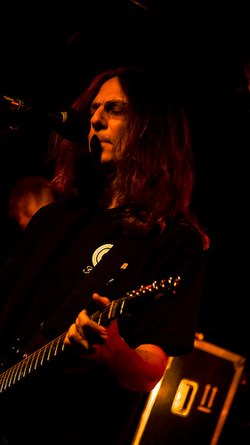
Ty Tabor (/ˈtaɪ ˈteɪbɜːr/ TAY-bur; born September 17, 1961)[1] is an American musician. He is the lead guitarist, songwriter, and co-lead vocalist for the hard rock band King's X. Tabor has a wide-ranging guitar style, from big guitar riffs to middling melodic passages. His use of volume swells and ambient passages add an elemental texture to his compositions. He names his main influences as the Beatles, Allan Holdsworth, Johnny Winter, Ace Frehley, Mel Galley, Brian May, Joe Perry, Mick Box, Buck Dharma, Steve Marriott, Dave Davies, Pete Townshend, Mark Farner, John Fogerty, Alex Lifeson, Phil Keaggy, and the original Alice Cooper band.[2] In 2008, Tabor was added to the guitar show "Chop Shop's" list of "Top 100 Most Complete Guitar Players of All Time" at number 84.[3]
Biography
[edit]Ty Tabor was born in Pearl, Mississippi,[1] and began singing and playing guitar at a young age, and by his early teens was performing with his father and his brother in a bluegrass band in and around his native Jackson. Tabor had also been taken over by the rock and roll sounds of the 1960s and '70s (most notably, The Beatles and Alice Cooper) and began playing in rock bands in his teen years. One of these was a Christian rock outfit called Matthew. Upon graduating from high school, Tabor began touring with Matthew throughout the south. Times were tough on that tour with the band often setting up and performing in the parking lots of restaurants in exchange for food.
He left Matthew and decided to move to Springfield, Missouri, to attend Evangel College, where he quickly entrenched himself in the local music scene. One group he played with got the chance to open up for guitarist Phil Keaggy. However, right before the show, the drummer for Tabor's band quit. Instead of cancelling and missing out on the big opportunity, Tabor volunteered to play drums for the show. Not having his own drum kit, however, forced Tabor to ask Keaggy's drummer if he could use his. The drummer, who happened to be Jerry Gaskill, agreed and the show took place.
Tabor and Gaskill again crossed paths during some demo recording sessions with the Tracy Zinn Band. The two became friends and were involved off and on with other musical projects together.
In spring of 1980, Tabor was asked to perform at a talent show at Evangel with a female singer. In the audience was Doug Pinnick, who was impressed by Tabor's performance. Pinnick eventually got in touch with Tabor and the two began collaborating musically.
Eventually Tabor, Pinnick, Gaskill, and guitarist Dan McCollam formed their own band called The Edge which, over time, evolved into King's X. Tabor is the youngest member of King's X, with Pinnick being eleven years his senior, and Gaskill three-and-a-half years older than him.
Tabor also opened his own recording and mastering facility in Katy, Texas, called Alien Beans Studios.[citation needed] He has mastered numerous album projects as well as produced albums by Rez Band, Jerry Gaskill's solo album, Come Somewhere, and many others. Tabor has since relocated and moved Alien Beans Studios to Kansas City.[4]
Solo works
[edit]
After writing and performing almost exclusively for King's X for over 15 years, Tabor's first solo album, Naomi's Solar Pumpkin, was released independently in 1997. Most of the songs from that debut appeared (re-recorded) on his following 1998 album, Moonflower Lane. It was released on Metal Blade Records with much wider distribution as well as a few new tracks, and also featured drummer Alan Doss on the entire album.
Tabor's next release was 2002's Safety, a much more introspective album that reflected on his then-recent divorce. Subsequent Tabor solo albums are Rock Garden (2006), Balance (2008), Something's Coming (2010), Nobody Wins When Nobody Plays (2013) and Shades (2022).
Other bands
[edit]Tabor has also been a member of several other bands. He played guitar and sang in Platypus featuring Rod Morgenstein (previously of the Dixie Dregs and Winger) on drums, John Myung (of Dream Theater) on bass, and keyboardist Derek Sherinian (of Planet X and formerly Dream Theater). They released two albums.
The same group minus Derek Sherinian continued on as The Jelly Jam and currently have four full-length albums to their credit.
Ty played guitar solos on two tracks, Ode To Pain and Goodbye 25, with Dallas/Houston friends, Mind Body Soul, on their self-titled 4-song EP in 1998, which Ty also mixed and mastered.
Tabor was also involved with the band Jughead featuring two-time David Lee Roth band member Gregg Bissonette (drums), Derek Sherinian (keyboards), and Matt Bissonette (lead vocals, bass). Jughead's self-titled LP was released in 2002 on InsideOut Music.
Tabor has guest appearances on several albums including two different Carmine Appice Guitar Zeus albums, Loudness drummer Munetaka Higuchi's Free World album, and Gregg Bissonette's self-titled solo record.
He also played electric guitar and bass on King's X bandmate Jerry Gaskill's solo album Come Somewhere.
He currently has an ambient / electronica style project with Wally Farkas called Xenuphobe. They have 2 albums that were released through Molken Music.
Tabor also sang one of the human roles on Ayreon's release, 01011001. He played the character "Ty" in the first interlude, Connect the Dots.
Tabor, along with King's X bandmate Doug Pinnick and former Galactic Cowboys members Wally Farkas and Alan Doss, have a band called The Jibbs who have a single song available for download to benefit relief efforts in the aftermath of Hurricane Ike.
Discography
[edit]
King's X[edit]See: King's X discography Solo[edit]
Side projects[edit]
|
Guest appearances[edit]
|
References
[edit]- ^ a b "Fretprints: Ty Tabor". Vintageguitar.com. Retrieved November 10, 2025.
- ^ "Kings X's Ty Tabor: 5 Essential Guitar Albums". November 22, 2016. Retrieved April 24, 2017.
- ^ "JIMMY PAGE, JIMI HENDRIX, EDDIE VAN HALEN, STEVE VAI Among 'Chop Shop''s Top Guitarists". BlabberMouth. Archived from the original on March 15, 2009.
- ^ Price, Jason (December 21, 2017). "ALIEN BEANS: King's X Guitarist Ty Tabor On Breathing Life In His New Solo Record!".
- ^ McGovern, Brian Vincent (November–December 1998). "TY TABOR Moonflower Lane". HM Magazine (74). ISSN 1066-6923. Archived from the original on February 22, 2001.
External links
[edit]| International | |
|---|---|
| National | |
| Artists | |
| People | |
| Other | |

Ty Tabor
View on GrokipediaEarly life
Childhood and musical beginnings
Ty Tabor was born on September 17, 1961, in Pearl, Mississippi, a suburb of Jackson, making him the youngest member of the rock band King's X. Raised in a musical family in the Jackson area, he was immersed in bluegrass traditions from an early age, alongside regional rural blues influences.[1][2] As a youngster, Tabor received his first guitar as a gift from his father and began teaching himself the basics by listening to records and practicing extensively. He soon formed a family bluegrass band, with his brother on banjo and his father providing washtub bass; the group performed at local festivals around Mississippi and shared stages with legends such as Lester Flatt, Grandpa Jones, and Minnie Pearl. These early performances, starting in his pre-teen years, fostered his initial passion for music and stage presence.[7][2][8] During his high school years in Jackson, Tabor continued playing guitar in local bands, expanding his influences to include hard rock acts like the Beatles, Jimi Hendrix, Alice Cooper, KISS, Rush, Queen, and Aerosmith, which shifted his focus from bluegrass toward electric guitar and rock. At age 15, he attended a KISS concert at the Jackson Coliseum, an experience that further solidified his enthusiasm for live music. Upon graduating high school, Tabor decided to commit fully to a career in music, forgoing other conventional paths, and relocated to Springfield, Missouri, to pursue opportunities in recording and performance.[1][2][9]Initial bands and influences
In his late teens during the late 1970s, Ty Tabor formed several local rock bands in Jackson, Mississippi.[1] These early groups marked his transition from family-based bluegrass ensembles—such as one he started with his brother on banjo and father on washtub bass, playing festivals across the state—to more rock-oriented outfits that allowed him to experiment with electric guitar. Tabor also joined the Christian rock band Matthew around this time, immersing himself in the burgeoning scene that blended faith-based lyrics with hard rock energy. After graduating high school, he toured with Matthew throughout the South before leaving the band.[2][2] Tabor's musical style was profoundly shaped by a diverse array of influences from the 1960s and 1970s, including the innovative guitar work of Jimi Hendrix, the melodic songcraft of The Beatles, and the heavy riffing of Led Zeppelin.[1] Progressive rock elements from bands like Yes and Genesis further inspired his interest in complex structures and atmospheric textures, while hard rock pioneers such as Alice Cooper, KISS, Rush, Queen, and Aerosmith fueled his passion for dynamic performances and solid-state amplification techniques.[2] Guitarists like Brian May, Eric Clapton (during his Cream era), Robin Trower, Johnny Winter, Alex Lifeson, Ace Frehley, and Phil Keaggy also played key roles in honing his versatile tone and phrasing, which emphasized volume swells and ambient passages.[10] These inspirations laid the groundwork for Tabor's signature sound, informing the guitar tone he would refine in subsequent projects. After attending Evangel University in Springfield, Missouri, around 1980, Tabor relocated to Houston, Texas, in the mid-1980s, drawn by opportunities in the Christian rock community through a label connection that offered production work.[1] This move deepened his engagement with the scene, where he collaborated on spiritually themed music amid a network of faith-driven artists and producers.[10] Prior to the formation of King's X, Tabor co-founded the band The Edge in Springfield circa 1980 with bassist/vocalist Doug Pinnick and drummer/vocalist Jerry Gaskill, initially adding guitarist Dan McCollam and later Kirk Henderson to the lineup.[1] Operating as a Top 40 and classic rock cover band on the Missouri bar circuit, The Edge provided Tabor with a platform to develop his songwriting, blending original compositions with covers to explore vocal harmonies and instrumental interplay.[10] This period was crucial for refining his creative process, as the group's evolution into the trio Sneak Preview allowed him to focus on collaborative songcraft that emphasized emotional depth and rhythmic innovation.[1]Career with King's X
Formation and early success
In the early 1980s, Ty Tabor met bassist/vocalist dUg Pinnick and drummer/vocalist Jerry Gaskill in Springfield, Missouri, through the local Christian music scene at Evangel University, where Tabor's performance caught Pinnick's attention during a talent show.[1] The trio formed a band initially called The Edge, initially covering popular rock songs, while drawing from their Christian backgrounds but steering away from explicitly religious themes and the Christian rock label, with Tabor contributing guitar riffs and backing vocals alongside his bandmates' influences from gospel, funk, and hard rock.[11] By 1985, they relocated to Houston, Texas, to pursue opportunities in the larger music market, adopting the name King's X under the guidance of manager Sam Taylor, who helped refine their sound into a distinctive blend of progressive metal and soulful harmonies.[11] King's X signed with independent label Megaforce Records in 1987, releasing their debut album Out of the Silent Planet on March 15, 1988, which showcased Tabor's heavy, riff-driven guitar work on tracks like "Goldilox" and "Power of Love," establishing the band's signature layered sound.[1] The album received positive critical reception for its innovative fusion of genres but achieved modest commercial success, peaking outside the Billboard 200 while building a dedicated underground following through word-of-mouth and early live shows.[12] Following the debut, King's X transitioned to major label Atlantic Records, releasing Gretchen Goes to Nebraska in 1989, a concept album inspired by Gaskill's short story that highlighted Tabor's evolving riff craftsmanship and the band's tight rhythmic interplay, earning acclaim as a progressive rock milestone.[11] Their third album, Faith Hope Love in 1990, further solidified their reputation with melodic hooks and spiritual undertones, achieving their first Billboard 200 entry at No. 85 and spawning the single "It's Love," though mainstream radio largely overlooked them due to their eclectic style amid the rise of hair metal and emerging grunge.[13] The band's early success came through relentless touring in the late 1980s and early 1990s, opening for established acts like Cheap Trick, Blue Öyster Cult, and Robert Plant, as well as sharing bills with Seattle grunge pioneers, which exposed them to broader audiences and fostered a loyal cult following despite persistent radio resistance.[11] These tours, often in mid-sized venues, highlighted Tabor's dynamic stage presence and riff-heavy sets, helping King's X carve out a niche as influencers on future alternative rock acts, even as commercial breakthroughs remained elusive.[14]Evolving role and recent developments
In the 2000s, King's X navigated significant challenges following their major-label tenure, including being dropped by Atlantic Records following the release of Ear Candy in 1996, which shifted their focus toward independent releases and extensive touring to maintain their fanbase.[15] The band issued Ogre Tones in 2004 through Metal Blade Records, where Ty Tabor's songwriting contributions grew more prominent, including co-writing tracks that highlighted his layered guitar arrangements and occasional lead vocals, marking an evolution from his earlier rhythm-focused role. This trend continued on the self-titled XV in 2008, their last studio album for over a decade, featuring Tabor's increased involvement in vocal harmonies and compositions such as "Silent Night," which underscored the band's maturing collaborative dynamic.[16] The post-2008 period saw a brief hiatus in studio recording amid personal and logistical hurdles, with the trio prioritizing live performances across North America and Europe during the 2010s to sustain momentum without a major label backing.[17] Tabor's role evolved further as he assumed more lead vocal duties in select songs during tours, allowing for a balanced interplay with dUg Pinnick's dominant presence, while his production input refined the band's signature groove-oriented sound.[18] King's X broke the 14-year studio silence with Three Sides of One in September 2022 via Inside Out Music, an album that emphasized Tabor's expanded creative footprint through key tracks like "Let It Rain," where he delivered lead vocals and intricate riffing that captured the band's renewed unity.[19] However, the release was overshadowed by Tabor's diagnosis of a serious, unspecified illness in July 2022, which required vigilant medical monitoring and forced the cancellation of their planned European fall tour.[20] Tabor underwent treatment and recovered sufficiently to resume activities, enabling the band to support the album with U.S. dates later that year.[21] In 2025, King's X toured actively, with Tabor fully reintegrated into live performances that showcase his enduring guitar prowess and vocal contributions. The band performed Northeast dates in October, including a show at Space Ballroom in Hamden, Connecticut, on October 16, followed by Florida engagements in November, such as the November 13 performance at Culture Room in Fort Lauderdale.[22] These outings reflect the stability of the lineup and Tabor's pivotal role in sustaining the group's legacy amid ongoing challenges. This period also paralleled Tabor's solo release Shades in 2022, which complemented his band work without overshadowing it.[23]Solo career
Debut and experimental phase
Ty Tabor's motivations for pursuing solo work emerged in the late 1990s, during a period of continued success with King's X, as he sought to explore personal songwriting and production free from the band's collaborative constraints.[24] His debut solo album, Naomi's Solar Pumpkin, was self-produced and recorded sporadically from November 1996 to June 1997 at his home studio in Katy, Texas.[25] Intended initially as a demo to secure a record deal, the album was released independently in 1997 through mail-order distribution, marking Tabor's first foray into fully autonomous creative control.[26] Building on this foundation, Tabor released Moonflower Lane in 1998, which re-recorded several tracks from Naomi's Solar Pumpkin while incorporating new material in a self-produced format recorded at Alien Beans and Sunflower Studio from September to October 1997.[27] The album blended rock elements with introspective pop influences, evoking a Beatles-like flavor through Tabor's solo handling of vocals, guitar, bass, and drums.[28] In the early 2000s, Tabor furthered his experimental tendencies with Safety in 2002, an album written and recorded over three years that delved into lo-fi aesthetics and improvisational song structures to chronicle personal emotional journeys, including the end of a marriage.[29] Released on Metal Blade Records, it emphasized raw, heartfelt rock delivery with minimal production polish.[30] The establishment of Alien Beans Studios in Texas during this phase afforded Tabor greater recording flexibility, enabling home-based experimentation without external pressures.[3]Maturity and later works
In the mid-2000s, Ty Tabor's solo work began to emphasize more structured rock arrangements, moving toward polished melodic compositions while incorporating personal lyrical reflections. His 2006 album Rock Garden, released via InsideOut Music, exemplifies this shift with its focus on driving rock tracks featuring Tabor's signature guitar work and catchy hooks, marking it as his most commercially embraced solo effort to date.[31][32] This evolution continued into the early 2010s, as seen in Something's Coming (2010, Molken Music), where Tabor delivered introspective lyrics addressing ambiguous social and personal themes, including critiques of politics and human behavior, blended with heavy guitar-driven rock structures.[33][34] The album highlighted Tabor's growth in songwriting, balancing emotional depth with accessible hard rock energy, and showcased his ability to layer personal narratives over robust instrumentation. Around 2017, Tabor relocated Alien Beans Studios to Kansas City, Missouri, upgrading to enhanced facilities that supported advanced recording and mastering capabilities for his ongoing projects.[35] This move aligned with a period of professional refinement, allowing greater control over production in his solo endeavors. Tabor's later solo output deepened themes of introspection, personal loss, and musicianship, often drawing from life experiences. His 2022 album Shades, his 11th solo release via Rat Pak Records, features ten new tracks that return to foundational rock elements with autobiographical lyrics exploring love, heartbreak, redemption, and grief—particularly the death of his father in songs like "Best Day in a While" and "Ashes."[36][37] Recorded amid the COVID-19 pandemic and a temporary hiatus from King's X (whose album Three Sides of One also arrived that year), Shades underscores Tabor's meditative approach to guitar textures and existential reflections on human fragility.[38] These works reflect a mature synthesis of faith-infused resilience—echoing broader motifs in his career—and technical prowess, prioritizing emotional authenticity over experimentation.[37]Other projects and collaborations
Supergroups and side bands
Ty Tabor has been a key member of several supergroups and side bands, often blending progressive rock, jam elements, and experimental sounds with musicians from prominent acts. These projects allow him to explore collaborative dynamics beyond his primary work, showcasing his guitar work and vocals in diverse lineups. One of Tabor's notable supergroups is Platypus, formed in the late 1990s with bassist John Myung of Dream Theater, keyboardist Derek Sherinian, and drummer Rod Morgenstein of the Dixie Dregs. The band released two albums: When Pus Comes to Shove in 1998 and Ice Cycles in 2000, emphasizing intricate progressive metal compositions with Tabor handling lead guitar and vocals.[39][40] Tabor co-founded The Jelly Jam in 2001 with Dream Theater's John Myung on bass and Rod Morgenstein on drums, creating an ongoing power trio focused on jam-oriented progressive rock. The group has released four studio albums, including The Jelly Jam (2002), 2 (2004), Shall We Descend? (2011), and Profit (2016), with Tabor contributing guitar, lead vocals, and production.[41][42] In 2002, Tabor participated in the one-off rock project Jughead, a high-energy pop-rock outfit featuring keyboardist Derek Sherinian, bassist Matt Bissonette, and drummer Gregg Bissonette. The band's self-titled album, released that year on InsideOut Music, delivered a mix of alternative rock and power pop tracks, with Tabor on guitar and vocals.[43] Tabor also collaborates in the ambient duo Xenuphobe with Wally Farkas of Galactic Cowboys, pursuing instrumental electronica and atmospheric soundscapes. The project debuted with 1.0 in 2006, followed by 2.0 Electrolux in 2007 and Drone in 2015, all released through Molken Music, emphasizing Tabor's textural guitar layers in a non-vocal, experimental format.[44]Guest appearances and production
Throughout his career, Ty Tabor has made notable guest contributions to other artists' recordings, often lending his distinctive guitar work and vocals to progressive and hard rock projects. One prominent example is his vocal performance on the 2008 Ayreon album 01011001, where he portrayed the character "Ty," a 21st-century corporate wage slave, on the track "Connect the Dots." His parts were recorded at his own Alien Beans Studio in Texas, adding a layer of introspective, blues-tinged delivery to Arjen Lucassen's expansive concept album. Additionally, Tabor provided a vocal sample for the album's title track, "01011001," enhancing the futuristic narrative with his raw, emotive style.[45][46][47] Tabor also collaborated with the band Mind Body Soul on their self-titled 1998 EP, contributing guitar performances alongside band members Maston Walker and Randy St. John, who shared ties to the Christian rock scene overlapping with King's X. In addition to playing, Tabor mixed and mastered the four-track release, which featured songs like "Fly" and "Sweet Time," reflecting a blend of alternative rock and introspective lyrics. He further supported the project by shooting and editing the music video for "Fly," showcasing his multifaceted involvement in supporting peers from the Houston music community.[48] Beyond vocals, Tabor has appeared as a guest guitarist on select tracks across various releases, including indie and supergroup efforts. For instance, on Carmine Appice's 1995 album Guitar Zeus, Tabor delivered the guitar solo on "Killing Time," contributing his signature riff-driven approach to the all-star drum project that featured luminaries like Brian May and Yngwie Malmsteen. Similar guest spots appear on later iterations, such as the 2006 compilation Ultimate Guitar Zeus, including his contribution on "Trippin' Again," from Guitar Zeus 2. These one-off contributions highlight Tabor's influence without long-term band commitments.[49] In production roles, Tabor handled the full production for his early solo albums, such as Naomi's Solar Pumpkin (1997) and Moonflower Lane (1998), where he shaped the ambient, guitar-focused soundscapes that defined his initial forays outside King's X. He extended this expertise to friends' projects, notably producing Resurrection Band's 1995 concept album Lament, a modern retelling of the prodigal son story, which earned praise for its polished hard rock edge. At Alien Beans Studio, Tabor occasionally engineered demos and sessions for collaborators, including hosting Ayreon's recordings, providing a creative hub for emerging and established acts in the progressive scene. These behind-the-scenes efforts underscore his role as a mentor and technician in the rock underground.[50][51][52]Musical style and equipment
Guitar technique and influences
Ty Tabor's guitar technique is distinguished by its versatility, incorporating hybrid picking and fingerstyle elements to fuse funk rhythms, progressive intricacies, and heavy riffing. This approach allows for dynamic textural shifts, from punchy, syncopated grooves to fluid, arpeggiated passages that enhance the layered sound of King's X. His right-hand precision enables seamless transitions between picked aggression and thumb-assisted hybrid lines, creating a rhythmic drive that underpins the band's signature blend of genres.[8][53] Central to Tabor's style is an emphasis on melodic solos that prioritize emotional expression over flash, often weaving bluesy bends and sustained notes into the harmonic framework. In live settings, these solos integrate closely with co-lead vocals, where Tabor's guitar lines harmonize with his and Doug Pinnick's shared singing, as demonstrated in King's X's 2025 performances of "In the New Age." This vocal-guitar synergy amplifies the band's communal feel, turning solos into extensions of the lyrical narrative.[10][54] Tabor's influences draw from rock's expressive pioneers, including Jimi Hendrix's cosmic blues and emotive phrasing, Eddie Van Halen's tapping innovations that expanded technical possibilities, and Allan Holdsworth's fusion complexity, which reshaped his conceptual approach to improvisation. He has described Holdsworth's contributions to the 1978 U.K. album as transformative, fundamentally altering his perspective on guitar voicing and harmony. Additional inspirations like Johnny Winter's aggressive blues and Ace Frehley's melodic leads further inform Tabor's riff-oriented yet lyrical sensibility.[53][55][56] In recognition of his well-rounded proficiency, Tabor was ranked #84 on Chop Shop's 2008 list of the Top 100 Most Complete Guitar Players of All Time, highlighting his command of rhythm, lead, and compositional depth.Signature gear and tone
Ty Tabor has long favored solid-state amplifiers for their reliability and consistent tone, a preference that shapes his warm, riff-driven sound characterized by clarity and immediacy without the variability of tube amps. His go-to amp has been the Gibson Lab Series L5, a solid-state model he has described as his all-time favorite for its punchy response and ability to deliver a full-bodied tone suitable for both rhythm and leads.[23] In recent years, he has incorporated the Orange Crush series, another solid-state option, praising its girth and similarity to the L5 while noting its modern reliability for live and studio use.[23] Tabor's shift toward solid-state setups evolved from early experiences with the Lab Series in the 1980s, where he valued its stability amid touring challenges, though he briefly experimented with tube amps like Marshalls before returning to transistors for their predictability.[57][23] For guitars, Tabor primarily relies on solid-body electrics that emphasize sustain and articulation, including his signature models such as the Zion Ty Tabor and Guilford Ty Tabor designs, both equipped with versatile pickups like Seymour Duncan P-Rails for humbucker and single-coil tones. He also frequently uses Fender Stratocaster Elites from the 1980s, modified for drop tunings, and Gibson Les Pauls for their thick midrange, which complements his riff-heavy style. These instruments contribute to his iconic sound by providing a balanced frequency response that cuts through King's X's dense mixes without overpowering the band's harmonies.[58][59] Tabor's effects chain remains minimalistic, focusing on analog delays and overdrives to enhance rather than dominate his natural amp tone, resulting in a warm, organic riff quality with subtle depth. Key pedals include the Ibanez DD200 for short, ambient delays that add space to leads, and the Mojo Hand Rook Royale as a clean boost to push the amp into natural overdrive without heavy distortion. He occasionally employs vibe pedals like the Sweet Sound Ultra Vibe or Rick Weaver Violet Vibe for modulation, but avoids complex processing to maintain a direct, riff-driven edge. This setup supported the recording of his 2022 solo album Shades, where multiple guitar layers through solid-state amps created layered solos with harmonic richness.[57][23] In his home studio, Alien Beans, Tabor employs a compact yet effective setup centered on solid-state amps and multi-tracking techniques to build solos, layering multiple takes of his Strat or Les Paul through the Lab Series L5 for depth and texture. This approach allows him to experiment with riff variations and harmonic overlays, capturing the warmth of analog delays in a controlled environment.[60]Discography
King's X contributions
Ty Tabor served as lead guitarist, backing and co-lead vocalist, and primary songwriter alongside Doug Pinnick and Jerry Gaskill for King's X's discography, co-authoring the majority of the band's material across their collaborative output.[61] His contributions emphasized melodic guitar riffs, harmonic structures, and introspective lyrics, often drawing from progressive rock and psychedelic influences.Studio albums
King's X released thirteen studio albums featuring Tabor's songwriting and performances, spanning from their debut to their most recent full-length release as of 2025.- Out of the Silent Planet (1988) – Tabor co-wrote tracks including the psychedelic opener "In the Kingdom," establishing the band's signature sound.[62]
- Gretchen Goes to Nebraska (1989) – Includes Tabor's co-written hit "Summerland," which he wrote, alongside "Pleiades."[62][63]
- Faith Hope Love (1990) – Tabor contributed to songs like "It's Love," blending Beatles-esque harmonies with his guitar work.[64]
- King's X (1992) – All tracks co-written by Tabor, Pinnick, and Gaskill, except "Prisoner"; features Tabor's layered guitar on "The World Around Me."[65]
- Dogman (1994) – Tabor co-wrote heavier tracks like "Dogman" and "Fool's Gold," shifting toward grunge influences.[62]
- Ear Candy (1996) – Includes Tabor's contributions to "Let Me Live My Life" and acoustic-driven pieces.[62]
- Tape Head (1998) – Tabor co-authored songs such as "Tangerine" and "Over and Over."[62]
- Please Come Home...Mr. Bulbous (2000) – Features Tabor's writing on experimental tracks like "Screaming in the Silence."[62]
- Manic Moonlight (2001) – Tabor contributed to "Trinity" and "Reigning Frogs," incorporating electronic elements.[62]
- Black Like Sunday (2003) – Includes Tabor's co-writes on "When I'm Dead" and gospel-tinged "Finish What Ya Started."[62]
- Ogre Tones (2005) – Tabor helped craft raw, riff-heavy songs like "Tide of the Rising Son."[62]
- XV (2008) – Tabor co-wrote all tracks, including the title track and "Love and Rockets."[62]
- Three Sides of One (2022) – Tabor's most recent studio album contribution with the band as of 2025, co-writing songs like "Let It Rain" and providing lead vocals on "Flood, Pt. 1."[62][66]
Live albums
King's X issued several live recordings capturing Tabor's dynamic stage presence and improvisational guitar solos.- Live and Live Some More (1994, recorded in Dallas 1994)[61]
- Live All Over the Place (2004) – A double-disc set spanning the band's career, with Tabor's performances on classics like "King."[61]
- Live Love in London (2010)[61]
- Tales from the Empire: Cleveland 6.26.92 (2010)[61]
- Burning Down Boston: Live at the Channel (2012, recorded 1991)[61]
- Born of Fire (2020, live 1992) – Archival release highlighting early high-energy shows.[67]
Compilations
- Best of King's X (1997) – Collects key tracks from 1988–1996, including Tabor-co-written staples like "Goldilox" and "Mr. Wilson."[68]
- Dogman Demos (2005) – Unreleased demos from the Dogman era, featuring Tabor's raw songwriting sketches.[61]
Singles
King's X released several singles, with Tabor contributing guitar and vocals.- "King" (1988)[61]
- "Goldilox" (1988)[61]
- "Summerland" (1989)[61]
- "Over My Head" (1990)[61]
- "Let It Rain" (2022) – Lead single from Three Sides of One, co-written by Tabor, Pinnick, and Gaskill.[66]
Solo albums
Ty Tabor began releasing solo albums in the late 1990s, marking a departure from his work with King's X to explore personal songwriting and multi-instrumental production, often during band hiatuses. His early efforts were self-recorded at his home studio, Alien Beans, emphasizing melodic rock with introspective lyrics. Over the years, Tabor has issued nine solo studio albums as of 2025, primarily handling production duties himself and releasing through independent labels.[50]| Album | Release Year | Label | Key Notes |
|---|---|---|---|
| Naomi's Solar Pumpkin | 1997 | Tabor Tooth Music | Tabor's debut solo album, recorded sporadically at home from November 1996 to June 1997 as a demo to attract a record deal; he played all instruments and produced it independently, with limited online distribution.[26][69][6] |
| Moonflower Lane | 1998 | InsideOut Music | Second solo release, recorded in just two weeks in September 1997 at Alien Beans; self-produced by Tabor, featuring 11 tracks of melodic hard rock, including contributions from his son on French horn for one song.[70][71] |
| Safety | 2002 | Earache Records | Written and recorded over three years at Alien Beans, self-produced, mixed, and mastered by Tabor; explores personal themes like marital struggles through 10 plangent pop-rock songs, with programmed and live drums.[72][73] |
| Rock Garden | 2006 | InsideOut Music | Third solo album, inspired by Tabor's Houston backyard; he handled vocals, guitars, bass, and keyboards, with drums by Randy St. Nicholas and guest appearances by Dug Pinnick and Wally Farkas; emphasizes Beatle-esque melodies across 11 tracks.[74][75] |
| Balance | 2008 | Molken Music | Self-produced at home, featuring Tabor on most instruments including keyboards; 10 tracks blending progressive and alternative rock, with guest drums by Randy St. Nicholas, noted for its craftsmanship in songwriting and guitar work.[76][77] |
| Something's Coming | 2010 | Molken Music | Home-recorded and self-produced; 11 songs showcasing Tabor's melodic style, with a focus on anticipation and personal reflection, continuing his independent release approach.[50] |
| Nobody Wins When Nobody Plays | 2013 | Molken Music | Produced by Tabor at Alien Beans; 10 tracks of idiosyncratic melodies and evocative lyrics, highlighting his multi-instrumental talents and introspective themes.[50][78] |
| Alien Beans | 2018 | Rat Pak Records | Named after Tabor's home studio; eighth solo album, self-produced with accessible hard rock elements, featuring 10 songs that balance melody and energy, recorded entirely by Tabor except for drums.[79] |
| Shades | 2022 | Rat Pak Records | Latest solo release as of 2025, produced by Tabor; 10 tracks exploring varied emotional "shades" through rock arrangements, with modern production touches while retaining his signature guitar-driven sound.[80] |
Side projects and collaborations
Ty Tabor has been involved in several collaborative projects outside his primary work with King's X, often teaming up with fellow progressive and hard rock musicians to explore diverse styles from prog rock to ambient electronica. Platypus was a short-lived progressive rock supergroup formed in 1997, featuring Tabor on guitar and vocals alongside bassist John Myung (Dream Theater), keyboardist Derek Sherinian (ex-Dream Theater), and drummer Rod Morgenstein (Dixie Dregs). The band released two studio albums: When Pus Comes to Shove in 1998, which showcased a blend of hard rock grooves and intricate instrumentation, and Ice Cycles in 2000, emphasizing Tabor's melodic guitar work and songwriting contributions.[81][40] The Jelly Jam, another supergroup collaboration, began in 2001 with Tabor providing guitar and vocals, joined by Myung on bass and Morgenstein on drums. Known for its fusion of progressive elements and heavy riffing, the band has issued four studio albums: the self-titled debut The Jelly Jam in 2002, The Jelly Jam 2 in 2004, Shall We Descend? in 2011, and Profit in 2016, with Tabor's layered guitar tones and harmonies central to their sound.[41][42] In 2002, Tabor contributed guitar to the self-titled debut album by Jughead, a rock outfit also featuring Sherinian on keyboards, Matt Bissonette on bass, and Gregg Bissonette on drums; the release highlighted energetic, riff-driven tracks influenced by classic hard rock.[82] Tabor's ambient side emerged in Xenuphobe, an instrumental electronic project he co-founded with Wally Farkas (Galactic Cowboys) in the mid-2000s. Their releases include the digital album 1.0 in 2006 and 2.0 Electrolux in 2007, focusing on atmospheric soundscapes and experimental textures crafted primarily through guitar effects and synthesizers.[44] Earlier, in 1998, Tabor lent guitar solos to two tracks on the self-titled four-song EP by the Dallas-based rock band Mind Body Soul, while also handling mixing and mastering duties for the project.[48]Guest spots
Throughout his career, Ty Tabor has contributed to various external recordings through guest spots, providing guitar work, vocals, and production on select tracks and albums by other artists. These appearances, often fitting around King's X touring and recording schedules, showcase his collaborative spirit in rock, metal, and progressive genres.[2] The following is a chronological overview of notable guest contributions:- 1986: Tabor played guitar on multiple tracks of Christian contemporary artist Morgan Cryar's album Fuel on the Fire, and co-wrote the song "Pray in the USA."[83]
- 1995: Tabor produced the Resurrection Band's concept album Lament, providing creative input alongside his production duties.[52][84]
- 1995: Tabor contributed guitar to "Killing Time" on drummer Carmine Appice's all-star project Guitar Zeus.[82]
- 1997: Tabor performed guitar on tracks 1 ("Nuclear Foot"), 3 ("Free World"), 7 ("Bell"), 9 ("New York"), and 10 ("Dream On") from Loudness drummer Munetaka Higuchi's Free World, co-writing tracks 1 and 10.[85]
- 1998: Tabor played guitar on "Dr. Toulak" from drummer Gregg Bissonette's self-titled instrumental album.[86]
- 2000: Tabor provided guitar for "Trippin' Again" on Carmine Appice's Guitar Zeus 2: Channel Mind Radio.[87]
- 2008: Tabor delivered vocals portraying a 21st-century corporate wage slave on "Connect the Dots" from Ayreon mastermind Arjen Lucassen's concept album 01011001.[88]
- 2013: Tabor recorded guitar solos for tracks 5 ("Bellerification"), 11 ("WTC 7"), and 12 ("March of the Neocons") on indie rock project Bill Pitts' The Adventures of Dr. Mumbai.[89]