Recent from talks
Nothing was collected or created yet.
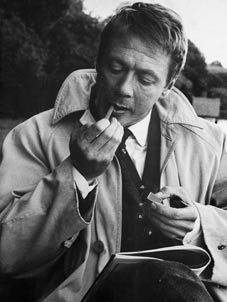
Allan Edwall
View on WikipediaJohan Allan Edwall (25 August 1924 – 7 February 1997) was a Swedish actor, director, author, composer and singer, best-known outside Sweden for the small roles he played in some of Ingmar Bergman's films, such as Fanny and Alexander (1982). He found his largest audience in the Scandinavian countries for playing lovable characters in several of the film and TV adaptations of the children's stories by Astrid Lindgren. He attended Stockholm's Royal Dramatic Training Academy from 1949 to 1952. During his long career he appeared in over 400 works. At the 10th Guldbagge Awards in 1974, he won the award for Best Actor for his role as Emil's short-tempered father Anton Svensson in Emil and the Piglet.[2]
Key Information
His 1984 film Åke and His World was entered into the 14th Moscow International Film Festival.[3]
In his self-written songs, he frequently attacked the injustices of society. The music is similar to folk music often using violin and accordion. He won a Swedish Grammy posthumously in 2006.
Edwall also owned a theatre, Teater Brunnsgatan Fyra in Stockholm, which he bought in 1986 and operated until his death in 1997 of prostate cancer (it is now managed by Kristina Lugn’s daughter Martina Montelius). [citation needed]He was the father of photographer Mattias Edwall and stage director, actor and musician Måns Edwall (1960–2016).[4] Acting colleague Erland Josephson wrote about him in Expressen after his death: "He was odd. But, damn it, he managed to be odd in a universal way!"
Partial filmography
[edit]- Resan till dej (1953) - Composer (uncredited)
- Our Father and the Gypsy (1954) - Natan
- Dans på rosor (1954) - Olsson, journalist (uncredited)
- Wild Birds (1955) - Fiorentino
- Girls Without Rooms (1956) - Ulla's Husband (uncredited)
- No Tomorrow (1957) - Poet
- Körkarlen (1958) - Tramp
- Raggare! (1959) - Narrator (voice)
- The Virgin Spring (1960) - Beggar
- The Die Is Cast (1960) - Dag Serén
- Heart's Desire (1960) - Servant
- The Wedding Day (1960) - Vicar
- The Devil's Eye (1960) - The ear demon
- On a Bench in a Park (1960) - Man at Restaurant
- Lovely Is the Summer Night (1961) - Luffaren
- Briggen Tre Liljor (1961) - Simon Toking
- Kort är sommaren (1962) - Doctor
- Winter Light (1963) - Algot Frövik
- All These Women (1964) - Jillker
- 4x4 (1965) - Banvakten (segment "Uppehåll i myrlandet")
- My Home Is Copacabana (1965) - Narrator (voice)
- Festivitetssalongen (1965) - Lund - Doctor
- Träfracken (1966) - Falk
- Här har du ditt liv (1966) - August
- Mördaren - en helt vanlig person (1967) - Wilhelmsson
- Människor möts och ljuv musik uppstår i hjärtat (1967) - Narrator (voice)
- Eriksson (1969) - Eriksson - Verkstadsarbetare
- Bokhandlaren som slutade bada (1969) - Jacob
- We Are All Demons (1969) - Tor, den syke matrosen
- Ministern (1970) - Lindbaum
- The Emigrants (1971) - Danjel
- Emil i Lönneberga (1971) - Anton - Emils pappa
- The New Land (1972) - Danjel
- Nya hyss av Emil i Lönneberga (1972) - Anton - Emils pappa
- Emil och griseknoen (1973) - Anton
- Elvis! Elvis! (1976) - Elvis' Grandfather
- Games of Love and Loneliness (1977) - Markel
- Måndagarna med Fanny (1977) - Driver
- The Brothers Lionheart (1977) - Mattias
- To Be a Millionaire (1980) - Kansliråd Allan Persson
- Sverige åt svenskarna (1980) - Doctor Karl Otto
- Madicken på Junibacken (1980) - Herr Nilsson
- SOPOR (1981) - Thorbjörn Fälldin
- Tuppen (1981) - Thorsson, receptionist
- Rasmus på luffen (1981) - Oskar
- Fanny and Alexander (1982) - Oscar Ekdahl - Ekdahlska huset
- Limpan (1983) - Sture Charles 'Limpan' Lindberg
- P & B (1983) - Josef 'Stavros' Bendel
- Åke and His World (1984) - Principal Godeman
- Ronia, the Robber's Daughter (1984) - Skalle-Per
- The Sacrifice (1986) - Otto
- Mälarpirater (1987) - Frans i Flinta
- Resan till Melonia (1989) - Prospero (voice)
Discography
[edit]- 1979: Grovdoppa
- 1981: Färdknäpp
- 1982: Gnällspik
- 1982: Ramsor om dom och oss
- 1984: Vetahuteri
- 1991: Edwalls blandning
- 2002: Den lilla bäcken - Allans bästa (posthumous)
- 2005: Aftonro (posthumous)
- 2005: Alla Allans visor (posthumous)
- 2005: Allans allra bästa (posthumous)
Bibliography
[edit]- Protokoll (1954, novel)
- Ljuva läge (1967, novel)
- Engeln (1974, novel)
- Limpan (1977, novel)
- Mellan liv och död (1993, plays)
Notes
[edit]- ^ "Britt Edwall är död". Aftonbladet. July 10, 2025.
- ^ "Emil och griseknoen (1973)". Swedish Film Institute. 4 March 2014. Archived from the original on 20 February 2015. Retrieved 4 March 2014.
- ^ "14th Moscow International Film Festival (1985)". MIFF (Press release). Archived from the original on 2013-03-16. Retrieved 2013-02-16.
- ^ "Måns Edwall är död – blev 56 år gammal". 11 October 2016. Archived from the original on 2016-10-11. Retrieved 2016-10-11.
References
[edit]- "Allan Edwall" (in Swedish). Swedish Film Institute. 25 August 1924. Retrieved 28 February 2010.
External links
[edit]- Allan Edwall at IMDb
Allan Edwall
View on GrokipediaJohan Allan Edwall (25 August 1924 – 7 February 1997) was a Swedish actor, director, author, composer, and singer renowned for his prolific career spanning theater, film, television, and music.[1][2]
Born into a working-class family in Rödön, Jämtland, with a father active in trade unions and communism, Edwall trained at Stockholm's drama school from 1949 to 1952 and graduated from the Royal Dramatic Theatre's Acting School.[1][2][3]
He amassed over 400 roles across various media, directed films, and contributed as a songwriter and performer on records.[1]
Internationally, Edwall gained recognition for supporting roles in Ingmar Bergman's films, including The Virgin Spring (1960), Through a Glass Darkly (1961), Fanny and Alexander (1982), and The Sacrifice (1986).[2][1]
Domestically, he earned acclaim for portraying Anton Svensson in Emil and the Piglet (1973), securing the Guldbagge Award for Best Actor in 1974, and appeared in adaptations like The Brothers Lionheart (1977) and Ronia, the Robber's Daughter (1984).[4][1]
Edwall succumbed to prostate cancer in Stockholm at age 72, leaving a legacy as one of Sweden's most versatile and beloved performers in stage and screen.[5][3]
Early life and education
Family background and upbringing
Allan Edwall was born Johan Allan Edwall on August 25, 1924, in Hissmofors, Rödön parish, Jämtland county, Sweden.[6] His parents were Karl Anselm Irenius Olsson Edvall (1888–1977), a worker, and Magdalena Elisabeth Jonsson (1901–1989).[7][8] The family belonged to Sweden's working class, residing in a modest home amid Jämtland's rural landscape of forests, farms, and sparse settlements.[5] Edwall's father worked in labor-related roles and held communist political views, alongside active involvement in trade unions, which situated the household within early 20th-century Swedish proletarian networks focused on workers' rights amid industrialization.[5] This environment exposed Edwall to discussions of class struggle and collective bargaining from a young age, though records do not detail his own early responses.[5] Raised in Jämtland—a northern province with a population density of under 3 inhabitants per square kilometer in the 1920s, reliant on agriculture, forestry, and nascent hydroelectric development—Edwall experienced the practical demands of rural self-sufficiency, including seasonal labor and community interdependence in isolated communities. The region's harsh climate and economic constraints fostered resilience, with families like Edwall's navigating limited infrastructure and reliance on local resources for sustenance. Siblings included brothers John, Folke, and Karl Haldo, contributing to a large household shaped by these socioeconomic realities.[9]Training and initial professional steps
Edwall enrolled at Dramatens elevskola, the Royal Dramatic Theatre's acting school in Stockholm, in 1949 and completed his training in 1952.[2][5] This formal education provided foundational instruction in classical and contemporary techniques, diverging from the manual labor trajectories common in his rural Jämtland origins toward professional performance.[2] His professional entry followed swiftly, with an debut at Dramaten in 1950 as the gardener Wilhelmsson in August Strindberg's Fadren, even prior to graduation, marking initial exposure to ensemble dynamics under directors like Alf Sjöberg.[10][11] Post-1952, he maintained attachments to Dramaten through 1955, accumulating minor roles in productions such as Escorial (1954), which built proficiency in versatile character work across dramatic repertoires.[12] These early engagements emphasized adaptability, drawing on the school's emphasis on Stanislavskian methods adapted to Swedish textual traditions.[13]Career
Theater work
Edwall commenced his professional theater career following graduation from the Royal Dramatic Theatre's Acting School in 1952, initially engaging with Dramaten in periods spanning 1952–1955, 1958–1962, and 1963–1971.[14] During this tenure at Sweden's premier stage venue, he portrayed 63 roles, a substantial number directed by Alf Sjöberg, whose influence shaped Edwall's approach to character interpretation in both classical and modern repertory.[10] Notable among these was his embodiment of Arnolphe in Molière's School for Wives (Hustruskolan), a production originally rehearsed under Sjöberg's direction at Dramaten in 1980; following Sjöberg's fatal accident, Edwall assumed the lead, showcasing his physical command and emotional depth in live performance opposite actors including Stellan Skarsgård as Horace.[15] This role exemplified Edwall's proficiency in classical French comedy, where his robust physicality enabled vivid portrayals of flawed, obsessive figures, contributing to the production's success through direct, unadorned stage presence.[16] In 1986, Edwall established Teater Brunnsgatan Fyra, an independent Stockholm venue in a former potato cellar at Brunnsgatan 4, prioritizing classical texts alongside experimental collaborations with playwrights such as Kristina Lugn to foster intimate, actor-driven interpretations.[17] Operating the theater single-handedly—from acting and directing to ticket sales—until his death, Edwall mounted productions emphasizing raw, ensemble-based storytelling, diverging from subsidized institutions' scale while maintaining rigorous fidelity to source material and authorial intent.[1] His work there extended his Dramaten legacy, amassing over 400 total roles across theater and other media, with theater engagements highlighting endurance in diverse characterizations from unpretentious everymen to complex antiheroes.[18]Film and television roles
Edwall frequently portrayed grounded, everyday figures in Swedish cinema, contributing to over 400 screen roles across film and television that highlighted his understated acting style.[2] His collaborations with Ingmar Bergman included supporting parts in eleven films, such as the beggar in The Virgin Spring (1960) and Oscar Ekdahl in Fanny and Alexander (1982), where his performances added layers to ensemble dynamics without overshadowing leads.[19] In Jan Troell's The Emigrants (1971), he played Danjel Andreasson, a devout religious figure leading his family through persecution and migration to America, earning praise for embodying resilient rural piety amid the group's hardships.[20] This role extended into the sequel The New Land (1972), maintaining continuity in the epic narrative of Swedish settlers. Edwall's international exposure came through Andrei Tarkovsky's The Sacrifice (1986), where he portrayed Otto, the eccentric postman who introduces mystical elements into the protagonist's crisis of faith during an apocalyptic threat.[21] The performance, delivered in Swedish alongside an international cast, underscored his adaptability in philosophical cinema focused on existential dread and redemption.[22] Domestically, he gained prominence in family-oriented films like the Emil i Lönneberga series, portraying the stern yet affectionate father Anton Svensson across entries from 1971 to 1973, roles that secured him the Guldbagge Award for Best Actor in 1974 for Emil och griseknoen. In television, Edwall's output was prolific, featuring in numerous Swedish productions that leveraged his reliability for character-driven narratives, from adaptations of national literature to contemporary dramas, amassing credits that reflected steady industry demand through the 1970s and 1980s.[1] These roles often mirrored his film work in emphasizing authentic, non-sensational portrayals of working-class life, contributing to his reputation as a versatile supporting player in Scandinavian media.[2]Directing, writing, and other contributions
Edwall directed several films and television productions, often adapting literary works or original stories with a focus on narrative clarity and character-driven storytelling. His directorial debut in feature film was Åke and His World (1984), a semi-autobiographical adaptation of his own childhood experiences set in 1920s rural Sweden, emphasizing economical plotting over extraneous elements.[23] Subsequent works included Pirates of the Lake (Mälarpirater, 1987), a children's adventure film he also wrote, and television adaptations such as Doctor Glas (1989), based on Hjalmar Söderberg's 1905 novel, and The Gentle One (Den milda, 1996).[1] These projects reflect his preference for intimate, self-contained narratives, likely influenced by decades of on-stage observation as an actor, enabling precise control over performance and pacing without reliance on institutional oversight.[1] In theater, Edwall sought greater autonomy by founding Teater Brunnsgatan Fyra in Stockholm in 1986, an independent venue designed for small-scale Swedish dramas and literary adaptations in a 50-seat space to foster unmediated artistic expression.[24] He directed productions there until his death, collaborating with playwright Kristina Lugn on works that prioritized textual fidelity and live immediacy, allowing him to integrate directing with his accumulated insights from ensemble acting to refine blocking and actor motivations directly.[10] This initiative stemmed from frustrations with larger theaters' bureaucratic constraints, providing a platform for experimental yet grounded stagings unburdened by commercial or ideological impositions.[24] As a writer, Edwall authored scripts for his directed works, including Åke and His World (1984), The Nervous Man (Den nervöse mannen, 1986), and Pirates of the Lake (1987), where he streamlined source materials to highlight causal character arcs and sparse dialogue.[25] He also penned original plays performed at Dramaten in 1972 and 1978, though specific titles remain less documented, focusing on economical narratives that avoided didactic messaging in favor of observed human contingencies.[10] These efforts underscore his approach to authorship as an extension of performative realism, derived from firsthand rehearsal dynamics rather than abstract theorizing.[1] Other contributions included composing incidental music for his multimedia theater and film projects, synthesizing sound with visuals to reinforce thematic restraint without overpowering narrative flow, as seen in integrated scores for Teater Brunnsgatan Fyra adaptations.[1] This interdisciplinary role enabled holistic creative oversight, bridging his acting background with production elements for cohesive outputs.[10]Musical career
Edwall composed and performed original songs characterized by heavy Jämtland dialect, blending traditional Swedish folk elements with personal, often anarchist-inflected lyricism. His music frequently employed instruments like violin and accordion, evoking rural visa traditions from his native region while incorporating modern singer-songwriter introspection.[2][26] His recorded output began prominently in the late 1970s, with the album Grovdoppa released in 1979 on A-Disc, featuring tracks such as "Jämtsnoa" that highlighted folkloric rhythms and narrative storytelling.[27] This was followed by Färdknäpp in 1981 and Vetahuteri in 1984, both emphasizing acoustic arrangements and poetic themes drawn from everyday life and nature.[28] Later releases included Gnällspik and Ramsor om dom och oss in 1982, as well as compilations like Edwalls blandning in 1991, showcasing his compositional breadth beyond acting.[14] Edwall's songs received niche appreciation in Sweden, with popular tracks such as "Jämtländsk vaggvisa" and "Årstider" enduring through folk revival circles, though no major commercial chart success is documented.[29] He occasionally integrated musical performances into theater contexts, fusing songs with dramatic works to enhance audience immersion, as seen in adaptations of his own texts.[30]Personal life
Marriage and children
Edwall was first married to Berit Linnéa Larsson from 1947 to 1952, with whom he had one son, Jan Mikael Edwall (born 1948, died 2016).[14][31] He married actress Britt Elin Edwall in 1957; the couple divorced in 1965 and had three children together, including actor Måns Johan Edwall.[1][32][6]Political and social influences
Edwall was born in 1924 into a working-class family in rural Jämtland, Sweden, where his father worked as a trade unionist and adhered to communist principles, providing an early contextual influence of leftist ideology amid the era's labor movements and social democratic shifts.[1] This background exposed him to themes of class struggle and workers' rights from childhood, though direct transmission to Edwall's personal beliefs remains inferred from familial environment rather than documented paternal indoctrination.[33] Throughout adulthood, Edwall demonstrated alignment with communist sympathies, maintaining activity within Vänsterpartiet (the former Communist Party of Sweden, later the Left Party), a commitment reportedly sustained from youth without compromising his artistic independence.[34][33] Sources affiliated with leftist publications emphasize this political consciousness as integral to his worldview, yet primary evidence of overt activism—such as public endorsements, protests, or policy advocacy—is sparse, suggesting influences manifested more through empathetic portrayals of societal outcasts than explicit partisanship.[35] Socially, Edwall's rural proletarian origins fostered a realism in depicting human resilience and injustice, prioritizing authentic individual struggles over ideological abstraction, as evidenced in his preference for visdiktare (songwriting) that critiqued inequality while evoking universal empathy rather than doctrinal agitation.[36] This approach aligns with mid-20th-century Swedish cultural currents, where personal artistry often subsumed overt politics amid widespread social welfare consensus, avoiding the polarizing theater prevalent in some Eastern Bloc contexts.[37] No records indicate deviation toward authoritarian alignments or rejection of democratic norms, underscoring a grounded, non-dogmatic engagement with inherited ideals.Death
Illness and final years
Edwall was diagnosed with prostate cancer, a condition he concealed from the public until his final days, reflecting his determination to maintain professional normalcy amid terminal illness.[38] Despite the advancing disease, he persisted in directing and performing at Teater Brunnsgatan Fyra, the Stockholm venue he had operated independently since 1986, handling roles from acting to ticket sales.[1] His final onstage appearance occurred four days before his death, underscoring physical endurance in the face of metastatic progression typical of untreated or late-stage prostate cancer, which often spreads to bones and organs, causing systemic decline.[38] Edwall succumbed to the cancer on February 7, 1997, at Karolinska University Hospital in Solna, near Stockholm, aged 72.[14] In the immediate aftermath, colleague Erland Josephson reflected in Expressen: "He was odd. But, damn it, he managed to be odd in a universal way!", capturing Edwall's idiosyncratic yet broadly resonant presence in Swedish arts.[1]Legacy
Artistic impact
Edwall's proficiency across dramatic, comedic, and musical performances positioned him as a paradigm for polymath artists in Scandinavian arts, where his command of monologues fused verbal precision with physical expressiveness to convey psychological complexity in both intimate theater settings and expansive film narratives.[39] This range, evident in roles spanning rustic laborers to introspective intellectuals, influenced subsequent performers by demonstrating the viability of seamless genre transitions without dilution of authenticity.[39] His extensive collaborations with directors Ingmar Bergman—appearing in eleven films including The Virgin Spring (1960) and Fanny and Alexander (1982)—and Andrei Tarkovsky in The Sacrifice (1986) integrated Swedish theatrical traditions into global cinematic discourse, elevating national archetypes through empirically grounded portrayals that prioritized behavioral realism over stylization.[19] These partnerships, totaling key supporting and lead roles in over 65 feature films alongside theater productions, provided a corpus of work that later actors referenced for embodying understated emotional depth amid auteur-driven narratives.[1] By establishing Teater Brunnsgatan Fyra in 1986, Edwall pioneered a self-sustaining independent venue model in Stockholm, managing production, performance, and operations single-handedly until 1997, which fostered experimental, low-overhead theater practices amid Sweden's post-1980s cultural decentralization.[17] This initiative causally supported the proliferation of auteur-centric troupes by preserving archival scripts and monologic techniques, ensuring their adaptation into contemporary independent movements that emphasized performer autonomy over institutional subsidies.[17]Recognition and tributes
Edwall received the Guldbagge Award for Best Actor at the 10th Guldbagge Awards on 26 January 1974, for his portrayal of the short-tempered farmer Anton Svensson in the film Emil och griseknoen (Emil and the Piglet).[4] This recognition highlighted his skill in comedic and dramatic family roles within Swedish cinema. He was also nominated for the Gold Hugo for Best Short Film at the Chicago International Film Festival in 1985, associated with his directorial efforts.[4] While Edwall's collaborations, such as his role in Ingmar Bergman's Fanny and Alexander (1982), earned him notice among international cinephiles, formal tributes remained centered in Sweden, with no major posthumous honors documented beyond domestic archival preservations of his films and theater works.[4] His reputation as a versatile performer was affirmed by peers in Swedish theater, emphasizing technical proficiency in adapting literary roles like those from Astrid Lindgren's works, though he lacked the global icon status of contemporaries like Bergman.[40] This domestic focus underscores his relative obscurity outside Scandinavia, where his contributions have not prompted widespread international retrospectives or awards revivals since his death in 1997.References
- https://commons.wikimedia.org/wiki/File:Anders-Ek-and-Allan-Edwall-in-the-drama-Escorial-352109121272.jpg

