Hubbry Logo
Allan ShermanAllan ShermanMain
Open search
Allan Sherman
Community hub
Allan Sherman
logo
8 pages, 0 posts
0 subscribers
Be the first to start a discussion here.
Allan Sherman
Allan Sherman
from Wikipedia

Allan Sherman (born Allan Copelon[1] or Allan Gerald Copelon;[2] November 30, 1924 – November 20, 1973) was an American musician, comedian, and television producer who became known as a song parodist in the early 1960s. His first album, My Son, the Folk Singer (1962), became the fastest-selling record album up to that time.[3] His biggest hit was "Hello Muddah, Hello Fadduh", a comic song in which a boy describes his summer camp experiences to the tune of Ponchielli's Dance of the Hours.

Key Information

Early life

[edit]

Sherman was born on November 30, 1924, in Chicago, to Percy Copelon and Rose Sherman.[1] Percy was an auto mechanic and race car driver from Birmingham, Alabama who suffered from obesity (he weighed over 350 pounds) and died while attempting a 100-day diet.[4] Sherman's family was Jewish. His parents divorced when he was seven,[1] and he adopted his mother's maiden name. Because his parents frequently moved to new residences, he attended 21 public schools in Chicago, New York, Los Angeles, and Miami.[5] For his High School years, he attended Fairfax High School in Los Angeles where he graduated in 1941. He later attended the University of Illinois, where he earned mostly "C" grades and contributed a humor column to The Daily Illini, the college newspaper. He was expelled for breaking into the Sigma Delta Tau sorority house with his girlfriend and future wife, Dolores "Dee" Chackes.[6]

Television writer and producer

[edit]

Sherman devised a game show with comedy writer Howard Merrill, which he intended to call I Know a Secret.[6] Television producer Mark Goodson adapted Sherman's idea into I've Got a Secret, which ran on CBS from 1952 to 1967. Rather than pay him for the concept, Mark Goodson-Bill Todman Productions made Sherman the show's producer; Merrill was paid a royalty and withdrew from the project. "You couldn't help but be fond of Allan, as long as you didn't have to work with him," recalled Goodson-Todman executive Gil Fates. "Notice I said with him. He was always kind and understanding to those who worked for him."[7] Sherman clashed with anyone who disagreed with his ideas or tried to restrain his creativity. As producer of I've Got a Secret, which was broadcast live, he showed a fondness for large-scale stunts that teetered on the brink of disaster. He once released 100 rabbits onstage as an Easter surprise for the Madison Square Boys Club, whose members were seated in the studio. The boys were invited to come up onstage to collect their prize. Although the resultant melee made a good story, it did not necessarily make for good television. Fates saw that host Garry Moore, "who was out on stage trying to protect the bunnies as best he could, realized that the spot was beyond salvage. Most of the kids gave back the rabbits".[8]

In his autobiography A Gift of Laughter, Sherman writes that he was fired from I've Got a Secret in 1958, the night when guest star Tony Curtis demonstrated childhood street games. First, Curtis had never heard of the games that Sherman wanted to stage, resulting in awkward reenactments. Then, according to Sherman, Henry Morgan was left short of scripted material by seven minutes,[6] and Morgan filled the time by berating Sherman on air.[6] However, the episode in question does not run short. Morgan ends it abruptly and says that they have run out of time.[9] "The spot was not only a fiasco but also a catastrophe," recalled Fates. "That show was Goodson's last straw and Allan's last I've Got a Secret. Within hours, the reaction from the network and the sponsors was in, and Allan was out."[10] Sherman was replaced by associate producer Chester Feldman.

Sherman also produced a short-lived 1954 game show What's Going On?, which was technologically ambitious, with studio guests interacting with multiple live cameras in remote locations. In 1961, he produced a daytime game show for Al Singer Productions called Your Surprise Package, which aired on CBS with host George Fenneman.[11]

Song parodies

[edit]

In 1951, Sherman recorded a 78-rpm single with veteran singer Sylvia Froos that contains "A Satchel and a Seck", parodying "A Bushel and a Peck" from Guys and Dolls, coupled with "Jake's Song", parodying "Sam's Song", a contemporary hit for Bing Crosby and his son Gary.[12] The single sold poorly and when Sherman wrote his autobiography, he did not mention it. Later, he found that the song parodies he performed to amuse his friends and family were taking on a life of their own. Sherman lived in the Brentwood section of West Los Angeles next door to Harpo Marx, who invited him to perform his song parodies at parties attended by Marx's show-biz friends. After one party, George Burns phoned an executive at Warner Bros. Records and persuaded him to sign Sherman to a contract. The result was an LP of these parodies, My Son, the Folk Singer, released in 1962. It sold over one million copies, and was awarded a gold disc.[13] The album was very successful and was quickly followed by My Son, the Celebrity.

Capitalizing on his success, in 1962 Jubilee Records re-released Sherman's 1951 single on the album More Folk Songs by Allan Sherman and His Friends, which compiled material by various Borscht Belt comedians such as Sylvia Froos, Fyvush Finkel and Lee Tully.

Sherman's first two LPs were mainly reworkings of public domain folk songs to infuse them with Jewish humor. His first minor hit was "Sarah Jackman" (pronounced "Jockman"), a takeoff of "Frère Jacques" in which he and a woman (Christine Nelson) exchange family gossip. The popularity of "Sarah Jackman" (as well as the album My Son, the Folk Singer) was enhanced after President John F. Kennedy was overheard singing the song in the lobby of the Carlyle hotel.[14]: 13  By his peak with My Son, the Nut in 1963, however, Sherman had broadened both his subject matter and his choice of parody material and begun to appeal to a larger audience.

Sherman wrote his parody lyrics in collaboration with Lou Busch. A few of the Sherman/Busch songs are completely original creations, featuring original music as well as lyrics, rather than new lyrics applied to an existing melody.

However, Sherman had trouble in getting permission to record for profit from some well-known composers and lyricists, who did not tolerate parodies or satires of their melodies and lyrics, including Irving Berlin, Richard Rodgers, Ira Gershwin, Meredith Willson, Alan Jay Lerner, and Frederick Loewe, as well as the estates of Lorenz Hart, Oscar Hammerstein, Kurt Weill, George Gershwin and Bertolt Brecht, which prevented him from releasing parodies or satires of their songs. In the late 1950s, Sherman was inspired by a recording of a nightclub musical show called My Fairfax Lady, a parody of My Fair Lady set in the Jewish section of Los Angeles that was performed at Billy Gray's Band Box. Sherman then wrote his own song parodies of My Fair Lady, which appeared as a bootleg recording in 1964, and were officially released in 2005 on My Son, the Box. Alan Jay Lerner did not approve of having the parody being performed; however, he reluctantly settled to allow the performances of "Fairfax Lady", on the strict conditions that the show could be allowed to be performed only inside the Fairfax Theater, without any touring company, and that the musical could not be videotaped or recorded for any album.

Although Sherman believed that all the songs parodied on My Son, the Folk Singer were in the public domain, two of them, "Matilda" and "Water Boy"–parodied as "My Zelda" and "Seltzer Boy", respectively–were actually under copyright, and Sherman was sued for copyright infringement.[14]: 262 [15]

In 1963's My Son, the Nut, Sherman's pointed parodies of classical and popular tunes dealt with automation in the workplace ("Automation", to the tune of "Fascination"), space travel ("Eight Foot Two, Solid Blue", to "Five Foot Two, Eyes of Blue"), summer camp ("Hello Muddah, Hello Fadduh", to the tune of Dance of the Hours by Ponchielli), the exodus from the city to the suburbs ("Here's to the Crabgrass", to the tune of "English Country Garden"), and his own bulky physique ("Hail to Thee, Fat Person", which claims his obesity was a public service similar to the Marshall Plan). Seven cartoon bears were printed on back of every album.[16]

A Top 40 hit

[edit]

One track from My Son, the Nut, a spoof of summer camp titled "Hello Muddah, Hello Fadduh", became a surprise novelty hit, reaching No. 2 on the national Billboard Hot 100 chart for three weeks in late summer 1963. The lyrics were sung to the tune of one segment of Ponchielli's Dance of the Hours. That December, Sherman's "The Twelve Gifts of Christmas" single appeared on Billboard's separate Christmas chart. Sherman had one other Top 40 hit, a 1965 take-off on the Petula Clark hit "Downtown" called "Crazy Downtown", which spent one week at #40. Two other Sherman singles charted in the lower regions of the Billboard 100: an updated "Hello Mudduh, Hello Fadduh" (#59 in 1964), and "The Drinking Man's Diet" (#98 in 1965). Sherman's "The End of a Symphony", spotlighting Arthur Fiedler's Boston Pops Orchestra, reached #113 on the "Bubbling Under" chart in 1964, but did not make the Hot 100.

The songs on Sherman's next album My Name Is Allan (1965) were thematically connected: except for a couple of original novelty songs with music by Sherman and Busch, all the songs on the album are parodies of songs that had won, or were nominated for, the Academy Award for Best Song. They included "That Old Black Magic", "Secret Love", "The Continental", "Chim Chim Cher-ee" and "Call Me Irresponsible". The cover of the album bore a childhood photograph of Sherman. That, and the album's title, were references to Barbra Streisand's album My Name Is Barbra, released earlier that year, which featured a cover photograph of the singer as a young girl.

During his brief heyday, Sherman's parodies were so popular that he had at least one contemporary imitator: My Son the Copycat was an album of song parodies performed by Stanley Ralph Ross, co-written by Ross and Bob Arbogast. Lest there be any doubt of whom Ross is copying, his album's cover bears a crossed-out photo of Sherman. One of the songs on this album is a fat man's lament, "I'm Called Little Butterball", parodying "I'm Called Little Buttercup" from Gilbert and Sullivan's operetta HMS Pinafore. Sherman would later parody this same song as "Little Butterball" – with the same subject matter – on his album Allan in Wonderland. The song may have had more poignancy for Sherman, as he, unlike Stanley Ross, was genuinely overweight. Sherman also parodied Gilbert and Sullivan's "Titwillow" from The Mikado, in the song "The Bronx Bird-Watcher" (on My Son, the Celebrity), as well as several other Gilbert and Sullivan songs.

Later work

[edit]

In 1965, Sherman published an autobiography, A Gift of Laughter, and, for a short period at least, he was culturally ubiquitous. He sang on and guest-hosted The Tonight Show, was involved in the production of Bill Cosby's first three albums, appeared in the Macy's Thanksgiving Day Parade, and sang "The Dropouts' March" on the March 6, 1964, edition of the NBC satirical program That Was The Week That Was.

Also in 1964, Sherman narrated his own version of Prokofiev's Peter and the Wolf in a live concert at Tanglewood with the Boston Pops under Arthur Fiedler. The concert, which was released by RCA Victor Red Seal as the album Peter and the Commissar, also included "Variations on 'How Dry I Am'", with Sherman as conductor, and "The End of a Symphony". In "Variations", Fiedler was the guest soloist, providing solo hiccups. In 2004, Collector's Choice reissued the complete RCA Victor album on CD.[17]

Sherman's later albums grew more pointedly satirical and less light-hearted, skewering protesting students ("The Rebel"), consumer debt ("A Waste of Money", based on "A Taste of Honey"), and the generation gap ("Crazy Downtown" and "Pop Hates the Beatles"). It was for this reason that Ken Barnes, when attempting to analyze American music acts that were harmed by the British Invasion, surmised in 2021 that Sherman had been doomed to lose momentum anyway and could not blame the Invasion for his career decline[18] (even as "Crazy Downtown" was a top-40 hit for him).

Sherman was often tapped to produce specialty song parodies for corporations. An album of six paper-cup and vending machine related songs, titled Music to Dispense With, was created for the Container Division of the Scott Paper Company for distribution to its vendors and customers. It consisted of the tracks "Makin' Coffee" (a parody of "Makin' Whoopee"), "Vending Machines", "There Are Cups", "That's How the Change Is Made", "The Wonderful Tree in the Forest" and "Scott Cups".[19]

Sherman also created a group of eight "public education" radio spots for Encron carpet fibers, singing their praises to the tunes of old public-domain songs. Entitled Allan Sherman Pours It On for Carpets Made with Encron Polyester, it featured an introduction by Sherman and comprised the tracks "Encron Is a Brand New Fiber" (to the tune of the Michael Renzi-Jack Norworth-Nora Bayes hit "Shine On, Harvest Moon"), "Put Them All Together, They Spell Encron" (to the tune of Theodore Morse and E. Johnson Howard's "M-O-T-H-E-R"), "There's a Fiber Called Encron" (to the tune of William H. Hill's "There is a Tavern in the Town"), "Encron Alive, Alive-O" (to the tune of "Molly Malone"), "Encron's the Name", "Why They Call It Encron" (to the tune of "Let Me Call You Sweetheart"), "Encron, Encron" (to the tune of "Daisy Bell") and "Encron Is a Great New Fiber" (to the tune of "Take Me to the Fair").[20]

Decline

[edit]

Sherman's career success was short-lived: after peaking in 1963, his popularity declined rather quickly. After the assassination of John F. Kennedy, the public taste for Sherman's type of comedy lessened.[21][further explanation needed] Beginning in 1964, Sherman was among many American acts whose sales were affected badly by the British Invasion[citation needed] (which Sherman skewered in the song "Pop Hates the Beatles", a spoof of "Pop! Goes the Weasel").

By 1965, Sherman had released two albums that did not make the Top 50 and in 1966, Warner Bros. Records dropped him from the roster. His last album for WB, Togetherness, was released in 1967 to poor reviews and poor sales. All of his previous releases had been recorded in front of a live studio audience – or in the case of Live, Hoping You Are the Same, recorded during a Las Vegas performance – but Togetherness was purely a studio recording, and the lack of an audience and their response affected the result, as did the nondescript backup singers and studio orchestra.

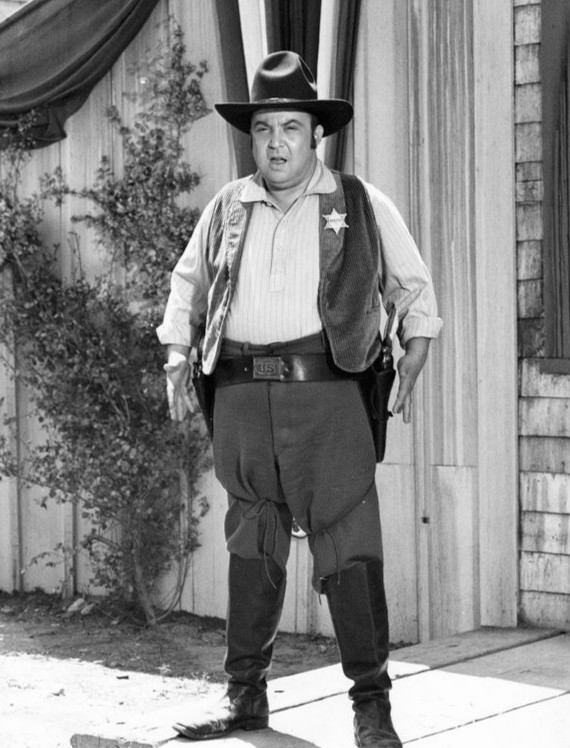
On November 13, 1965, Sherman made a rare primetime television acting appearance in "The Sheriff of Fetterman's Crossing," an episode of Rod Serling's short-lived Western series The Loner (1965–1966).[22] Sherman played Walton Peterson Tetley, a local schnook who went off to war and rose to regiment cook before returning home a hero, thanks to tall tales and yarn-spinning. The town hails its conquering hero and Tetley is appointed sheriff. Series star Lloyd Bridges as William Colton, a wandering Union veteran, comes to town and signs on to be Tetley's deputy, discovering quickly his boss' utter incompetence in the office.[23] Tetley receives a threatening note from a gunslinger challenging this purported hero to a gunfight when he arrives on the noon stage, at which point the story becomes a parody of iconic Western movie High Noon (1952). Colton sets to teaching the shivering-in-his-boots sheriff courage and gunmanship. Sherman's semi-serious and sympathetic performance was strong and his presence an affable one.[24]

In 1966, Sherman visited Australia. He did a television series in Melbourne, Victoria, for a live audience. During the performance, he sang a parody of "Molly Malone." It included a play on the word "but" (butt) which did not elicit a laugh. What Sherman did not know is that Australians use the word "bum" where Americans would say "butt" (although usage of the word "butt" has since become widespread in Australia). Otherwise, Sherman was well received by the audience. Afterward, he met with some of his fans and signed at least one autograph.

In 1969, Sherman wrote the book and lyrics – with music by Albert Hague – for The Fig Leaves Are Falling, a flop Broadway musical that ran only four performances, despite direction by George Abbott and a cast that included Barry Nelson, Dorothy Loudon, and David Cassidy.[25] In 1973, Sherman published The Rape of the A*P*E*, which detailed his point of view on American Puritanism and the sexual revolution.

In 1971, Sherman was the voice of Dr. Seuss's The Cat in the Hat for the animated television special. He reprised the role for Dr. Seuss on the Loose, his last project before his death.

Health problems and death

[edit]

In his final years, Sherman's alcoholism and weight gain caused severe deterioration of his health; he later developed diabetes and lung disease.[26] In 1966, his wife Dee filed for divorce[27] and received full custody of their son and daughter.[28]

Sherman lived on unemployment benefits for a time and moved into the Motion Picture & Television Country House and Hospital for a short time to lose weight.[26] He died while entertaining his friends during the night of November 20, 1973, at his home in Los Angeles, ten days shy of his 49th birthday. According to sheriff's officers, Sherman, who had been undergoing treatment for emphysema, asthma, and obesity, died of respiratory failure.[29] He is entombed in Culver City, California's Hillside Memorial Park Cemetery.[30]

Legacy

[edit]

Sherman was the inspiration for a new generation of developing parodists such as "Weird Al" Yankovic,[31] who pays homage to Sherman on the cover of his first LP.

Sherman's hit song "Hello Muddah, Hello Fadduh" has been translated into other languages. In one notable example, the Dutch–Swedish poet Cornelis Vreeswijk translated the song loosely into Swedish as "Brev från kolonien" (Letter from Summer Camp), which reached fourth on the Swedish popular music chart Svensktoppen in the summer of 1965[32] and is still popular in Sweden today.[33]

A Best of Allan Sherman CD was released in 1990, and a boxed set of most of his songs was released in 2005 under the title My Son, the Box. In 1992 a musical revue of his songs titled Hello Muddah, Hello Faddah ran for over a year off-off-Broadway; other productions ran Off-Broadway for four months in 2001 and toured in 2003.[34] A children's book based on the song "Hello Muddah, Hello Fadduh", with illustrations by Syd Hoff, was published in 2004.

On March 14, 2006, National Public Radio profiled Sherman on All Things Considered.[35]

In 2010, eight of Allan Sherman's Warner Records albums were individually released on CD:

Sherman's son Robert (not to be confused with others of that name in the showbusiness industry) became a game show producer, producing for Mark Goodson during the 1970s and 1980s, including Password Plus, Blockbusters, Body Language and Super Password.

[edit]
  • Sherman's song "Ratt Fink" was covered by punk rock band The Misfits on their 1979 single "Night of the Living Dead". It was also covered by Ex-Misfits guitarist Bobby Steele by his band The Undead. Sherman wrote the song as a parody of "Rag Mop," originally performed by Johnnie Lee Wills and popularized by The Ames Brothers in 1950.
  • In the "Three Gays of the Condo" episode of The Simpsons, Homer asks "Weird Al" Yankovic which of two parody songs Homer sent him he preferred, and Yankovic replies that they were pretty much the same. Homer then mutters angrily, "Yeah, like you and Allan Sherman." Other references to Sherman came in the episode "Marge Be Not Proud", when Bart hides an answering machine tape in a copy of his (fictitious) Camp Granada album – "where no one would ever listen to it"; in another episode, where Homer flips through his meager collection of LPs which includes a copy of My Son, the Folk Singer; and in "A Midsummer's Nice Dream", where Homer shows Bart and Lisa his copy of another fictional Sherman album, Helter Shmelter: Sorry for the Mess.[36]
  • The political parody group Capitol Steps used "Hello Muddah, Hello Fadduh" in Fools on the Hill (Songs of 1992).
  • Dutch comedian Rijk de Gooyer sang two Dutch versions of "Hello Muddah, Hello Fadduh" named "Brief uit La Courtine" (Letter from La Courtine) and "Brief naar La Courtine" (Letter to La Courtine). In the first one, he describes his adventures as a soldier in the Dutch base at La Courtine; the second is his father's reply.

Discography

[edit]

Albums

[edit]
Year Title Billboard 200 Record Label
1962 My Son, the Folk Singer 1 Warner Bros. Records
1963 More Folk Songs by Allan Sherman and His Friends Jubilee
1963 My Son, the Celebrity 1 Warner Bros. Records
My Son, the Nut 1 Warner Bros. Records
1964 Allan in Wonderland 25 Warner Bros. Records
Peter and the Commissar 53 RCA Victor
For Swingin' Livers Only! 25 Warner Bros. Records
1965 My Name Is Allan 88 Warner Bros. Records
1966 Allan Sherman: Live!!! (Hoping You Are the Same)

-

Warner Bros. Records
1967 Togetherness

-

Warner Bros. Records
2014 There Is Nothing Like a Lox: The Lost Song Parodies of Allan Sherman

-

Rockbeat Records / Smore

Singles

[edit]
Year Titles (A-side, B-side)
Both sides from same album except where indicated
Chart positions Album
US AC UK
1963 "Hello Muddah, Hello Fadduh! (A Letter From Camp)"
b/w "Rat Fink"
2 14 My Son, The Nut
"The Twelve Gifts Of Christmas"
b/w "(You Came A Long Way From St. Louis)
You Went The Wrong Way, Old King Louie" (from My Son, The Nut)
5
(Christmas charts)
For Swingin' Livers Only!
1964 "My Son, The Vampire"
b/w "I Can't Dance" (from Allan In Wonderland)
Non-album track
"(Heart) Skin"
b/w "The Drop-Outs March"
Allan In Wonderland
"Hello Mudduh, Hello Fadduh! (A Letter From Camp)" (1964 version)
b/w Original version of A-side (from My Son, The Nut)
59 9 Non-album track
"The End Of A Symphony"—Part 1
b/w Part 2
With The Boston Pops Orchestra—Arthur Fiedler, conductor
113 Peter and The Commissar
"Pop Hates The Beatles"
b/w "Grow, Mrs. Goldfarb"
Unreleased
For Swingin' Livers Only!
1965 "Crazy Downtown"
b/w "The Drop-Outs March" (from Allan In Wonderland)
40 6 Non-album track
"The Drinking Man's Diet"
b/w "The Laarge Daark Aardvark Song"
98 21 My Name Is Allan
1966 "Odd Ball"
b/w "His Own Little Island"
Non-album tracks
1967 "Westchester Hadassah"
b/w "Strange Things In My Soup"
Togetherness
1968 "The Fig Leaves Are Falling"
b/w "Juggling"
Non-album tracks

Musical theater

[edit]
  • The Fig Leaves Are Falling (1969) – musical – lyricist and book-writer
    • Songs: "All Is Well in Larchmont," "Lillian," "All of My Laughter," "Give Me a Cause," "Today I Saw a Rose," "We," "For Our Sake," "Light One Candle," "Oh, Boy," "The Fig Leaves Are Falling," "For the Rest of My Life," "I Like It," "Broken Heart," "Old Fashioned Song," "Lillian, Lillian, Lillian," "Did I Ever Really Live?" The music was composed by Albert Hague.

Filmography

[edit]

See also

[edit]

References

[edit]
[edit]
Revisions and contributorsEdit on WikipediaRead on Wikipedia
from Grokipedia

Allan Sherman (born Allan Copelon; November 30, 1924 – November 20, 1973) was an American comedian, songwriter, singer, and renowned for his satirical song parodies that drew on Jewish-American cultural tropes and everyday absurdities to achieve unprecedented commercial success in the early .
Sherman's career breakthrough arrived with his debut album My Son, the Folk Singer (1962), a collection of folk song parodies featuring tracks like "Sarah Jackman" and "The Ballad of Harry Lewis," which became the fastest-selling album in U.S. history at the time and topped the chart.
This success was followed by the novelty hit "Hello Muddah, Hello Fadduh (A Letter from Camp)" from his 1963 album My Son, the Nut, which parodied melody in the form of a humorous letter from and peaked at number two on the Hot 100.
Prior to his recording fame, Sherman worked as a writer for television, including contributions to The Jackie Gleason Show, and produced game shows, honing a style of verbal that emphasized rapid-fire and ethnic self-mockery.
Despite his brief dominance of the charts—releasing multiple platinum-selling albums before the —Sherman's career declined amid personal battles with , , and , which claimed his life at age 48.

Early Life and Background

Childhood and Family Dynamics

Allan Sherman was born Allan Copelon on November 30, 1924, in , , to Jewish parents Percy Copelon, an and aspiring race car driver with a history of unsuccessful business ventures, and Rose Sherman. His family exhibited limited engagement with Jewish cultural or religious practices, reflecting a secular household amid early 20th-century American patterns. Sherman's parents divorced in 1932 when he was seven years old, after which he adopted his mother's maiden name and ceased all contact with his father, who returned to his origins in . The separation precipitated chronic family instability, as his mother pursued transient employment and relationships, forcing frequent moves that exposed Sherman to and rootlessness. This nomadic existence resulted in Sherman attending 21 different grade and high schools across multiple cities, a pattern driven by economic and familial discord rather than opportunity. Such disruptions instilled early , with Sherman later recounting in biographical accounts how he navigated these hardships through improvised wit to deflect adversity and forge social connections. The absence of stable paternal figures and maternal oversight amid financial strain underscored causal links to his emergent comedic inclinations, grounded in observational of domestic dysfunction rather than idealized resilience.

Education and Early Influences

Sherman attended numerous public schools during his childhood, totaling 21 institutions across , , , and New York by the time he graduated high school in 1941, reflecting a peripatetic life marked by his parents' divorce and frequent relocations. He primarily resided with his maternal grandparents in during pre-teen years, immersing him in a Jewish cultural environment that included exposure to theater productions, which his grandfather attended with him and which fostered an early affinity for performative humor and satire. This milieu, characterized by storytelling traditions and theatrical exaggeration common in Eastern European Jewish immigrant communities, provided foundational influences on Sherman's later parodic style, emphasizing witty verbal distortion and cultural self-mockery rooted in familial and communal narratives. Following high school, Sherman briefly pursued higher education at the University of Illinois, where he earned predominantly "C" grades while contributing a humor column to the student newspaper, The Daily Illini, marking his initial forays into published comedic writing. His tenure there ended prematurely, reportedly due to academic dismissal, after which he enlisted in the U.S. Army in 1942 but was discharged after five months for allergies. These early educational experiences, combined with contemporaneous exposure to 1930s radio comedy broadcasts—such as those featuring Jack Benny's timing and situational irony—honed Sherman's ear for rhythmic and audience-engaging absurdity, elements that would underpin his adult creative output without formal training in the arts.

Professional Beginnings

Television Writing and Production

Sherman relocated to in 1945 following , seeking opportunities in the burgeoning television industry. There, he began writing and developing content, including a concept devised with collaborator Howard Merrill initially titled I Know a Secret. This idea was adapted by producers and into I've Got a Secret, a panel that premiered on on August 5, 1952, and ran until 1967, featuring celebrity panelists guessing contestants' secrets. Sherman served as the show's original producer, contributing to its early format of timed questioning and cash prizes for successful guesses, which helped popularize interactive panel entertainment on network television. In production roles during the early , Sherman worked on variety and game programming, including as producer for an episode of The Show in 1956, a series showcasing the folksy humorist's monologues and harmonica performances. His involvement in these shows honed skills in scripting efficient, audience-engaging segments and managing live broadcasts, fostering professional ties with figures like Goodson and Todman that supported his transition toward independent projects. Sherman's efficiency in scriptwriting—often producing material under tight deadlines—earned him recognition in an era when television demanded rapid content creation for weekly airings.

Transition to Comedy and Parody

In the mid-1950s, while employed as a television writer and producer in , Allan Sherman began performing improvised song parodies as a diversion at private gatherings and Hollywood parties hosted by industry acquaintances. These ad-libbed routines, often delivered spontaneously to entertain guests, drew enthusiastic responses and led to frequent invitations for repeat appearances, indicating grassroots demand among local social circles. Sherman's neighbor, , attended one such event and urged him to professionalize the act, recognizing its potential beyond informal settings. Sherman's parodies frequently targeted the contemporaneous folk music revival, subverting popular tunes like those associated with or by infusing them with humorous, exaggerated narratives drawn from everyday suburban life. This choice reflected the era's folk boom in the late , where authentic-sounding renditions masked his satirical intent, amplifying their appeal at parties. He had amassed over 20 such Jewish-inflected pieces by the time he sought broader outlets, many self-recorded on rudimentary demos that faced initial industry dismissals as too niche or uncommercial. The content of these early sketches centered on Jewish-American experiences, lampooning assimilation pressures and cultural through personal anecdotes of immigrant family dynamics and upward mobility struggles, rather than overt political commentary. Grounded in Sherman's observations of post-World War II suburban Jewish life, they highlighted tensions between traditional heritage and American integration, such as mangled Yiddish-infused English or comedic failures at WASP emulation. This approach resonated organically at Los Angeles events, where audiences of similar demographic backgrounds provided validation through laughter and requests, paving the way for his shift from behind-the-scenes television work to onstage comedy.

Breakthrough and Rise to Prominence

Development of Song Parodies

Allan Sherman's song parodies primarily adapted melodies from folk tunes, Broadway musicals, and popular standards to narrate vignettes of Jewish-American domesticity and suburban assimilation, transforming universal melodies into culturally specific commentaries on identity and routine absurdities. A representative example is "Sarah Jackman," set to the tune of "," which mimics a Yiddish-inflected between neighbors exchanging banal pleasantries like "How's by you?" to evoke the insularity of mid-century Jewish social networks. This method relied on minimal melodic alteration—retaining rhythm and structure intact—while overwriting lyrics to highlight ethnic particularities, such as name pronunciations or communal , thereby satirizing the tension between American conformity and retained old-world habits in the post-World War II era. The thematic core emphasized self-deprecating portrayals of psychological quirks, gustatory excesses, and familial pressures, positioning the parodies as affectionate mirrors rather than hostile critiques of the source material. Neuroses appeared through exaggerated laments over failures or hypochondria, food obsessions manifested in odes to deli staples like amid weight-loss struggles, and motifs lampooned overbearing mothers or marital mismatches, all framed as endearing flaws inherent to the Jewish-American experience. Sherman avoided animus toward original composers by crediting them explicitly in recordings and performances, underscoring the parodies' intent as homage-infused that presumed Jewish contributions to American songcraft as a given. This approach causally connected to 1960s cultural by amplifying anxieties of upward mobility and cultural dilution, where served as a for collective amid rapid societal shifts like urban exodus to suburbs. Legal challenges arose sporadically from parody subjects, notably when Sherman targeted "My Fair Lady" in an unreleased spoof, prompting resistance from the estate over perceived dilution of the original's commercial value. Such disputes tested boundaries of doctrine, which by the early 1960s increasingly accommodated transformative works like if they critiqued or commented on the underlying composition without supplanting its market, though Sherman's folk-derived selections often sidestepped litigation by leveraging elements or securing permissions. These incidents underscored causal realism in parody's viability: reliance on non-malicious, niche humor mitigated suits, as broad appeal without direct competition aligned with judicial precedents favoring cultural expression over strict proprietary control.

Debut Album and Initial Success

Allan Sherman's debut album, My Son, the Folk Singer, was recorded in a single session on August 6, 1962, at Radio Recorders in Hollywood, , with arrangements by Lou Busch and backing from a small ensemble including violinist . The album, consisting of 12 song parodies set to familiar folk and pop melodies with Yiddish-inflected lyrics drawn from Sherman's nightclub routines, was released by Warner Bros. Records later that year, initially targeting a niche audience with its Jewish cultural humor. The record achieved rapid commercial success, debuting at number one on the chart on December 1, 1962, and remaining there for multiple weeks amid the folk revival era. It sold over one million copies within months, earning platinum certification and marking it as the fastest-selling album up to that point, far exceeding Warner Bros.' modest expectations of 10,000 units for viability. Tracks like "The of Harry Lewis," a parody of "The ," exemplified the album's satirical edge, recounting the fictional death of a garment worker in a factory fire—complete with puns on his employer's name (Irving Roth) and ironic heroism ("He ran into the fire without a shirt")—to lampoon sweatshop labor conditions and immigrant entrepreneurship in New York's clothing trade. Initial reception propelled Sherman into mainstream visibility through print media coverage in outlets like Variety and early television spots, broadening its appeal from Jewish-American enclaves to general audiences via the novelty of accessible, self-deprecating parody amid post-war assimilation trends.

The "Hello Muddah, Hello Fadduh" Phenomenon

"Hello Muddah, Hello Fadduh (A Letter from Camp)" originated as a parody composed by Allan Sherman with Lou Busch, adapting the melody from Amilcare Ponchielli's "" in the opera La Gioconda. Sherman drew inspiration from real letters sent by his son Robert detailing mishaps at , transforming these into exaggerated complaints about weather, insects, food poisoning, and social woes at the fictional Camp . Released as a single by Warner Bros. Records on June 18, 1963, the recording propelled Sherman's career, peaking at number 2 on the Billboard Hot 100 chart and maintaining that position for three weeks starting August 24, 1963. Its novelty appeal drove widespread radio airplay during the summer season, contributing to over one million copies sold and substantial royalties that underscored the era's demand for accessible comedic relief. The track secured a Grammy Award for Best Comedy Performance at the 6th Annual Grammy Awards in 1964, affirming its artistic merit amid commercial dominance. Culturally, the song encapsulated suburban middle-class tensions in post-World War II America, where parents increasingly dispatched children to organized camps to instill and escape urban confines, yet faced pushback through tales of privation and peril. This mirrored empirical patterns of child-rearing shifts—rising camp enrollments from 1945 to 1963 amid economic prosperity—without glossing over the causal frictions of enforced separation, hypochondria, and institutional shortcomings that tested familial bonds. The unsparing humor highlighted realistic disconnects between parental aspirations for character-building and children's raw discomfort, capturing a snapshot of aspirational yet fraught independence in an expanding consumer society.

Career Peak

Album Releases and Chart Performance

Sherman's debut album, My Son, the Folk Singer, released in October 1962 by Warner Bros. Records, reached number one on the chart and became the fastest-selling album in history at that time, with 575,000 copies sold in the first six weeks and over one million by December 1962. The follow-up, My Son, the Celebrity, issued in January 1963, maintained commercial momentum as part of a trio of consecutive number-one comedy albums. Released in August 1963, My Son, the Nut also topped the , holding the position for eight weeks, remaining on the chart for 140 weeks, and selling 1.2 million copies.
Album TitleRelease DatePeak Billboard PositionCertified Sales
My Son, the Folk SingerOctober 1962#1>1 million
My Son, the CelebrityJanuary 1963#1Part of 3 million total for first three albums
My Son, the NutAugust 1963#11.2 million
These early releases collectively sold over three million copies, outpacing short-term sales of artists like and . The albums marked a thematic progression from parodies rooted in Jewish-American cultural tropes in My Son, the Folk Singer—such as mangled folk songs with Yiddish-inflected humor—to broader satires of everyday American experiences in subsequent works, including weight-loss diets and suburban absurdities that echoed Sherman's personal struggles with . This shift broadened appeal amid rising competition from rock acts like , whose U.S. began in early 1964, yet Sherman's format sustained top-chart dominance through 1963.

Live Performances and Public Reception

Sherman's live performances during the early 1960s peak featured sold-out concerts at major venues, including on , where he set attendance records, and the on July 19, 1963, drawing an over-capacity crowd of 16,076. He similarly broke records at , reflecting his status as a major concert draw amid the success of his parody albums. These shows emphasized his song parodies delivered with comedic timing and spoken interludes, often parodying folk and show tunes to highlight everyday absurdities. Television appearances amplified his reach, with multiple guest spots on , including a April 24, 1966, performance of "Return to Camp Granada" and a medley of parodies on classic songs, which showcased his rapid-fire delivery to national audiences. Reviews described his stage presence as engaging and humorous, with even young children finding the material side-splitting due to its accessible, non-explicit satire. Public reception gauged through attendance and contemporary accounts indicated broad popularity among middle-class families, as Sherman's parodies captured universal foibles like family vacations and suburban life, transcending ethnic-specific to resonate across demographics. His improvisational interactions and custom parodies during shows encouraged repeat attendance, fostering a lively, participatory atmosphere that contributed to his mega-star status before popularity declined post-1966.

Interactions with Political Figures

Sherman's comedic parodies gained traction among political elites during his peak popularity, exemplified by President John F. Kennedy's public affinity for the material. In 1962, Kennedy was overheard humming and singing "Sarah Jackman," a parody of "Frère Jacques" from Sherman's debut album My Son, the Folk Singer, while in the lobby of the Carlyle Hotel in New York City; this anecdote, reported contemporaneously, amplified the record's sales and cultural buzz. Additional accounts indicate Kennedy played Sherman's albums in the White House, reflecting the entertainer's alignment with the era's lighthearted escapism amid Cold War tensions. Prior to his song parody fame, Sherman incorporated impersonations of Kennedy into live comedy routines, as captured in a 1962 recording that sold over a million copies and showcased his of the president's distinctive New England accent and cadence. These elements highlighted Sherman's versatility but remained peripheral to his core output, which eschewed partisan advocacy in favor of universal, self-deprecating on domestic absurdities. Such restraint facilitated acceptance by figures across the , positioning Sherman as a non-threatening voice of mid-century American optimism rather than a political provocateur.

Later Career and Challenges

Diversification into Theater and Writing

In 1968, Sherman co-authored the book and lyrics for the Broadway musical The Fig Leaves Are Falling, with music by , drawing inspiration from his recent divorce to satirize themes of marital and sexual liberation. The production premiered on January 2, 1969, at the , featuring a cast including , , and , but closed after only four performances amid poor reviews that criticized its uneven humor and failure to adapt Sherman's record-based parody style to the stage. This venture reflected Sherman's ambition to extend his comedic persona into live theater, yet underscored a mismatch between his strengths in concise song spoofs and the demands of sustained narrative and staging. Parallel to his theatrical efforts, Sherman pursued literary projects, publishing the autobiography A Gift of Laughter in 1965 through Atheneum, which chronicled his career trajectory from early struggles in television writing and production to his breakthrough in musical , framing his rise as an "overnight success in only 38 years." The book candidly addressed personal hardships alongside professional anecdotes, receiving praise for its humor and frankness in depicting the comedian's self-perceived path to acclaim. Sherman also compiled parody collections and humorous essays, extending his satirical voice beyond audio formats, though these writings largely recycled motifs from his albums, revealing limits in branching into without the performative element of his recordings. By 1967, Sherman's album Togetherness on Warner Bros. Records exemplified diversification fatigue, featuring 11 tracks of parodies like "Westchester Hadassah," which mimicked "Winchester Cathedral" in a formula increasingly reliant on ethnic-Jewish humor and domestic without fresh innovation. Released amid waning chart momentum, the LP's repetitive structure—parodying pop standards with familiar tropes—signaled an overextension of his core style, as reviewers noted its lack of the novelty that defined his earlier hits. These non-musical pursuits demonstrated Sherman's drive to leverage fame across media, but outcomes highlighted constraints in talents suited primarily to short-form audio rather than extended dramatic or literary forms.

Factors Contributing to Declining Popularity

Sherman's popularity waned beginning in 1964 as the British Invasion reshaped the music landscape, with British rock acts like the Beatles capturing the youth market and prioritizing energetic, authentic performances over novelty comedy. This influx displaced many American novelty artists, including those specializing in parody, as radio airplay and chart dominance shifted toward rock singles and albums that aligned with emerging countercultural tastes. By early 1965, despite a primetime NBC special, Sherman's record sales had already collapsed, reflecting broader industry pivots away from comedic folk parodies toward youth-driven rock. The repetitive nature of Sherman's parody formula, centered on Jewish-American humor and adaptations of folk standards, contributed to audience and critical fatigue after his initial breakthrough albums. While My Son, the Folk Singer (1962) and subsequent releases topped charts through 1963, later efforts like 1965's My Name Is Allan peaked at only number 88 on the Billboard 200, signaling diminishing returns from oversaturation. Record labels, including Warner Bros., which dropped Sherman in 1966, increasingly favored high-volume singles and rock acts that sustained longer-term appeal amid evolving consumer preferences for musical innovation over satirical novelty.

Final Projects and Publications

Sherman's final major publication was the 1973 book The Rape of the A.P.E. (American Puritan Ethic), commissioned and released by Playboy Press as a satirical history of the American sex revolution from to 1973. In it, he contended that longstanding cultural prudishness and laws—rooted in what he termed the "American Puritan Ethic"—had been eroded and ultimately defeated by progressive shifts in sexual , framing the era's as a triumphant "obscening of America" against repressive propriety. The work eschewed restraint in detailing battles over and norms, positioning the changes as a decisive cultural with few remaining strongholds of traditional . Amid these efforts, Sherman pursued limited recording and television projects, including a May 10, 1973, performance recorded by featuring his routine Hallowed Be Thy Game, a comedic on . He also provided the voice for the Cat in the Hat in the 1971 animated TV special . These undertakings underscored his frustration with as a one-note parodist, as his label had dropped him after the 1967 Togetherness, which garnered poor reviews and sales far below his earlier multimillion-copy successes. By contrast, his late-1960s releases sold in the low thousands, empirically marking a sharp decline in commercial viability and audience interest.

Personal Struggles

Marriages, Relationships, and Family

Sherman married Dolores "Dee" Chackes on June 15, 1945. The couple had two children: son , born January 9, 1950, who later worked as a , and an unnamed daughter. Their ended in in 1966, with Chackes receiving full custody of both children. The dissolution followed two decades marked by Sherman's professional volatility and personal excesses, which strained family ties and contributed to subsequent estrangements from his children.

Health Issues and Addictions

Sherman battled lifelong morbid obesity, which biographer Mark Cohen describes as a central factor in his physical decline, often exceeding 300 pounds despite numerous unsuccessful dieting efforts that failed to produce sustained weight loss. His chronic overeating and sedentary lifestyle, compounded by genetic predispositions, imposed severe cardiovascular strain, contributing to the development of type 2 diabetes in his later years. This obesity not only limited his mobility and public performances but also fostered social isolation, as Sherman increasingly withdrew from professional engagements due to the physical toll. Heavy smoking throughout his adulthood led to , a progressive disease characterized by alveolar damage and , which further deteriorated his respiratory function and overall stamina. By the early , these pulmonary issues, intertwined with obesity-related strain, markedly reduced his capacity for creative output, as episodes of fatigue and breathlessness interrupted writing and recording sessions. Sherman also contended with , a dependency that escalated in his final decade, exacerbating metabolic disorders like and impairing hepatic function under the burden of excess weight. This , while not excusing lapses in productivity, causally linked to erratic behavior and creative blocks, as alcohol's depressive effects hindered sustained focus amid mounting health complications.

Psychological and Financial Difficulties

Following the rapid decline in his popularity after 1963, Allan Sherman experienced profound depression exacerbated by professional s and personal losses, including the of his mother, which necessitated psychiatric intervention. He consulted at least four therapists, among them the psychoanalyst Edmund Bergler, though Sherman ultimately dismissed their approaches as ineffective and deemed the practitioners themselves unstable. This period revealed underlying anxiety and a pervasive of , manifesting in self-destructive patterns such as compulsive , heavy , , and , which compounded his emotional turmoil and reflected a broader commitment to self-sabotage. Financially, Sherman's early success generated substantial earnings from album sales exceeding one million copies each for several releases between 1962 and 1963, yet his Great Depression-era upbringing did not instill fiscal restraint, leading to reckless expenditures on vices and indulgences. These habits, including and despite chronic , contributed to mounting strain, culminating in his 1966 divorce from second wife Dee Golden amid reports of casual affairs and profligate spending. By the late 1960s, as parody demand waned and later projects faltered, his unchecked eroded stability, mirroring the self-inflicted decline observed in his personal conduct.

Death and Immediate Aftermath

Cause of Death and Circumstances

Allan Sherman died on November 20, 1973, at his home in , at the age of 48, ten days before his 49th birthday. Sheriff's officers reported the cause as , attributed to his ongoing , for which he had been receiving treatment alongside and obesity-related complications. No autopsy details were publicly detailed, but the official determination excluded acute events like overdose, despite Sherman's documented history of heavy alcohol use; toxicology or forensic evidence pointing to intentional or drug involvement has not been reported in contemporaneous accounts. In his final hours, Sherman was at home entertaining friends when he suffered the fatal episode, with no immediate medical intervention available or sought, consistent with the sudden onset of his chronic lung condition exacerbating respiratory distress. Friends present noted his attempt to perform or amuse them amid evident physical decline, but he collapsed without prior hospitalization that evening. His untreated or inadequately managed —linked to long-term and —had progressively worsened, rendering him housebound in his later months with limited professional medical oversight beyond routine treatments.

Estate and Family Response

Following Allan Sherman's death on November 20, 1973, from emphysema-related complications, his estate—diminished by years of financial instability and unsuccessful ventures—was probated without notable disputes or public litigation, with assets primarily allocated to his two children, son and daughter Nancy. The family prioritized privacy in the aftermath, issuing no extensive public statements and shielding personal details from media scrutiny, consistent with Sherman's own reclusive tendencies in later years. Robert Sherman, in particular, contributed to later tributes by facilitating access to family-held materials, enabling biographical works that drew on preserved archives without altering the low-profile disposition of the estate. Sherman's papers, recordings, and unpublished writings were maintained by the estate, providing resources for researchers and avoiding dispersal or destruction, though the modest holdings reflected his post-peak career trajectory rather than generating ongoing revenue streams for heirs.

Legacy and Cultural Impact

Influence on Subsequent Comedians and Parodists

Allan Sherman's approach to song parody, which involved meticulously adapting humorous to the melodies of familiar folk, pop, and classical tunes while preserving their rhythmic structure and rhyme schemes, directly shaped the technical foundations of later musical comedy. This method allowed for rapid production of accessible, content, as seen in his 1962 album My Son, the Folk Singer, where tracks like "Sarah Jackman" reworked traditional songs with domestic Jewish-American themes. Parodists following him adopted similar syllable-matching and techniques to ensure parodies remained faithful to originals, enabling broad appeal without requiring new compositions. "Weird Al" Yankovic has repeatedly cited Sherman as a primary influence, crediting him alongside figures like Tom Lehrer and Spike Jones for inspiring his career in pop song parody. Yankovic's albums, starting with Weird Al Yankovic in 1983, mirror Sherman's formula by transforming contemporary hits—such as Michael Jackson's "Beat It" into "Eat It"—into comedic narratives through lyrical substitution while retaining melodic integrity. Sherman's success in charting parodies like "Hello Muddah, Hello Fadduh" (which reached No. 2 on the Billboard Hot 100 in August 1963) demonstrated commercial viability for this format, paving the way for Yankovic's genre to sustain novelty releases through the 1980s and beyond. Sherman's parodies contributed to a resurgence of novelty songs in the 1980s and 1990s, where artists emulated his blend of topical and musical familiarity amid the rise of syndicated radio shows like The Show, which frequently aired Sherman's work to introduce it to new audiences. This revival extended into the 2000s, with parodists building on his template for quick-witted adaptations that critiqued everyday absurdities, influencing the structure of comedy sketches and viral audio clips that riffed on established tunes.

Role in Mainstreaming Jewish Humor

Prior to the 1960s, Jewish humor in the United States was largely confined to ethnic enclaves such as the resorts in New York's , where performers catered to Jewish vacationers with insider parodies of cultural traits like kvetching and family dynamics, but these routines rarely penetrated broader American audiences due to prevailing social segregation and anti-Semitic sensitivities. Sherman's 1962 debut album, My Son, the Folk Singer, marked a pivotal shift by repurposing popular folk tunes into Yiddish-inflected parodies that exaggerated observable Jewish-American mannerisms—such as suburban hypochondria in "Shake Hands with Your Uncle Max" or marital nagging in "Sarah Jackman"—achieving commercial dominance with over one million copies sold in its initial release and topping the album charts. This breakthrough evidenced a causal normalization of ethnic self-parody, as sales data reflected appeal transcending niche demographics to include buyers, thereby bridging Borscht Belt insularity to national pop culture without relying on external validation from biased institutional gatekeepers. Sherman's approach empowered through ownership of absurdities empirically rooted in community experiences, such as endless complaining or food obsessions, transforming potential into sources of communal mirth rather than defensive victimhood; for instance, tracks like "The Ballad of Harry Lewis" lampooned garment industry drudgery with affectionate exaggeration, fostering resilience by preempting outsider mockery. This self-directed humor countered anti-Semitic tropes not by denial but by volumetric embrace, as demonstrated by President John F. Kennedy's public affinity—reportedly humming "Sarah Jackman" in a lobby—which amplified Sherman's visibility and signaled elite acceptance, with subsequent live recordings featuring Kennedy impersonations selling a million units. Empirical metrics, including My Son, the Folk Singer's chart performance and rapid sales velocity, substantiate that Sherman's output catalyzed ethnic comedy's viability in mainstream venues, paving pathways for later performers by proving profitability in unapologetic cultural specificity over sanitized assimilation.

Criticisms and Reevaluations

Sherman's song parodies drew legal scrutiny, with songwriters and publishers filing multiple lawsuits against him for unauthorized alterations of copyrighted material, prompting shifts in his repertoire toward folk tunes to mitigate further challenges. Contemporary observers criticized his emphasis on Jewish suburban mannerisms as reinforcing self-caricature, reducing complex ethnic identities to exaggerated tropes of assimilation and domestic that risked perpetuating stereotypes rather than subverting them. Defenders countered that Sherman's routines realistically satirized the cultural tensions of mid-century , unmasking the contrived "Americanness" of Broadway and folk traditions as veiled ethnic expressions, thereby highlighting rather than mocking the paradoxes of identity retention amid upward mobility. This perspective posits his humor as a form of cultural excavation, compelling audiences to confront the Jewish underpinnings of mainstream entertainment forms previously sanitized for broader appeal. The 2013 biography Overweight Sensation: The Life and Comedy of Allan Sherman by Mark Cohen reevaluated Sherman not as a fleeting novelty performer but as a profoundly influential yet self-destructive innovator whose parodies captured era-defining anxieties, influencing later parodists while underscoring his personal unraveling as emblematic of untethered creative intensity. In reevaluations, Sherman's legacy resists reductive dismissal amid evolving sensitivities to ethnic humor, with analysts noting that his reliance on recognizable communal clichés exhausted available material without descending into malice, preserving relevance through layered commentary on conformity's costs over outright offense.

Recent Revivals and Recognition

In the 2010s, Allan Sherman's recordings saw reissues on CD by specialty labels, including Collectors' Choice Music's edition of his 1966 live album Live!!! and the 1964 release Togetherness, which brought his parodies to new audiences through expanded remastered formats. His catalog subsequently became accessible via major streaming services such as Spotify and Apple Music, where tracks like "Hello Muddah, Hello Faddah" continue to attract listeners, evidencing a persistent niche cult following among fans of novelty and parody music. The 2013 publication of Overweight Sensation: The Life and Comedy of Allan Sherman by Mark Cohen, issued by Press, prompted renewed scholarly and media attention to Sherman's career, with reviews emphasizing his pioneering role in ethnic and its cultural context. This biography spurred contemporaneous articles, including NPR's examination of his rapid rise and fall and The Hollywood Reporter's profile noting occasional post-mortem revivals amid declining mainstream interest. Sherman's centennial in 2024 elicited targeted recognitions, such as commentary on his parodic innovations in entertainment history, underscoring sustained references in discussions of mid-20th-century humor's evolution into modern self-deprecating styles. These efforts highlight his works' availability fostering episodic rediscoveries, though without broad commercial resurgence, aligning with a pattern of specialized rather than mass-market revival.

Works

Discography

Allan Sherman's recording career primarily spanned 1962 to 1967 with , yielding eight albums featuring musical parodies of folk, pop, and traditional songs, often infused with Jewish-American humor. His debut, My Son, the Folk Singer, released in October 1962, topped the chart for 12 weeks and earned gold certification from the RIAA for sales exceeding 500,000 copies. Notable tracks included "The Ballad of Harry Lewis" and "Shake Hands with Your Uncle Max." His follow-up, My Son, the Nut, issued in July 1963, also reached number 1 on the and contained his signature hit "Hello Muddah, Hello Fadduh (A Letter from Camp)." Subsequent releases saw declining commercial success. My Son, the Celebrity appeared in early 1964, peaking at number 85 on the Billboard 200. For Swingin' Livers Only!, a thematic album parodying dieting and lifestyle tropes, debuted in November 1964 and climbed to number 46. Allan in Wonderland (1964) and My Name Is Allan (1965) followed, with the latter incorporating self-referential comedy but failing to chart prominently. Live recordings like Allan Sherman Live!!! (Hoping You Are the Same) (1966) captured stage performances, while Togetherness (1967) marked his final Warner Bros. studio effort amid waning sales. Later works included a 1971 children's album, Allan Sherman Is the Cat in the Hat and Other Stories, adapting Dr. Seuss tales, but it received limited distribution.
YearTitleLabelBillboard 200 Peak
1962My Son, the Folk Singer1
1963My Son, the Nut1
1964My Son, the Celebrity85
1964For Swingin' Livers Only!46
1964Allan in Wonderland
1965My Name Is Allan
1966Allan Sherman Live!!! (Hoping You Are the Same)
1967Togetherness
Sherman's singles, often extracted from albums, achieved modest radio play. The standout was "Hello Muddah, Hello Fadduh (A Letter from Camp)" (August 1963, , b/w instrumental version), which peaked at number 2 on the for four weeks and sold over a million copies, earning status. Other releases included "The Twelve Gifts of " (1963, peaked #25 Holiday chart) and "" (1963, minor chart entry), but none replicated the flagship single's impact. Post-1967 singles like "Crazy Downtown" (1965) bubbled under the Hot 100 at equivalent to #138. No major unreleased music from this era has surfaced, though compilations such as My Son, the Greatest (later reissues) aggregate tracks.

Other Media Contributions

Sherman published his , A Gift of Laughter: The Autobiography of Allan Sherman, in 1965, chronicling his early struggles and ascent to comedic prominence after decades of varied work. In the book, he detailed personal anecdotes from childhood through his breakthrough with song parodies, emphasizing perseverance amid rejections in writing and production roles. In 1973, Sherman released The Rape of the A.P.E. (American Puritan Ethic), a satirical examination of the spanning 1945 to 1973, commissioned and issued by Press as a critique of shifting cultural . The work framed post-World War II societal changes as an "obscening" of America, blending humor with commentary on evolving attitudes toward sexuality and . Sherman contributed to musical theater as the author of the book and lyrics for The Fig Leaves Are Falling, a Broadway production with music by that opened on January 2, 1969, at the . The show, which satirized suburban and marital dynamics, featured a cast including and Dorothy Greener but closed after 16 performances on January 19, 1969, due to mixed reviews and low attendance. Sherman also handled orchestration arrangements through collaborators like Manny Albam.

Filmography

Allan Sherman's limited filmography centers on voice acting in animated Dr. Seuss television specials produced in the early 1970s. In the 1971 CBS special The Cat in the Hat, directed by Hawley Pratt, Sherman voiced the titular character, delivering the Cat's mischievous narration and songs in this half-hour adaptation that incorporated musical sequences beyond the original book. He reprised the role in the 1973 ABC anthology Dr. Seuss on the Loose, also directed by Pratt, where the Cat in the Hat serves as host for segments adapting "The Sneetches," "Green Eggs and Ham," and "The Zax," marking Sherman's final on-screen credit before his death later that year.

References

Add your contribution
Related Hubs
User Avatar
No comments yet.