
Recent from talks
Almanach de Gotha
Knowledge base stats:
Talk channels stats:
Members stats:
Almanach de Gotha
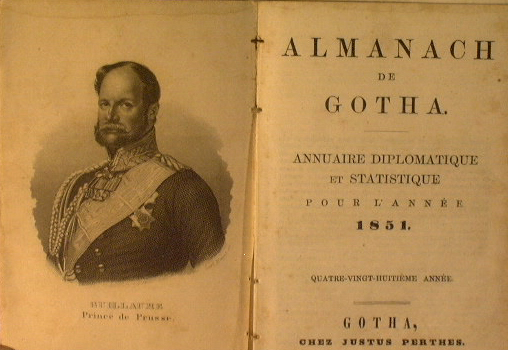
The Almanach de Gotha (German: Gothaischer Hofkalender, pronounced [ˈɡoːtaɪʃɐ ˈhoːfkaˌlɛndɐ]) is a directory of Europe's royalty and higher nobility, also including the major governmental, military and diplomatic corps, as well as statistical data by country. First published in 1763 by Carl Wilhelm Ettinger in Gotha in Thuringia, Germany at the ducal court of Frederick III, Duke of Saxe-Gotha-Altenburg, it came to be regarded as an authority in the classification of monarchies and their courts, reigning and former dynasties, princely and ducal families, and the genealogical, biographical and titulary details of Europe's highest level of aristocracy. It was published annually from 1785 until 1944 by Justus Perthes Publishing House in Gotha.
In 1992, the family of Justus Perthes re-established its right to use the name Almanach de Gotha. In 1998, a London-based publisher, John Kennedy, acquired the rights for use of the title of Almanach de Gotha from Justus Perthes Verlag Gotha GmbH, then a fully owned subsidiary of Ernst Klett Schulbuchverlag GmbH, Stuttgart. The last edition produced by Justus Perthes was the 181st, produced in 1944. After a gap of 54 years the first of the new editions (the 182nd) was published in 1998 with English, the new diplomatic language, used as the lingua franca in the place of French or German. Perthes regards the resultant volumes as new works, and not as a continuation of the editions which Perthes had published from 1785 to 1944. Two volumes have been printed since 1998, with Volume I containing lists of the sovereign, formerly sovereign and mediatised houses of Europe, and a diplomatic and statistical directory; and Volume II containing lists of the non-sovereign princely and ducal houses of Europe.
The original Almanach de Gotha provided detailed facts and statistics on nations of the world, including their reigning and formerly reigning houses, those of Europe being more complete than those of other continents. It also named the highest incumbent officers of state, members of the diplomatic corps, and Europe's upper nobility with their families. At its most extensive the Almanach had more than 1200 pages, fewer than half of which were dedicated to monarchical or aristocratic data. It acquired a reputation for the breadth and precision of its information on royalty and nobility compared to other almanacs.
The Almanach's publication by Justus Perthes began at the ducal court of Saxe-Coburg and Gotha in Germany. The almanac listed the reigning dynasty of that court first well into the 19th century, usually followed by kindred sovereigns of the House of Wettin and then, in alphabetical order, other families of princely rank, reigning and non-reigning. Although always published in French, other almanacs in French and English were more widely sold internationally. The almanac's structure changed and its scope expanded over the years. The second portion, called the Annuaire diplomatique et statistique ("Diplomatic and Statistical Yearbook"), provided demographic and governmental information by nation, similar to other almanacs. Its first portion, called the Annuaire généalogique ("Genealogical Yearbook"), came to consist essentially of three sections: reigning and formerly reigning families, mediatized families and non-sovereign families at least one of whose members bore the title of prince or duke.
The first section always listed Europe's sovereign houses, whether they reigned as emperor, king, grand duke, duke, prince, or some other title such as prince elector, margrave, landgrave, count palatine or pope. Until 1810 these sovereign houses were listed alongside such families and entities as Barbiano-Belgiojoso, Clary-Aldringen, Colloredo-Mansfeld, Fürstenberg, the Emperor, Genoa, Gonzaga, Hatzfeldt, Jablonowski, Kinsky, Ligne, Paar, Radziwill, Starhemberg, Thurn and Taxis, Turkey, Venice, the Order of Malta and the Teutonic Knights. In 1812, these entries began to be listed in groups: first were German sovereigns who held the rank of grand duke or prince elector and above (the Duke of Saxe-Gotha was, however, listed here along with, but before, France—see below).
Listed next were Germany's reigning ducal and princely dynasties under the heading "College of Princes", e.g. Hohenzollern, Isenburg, Leyen, Liechtenstein and the other Saxon duchies. They were followed by heads of non-German monarchies, such as Austria, Brazil, and Great Britain. Fourth were listed non-reigning dukes and princes, whether mediatized or not, including La Rochefoucauld (including Dominique and his son Gabriel), Arenberg, Croy, Fürstenberg alongside Batthyany, Jablonowski, Sulkowski, Porcia and Benevento.
In 1841 a third section was added to those of the sovereign dynasties and the non-reigning princely and ducal families. It was composed exclusively of the mediatised houses of comital rank recognized by the various states of the German Confederation as belonging, since 1825, to the same historical category and sharing some of the same privileges as reigning dynasties because they previously held the rank of ruling Princes of the Holy Roman Empire; these families were German with a few exceptions (e.g. Bentinck, Rechteren-Limpurg). The 1815 treaty of the Congress of Vienna had authorized – and Article 14 of the German Confederation's Bundesakt (charter) recognized – retention from the German Imperial regime of equality of birth for marital purposes of mediatized families (called Standesherren) to reigning dynasties. In 1877, the mediatized comital families were moved from section III to section II A, where they joined the princely mediatized families.
In the third section were members of such non-reigning but historically notable princely or ducal families such as Rohan, Orsini, Ursel, Norfolk, Czartoryski, Galitzine, La Rochefoucauld, Kinsky, Radziwill, Merode, Dohna and Alba.
Hub AI
Almanach de Gotha AI simulator
(@Almanach de Gotha_simulator)
Almanach de Gotha
The Almanach de Gotha (German: Gothaischer Hofkalender, pronounced [ˈɡoːtaɪʃɐ ˈhoːfkaˌlɛndɐ]) is a directory of Europe's royalty and higher nobility, also including the major governmental, military and diplomatic corps, as well as statistical data by country. First published in 1763 by Carl Wilhelm Ettinger in Gotha in Thuringia, Germany at the ducal court of Frederick III, Duke of Saxe-Gotha-Altenburg, it came to be regarded as an authority in the classification of monarchies and their courts, reigning and former dynasties, princely and ducal families, and the genealogical, biographical and titulary details of Europe's highest level of aristocracy. It was published annually from 1785 until 1944 by Justus Perthes Publishing House in Gotha.
In 1992, the family of Justus Perthes re-established its right to use the name Almanach de Gotha. In 1998, a London-based publisher, John Kennedy, acquired the rights for use of the title of Almanach de Gotha from Justus Perthes Verlag Gotha GmbH, then a fully owned subsidiary of Ernst Klett Schulbuchverlag GmbH, Stuttgart. The last edition produced by Justus Perthes was the 181st, produced in 1944. After a gap of 54 years the first of the new editions (the 182nd) was published in 1998 with English, the new diplomatic language, used as the lingua franca in the place of French or German. Perthes regards the resultant volumes as new works, and not as a continuation of the editions which Perthes had published from 1785 to 1944. Two volumes have been printed since 1998, with Volume I containing lists of the sovereign, formerly sovereign and mediatised houses of Europe, and a diplomatic and statistical directory; and Volume II containing lists of the non-sovereign princely and ducal houses of Europe.
The original Almanach de Gotha provided detailed facts and statistics on nations of the world, including their reigning and formerly reigning houses, those of Europe being more complete than those of other continents. It also named the highest incumbent officers of state, members of the diplomatic corps, and Europe's upper nobility with their families. At its most extensive the Almanach had more than 1200 pages, fewer than half of which were dedicated to monarchical or aristocratic data. It acquired a reputation for the breadth and precision of its information on royalty and nobility compared to other almanacs.
The Almanach's publication by Justus Perthes began at the ducal court of Saxe-Coburg and Gotha in Germany. The almanac listed the reigning dynasty of that court first well into the 19th century, usually followed by kindred sovereigns of the House of Wettin and then, in alphabetical order, other families of princely rank, reigning and non-reigning. Although always published in French, other almanacs in French and English were more widely sold internationally. The almanac's structure changed and its scope expanded over the years. The second portion, called the Annuaire diplomatique et statistique ("Diplomatic and Statistical Yearbook"), provided demographic and governmental information by nation, similar to other almanacs. Its first portion, called the Annuaire généalogique ("Genealogical Yearbook"), came to consist essentially of three sections: reigning and formerly reigning families, mediatized families and non-sovereign families at least one of whose members bore the title of prince or duke.
The first section always listed Europe's sovereign houses, whether they reigned as emperor, king, grand duke, duke, prince, or some other title such as prince elector, margrave, landgrave, count palatine or pope. Until 1810 these sovereign houses were listed alongside such families and entities as Barbiano-Belgiojoso, Clary-Aldringen, Colloredo-Mansfeld, Fürstenberg, the Emperor, Genoa, Gonzaga, Hatzfeldt, Jablonowski, Kinsky, Ligne, Paar, Radziwill, Starhemberg, Thurn and Taxis, Turkey, Venice, the Order of Malta and the Teutonic Knights. In 1812, these entries began to be listed in groups: first were German sovereigns who held the rank of grand duke or prince elector and above (the Duke of Saxe-Gotha was, however, listed here along with, but before, France—see below).
Listed next were Germany's reigning ducal and princely dynasties under the heading "College of Princes", e.g. Hohenzollern, Isenburg, Leyen, Liechtenstein and the other Saxon duchies. They were followed by heads of non-German monarchies, such as Austria, Brazil, and Great Britain. Fourth were listed non-reigning dukes and princes, whether mediatized or not, including La Rochefoucauld (including Dominique and his son Gabriel), Arenberg, Croy, Fürstenberg alongside Batthyany, Jablonowski, Sulkowski, Porcia and Benevento.
In 1841 a third section was added to those of the sovereign dynasties and the non-reigning princely and ducal families. It was composed exclusively of the mediatised houses of comital rank recognized by the various states of the German Confederation as belonging, since 1825, to the same historical category and sharing some of the same privileges as reigning dynasties because they previously held the rank of ruling Princes of the Holy Roman Empire; these families were German with a few exceptions (e.g. Bentinck, Rechteren-Limpurg). The 1815 treaty of the Congress of Vienna had authorized – and Article 14 of the German Confederation's Bundesakt (charter) recognized – retention from the German Imperial regime of equality of birth for marital purposes of mediatized families (called Standesherren) to reigning dynasties. In 1877, the mediatized comital families were moved from section III to section II A, where they joined the princely mediatized families.
In the third section were members of such non-reigning but historically notable princely or ducal families such as Rohan, Orsini, Ursel, Norfolk, Czartoryski, Galitzine, La Rochefoucauld, Kinsky, Radziwill, Merode, Dohna and Alba.
Recent media