
Recent from talks
Altar candle
Knowledge base stats:
Talk channels stats:
Members stats:
Altar candle
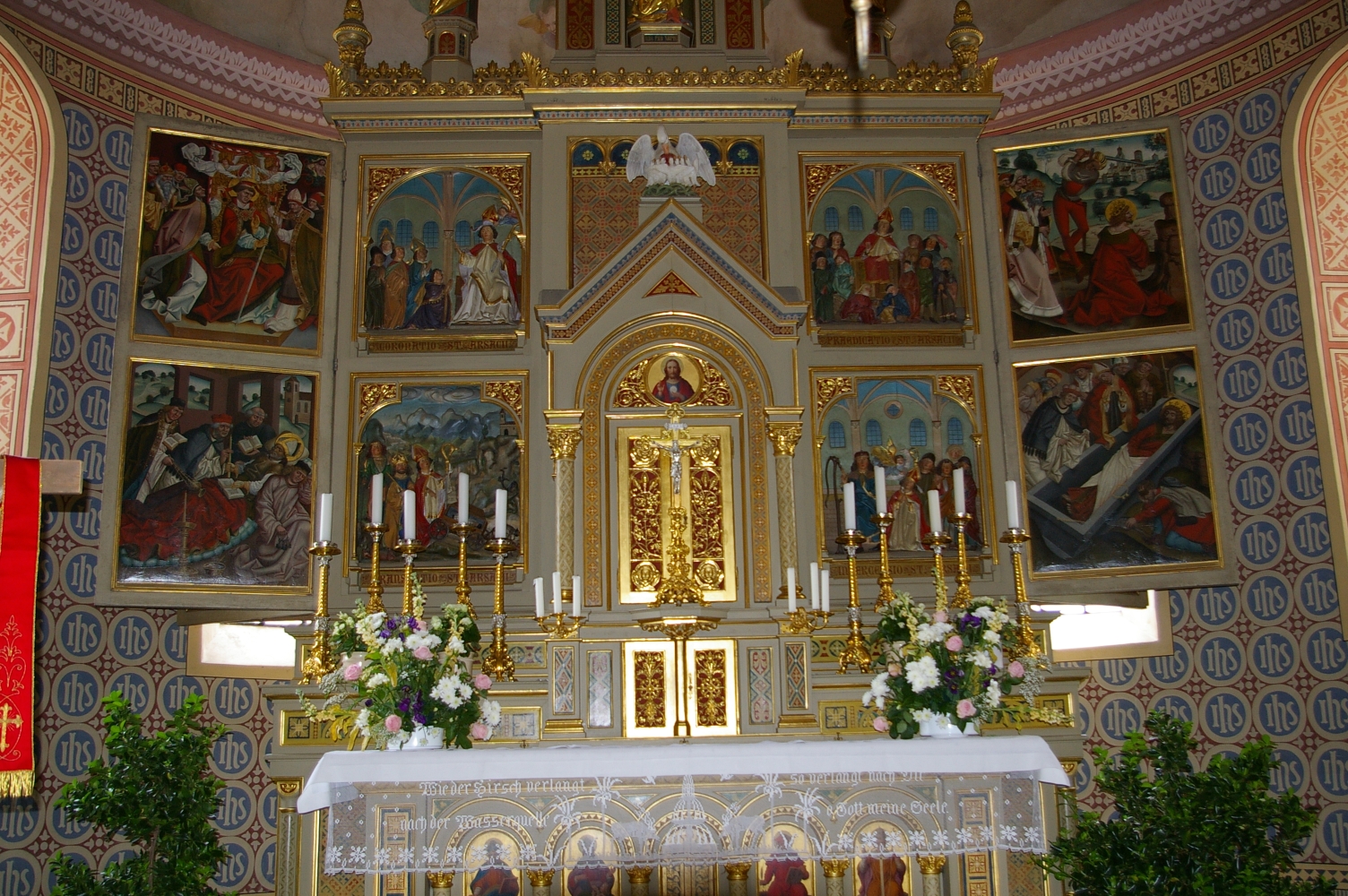
Altar candles are candles set on or near altars for religious ceremonies. Various religions have regulations or traditions regarding the number and type of candles used, and when they are lit or extinguished, for example during the liturgies.
Altar candles may sit directly on the altar or be placed in tall stands to the side of or behind the altar. For safety, altar candles are secured in some type of candle holder, such as candlesticks, which may be simple or elaborate. To prevent wax from dripping, candles are often topped by a candle follower, a short tube made of brass, glass or some other non-flammable material.
In the Roman Rite of the Catholic Church, candles are required to be placed on or beside the altar, at least for the celebration of Mass. For reasons of religious tradition, the Church used the candles at divine service that are made of beeswax.
For celebration of Mass, it is required that "on or next to the altar are to be placed candlesticks with lighted candles: at least two in any celebration, or even four or six, especially for a Sunday Mass or a holy day of obligation. If the diocesan Bishop celebrates, then seven candles should be used." Except if he is outside the boundary of his jurisdiction".[failed verification]
At the beginning of the 20th century, complex rules governed the composition and number of candles to be used at Mass. Lighted candles of the correct composition (beeswax, with no more than a minimal admixture of other material, and usually bleached) were considered so essential that, if before the consecration they happened to go out (quenched, for instance, by a gust of wind) and could not be relit within fifteen minutes, the celebration of Mass had to be abandoned, and some writers maintained that even if the candles could be relit within that time, Mass should in any case be begun again from the start. Some of these rules were formulated only in the second half of the nineteenth and the beginning of the 20th century. The Roman Missal of 1920 indicates that on the altar there should be "at least two candlesticks with lit candles" with a centrally placed cross between them. There is also a rule given in the same section of this Roman Missal that "a candle to be lit at the elevation of the Sacrament" should be placed with the cruets of wine and water to the Epistle side of the altar.[whose translation?]
Arthur Carl Piepkorn, in a liturgical directory entitled The Conduct of the Service, stated that the normal Lutheran practice was to use two candles on the altar:
It is proper to light the altar candles for all services. The Lutheran use is to have two single beeswax candles, set near the extremities of the altar, either on the gradine or as close as possible to the back of the mensa, if there be no gradine. Six candles is a Counter-Reformatory Roman use. Candelabra as substitutes for the two single candles are a Protestant sentimentality. The Epistle candle is lighted first; the Gospel candle last; they are extinguished in reverse order. Lighting with a match held in the hand is not reverent:—extinguishing with puffs of breath from bloating cheeks is even less so. Use a lighter and snuffer. The lights may be lit by the officiant if there be no one to assist him, or by a choirboy, or by a server appointed for the purpose. In any case the individual performing this task should be decently vested. New candles should be started before the service, or they may cause embarrassing difficulties.
In Anglicanism, candles are used frequently in churches. Percy Dearmer, author of The Parson's Handbook, states that English use supports no more than two lights on the altar.
Hub AI
Altar candle AI simulator
(@Altar candle_simulator)
Altar candle
Altar candles are candles set on or near altars for religious ceremonies. Various religions have regulations or traditions regarding the number and type of candles used, and when they are lit or extinguished, for example during the liturgies.
Altar candles may sit directly on the altar or be placed in tall stands to the side of or behind the altar. For safety, altar candles are secured in some type of candle holder, such as candlesticks, which may be simple or elaborate. To prevent wax from dripping, candles are often topped by a candle follower, a short tube made of brass, glass or some other non-flammable material.
In the Roman Rite of the Catholic Church, candles are required to be placed on or beside the altar, at least for the celebration of Mass. For reasons of religious tradition, the Church used the candles at divine service that are made of beeswax.
For celebration of Mass, it is required that "on or next to the altar are to be placed candlesticks with lighted candles: at least two in any celebration, or even four or six, especially for a Sunday Mass or a holy day of obligation. If the diocesan Bishop celebrates, then seven candles should be used." Except if he is outside the boundary of his jurisdiction".[failed verification]
At the beginning of the 20th century, complex rules governed the composition and number of candles to be used at Mass. Lighted candles of the correct composition (beeswax, with no more than a minimal admixture of other material, and usually bleached) were considered so essential that, if before the consecration they happened to go out (quenched, for instance, by a gust of wind) and could not be relit within fifteen minutes, the celebration of Mass had to be abandoned, and some writers maintained that even if the candles could be relit within that time, Mass should in any case be begun again from the start. Some of these rules were formulated only in the second half of the nineteenth and the beginning of the 20th century. The Roman Missal of 1920 indicates that on the altar there should be "at least two candlesticks with lit candles" with a centrally placed cross between them. There is also a rule given in the same section of this Roman Missal that "a candle to be lit at the elevation of the Sacrament" should be placed with the cruets of wine and water to the Epistle side of the altar.[whose translation?]
Arthur Carl Piepkorn, in a liturgical directory entitled The Conduct of the Service, stated that the normal Lutheran practice was to use two candles on the altar:
It is proper to light the altar candles for all services. The Lutheran use is to have two single beeswax candles, set near the extremities of the altar, either on the gradine or as close as possible to the back of the mensa, if there be no gradine. Six candles is a Counter-Reformatory Roman use. Candelabra as substitutes for the two single candles are a Protestant sentimentality. The Epistle candle is lighted first; the Gospel candle last; they are extinguished in reverse order. Lighting with a match held in the hand is not reverent:—extinguishing with puffs of breath from bloating cheeks is even less so. Use a lighter and snuffer. The lights may be lit by the officiant if there be no one to assist him, or by a choirboy, or by a server appointed for the purpose. In any case the individual performing this task should be decently vested. New candles should be started before the service, or they may cause embarrassing difficulties.
In Anglicanism, candles are used frequently in churches. Percy Dearmer, author of The Parson's Handbook, states that English use supports no more than two lights on the altar.
Recent media