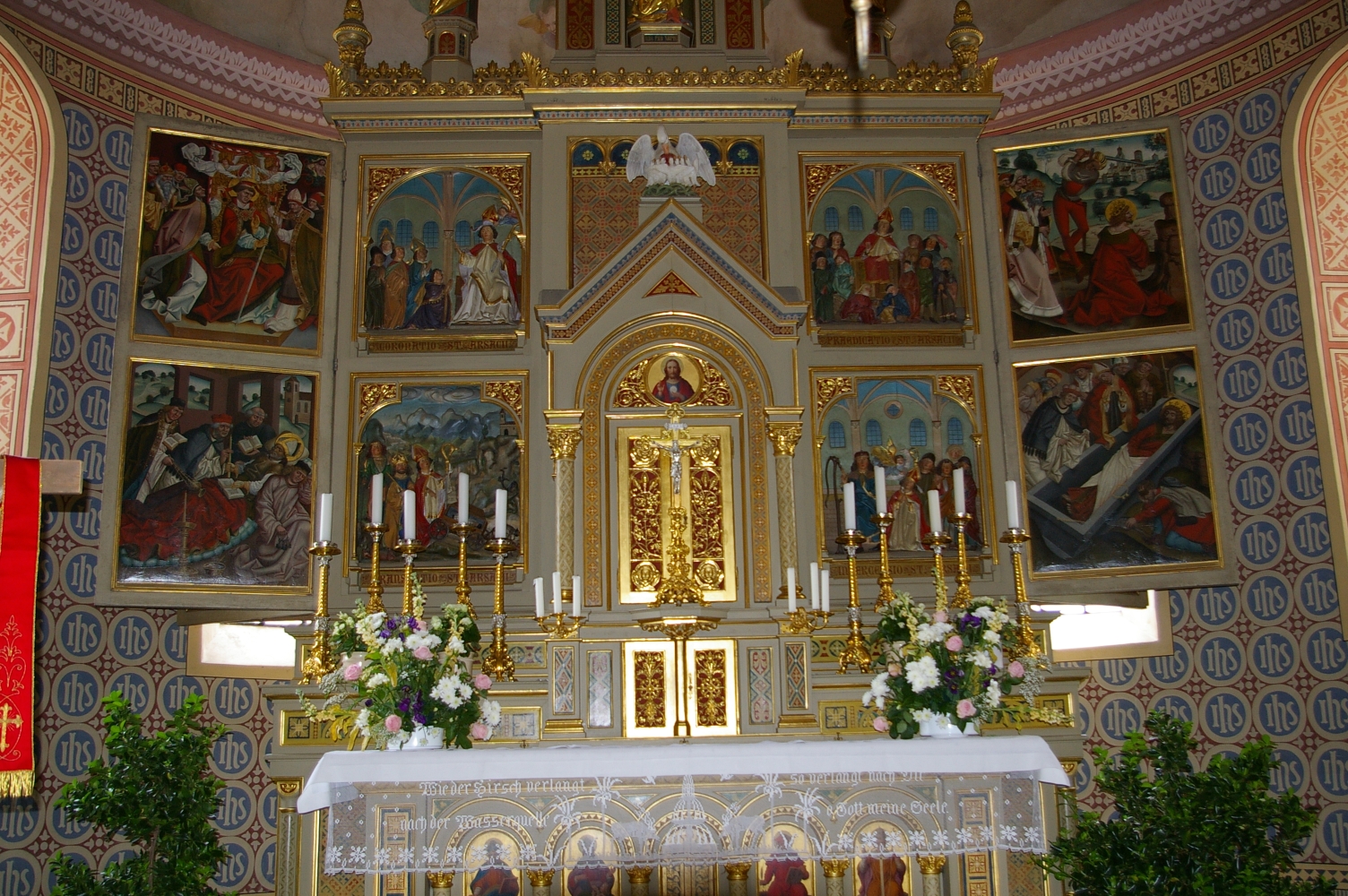
Altar candle
Altar candle
Main page
1676040

Altar candle

logo
Community Hub0 subscribers
Read side by side
from Wikipedia
Altar candles, along with chancel flowers, sit atop of the altar of St. Arsacius's church in Ilmmünster, Bavaria.

Altar candles are candles set on or near altars for religious ceremonies. Various religions have regulations or traditions regarding the number and type of candles used, and when they are lit or extinguished, for example during the liturgies.

Altar candles may sit directly on the altar or be placed in tall stands to the side of or behind the altar. For safety, altar candles are secured in some type of candle holder, such as candlesticks, which may be simple or elaborate. To prevent wax from dripping, candles are often topped by a candle follower, a short tube made of brass, glass or some other non-flammable material.

Christianity

[edit]

Catholic Church

[edit]

In the Roman Rite of the Catholic Church, candles are required to be placed on or beside the altar, at least for the celebration of Mass. For reasons of religious tradition, the Church used the candles at divine service that are made of beeswax.[1]

Regulation

[edit]

For celebration of Mass, it is required that "on or next to the altar are to be placed candlesticks with lighted candles: at least two in any celebration, or even four or six, especially for a Sunday Mass or a holy day of obligation. If the diocesan Bishop celebrates, then seven candles should be used."[2] Except if he is outside the boundary of his jurisdiction".[failed verification]

Blessing of the Candles at Candlemas at Saint Pancras Church, Ipswich

At the beginning of the 20th century, complex rules governed the composition and number of candles to be used at Mass.[3] Lighted candles of the correct composition (beeswax, with no more than a minimal admixture of other material, and usually bleached) were considered so essential that, if before the consecration they happened to go out (quenched, for instance, by a gust of wind) and could not be relit within fifteen minutes, the celebration of Mass had to be abandoned, and some writers maintained that even if the candles could be relit within that time, Mass should in any case be begun again from the start. Some of these rules were formulated only in the second half of the nineteenth and the beginning of the 20th century.[3] The Roman Missal of 1920 indicates that on the altar there should be "at least two candlesticks with lit candles" with a centrally placed cross between them. There is also a rule given in the same section of this Roman Missal that "a candle to be lit at the elevation of the Sacrament" should be placed with the cruets of wine and water to the Epistle side of the altar.[4][whose translation?]

Byzantine Rite

[edit]

Lutheranism

[edit]

Arthur Carl Piepkorn, in a liturgical directory entitled The Conduct of the Service, stated that the normal Lutheran practice was to use two candles on the altar:

It is proper to light the altar candles for all services. The Lutheran use is to have two single beeswax candles, set near the extremities of the altar, either on the gradine or as close as possible to the back of the mensa, if there be no gradine. Six candles is a Counter-Reformatory Roman use. Candelabra as substitutes for the two single candles are a Protestant sentimentality. The Epistle candle is lighted first; the Gospel candle last; they are extinguished in reverse order. Lighting with a match held in the hand is not reverent:—extinguishing with puffs of breath from bloating cheeks is even less so. Use a lighter and snuffer. The lights may be lit by the officiant if there be no one to assist him, or by a choirboy, or by a server appointed for the purpose. In any case the individual performing this task should be decently vested. New candles should be started before the service, or they may cause embarrassing difficulties.[5]

Anglicanism

[edit]

In Anglicanism, candles are used frequently in churches. Percy Dearmer, author of The Parson's Handbook, states that English use supports no more than two lights on the altar.

The use of a row of six candlesticks on the altar, or on a shelf or gradine behind it, is pure Romanism, and a defiance of the Ornaments Rubric, as of all other authority in the Church of England. From the beginning of the thirteenth century to the end of the nineteenth every declaration on the subject has mentioned the two lights on the altar only, and to this ancient and universal use of two lights, at the most, every known representation bears witness. Any one within reach of a large picture-gallery can verify this for himself; in the National Gallery, for instance, there are many illustrations of great interest in the Flemish, German, and Italian rooms and among the drawings of the Arundel collection. The evidence of the inventories, directories, &c., is practically the same. Now the instinct which led the church in the great ages of architecture and craftsmanship to use altar lights in this way was a true one; for an altar with two candlesticks upon it is more majestic and more beautiful than an altar with more than two. Furthermore, a row of candles hides the reredos or upper frontal, which ought to be one of the richest and most lovely things in the church[6]

"Church & altar candles"; Charles Farris

He points out, however, that English and north European sanctions the use of other candles near the altar, e.g., there were "very often two Standards on the pavement"[7] and "one very beautiful method was to have sconces for candles on the top of the four poles that sometimes stood at the four corners of the altar to carry the riddels."[8] He concludes:

A church may therefore have (1) two lights on the altar; (2) two standards on the pavement, or four if the sanctuary is large enough (as is seldom the case) for their comely arrangement without overcrowding; (3) other lights near but not behind the altar (preferably two or four on the rods or pillars for the riddels) for use on the principal feasts; (4) others hanging from the roof in candelabra."[8]

In the Protestant Episcopal Church in the United States of America, churches typically use two candles in the following manner:

Altar candles are tall, thin candles made of beeswax and stearine. They are topped with a brass or glass candle follower, which helps keep wax from spilling on the altar linens. Altar candles are lit using a taper, which is a lit wick attached to a long handle. They are lit and extinguished in a particular order so that the Gospel side candle is never burning alone. The Gospel side of the church is the left side as you are facing the front. So the candles are lit from right to left and extinguished from left to right.[9]

Methodism

[edit]
Two altar candles adorn the altar table of a Methodist chapel in Kent, Ohio, United States

Methodist churches typically use (normally two) candles in a manner similar to the Anglican way.

Many congregations use two candles on the altar to point out that Jesus was both a human being and God. At the end of the service, the light is carried out into the world to show that Jesus Christ is for all people everywhere [...] The acolyte leaves the worship service at the pastor's direction, carrying out the lighted candlelighter. This symbolizes the light of Jesus Christ going out into the world where believers are to serve.[10]

Other religions

[edit]

Taoism

[edit]
Taoist Altar showing three lamps, representing the Tao (center), Yin (left) and Yang (right)

In the Taoist religion, a central lamp on the altar represents the Tao, while two candles to the left and right of it represent the Yin and Yang respectively. [11]

See also

[edit]

References

[edit]

Further reading

[edit]
Revisions and contributorsEdit on WikipediaRead on Wikipedia
from Grokipedia
An altar candle is a liturgical candle placed on or near the altar during Christian worship services, serving both practical illumination and symbolic purposes as a representation of Christ as the light of the world.[1][2] These candles are typically composed of beeswax or a beeswax blend to ensure a clean, living flame, with Catholic regulations requiring at least 51% beeswax for ordinary altar candles and up to 100% for the Paschal candle used in Easter liturgies.[1][3] In many traditions, such as Episcopal and Lutheran worship, two altar candles are standard, positioned symmetrically to evoke solemnity and festivity while recalling Christ's dual nature as fully human and divine.[2][4] The historical use of candles in Christian liturgy traces back to the 4th century, initially for reading scriptures in dimly lit spaces like catacombs, before evolving into formalized symbolic elements by the 12th century, when they became customary on altars during papal Masses.[3][5] Symbolically, the beeswax is often interpreted as signifying the pure humanity of Christ derived from the Virgin Mary, the wick as his soul, and the flame as his divinity, while the overall light points to themes of enlightenment, grace, and the presence of the divine during sacraments like the Eucharist.[1][3] In practice, altar candles are lit at the beginning of services such as the Easter Vigil or Evening Prayer and extinguished at their conclusion, with their placement—either directly on the altar, in tall stands, or on a reredos—varying by denomination to enhance the sacred atmosphere without distracting from the rite.[2][5] Modern church guidelines emphasize non-smoky, wax-based materials to maintain reverence, prohibiting electric substitutes except in cases of necessity approved by ecclesiastical authority.[1]

History

Origins and Early Use

The precursors to modern candles originated in ancient Egypt around 3000 BCE, where rushlights or torches were created by soaking the pithy core of reeds in melted animal fat to produce a rudimentary source of illumination.[6] These early forms served practical purposes in daily life and rituals, laying the groundwork for later developments in lighting technology. In ancient Greek and Roman rituals, torches and lamps played a prominent role, often symbolizing the divine presence, enlightenment, or the gods' favor during cultic ceremonies, processions, and festivals such as those honoring Dionysos or in mystery rites.[7] Early Christianity, emerging in a Greco-Roman cultural milieu, assimilated elements of these practices through the influx of pagan converts, adapting the symbolic use of lights to represent spiritual illumination while gradually distancing from overt pagan associations.[8] The earliest documented references to the symbolic role of lighting in Christian worship appear in the 4th century CE, including in the writings of St. Ephraem the Syrian, who commented on the lamps described in Exodus 37 to contrast Old Testament practices with the spiritual "dawn" brought by Christ, rendering physical lamps obsolete in the new faith.[9] By this period, lamps and early candle forms were in normal use during Christian gatherings, primarily for practical illumination during evening services or to signify reverence, though church fathers like Tertullian and Lactantius critiqued excessive or superstitious applications inherited from pagan traditions.[10][3] During the 4th and 5th centuries in Europe, beeswax emerged as the preferred material for church candles due to its perceived purity—derived from the labor of bees, seen as mirroring Christ's virginal incarnation—and its cleaner, smokeless burn compared to tallow made from animal fat.[3] This shift marked a refinement in liturgical lighting, emphasizing symbolic cleanliness over utilitarian alternatives.

Evolution in Christian Liturgy

In the medieval period, the use of altar candles became standardized within Christian liturgy, particularly through ecclesiastical developments that mandated their presence during the Mass. Pope Innocent III, during the Fourth Lateran Council in 1215, is noted as the first to order lights to be placed upon the altar, symbolizing the doctrine of transubstantiation recently defined by the same pope and emphasizing the sacrificial nature of the Eucharist.[9] This marked a shift toward institutional requirements. By the 15th and 16th centuries, liturgical practices evolved to prioritize purity in materials, leading to a preference for beeswax over tallow for altar candles due to the latter's smoky and odorous burning properties, which were deemed unsuitable for sacred spaces. The Church's longstanding tradition, rooted in mystical associations of beeswax with Christ's purity, favored its use for ecclesiastical candles to maintain reverence during the liturgy. This aligned with broader reforms emphasizing symbolic integrity, though full mandates varied by region until later codifications. The 19th and 20th centuries brought innovations influenced by the Industrial Revolution, including the introduction of paraffin wax as a cheaper alternative, which began to supplement or replace pure beeswax in some contexts due to economic pressures. In 1904, the Sacred Congregation of Rites issued a decree permitting mixtures, requiring at least 75% beeswax for the Paschal candle, the candles used in the blessing of baptismal water, and Mass altar candles, and at least 50% for other altar candles to balance tradition with practicality.[3] The Second Vatican Council in the 1960s further adjusted practices for simplicity, removing strict material requirements for altar candles while encouraging beeswax where possible, allowing for more accessible setups in modern Catholic rites without diminishing their liturgical role.[1] Regional variations emerged prominently during the Baroque era (17th-18th centuries), where Catholic churches often featured elaborate high altars adorned with six or seven candles to evoke grandeur and divine illumination, as seen in counter-Reformation architecture. In contrast, Reformation-influenced Protestant areas adopted simpler configurations; for instance, under King Edward VI in 1547, English injunctions limited high altars to just two lights, reflecting a rejection of perceived Catholic excesses and prioritizing scriptural austerity over ritual elaboration.[9] These differences underscored ongoing tensions between ornate symbolism and minimalist worship across Christian traditions.

Symbolism and Significance

Theological Meanings

In Christian theology, altar candles primarily symbolize Christ as the "Light of the World," as declared in John 8:12 of the Gospel, where Jesus states, "I am the light of the world. Whoever follows me will not walk in darkness, but will have the light of life." This imagery portrays candles as embodiments of Christ's divine presence, illuminating the faithful and dispelling the spiritual darkness of sin and ignorance.[11] The placement of two candles on the altar often carries layered patristic interpretations, representing either the dual nature of Christ—fully divine and fully human—or the Old and New Testaments as precursors to and fulfillment in the Christian revelation. Medieval theologian Guillaume Durandus (c. 1230–1296) described altar candles as signifying "The Law and the Prophets," thereby evoking the continuity between the Hebrew Scriptures and the Gospel. Similarly, some early ritual interpretations assigned the pair to Christ's two natures, though this risked implying separation akin to Nestorianism.[9][9] The preference for beeswax in altar candles further enriches their theological depth, serving as a metaphor for purity and incarnation. The wax, produced by virginal worker bees without male involvement, symbolizes the immaculate flesh of Christ derived from the Virgin Mary, while the honey from which it derives represents the "superlative sweetness" of Christ's humanity. The United States Conference of Catholic Bishops affirms this tradition, noting that beeswax evokes the pure body of Christ born of Mary, with the wick signifying his soul and the flame his divinity.[12][1] Beyond immediate symbolism, altar candle flames hold eschatological significance, pointing to the eternal light of heaven and the soul's illumination by the Holy Spirit. In Orthodox theology, as articulated by St. Sophronius of Jerusalem (c. 560–638), candles and lamps reflect the Unwaning Light of God that gladdens the righteous in the Kingdom, prefiguring divine glory in the afterlife. During sacraments like Holy Unction, multiple candles underscore the Holy Spirit's grace-bestowing illumination, guiding souls toward eternal beatitude.[13]

Ritual Functions

In Christian liturgical practice, altar candles are typically lit before the commencement of worship services by acolytes or clergy members, ensuring the sanctuary is illuminated as a sign of reverence and the presence of divine light. The lighting procedure often begins with the candle nearest the center of the altar—such as the one closest to the cross—and proceeds outward symmetrically to maintain ceremonial order.[14][15] In some traditions, the candle on the right side (Epistle side, facing the altar) is lit first, symbolizing the Old Testament or the Jews who received revelation first, before proceeding to the left side.[16] The number of altar candles varies according to the solemnity of the rite: at minimum, two candles are used for ordinary celebrations, while four or six are employed for Sunday Masses or holy days of obligation, and seven for services presided over by a bishop. These are placed on or adjacent to the altar, typically flanking the tabernacle or crucifix at either end to frame the sacred space without obstructing the liturgical action.[14] Altar candles serve practical ritual functions during worship, including providing illumination for the performance of sacraments such as the Eucharist, where their steady light aids visibility on the altar. They also signal the initiation and conclusion of services, with candles required to be lit before Mass begins and remaining so throughout to underscore the continuity of the sacred rite. In processions, such as the entrance rite or the Gospel procession, candles are carried by ministers to extend the light's symbolism into movement, enhancing the ceremonial flow. A prominent example is the Paschal candle in the Easter Vigil, which is lit from new fire and processed into the darkened church, representing Christ's resurrection and serving as the source for lighting all other candles during the service.[14][17][18] Customs for extinguishing altar candles emphasize respect for the flame's sacred role: after services, they are typically snuffed using a dedicated tool to prevent smoke and scattering of embers, rather than blown out, though natural burnout is permitted on certain extended vigils or feast days to allow the light to persist symbolically. This practice ensures the candles are not extinguished prematurely, preserving the ritual's integrity until the rite fully concludes.[19][17]

Physical Characteristics

Materials and Composition

Altar candles are primarily composed of natural or synthetic waxes selected for their burning properties and symbolic purity in liturgical settings. Beeswax remains the traditional and preferred material due to its slow, clean burn and minimal smoke, producing a bright, steady flame that evokes divine light. In Roman Catholic practice, altar candles have traditionally contained at least 51% beeswax, particularly for the Paschal and sanctuary candles, though current guidelines require only wax that provides a living flame without smoke or noxious odors, ensuring a dignified and odor-free illumination during worship.[3][1] Historically, tallow—rendered from animal fats such as beef or mutton—was commonly used in church candles before the widespread adoption of beeswax, prized for its availability but largely phased out today owing to its unpleasant odor and sooty residue. Modern alternatives include paraffin, a petroleum-derived wax valued for its affordability and consistent burn, often blended with beeswax to achieve the required composition while reducing costs. Soy wax, derived from soybean oil, has emerged as an eco-friendly option in some contemporary ecclesiastical applications, offering a longer burn time and biodegradability compared to paraffin, though it is less common in strict traditional settings.[5][3][5] The wick, essential for even combustion, is typically made from braided cotton, which provides a self-trimming action to prevent excessive charring or "mushrooming" at the tip, or occasionally from hemp for similar steady burning in natural wax formulations. These wicks are often treated with a light wax coating to enhance capillary action and reduce initial smoking. Additives like stearic acid, a vegetable- or animal-derived fatty acid, are incorporated into paraffin or soy-based blends to increase hardness, slow the melting rate, and promote a more vertical flame, particularly in non-beeswax candles. Essential oils for scenting are generally avoided in liturgical altar candles to maintain ritual purity, though they may appear in non-ecclesiastical variants.[20][21][22] Standard altar candles are cylindrical in form, typically measuring 9 to 12 inches in height and 2 to 3 inches in diameter to fit common candelabra, with self-fitting or plain ends for secure placement. Votive candles, shorter and wider for side altars or devotions, follow similar material compositions but in smaller sizes around 2 inches tall. Colors are symbolic: white predominates for its association with purity and resurrection, while red variants are used on feasts of martyrs to signify blood and sacrifice.[23][24][25]

Manufacturing and Ecclesiastical Standards

The manufacturing of altar candles typically involves melting selected waxes, such as beeswax or stearin blends, and incorporating cotton wicks treated for even burning. For premium beeswax varieties, the hand-dipping process is employed, where wicks are repeatedly passed through a vat of molten wax to build layers until the desired thickness is achieved, followed by cooling, trimming excess wick, and shaping the ends.[22][26] In contrast, mass production often utilizes machine extrusion or pouring methods: wax is liquefied and forced into molds containing pre-positioned wicks, allowed to solidify, then demolded and trimmed for uniformity.[26][27] Ecclesiastical standards for altar candles emphasize materials that support liturgical symbolism and practical use. In the Roman Catholic Church, while pre-1983 canon law required at least 51% beeswax content to evoke purity, the current Code of Canon Law (1983) mandates only that candles be made of wax providing a living flame without smoke or noxious odors, allowing flexibility in composition; candles are traditionally blessed during rites like Candlemas for sacramental use.[1][1] In Eastern Orthodox traditions, altar candles must consist of 100% pure, natural beeswax without synthetic additives to maintain theological integrity, often hand-dipped and unbleached to preserve their traditional golden hue.[28][29] Quality controls ensure altar candles burn steadily without disrupting worship. Ideal flame height is approximately 1 to 1.5 inches to prevent excessive soot or flickering, achieved by trimming wicks to about 1/4 inch before lighting.[30] Burn times vary by diameter but typically range from 1.5 to 2 hours per inch for beeswax blends, allowing predictable replacement during services.[31] Smoke-free performance is required to safeguard altar aesthetics and air quality, with wicks and wax formulations tested to minimize residue on sanctuary surfaces.[30][32] Since the 2000s, some denominations have adapted to eco-friendly alternatives like soy or palm wax blends for altar candles, provided they meet non-smoky burning criteria under general liturgical guidelines; however, traditional beeswax remains predominant, especially in Orthodox practice.[1][33]

Uses in Christianity

Roman Catholicism

In Roman Catholicism, the use of altar candles is governed by the General Instruction of the Roman Missal (GIRM), which mandates at least two lighted candles for any celebration of Mass, with four or six recommended especially for Sundays and holy days of obligation; if the diocesan bishop celebrates, seven candles are used.[34] These candles must be placed on the altar or immediately adjacent to it, ensuring they are elevated and never positioned on the floor to maintain the altar's dignity as the focal point of the liturgy.[34] The GIRM emphasizes that candles provide a living flame symbolizing Christ as the light of the world, and electric lights are not permitted as substitutes to preserve this authentic symbolism.[1] Liturgical candles in the Roman Rite must be composed primarily of beeswax—at least 51% by weight in many episcopal conferences, including the United States—to evoke purity and the natural product of the beehive, a symbol of the Church's communal life.[1] This requirement aligns with longstanding ecclesiastical standards, though the GIRM itself delegates precise material specifications to bishops' conferences while insisting on wax-based candles that burn cleanly without smoke or odor.[1] Historically, the mandate for at least two lighted candles during Mass was codified in the Roman Missal promulgated by Pope St. Pius V in 1570 following the Council of Trent, standardizing the practice to ensure solemnity and uniformity across the Latin Church.[35] Specific rites highlight the prominence of altar candles. The Paschal candle, a large beeswax candle inscribed with the Alpha and Omega, the current year, and a cross embedded with five grains of incense representing Christ's wounds, is blessed and lit during the Easter Vigil and remains in use—lighted for all services—until the Pentecost Sunday liturgy, after which it is extinguished to signify the end of the Easter season.[34] During Advent, purple (violet) candles are integrated into the Advent wreath, typically placed near the altar in the sanctuary; three purple candles symbolize penance and expectation, lit progressively each Sunday, while the fourth is rose-colored for Gaudete Sunday to denote joy, complementing the altar candles in preparing for Christmas.

Eastern Orthodox and Byzantine Traditions

In Eastern Orthodox churches, altar candles are positioned on the Holy Table (altar) within the sanctuary, behind the iconostasis that separates the nave from the clergy's area. A seven-branched candlestick is typically placed behind or on the Holy Table, with its seven candles lit during the Divine Liturgy to symbolize the sacred number seven, evoking divine completeness and the light of Christ illuminating the Eucharistic celebration.[36] This arrangement honors the theological heritage affirmed by the seven ecumenical councils, as the Seventh Ecumenical Council specifically decreed the veneration of icons, relics, the Cross, and the Gospel through the lighting of candles before them.[37] Vigil lamps, often perpetual oil lamps or beeswax candles, burn continuously before icons on the iconostasis and throughout the church, representing the uncreated light of Christ as the eternal presence and illumination of the faithful. These lamps particularly evoke the Theotokos (Virgin Mary) as the bearer of the unquenchable divine light, with beeswax preferred for its purity—symbolizing Christ's incorruptible flesh incarnate through her—and its clean, smoke-free burn that maintains the sanctity of sacred spaces.[37][38] In home icon corners, similar vigil lamps foster personal devotion, mirroring the church's practice of perpetual prayerful light.[39] During liturgical services, the trikerion—a ornate triple candlestick holding three beeswax candles—serves as a key ritual element, symbolizing the three persons of the Holy Trinity and used by bishops in hierarchical Divine Liturgies for blessings and processions such as the Great Entrance.[39] These candles remain lit throughout the service, emphasizing the enduring divine light, and are extinguished only after the dismissal hymn to conclude the rite.[37] Byzantine Catholic traditions closely parallel Eastern Orthodox usage, with altar candles on the Holy Table behind the iconostasis and vigil lamps before icons. The Divine Liturgy requires at least two candles, often including a seven-branched candlestick symbolizing the seven sacraments, under guidelines from the Congregation for the Oriental Churches that preserve Byzantine symbolism of Trinitarian light while ensuring consistency with broader Catholic norms on materials such as beeswax composition.[40][41]

Protestant Denominations

In Protestant denominations, altar candle usage emphasizes simplicity and symbolic restraint compared to the more elaborate rituals in Catholic and Orthodox traditions, reflecting Reformation principles that prioritize scriptural light over ceremonial adornment. This approach stems from a historical evolution away from medieval norms toward minimalism to avoid perceived excesses, while still employing candles to evoke Christ's presence as the light of the world.[42] In Lutheranism, two candles are typically placed on the altar, influenced by the Augsburg Confession's view of such elements as permissible adornments rather than essential to worship. These candles are lit during services involving Holy Communion to symbolize Christ's dual nature as fully human and fully divine, representing his presence in the sacrament. Beeswax is optional, with paraffin alternatives commonly used for practicality, though traditional beeswax is preferred in some congregations for its purity. Additionally, Advent and Christ candles are often incorporated into wreaths during the Advent season, lit progressively to signify the coming of the Messiah and echoing themes of hope and incarnation.[43][44][42][45] Anglicanism permits a flexible arrangement of two to six candles on or near the altar, as outlined in the Book of Common Prayer (1662 and 1979 editions), which makes provision for their use without mandating specifics. These candles symbolize the light of Christ and Scripture illuminating the faith, lit during Eucharistic services to denote solemnity and divine presence. High Church Anglican parishes, influenced by the Oxford Movement, employ more elaborate setups with multiple candles in branched holders to enhance ritual beauty, while Low Church or Evangelical settings favor minimal use—often just two or none—to emphasize preaching over symbolism.[2][46][47] Methodist and Reformed traditions generally adopt subdued practices, with many congregations using one central candle or none in low-church environments to steer clear of associations with Roman Catholic ritualism, aligning with John Calvin's emphasis on simplicity in worship. In Methodist churches, however, two candles are common on the altar during services, lit to represent Christ's humanity and divinity and extinguished at the close to signify carrying his light into the world. Reformed churches vary, but since the 20th century, two candles have appeared more frequently in ecumenical settings to promote unity, such as in joint services or during Advent, without implying sacramental necessity.[48][49][50] Contemporary trends in Baptist and Evangelical churches increasingly incorporate electric candles on altars for safety reasons, particularly in settings with children or to reduce fire hazards, while maintaining a focus on personal devotion rather than formal ritual. These flameless options mimic traditional flames through LED technology, allowing continuous symbolism of Christ's light without the maintenance of wax drippings or smoke.[51][52]

Uses in Other Religions

Judaism

In Jewish tradition, the ner tamid, or eternal light, hangs above the Holy Ark in every synagogue, serving as a central symbol of God's perpetual presence and the continuity of divine light from the ancient Tabernacle.[53] Derived from the biblical commandment in Exodus 27:20-21 to maintain a continuous light before the Lord, it commemorates the seven-branched menorah of the Temple and represents unwavering sanctity amid communal worship on the bimah, the synagogue's raised platform analogous to an altar.[54] While traditionally a flame, many synagogues now use an electric bulb for the ner tamid to mitigate fire risks during services, ensuring safety without diminishing its symbolic role.[55] Shabbat candles hold a prominent place in Jewish home rituals, lit by women or girls eighteen minutes before sunset on Friday evenings to usher in the Sabbath.[56] Typically two candles are kindled, symbolizing the dual Torah commandments to "remember" (zachor) and "observe" (shamor) the Sabbath, while the lighting invokes shalom bayit (peace in the home) through the recited blessing to sanctify the onset of rest and holiness.[57][58] This practice, rooted in Talmudic teachings on enhancing Shabbat's delight through illumination, extends the theme of light as a conduit for divine peace into domestic settings.[59] The Hanukkah menorah, known as a hanukkiah, is an eight-branched candelabrum used during the eight-night festival, with a ninth elevated shamash (helper) candle employed to light the others progressively from right to left each evening.[60] This ritual commemorates the Maccabean Revolt's successful rededication of the Second Temple in 164 BCE, when a small cruse of oil miraculously burned for eight days despite expectations of only one.[61] Blessings are recited before lighting, beginning with three on the first night and two thereafter, emphasizing themes of triumph over oppression and enduring faith through incremental illumination.[62] Unlike continuous altar flames in some other traditions, Jewish synagogue services generally avoid open flames to prevent fire hazards, relying instead on the steady, safe glow of the ner tamid and focusing candle rituals in home observances.[55]

Hinduism and Buddhism

In Hinduism, diyas—small oil lamps that can resemble candles—are commonly lit on home altars or in temple shrines, especially during the festival of Diwali, to invoke divine presence and prosperity. The flame of the diya symbolizes knowledge (jnana), which dispels the darkness of ignorance (avidya), mirroring the philosophical triumph of enlightenment over delusion in Hindu teachings.[63][64] Certain variants, such as five-wick lamps, represent the Pancha Bhuta, the five cosmic elements (earth, water, fire, air, and space), fostering harmony and balance during rituals.[64] In Buddhism, altar practices involve lighting candles or butter lamps before statues of the Buddha, particularly in Theravada and Vajrayana traditions, as offerings that illuminate sacred spaces and aid meditation. Butter lamps, prevalent in Vajrayana temples, embody the radiance of wisdom, clearing spiritual obscurity much like a flame scatters shadows.[65] These lamps are integral to merit-making ceremonies, such as Vesak, where they honor the Buddha's enlightenment and generate positive karma for practitioners and the deceased.[66] In Vajrayana contexts, such offerings symbolize the light of wisdom that dispels ignorance and spiritual darkness.[67] Shared across Hinduism and Buddhism, these flame offerings—directed toward deities or enlightened figures—employ wicks soaked in ghee or oil to ensure prolonged burning, signifying enduring spiritual illumination. While no standardized count exists, lighting multiples of lamps is favored for their auspicious connotations, amplifying intentions of purity and prosperity.[68][69] Since the early 21st century, urban temples in both traditions have increasingly incorporated LED candles as safer alternatives to traditional flames, reducing fire risks while preserving ritual symbolism.[70][71]

Taoism

In Taoist practice, the altar is typically arranged with a central incense burner or sacred lamp symbolizing the Tao, flanked by two candles, often red and tall in Chinese traditions, on either side to represent the balance of Yin (positioned on the left, associated with the moon) and Yang (on the right, associated with the sun).[72][73] These candles are lit during ritual offerings to deities, invoking harmony between opposing cosmic forces and facilitating the flow of spiritual energy.[72] In terms of human physiology and Inner Alchemy, the candles also symbolize the original vital energy (Yuan Qi) and acquired life force (Hou Tian Qi), akin to the eyes that perceive inner light.[72] Candles play a key role in temple rituals for ancestor worship and feng shui harmonization, where their steady flames are interpreted as indicators of qi, the vital spiritual energy circulating through the space.[74] A bright, even flame suggests balanced qi and successful invocation, while flickering or dim light may signal disharmony requiring adjustment in the ritual or environment.[74] The materials for these altar candles are often red-dyed paraffin or beeswax, chosen for the auspicious color symbolizing vitality and protection in Chinese traditions, with wicks made from combustible fibers for clean burning.[73] They are typically renewed daily in active temples to maintain the sanctity of the space and ensure continuous energetic alignment.[73] The use of candles in Taoist altars traces its roots to Han Dynasty (206 BCE–220 CE) temple practices, when wax candles first became common offerings in Chinese religious contexts, evolving through the formalization of Daoist rituals and the compilation of the Daozang canon in later dynasties.[75][73] This integration reflects the broader cosmological symbolism of light as a manifestation of the Tao's eternal way.[72]

References

User Avatar
No comments yet.