
Recent from talks
Alternatives to car use
Knowledge base stats:
Talk channels stats:
Members stats:
Alternatives to car use
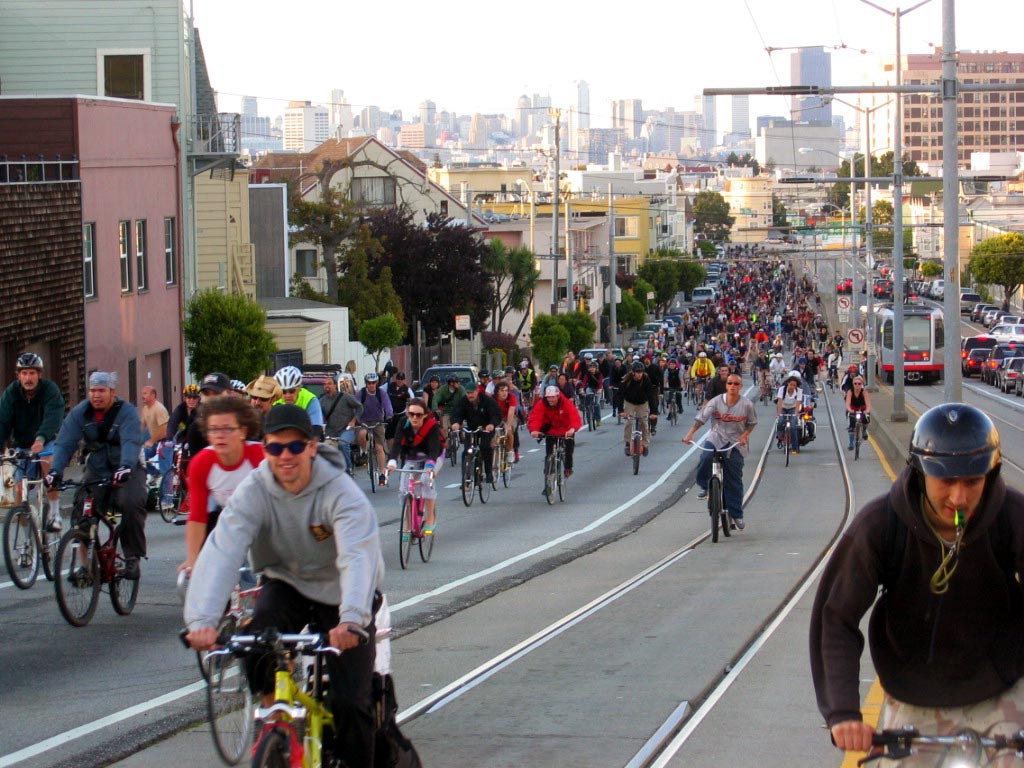
Established alternatives to car use are usually used to refer to transportation options that can improve health through increased physical activity, reduced pollution, less resource use and emissions, reduced congestion, less wasted time and money, as well as creating more livable and equitable communities by fostering social inclusion and reallocating space from parking and roads to other uses. Common alternatives include cycling, walking, kick scooters, rollerblading, skateboarding, twikes and (electric or internal combustion) motorcycles. Other alternatives are public transport vehicles (buses, guided buses, trolleybuses, trains, subways, monorails, tramways).
Prior to the popularity of car use which dominated motorised transport (and consequently urban planning) from around the 1950s onwards, several transportation modes were used. Pedestrianism for both short and long distances was used, but also travel by horse especially for long distances. Trams, especially powered trams, achieved widespread popularity in the 19th century. Carriages, used for centuries, are still used but mainly for tourism.
The public transport with the highest modal share worldwide is travelling by bus followed by travelling by rail due to infrastructure cost. A pedestrian form of public transport is a walking bus predominantly used by schools. An attempt to transform private transport by bicycle into public transport has been bicycle sharing schemes. Effectively they are renting access to a fleet. Bicycle-sharing systems have been implemented in over 1000 cities worldwide, and are especially common in many European and Chinese cities of all sizes. Similar programs have been implemented across the United States as well, including large cities like Washington, D.C., and New York City, as well as smaller cities like Buffalo, New York and Fort Collins, Colorado.
Personal rapid transit is a scheme that has been discussed, in which small, automated vehicles would run on special elevated tracks spaced within walking distance throughout a city, and could provide direct service to a chosen station without stops. However, despite several concepts existing for decades personal rapid transit has failed to gain significant ground and several prototypes and experimental systems have been dismantled as failures.
The private transport with the highest modal share, worldwide that is unmotorised, is pedestrianism followed by cycling.
Another possibility is forms of personal transport such as the electric skateboard/mountainboard, electric kick scooter, or personal transporters, such as self-balancing unicycles (i.e. Segway PT and others), which could serve as an alternative to cars and bicycles if they prove to be socially accepted.
Electric or internal combustion motorcycles (which also include scooters) are also an option. Internal combustion motorcycles do create some degree of local air pollution however. That said, the degree of local air pollution varies considerably depending on which fuel (i.e. gasoline, LPG, CNG/biogas, hydrogen) is injected to the internal combustion engine. This fuel can be freely chosen, and existing motorcycle engine can be converted to run on these. Hydrogen for instance is described as being "near-emissionless" when burned in an internal combustion engine.
Also, velomobiles exist (including electric assisted versions), which compared to regular bicycles have the benefit of being enclosed (hence protecting the driver from the weather), and the potential of being motorized, which can allow one to travel greater distances (at a faster speed).
Hub AI
Alternatives to car use AI simulator
(@Alternatives to car use_simulator)
Alternatives to car use
Established alternatives to car use are usually used to refer to transportation options that can improve health through increased physical activity, reduced pollution, less resource use and emissions, reduced congestion, less wasted time and money, as well as creating more livable and equitable communities by fostering social inclusion and reallocating space from parking and roads to other uses. Common alternatives include cycling, walking, kick scooters, rollerblading, skateboarding, twikes and (electric or internal combustion) motorcycles. Other alternatives are public transport vehicles (buses, guided buses, trolleybuses, trains, subways, monorails, tramways).
Prior to the popularity of car use which dominated motorised transport (and consequently urban planning) from around the 1950s onwards, several transportation modes were used. Pedestrianism for both short and long distances was used, but also travel by horse especially for long distances. Trams, especially powered trams, achieved widespread popularity in the 19th century. Carriages, used for centuries, are still used but mainly for tourism.
The public transport with the highest modal share worldwide is travelling by bus followed by travelling by rail due to infrastructure cost. A pedestrian form of public transport is a walking bus predominantly used by schools. An attempt to transform private transport by bicycle into public transport has been bicycle sharing schemes. Effectively they are renting access to a fleet. Bicycle-sharing systems have been implemented in over 1000 cities worldwide, and are especially common in many European and Chinese cities of all sizes. Similar programs have been implemented across the United States as well, including large cities like Washington, D.C., and New York City, as well as smaller cities like Buffalo, New York and Fort Collins, Colorado.
Personal rapid transit is a scheme that has been discussed, in which small, automated vehicles would run on special elevated tracks spaced within walking distance throughout a city, and could provide direct service to a chosen station without stops. However, despite several concepts existing for decades personal rapid transit has failed to gain significant ground and several prototypes and experimental systems have been dismantled as failures.
The private transport with the highest modal share, worldwide that is unmotorised, is pedestrianism followed by cycling.
Another possibility is forms of personal transport such as the electric skateboard/mountainboard, electric kick scooter, or personal transporters, such as self-balancing unicycles (i.e. Segway PT and others), which could serve as an alternative to cars and bicycles if they prove to be socially accepted.
Electric or internal combustion motorcycles (which also include scooters) are also an option. Internal combustion motorcycles do create some degree of local air pollution however. That said, the degree of local air pollution varies considerably depending on which fuel (i.e. gasoline, LPG, CNG/biogas, hydrogen) is injected to the internal combustion engine. This fuel can be freely chosen, and existing motorcycle engine can be converted to run on these. Hydrogen for instance is described as being "near-emissionless" when burned in an internal combustion engine.
Also, velomobiles exist (including electric assisted versions), which compared to regular bicycles have the benefit of being enclosed (hence protecting the driver from the weather), and the potential of being motorized, which can allow one to travel greater distances (at a faster speed).
Recent media