


Community hub
Recent from talks
Contribute something
Nothing was collected or created yet.
Biogas
View on Wikipedia

| Part of a series on |
| Sustainable energy |
|---|
 |


Biogas is a gaseous renewable energy source[1] produced from raw materials such as agricultural waste, manure, municipal waste, plant material, sewage, green waste, wastewater, and food waste. Biogas is produced by anaerobic digestion with anaerobic organisms or methanogens inside an anaerobic digester, biodigester or a bioreactor.[2][3]
The gas composition is primarily methane (CH
4) and carbon dioxide (CO
2) and may have small amounts of hydrogen sulfide (H
2S), moisture and siloxanes. The methane can be combusted or oxidized with oxygen. This energy release allows biogas to be used as a fuel; it can be used in fuel cells and for heating purpose, such as in cooking. It can also be used in a gas engine to convert the energy in the gas into electricity and heat.[4]
Biogas can be upgraded to natural gas quality specifications by stripping carbon dioxide and other contaminants. Biogas that has been upgraded to interchangeability with natural gas is called Renewable Natural Gas (RNG). RNG can be used a drop-in fuel in the gas grid or to produce compressed natural gas as a vehicle fuel.[5]
Biogas is considered to be a renewable resource. At a high level, biogas is a carbon neutral fuel in so far as emissions of carbon dioxide from its combustion are matched by carbon dioxide pulled from the atmosphere to produce biomass.[6] In practice, the carbon intensity of biogas can vary depending on emissions from the production of biomass and the processes used to produce and upgrade biogas.[5] In some applications, the capturing of biogas can avoid emissions of methane reducing overall emissions.[7]
Production
[edit]Biogas is produced by microorganisms, such as methanogens and sulfate-reducing bacteria, performing anaerobic respiration. Biogas can refer to gas produced naturally and industrially.
Natural
[edit]In soil, methane is produced in anaerobic environments by methanogens, but is mostly consumed in aerobic zones by methanotrophs. Methane emissions result when the balance favors methanogens. Wetland soils are the main natural source of methane. Other sources include oceans, forest soils, termites, and wild ruminants.[8]
Industrial
[edit]Anaerobic digestion is a sequence of processes by which microorganisms break down biodegradable material in the absence of oxygen.[9] This process produces biogas which can be used as a fuel. Industrial biogas production can either be purpose-built such as anaerobic digesters built to process manure and organic waste or can harvest biogas produced as byproduct from landfills or wastewater treatment plants.[10]
Biogas plants
[edit]A biogas plant is the name often given to an anaerobic digester that treats farm wastes, municipal organic waste and/or energy crops.[10] Industrial biogas plants process organic material in an air-tight tank to create anaerobic conditions. The material is heated to either mesothermic (~38oC) or thermophilic (>55oC) and held for a typical retention time of two to thirty days.[11]
These plants can be fed with energy crops such as maize silage or biodegradable wastes including sewage sludge and food waste. During the process, the micro-organisms transform biomass waste into biogas and digestate. Higher quantities of biogas can be produced when the wastewater is co-digested with other residuals from the dairy industry, sugar industry, or brewery industry. For example, while mixing 90% of wastewater from beer factory with 10% cow whey, the production of biogas was increased by 2.5 times compared to the biogas produced by wastewater from the brewery only.[12]
Landfill gas
[edit].jpg)
Landfill gas is produced by wet organic waste decomposing under anaerobic conditions in a similar way to biogas.[13][14]
The waste is covered and mechanically compressed by the weight of the material that is deposited above. This material prevents oxygen exposure thus allowing anaerobic microbes to thrive. Biogas builds up and is slowly released into the atmosphere if the site has not been engineered to capture the gas. Landfill gas released in an uncontrolled way can be hazardous since it can become explosive when it escapes from the landfill and mixes with oxygen. The lower explosive limit is 5% methane and the upper is 15% methane.[15]
The methane in biogas is 28[16] times more potent a greenhouse gas than carbon dioxide. Therefore, uncontained landfill gas, which escapes into the atmosphere may significantly contribute to the effects of global warming. In addition, volatile organic compounds (VOCs) in landfill gas contribute to the formation of photochemical smog.[17]
Dangers
[edit]The air pollution produced by biogas is similar to that of natural gas as when methane (a major constituent of biogas) is ignited for its usage as an energy source, Carbon dioxide is made as a product which is a greenhouse gas ( as described by this equation: CH4 + 2O2 → CO2 + 2H2O ). The content of toxic hydrogen sulfide presents additional risks and has been responsible for serious accidents.[18] Leaks of unburned methane are an additional risk, because methane is a potent greenhouse gas. A facility may leak 2% of the methane.[19][20]
Biogas can be explosive when mixed in the ratio of one part biogas to 8–20 parts air. Special safety precautions have to be taken for entering an empty biogas digester for maintenance work. It is important that a biogas system never has negative pressure as this could cause an explosion. Negative gas pressure can occur if too much gas is removed or leaked; Because of this biogas should not be used at pressures below one column inch of water, measured by a pressure gauge.[citation needed]
Frequent smell checks must be performed on a biogas system. If biogas is smelled anywhere windows and doors should be opened immediately. If there is a fire the gas should be shut off at the gate valve of the biogas system.[21]
Composition
[edit]| Compound | Formula | Percentage by volume |
|---|---|---|
| Methane | CH 4 |
50–80 |
| Carbon dioxide | CO 2 |
15–50 |
| Nitrogen | N 2 |
0–10 |
| Hydrogen | H 2 |
0–1 |
| Hydrogen sulfide | H 2S |
0–0.5 |
| Oxygen | O 2 |
0–2.5 |
| Source: www.kolumbus.fi, 2007[22] | ||
The composition of biogas varies depending upon the substrate composition, as well as the conditions within the anaerobic reactor (temperature, pH, and substrate concentration).[23] Landfill gas typically has methane concentrations around 50%. Advanced waste treatment technologies can produce biogas with 55–75% methane,[24] which for reactors with free liquids can be increased to 80–90% methane using in-situ gas purification techniques.[25] As produced, biogas contains water vapor. The fractional volume of water vapor is a function of biogas temperature; correction of measured gas volume for water vapour content and thermal expansion is easily done via simple mathematics[26] which yields the standardized volume of dry biogas.
For 1000 kg (wet weight) of input to a typical biodigester, total solids may be 30% of the wet weight while volatile suspended solids may be 90% of the total solids. Protein would be 20% of the volatile solids, carbohydrates would be 70% of the volatile solids, and finally fats would be 10% of the volatile solids.
Biochemical oxygen demand (BOD) is a measure of the amount of oxygen required by aerobic micro-organisms to decompose the organic matter in a sample of material being used in the biodigester as well as the BOD for the liquid discharge allows for the calculation of the daily energy output from a biodigester.
Contaminants
[edit]Sulfur compounds
[edit]Toxic, corrosive and foul smelling hydrogen sulfide (H
2S) is the most common contaminant in biogas. If not separated, combustion will produce sulfur dioxide (SO
2) and sulfuric acid (H
2SO
4), which are corrosive and environmentally hazardous.,[27] Other sulfur-containing compounds, such as thiols may be present.
Ammonia
[edit]Ammonia (NH
3) is produced from organic compounds containing nitrogen, such as the amino acids in proteins. If not separated from the biogas, combustion results in NO
x emissions.[27]
Siloxanes
[edit]In some cases, biogas contains siloxanes. They are formed from the anaerobic decomposition of materials commonly found in soaps and detergents. During combustion of biogas containing siloxanes, silicon is released and can combine with free oxygen or other elements in the combustion gas. Deposits are formed containing mostly silica (SiO
2) or silicates (Si
xO
y) and can contain calcium, sulfur, zinc, phosphorus. Such white mineral deposits accumulate to a surface thickness of several millimeters and must be removed by chemical or mechanical means.
Debate
[edit]| Part of a series on |
| Renewable energy |
|---|
 |
Arguments in favor
[edit]High levels of methane are produced when manure is stored under anaerobic conditions. During storage and when manure has been applied to the land, nitrous oxide is also produced as a byproduct of the denitrification process. Nitrous oxide (N
2O) is 273 times more aggressive as a greenhouse gas than carbon dioxide and methane 27 times more than carbon dioxide.[16]
By converting cow manure into methane biogas via anaerobic digestion, the millions of cattle in the United States would be able to produce 100 billion kilowatt hours of electricity, enough to power millions of homes across the United States. One cow can produce enough manure in one day to generate 3 kilowatt hours of electricity.[28] Furthermore, by converting cattle manure into methane biogas instead of letting it decompose, global warming gases could be reduced by 99 million metric tons or 4%.[29]
Arguments against
[edit]Others environmental groups have argued that manure based biogases are a form of greenwashing. They argue it encourages and subsidies the use of concentrated animal feeding operations and emits other pollutants such as hydrogen sulfide.[30] In 2022, 6 US senators including Bernie Sanders and Elizabeth Warren argued biogas would not be able to succeed without taxpayer dollars and that those would be better used on other methods. They also argued that they may accelerate consolidation in the industry and see farms expand their size specifically to be large enough to receive biogas subsidies. They point to evidence farmers did this following California's rollout of biogas incentive programs.[31] Others have argued the level of funding to biogas is already particularly outsized. For instance, in Wisconsin, just two years (2022-2023) of spending on biogas has been higher than 12 years of spending on solar energy.[32]
Manufacturing of biogas from intentionally planted maize has been described as being unsustainable and harmful due to very concentrated, intense and soil eroding character of these plantations.[33]
Applications
[edit]
Biogas can be used for electricity production on sewage works,[34] in a CHP gas engine, where the waste heat from the engine is conveniently used for heating the digester; cooking; space heating; water heating; and process heating. If compressed, it can replace compressed natural gas for use in vehicles, where it can fuel an internal combustion engine or fuel cells and is a much more effective displacer of carbon dioxide than the normal use in on-site CHP plants.[34][35][36]
Biogas upgrading
[edit]Raw biogas produced from digestion is roughly 60% methane and 39% CO
2 with trace elements of H
2S: inadequate for use in machinery. The corrosive nature of H
2S alone is enough to destroy the mechanisms.[27]
Methane in biogas can be concentrated via a biogas upgrader to the same standards as fossil natural gas, which itself has to go through a cleaning process, and becomes biomethane. If the local gas network allows, the producer of the biogas may use their distribution networks. Gas must be very clean to reach pipeline quality and must be of the correct composition for the distribution network to accept. Carbon dioxide, water, hydrogen sulfide, and particulates must be removed if present.[27]
There are four main methods of upgrading: water washing, pressure swing absorption, selexol absorption, and amine gas treating.[37] In addition to these, the use of membrane separation technology for biogas upgrading is increasing, and there are already several plants operating in Europe and USA.[27][38]
The most prevalent method is water washing where high pressure gas flows into a column where the carbon dioxide and other trace elements are scrubbed by cascading water running counter-flow to the gas. This arrangement could deliver 98% methane with manufacturers guaranteeing maximum 2% methane loss in the system. It takes roughly between 3% and 6% of the total energy output in gas to run a biogas upgrading system.
Biogas gas-grid injection
[edit]Gas-grid injection is the injection of biogas into the methane grid (natural gas grid) is possible if biogas is upgraded to biomethane. Until the breakthrough of micro combined heat and power two-thirds of all the energy produced by biogas power plants was lost (as heat). Using the grid to transport the gas to consumers, the energy can be used for on-site generation,[39] resulting in a reduction of losses in the transportation of energy. Typical energy losses in natural gas transmission systems range from 1% to 2%; in electricity transmission they range from 5% to 8%.[40]
Before being injected in the gas grid, biogas passes a cleaning process, during which it is upgraded to natural gas quality. During the cleaning process trace components harmful to the gas grid and the final users are removed.[41]
Biogas in transport
[edit]
If concentrated and compressed, it can be used in vehicle transportation. Compressed biogas is becoming widely used in Sweden, Switzerland, and Germany. A biogas-powered train, named Biogaståget Amanda (The Biogas Train Amanda), has been in service in Sweden since 2005.[42][43] Biogas powers automobiles. In 1974, a British documentary film titled Sweet as a Nut detailed the biogas production process from pig manure and showed how it fueled a custom-adapted combustion engine.[44][45] In 2007, an estimated 12,000 vehicles were being fueled with upgraded biogas worldwide, mostly in Europe.[46]
Biogas is part of the wet gas and condensing gas (or air) category that includes mist or fog in the gas stream. The mist or fog is predominately water vapor that condenses on the sides of pipes or stacks throughout the gas flow. Biogas environments include wastewater digesters, landfills, and animal feeding operations (covered livestock lagoons).
Ultrasonic flow meters are one of the few devices capable of measuring in a biogas atmosphere. Most of thermal flow meters are unable to provide reliable data because the moisture causes steady high flow readings and continuous flow spiking, although there are single-point insertion thermal mass flow meters capable of accurately monitoring biogas flows with minimal pressure drop. They can handle moisture variations that occur in the flow stream because of daily and seasonal temperature fluctuations, and account for the moisture in the flow stream to produce a dry gas value.
Biogas generated heat/electricity
[edit]Biogas can be used in different types of internal combustion engines, such as the Jenbacher or Caterpillar gas engines.[47] Other internal combustion engines such as gas turbines are suitable for the conversion of biogas into both electricity and heat. The digestate is the remaining inorganic matter that was not transformed into biogas. It can be used as an agricultural fertiliser.
Biogas can be used as the fuel in the system of producing biogas from agricultural wastes and co-generating heat and electricity in a combined heat and power (CHP) plant. Unlike the other green energy such as wind and solar, the biogas can be quickly accessed on demand. The global warming potential can also be greatly reduced when using biogas as the fuel instead of fossil fuel.[48]
However, the acidification and eutrophication potentials produced by biogas are 25 and 12 times higher respectively than fossil fuel alternatives. This impact can be reduced by using correct combination of feedstocks, covered storage for digesters and improved techniques for retrieving escaped material. Overall, the results still suggest that using biogas can lead to significant reduction in most impacts compared to fossil fuel alternative. The balance between environmental damage and green house gas emission should still be considered while implicating the system.[49]
Technological advancements
[edit]Projects such as NANOCLEAN are nowadays developing new ways to produce biogas more efficiently, using iron oxide nanoparticles in the processes of organic waste treatment. This process can triple the production of biogas.[50]
Wastewater Treatment
[edit]Faecal Sludge is a product of onsite sanitation systems. Post collection and transportation, Faecal sludge can be treated with sewage in a conventional treatment plant, or otherwise it can be treated independently in a faecal sludge treatment plant. Faecal sludge can also be co-treated with organic solid waste in composting or in an anaerobic digestion system.[51] Biogas can be generated through anaerobic digestion in the treatment of faecal sludge.
The appropriate management of excreta and its valorisation through the production of biogas from faecal sludge helps mitigate the effects of poorly managed excreta such as waterborne diseases and water and environmental pollution.[52]
The Resource Recovery and Reuse is a subprogram of the CGIAR Research Program on Water, Land and Ecosystems dedicated to applied research on the safe recovery of water, nutrients and energy from domestic and agro-industrial waste streams.[53] They believe using waste as energy would be good financially and would tackle sanitation, health and environmental issues.
Legislation
[edit]European Union
[edit]The European Union has legislation regarding waste management and landfill sites called the Landfill Directive.
Countries such as the United Kingdom and Germany now have legislation in force that provides farmers with long-term revenue and energy security.[54]
The EU mandates that internal combustion engines with biogas have ample gas pressure to optimize combustion, and within the European Union ATEX centrifugal fan units built in accordance with the European directive 2014–34/EU (previously 94/9/EG) are obligatory. These centrifugal fan units, for example Combimac, Meidinger AG or Witt & Sohn AG are suitable for use in Zone 1 and 2 .
United States
[edit]The United States legislates against landfill gas as it contains VOCs. The United States Clean Air Act and Title 40 of the Code of Federal Regulations (CFR) requires landfill owners to estimate the quantity of non-methane organic compounds (NMOCs) emitted. If the estimated NMOC emissions exceeds 50 tonnes per year, the landfill owner is required to collect the gas and treat it to remove the entrained NMOCs. That usually means burning it. Because of the remoteness of landfill sites, it is sometimes not economically feasible to produce electricity from the gas.[55]
There are a variety of grants and loans the support the development of anaerobic digestor systems. The Rural Energy for American Program provides loan financing and grant funding for biogas systems, as does the Environmental Quality Incentives Program, Conservation Stewardship Program, and Conservation Loan Program.[56]
Global developments
[edit]United States
[edit]With the many benefits of biogas, it is starting to become a popular source of energy and is starting to be used in the United States more.[57] In 2003, the United States consumed 43 TWh (147 trillion BTU) of energy from "landfill gas", about 0.6% of the total U.S. natural gas consumption.[46] Methane biogas derived from cow manure is being tested in the U.S. According to a 2008 study, collected by the Science and Children magazine, methane biogas from cow manure would be sufficient to produce 100 billion kilowatt hours enough to power millions of homes across America. Furthermore, methane biogas has been tested to prove that it can reduce 99 million metric tons of greenhouse gas emissions or about 4% of the greenhouse gases produced by the United States.[58]
The number of farm-based digesters increased by 21% in 2021 according to the American Biogas Council.[59] In Vermont biogas generated on dairy farms was included in the CVPS Cow Power program. The program was originally offered by Central Vermont Public Service Corporation as a voluntary tariff and now with a recent merger with Green Mountain Power is now the GMP Cow Power Program. Customers can elect to pay a premium on their electric bill, and that premium is passed directly to the farms in the program. In Sheldon, Vermont, Green Mountain Dairy has provided renewable energy as part of the Cow Power program. It started when the brothers who own the farm, Bill and Brian Rowell, wanted to address some of the manure management challenges faced by dairy farms, including manure odor, and nutrient availability for the crops they need to grow to feed the animals. They installed an anaerobic digester to process the cow and milking center waste from their 950 cows to produce renewable energy, a bedding to replace sawdust, and a plant-friendly fertilizer. The energy and environmental attributes are sold to the GMP Cow Power program. On average, the system run by the Rowells produces enough electricity to power 300 to 350 other homes. The generator capacity is about 300 kilowatts.[60]
In Hereford, Texas, cow manure is being used to power an ethanol power plant. By switching to methane biogas, the ethanol power plant has saved 1000 barrels of oil a day. Over all, the power plant has reduced transportation costs and will be opening many more jobs for future power plants that will rely on biogas.[61]
In Oakley, Kansas, an ethanol plant considered to be one of the largest biogas facilities in North America is using integrated manure utilization system to produce heat for its boilers by utilizing feedlot manure, municipal organics and ethanol plant waste. At full capacity the plant is expected to replace 90% of the fossil fuel used in the manufacturing process of ethanol and methanol.[62][63]
In California, the Southern California Gas Company has advocated for mixing biogas into existing natural gas pipelines. However, California state officials have taken the position that biogas is "better used in hard-to-electrify sectors of the economy-- like aviation, heavy industry and long-haul trucking".[64]
Europe
[edit]
The level of development varies greatly in Europe. While countries such as Germany, Austria, Sweden and Italy are fairly advanced in their use of biogas, there is a vast potential for this renewable energy source in the rest of the continent, especially in Eastern Europe. MT-Energie is a German biogas technology company operating in the field of renewable energies.[65] Different legal frameworks, education schemes and the availability of technology are among the prime reasons behind this untapped potential.[66] Another challenge for the further progression of biogas has been negative public perception.[67]
In February 2009, the European Biogas Association (EBA) was founded in Brussels as a non-profit organisation to promote the deployment of sustainable biogas production and use in Europe. EBA's strategy defines three priorities: establish biogas as an important part of Europe's energy mix, promote source separation of household waste to increase the gas potential, and support the production of biomethane as vehicle fuel. In July 2013, it had 60 members from 24 countries across Europe.[68]
UK
[edit]As of September 2013[update], there are about 130 non-sewage biogas plants in the UK. Most are on-farm, and some larger facilities exist off-farm, which are taking food and consumer wastes.[69]
On 5 October 2010, biogas was injected into the UK gas grid for the first time. Sewage from over 30,000 Oxfordshire homes is sent to Didcot sewage treatment works, where it is treated in an anaerobic digestor to produce biogas, which is then cleaned to provide gas for approximately 200 homes.[70]
In 2015 the Green-Energy company Ecotricity announced their plans to build three grid-injecting digesters.[71]
Italy
[edit]In Italy the biogas industry first started in 2008, thanks to the introduction of advantageous feed tariffs. They were later replaced by feed-in premiums and the preference was given to by products and farming waste and leading to stagnation in biogas production and derived heat and electricity since 2012.[72]As of September 2018[update], in Italy there are more than 200 biogas plants with a production of about 1.2 GW[73][74][75]
Germany
[edit]Germany is Europe's biggest biogas producer[76] and the market leader in biogas technology.[77] In 2010 there were 5,905 biogas plants operating throughout the country: Lower Saxony, Bavaria, and the eastern federal states are the main regions.[78] Most of these plants are employed as power plants. Usually the biogas plants are directly connected with a CHP which produces electric power by burning the bio methane. The electrical power is then fed into the public power grid.[79] In 2010, the total installed electrical capacity of these power plants was 2,291 MW.[78] The electricity supply was approximately 12.8 TWh, which is 12.6% of the total generated renewable electricity.[80]
Biogas in Germany is primarily extracted by the co-fermentation of energy crops (called 'NawaRo', an abbreviation of nachwachsende Rohstoffe, German for renewable resources) mixed with manure. The main crop used is corn. Organic waste and industrial and agricultural residues such as waste from the food industry are also used for biogas generation.[81] In this respect, biogas production in Germany differs significantly from the UK, where biogas generated from landfill sites is most common.[76]
Biogas production in Germany has developed rapidly over the last 20 years. The main reason is the legally created frameworks. Government support of renewable energy started in 1991 with the Electricity Feed-in Act (StrEG). This law guaranteed the producers of energy from renewable sources the feed into the public power grid, thus the power companies were forced to take all produced energy from independent private producers of green energy.[82] In 2000 the Electricity Feed-in Act was replaced by the Renewable Energy Sources Act (EEG). This law even guaranteed a fixed compensation for the produced electric power over 20 years. The amount of around 8 ¢/kWh gave farmers the opportunity to become energy suppliers and gain a further source of income.[81]
The German agricultural biogas production was given a further push in 2004 by implementing the so-called NawaRo-Bonus. This is a special payment given for the use of renewable resources, that is, energy crops.[83] In 2007 the German government stressed its intention to invest further effort and support in improving the renewable energy supply to provide an answer on growing climate challenges and increasing oil prices by the 'Integrated Climate and Energy Programme'.
This continual trend of renewable energy promotion induces a number of challenges facing the management and organisation of renewable energy supply that has also several impacts on the biogas production.[84] The first challenge to be noticed is the high area-consuming of the biogas electric power supply. In 2011 energy crops for biogas production consumed an area of circa 800,000 ha in Germany.[85] This high demand of agricultural areas generates new competitions with the food industries that did not exist hitherto. Moreover, new industries and markets were created in predominately rural regions entailing different new players with an economic, political and civil background. Their influence and acting has to be governed to gain all advantages this new source of energy is offering. Finally biogas will furthermore play an important role in the German renewable energy supply if good governance is focused.[84]
Developing countries
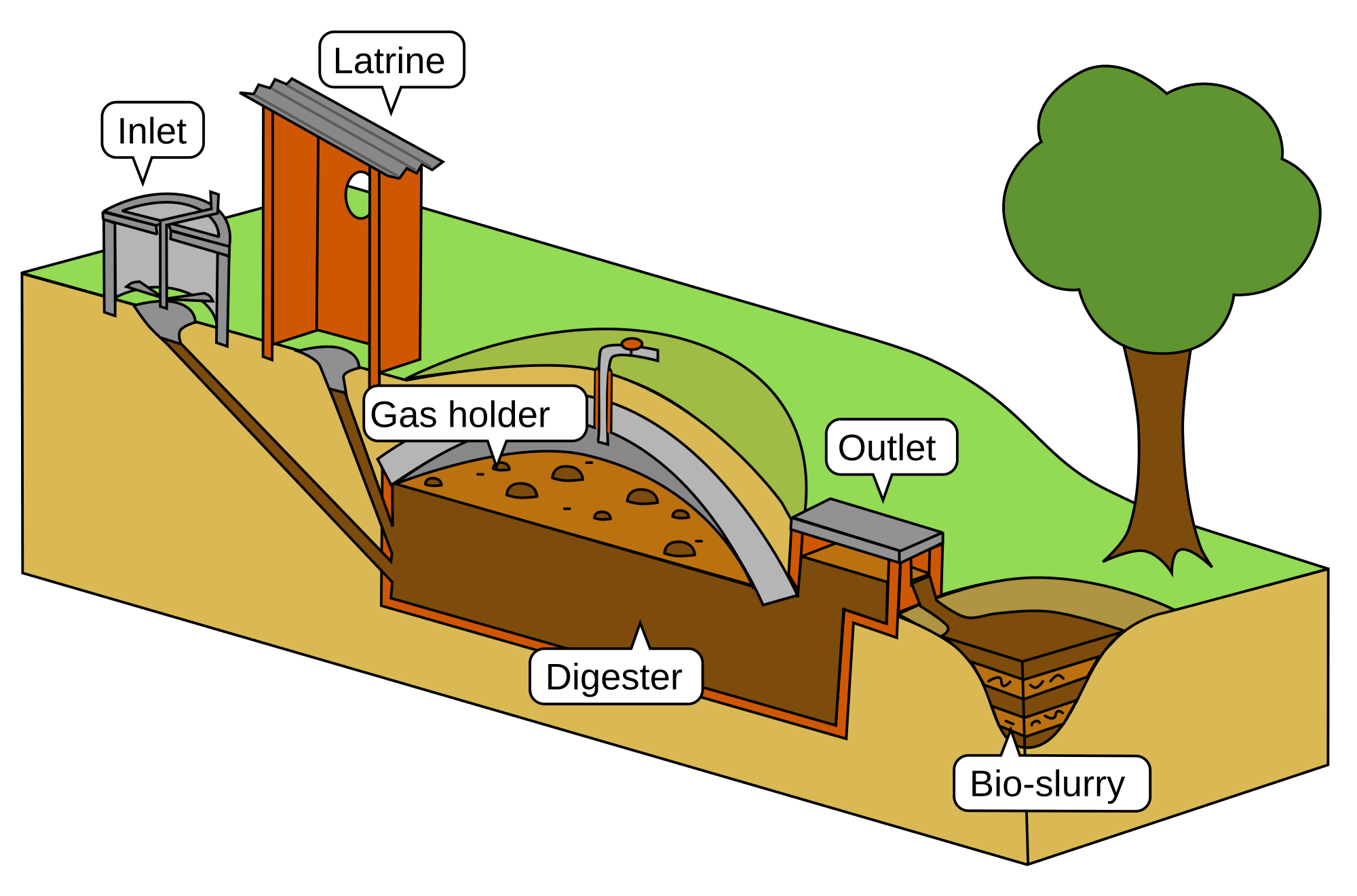
[edit]Domestic biogas plants convert livestock manure and night soil into biogas and slurry, the fermented manure. This technology is feasible for small-holders with livestock producing 50 kg manure per day, an equivalent of about 6 pigs or 3 cows. This manure has to be collectable to mix it with water and feed it into the plant. Toilets can be connected. Another precondition is the temperature that affects the fermentation process. With an optimum at 36 °C the technology especially applies for those living in a (sub) tropical climate. This makes the technology for small holders in developing countries often suitable.[86]
Depending on size and location, a typical brick made fixed dome biogas plant can be installed at the yard of a rural household with the investment between US$300 to $500 in Asian countries and up to $1400 in the African context.[87] A high quality biogas plant needs minimum maintenance costs and can produce gas for at least 15–20 years without major problems and re-investments. For the user, biogas provides clean cooking energy, reduces indoor air pollution, and reduces the time needed for traditional biomass collection, especially for women and children. The slurry is a clean organic fertilizer that potentially increases agricultural productivity.[86] In developing countries, it was also determined that the use of biogas leads to a 20% reduction in GHG emissions compared with GHG emissions due to firewood. Moreover, GHG emissions of 384.1 kg CO2 equivalent per year per animal could be prevented.[88]
Energy is an important part of modern society and can serve as one of the most important indicators of socio-economic development. As much as there have been advancements in technology, even so, some three billion people, primarily in the rural areas of developing countries, continue to access their energy needs for cooking through traditional means by burning biomass resources like firewood, crop residues and animal dung in crude traditional stoves.[89]
Domestic biogas technology is a proven and established technology in many parts of the world, especially Asia.[90] Several countries in this region have embarked on large-scale programmes on domestic biogas, such as China[91] and India.
.jpg)
The Netherlands Development Organisation, SNV,[92] supports national programmes on domestic biogas that aim to establish commercial-viable domestic biogas sectors in which local companies market, install and service biogas plants for households. In Asia, SNV is working in Nepal,[93] Vietnam,[94][95] Bangladesh,[96] Bhutan, Cambodia,[96] Lao PDR,[97] Pakistan[98] and Indonesia,[99] and in Africa; Rwanda,[100] Senegal, Burkina Faso, Ethiopia,[101] Tanzania,[102] Uganda, Kenya,[103] Benin and Cameroon.
In South Africa a prebuilt Biogas system is manufactured and sold. One key feature is that installation requires less skill and is quicker to install as the digester tank is premade plastic.[104]
India
[edit]Biogas in India[105] has been traditionally based on dairy manure as feed stock and these "gobar" gas plants have been in operation for a long period of time, especially in rural India. In the last 2–3 decades, research organisations with a focus on rural energy security have enhanced the design of the systems resulting in newer efficient low cost designs such as the Deenabandhu model.
The Deenabandhu Model is a new biogas-production model popular in India. (Deenabandhu means "friend of the helpless".) The unit usually has a capacity of 2 to 3 cubic metres. It is constructed using bricks or by a ferrocement mixture. In India, the brick model costs slightly more than the ferrocement model; however, India's Ministry of New and Renewable Energy offers some subsidy per model constructed.
Biogas which is mainly methane/natural gas can also be used for generating protein rich cattle, poultry and fish feed in villages economically by cultivating Methylococcus capsulatus bacteria culture with tiny land and water foot print.[106][107][108] The carbon dioxide gas produced as by product from these plants can be put to use in cheaper production of algae oil or spirulina from algaculture particularly in tropical countries like India which can displace the prime position of crude oil in near future.[109][110] Union government of India is implementing many schemes to utilise productively the agro waste or biomass in rural areas to uplift rural economy and job potential.[111][112] With these plants, the non-edible biomass or waste of edible biomass is converted in to high value products without any water pollution or green house gas (GHG) emissions.[113]
LPG (Liquefied Petroleum Gas) is a key source of cooking fuel in urban India and its prices have been increasing along with the global fuel prices. Also the heavy subsidies provided by the successive governments in promoting LPG as a domestic cooking fuel has become a financial burden renewing the focus on biogas as a cooking fuel alternative in urban establishments. This has led to the development of prefabricated digester for modular deployments as compared to RCC and cement structures which take a longer duration to construct. Renewed focus on process technology like the Biourja process model[114] has enhanced the stature of medium and large scale anaerobic digester in India as a potential alternative to LPG as primary cooking fuel.
In India, Nepal, Pakistan and Bangladesh biogas produced from the anaerobic digestion of manure in small-scale digestion facilities is called gobar gas; it is estimated that such facilities exist in over 2 million households in India, 50,000 in Bangladesh and thousands in Pakistan, particularly North Punjab, due to the thriving population of livestock. The digester is an airtight circular pit made of concrete with a pipe connection. The manure is directed to the pit, usually straight from the cattle shed. The pit is filled with a required quantity of wastewater. The gas pipe is connected to the kitchen fireplace through control valves. The combustion of this biogas has very little odour or smoke. Owing to simplicity in implementation and use of cheap raw materials in villages, it is one of the most environmentally sound energy sources for rural needs. One type of these system is the Sintex Digester. Some designs use vermiculture to further enhance the slurry produced by the biogas plant for use as compost.[115]
In Pakistan, the Rural Support Programmes Network is running the Pakistan Domestic Biogas Programme[116] which has installed 5,360 biogas plants[117] and has trained in excess of 200 masons on the technology and aims to develop the Biogas Sector in Pakistan.
In Nepal, the government provides subsidies to build biogas plant at home.
China
[edit]As of at least 2023, China is both the world's largest producer and largest consumer of household biogas.[118]: 172
The Chinese have experimented with the applications of biogas since 1958. Around 1970, China had installed 6,000,000 digesters in an effort to make agriculture more efficient. During the last few years, technology has met high growth rates. This seems to be the earliest developments in generating biogas from agricultural waste.[119]
The rural biogas construction in China has shown an increased development trend. The exponential growth of energy supply caused by rapid economic development and severe haze condition in China have led biogas to become the better eco-friendly energy for the rural areas. In Qing county, Hebei Province, the technology of using crop straw as a main material to generate biogas is currently developing.[120]
China had 26.5 million biogas plants, with an output of 10.5 billion cubic meter biogas until 2007. The annual biogas output has increased to 248 billion cubic meter in 2010.[121] The Chinese government had supported and funded rural biogas projects.[122] As of 2023, more than 30 million rural Chinese households use biogas digesters.[118]: 172
During the winter, the biogas production in northern regions of China is lower. This is caused by the lack of heat control technology for digesters thus the co-digestion of different feedstock failed to complete in the cold environment.[123]
Zambia
[edit]Lusaka, the capital city of Zambia, has two million inhabitants with over half of the population residing in peri-urban areas. The majority of this population use pit latrines as toilets generating approximately 22,680 tons of fecal sludge per annum. This sludge is inadequately managed: Over 60% of the generated faecal sludge remains within the residential environment thereby compromising both the environment and public health.[124]
In the face of research work and implementation of biogas having started as early as in the 1980s, Zambia is lagging behind in the adoption and use of biogas in the sub-Saharan Africa. Animal manure and crop residues are required for the provision of energy for cooking and lighting. Inadequate funding, absence of policy, regulatory framework and strategies on biogas, unfavorable investor monetary policy, inadequate expertise, lack of awareness of the benefits of biogas technology among leaders, financial institutions and locals, resistance to change due cultural and traditions of the locals, high installation and maintenance costs of biogas digesters, inadequate research and development, improper management and lack of monitoring of installed digesters, complexity of the carbon market, lack of incentives and social equity are among the challenges that have impeded the acquiring and sustainable implementation of domestic biogas production in Zambia.[125]
Associations
[edit]- World Biogas Association (https://www.worldbiogasassociation.org/)
- Anaerobic Digestion and Bioresources Association (United Kingdom) (https://adbioresources.org/)
- American Biogas Council (https://americanbiogascouncil.org/)
- Canadian Biogas Association (https://www.biogasassociation.ca/)
- European Biogas Association[126]
- German Biogas Association[127]
- Indian Biogas Association[128]
Society and culture
[edit]In the 1985 Australian film Mad Max Beyond Thunderdome the post-apocalyptic settlement Barter town is powered by a central biogas system based upon a piggery. As well as providing electricity, methane is used to power Barter's vehicles.
"Cow Town",[clarification needed] written in the early 1940s, discusses the travails of a city vastly built on cow manure and the hardships brought upon by the resulting methane biogas. Carter McCormick, an engineer from a town outside the city, is sent in to figure out a way to utilize this gas to help power, rather than suffocate the city.[citation needed]
Contemporary biogas production provides new opportunities for skilled employment, drawing on the development of new technologies.[129]
See also
[edit]
- Anaerobic digestion – Processes by which microorganisms break down biodegradable material in the absence of oxygen
- Biochemical oxygen demand – Oxygen needed to remove organics from water
- Biodegradability – Decomposition by living organisms
- Bioenergy – Renewable energy made from biomass
- Biofuel – Fuel derived from biological sources
- Biohydrogen – Hydrogen that is produced biologically
- Hydrogen economy – Using hydrogen to decarbonize more sectors
- Landfill gas monitoring – Process of monitoring gas from landfills.
- Methanation – Conversion of carbon monoxide and carbon dioxide (COx) to methane (CH4)
- MSW/LFG (municipal solid waste and landfill gas)
- Natural gas – Gaseous fossil fuel
- Renewable energy – Energy collected from renewable resources
- Renewable natural gas – Methane enriched biogas that can easily be upgraded
- Relative cost of electricity generated by different sources – Comparison of costs of different electricity generation sources
- Thermal hydrolysis
- Waste management – Activities and actions required to manage waste from its source to its final disposal
- European Biomass Association – European bioenergy organisation
References
[edit]- ^ National Non-Food Crops Centre. "NNFCC Renewable Fuels and Energy Factsheet: Anaerobic Digestion" Archived 10 July 2018 at the Wayback Machine, Retrieved on 2011-02-16
- ^ Webdesign, Insyde. "How does biogas work?". www.simgas.com. Archived from the original on 10 May 2018. Retrieved 16 May 2018.
- ^ Mao, Chunlan; Feng, Yongzhong; Wang, Xiaojiao; Ren, Guangxin (2015). "Review on research achievements of biogas from anaerobic digestion". Renewable and Sustainable Energy Reviews. 45: 540–555. Bibcode:2015RSERv..45..540M. doi:10.1016/j.rser.2015.02.032.
- ^ "Biogas & Engines". clarke-energy.com. Retrieved 21 November 2011.
- ^ a b Government of Canada, Canada Energy Regulator (24 November 2023). "CER – Market Snapshot: Two Decades of Growth in Renewable Natural Gas in Canada". www.cer-rec.gc.ca. Retrieved 20 October 2025.
- ^ "Are Biofuels Carbon Neutral? Feedstocks & Applications". 29 July 2025. Retrieved 20 October 2025.
- ^ Liebetrau, J., Ammenberg, J., Gustafsson, M., Pelkmans, L., Murphy, J.D. (2022). The role ofbiogas and biomethane in pathway to net zero. Murphy, J.D (Ed.) IEA Bioenergy Task 37, 2022
- ^ Le Mer, Jean; Roger, Pierre (January 2001). "Production, oxidation, emission and consumption of methane by soils: A review". European Journal of Soil Biology. 37 (1): 25–50. Bibcode:2001EJSB...37...25L. doi:10.1016/S1164-5563(01)01067-6. S2CID 62815957.
- ^ US EPA, OAR (18 March 2019). "How Does Anaerobic Digestion Work?". www.epa.gov. Retrieved 27 October 2025.
- ^ a b "An introduction to biogas and biomethane – Outlook for biogas and biomethane: Prospects for organic growth – Analysis". IEA. Retrieved 27 October 2025.
- ^ "Anaerobic Digesters: Frequently Asked Questions" (PDF). Alberta Department of Agriculture. May 2014. Retrieved 27 October 2025.
- ^ Appels, Lise; Baeyens, Jan; Degrève, Jan; Dewil, Raf (2008). "Principles and potential of the anaerobic digestion of waste-activated sludge". Progress in Energy and Combustion Science. 34 (6): 755–781. Bibcode:2008PECS...34..755A. doi:10.1016/j.pecs.2008.06.002. ISSN 0360-1285. S2CID 95588169. Archived from the original on 25 June 2021.
- ^ "Biogas – Bioenergy Association of New Zealand (BANZ)". Bioenergy.org.nz. Archived from the original on 25 January 2010. Retrieved 21 February 2010.
- ^ LFG energy projects Archived 3 January 2009 at the Wayback Machine
- ^ Safety Page, Beginners Guide to Biogas Archived 17 February 2015 at the Wayback Machine, www.adelaide.edu.au/biogas. Retrieved 22.10.07.
- ^ a b "Archived copy" (PDF). Archived from the original (PDF) on 12 November 2018. Retrieved 22 December 2018.
{{cite web}}: CS1 maint: archived copy as title (link) - ^ Gupta, Sujata (3 November 2010). "Cold climates no bar to biogas production". New Scientist. London: Sunita Harrington. p. 14.
- ^ Hedlund, FH; Madsen, M (2018). "Incomplete understanding of biogas chemical hazards – Serious gas poisoning accident while unloading food waste at biogas plant" (PDF). Journal of Chemical Health & Safety. 25 (6): 13–21. doi:10.1016/j.jchas.2018.05.004. S2CID 67849856.
- ^ Reinelt, Torsten; Liebetrau, Jan (January 2020). "Monitoring and Mitigation of Methane Emissions from Pressure Relief Valves of a Biogas Plant". Chemical Engineering & Technology. 43 (1): 7–18. doi:10.1002/ceat.201900180. S2CID 208716124.
- ^ Michael Fredenslund, Anders; Gudmundsson, Einar; Maria Falk, Julie; Scheutz, Charlotte (February 2023). "The Danish national effort to minimise methane emissions from biogas plants". Waste Management. 157: 321–329. Bibcode:2023WaMan.157..321M. doi:10.1016/j.wasman.2022.12.035. PMID 36592586. S2CID 254174784.
- ^ "Biogas Problems". Retrieved 15 May 2015.
- ^ Basic Information on Biogas Archived 6 January 2010 at the Wayback Machine, www.kolumbus.fi. Retrieved 2.11.07.
- ^ Hafner, Sasha (2017). "Predicting methane and biogas production with the biogas package" (PDF). CRAN.
- ^ "Juniper". Archived from the original on 30 April 2015. Retrieved 15 May 2015.
- ^ Richards, B.; Herndon, F. G.; Jewell, W. J.; Cummings, R. J.; White, T. E. (1994). "In situ methane enrichment in methanogenic energy crop digesters". Biomass and Bioenergy. 6 (4): 275–282. Bibcode:1994BmBe....6..275R. doi:10.1016/0961-9534(94)90067-1. hdl:1813/60790.
- ^ Richards, B.; Cummings, R.; White, T.; Jewell, W. (1991). "Methods for kinetic analysis of methane fermentation in high solids biomass digesters". Biomass and Bioenergy. 1 (2): 65–73. Bibcode:1991BmBe....1...65R. doi:10.1016/0961-9534(91)90028-B. hdl:1813/60787.
- ^ a b c d e Abatzoglou, Nicolas; Boivin, Steve (2009). "A review of biogas purification processes". Biofuels, Bioproducts and Biorefining. 3 (1): 42–71. doi:10.1002/bbb.117. ISSN 1932-104X. S2CID 84907789.
- ^ State Energy Conservation Office (Texas). "Biomass Energy: Manure for Fuel." State Energy Conservation Office (Texas). State of Texas, 23 April 2009. Web. 3 October 2009.
- ^ Webber, Michael E and Amanda D Cuellar. "Cow Power. In the News: Short News Items of Interest to the Scientific Community." Science and Children os 46.1 (2008): 13. Gale. Web. 1 October 2009 in United States.
- ^ Udasin, Sharon (23 October 2024). "California subsidies for manure-based biogas face rising scrutiny over pollution concerns". The Hill. Archived from the original on 11 November 2024. Retrieved 8 August 2025.
- ^ "Markey, Booker, Gillibrand, Sanders, Warren Urge EPA and USDA to Limit New Incentives for Factory Farm Biodigesters | U.S. Senator Ed Markey of Massachusetts". www.markey.senate.gov. Retrieved 8 August 2025.
- ^ Redman, Henry (2 January 2024). "Proposed anaerobic digester in Waupaca County stirs local controversy • Wisconsin Examiner". Wisconsin Examiner. Retrieved 8 August 2025.
- ^ "How a false solution to climate change is damaging the natural world | George Monbiot". the Guardian. 14 March 2014. Retrieved 5 October 2021.
- ^ a b Administrator. "Biogas CHP – Alfagy – Profitable Greener Energy via CHP, Cogen and Biomass Boiler using Wood, Biogas, Natural Gas, Biodiesel, Vegetable Oil, Syngas and Straw". Archived from the original on 30 April 2015. Retrieved 15 May 2015.
- ^ Mertins, Anica; Wawer, Tim (2022). "How to use biogas?: A systematic review of biogas utilization pathways and business models". Bioresources and Bioprocessing. 9 (1): 59. doi:10.1186/s40643-022-00545-z. PMC 10992758. PMID 38647793.
- ^ Kabeyi, Moses Jeremiah Barasa; Olanrewaju, Oludolapo Akanni (2022). "Biogas Production and Applications in the Sustainable Energy Transition". Journal of Energy. 2022: 1–43. doi:10.1155/2022/8750221.
- ^ "Nyheter – SGC". Archived from the original (PDF) on 4 December 2014. Retrieved 15 May 2015.
- ^ Petersson A., Wellinger A. (2009). Biogas upgrading technologies – developments and innovations. IEA Bioenergy Task 37 Archived 29 November 2014 at the Wayback Machine
- ^ "Biogas Flows Through Germany's Grid Big Time – Renewable Energy News Article". 14 March 2012. Archived from the original on 14 March 2012. Retrieved 17 June 2016.
- ^ "energy loss, transmission loss". Archived from the original on 22 September 2018. Retrieved 15 May 2015.
- ^ "Adding gas from biomass to the gas grid" (PDF). Swedish Gas Center. Archived from the original (PDF) on 20 October 2017. Retrieved 20 October 2017.
- ^ Biogas train in Sweden Archived 29 September 2011 at the Wayback Machine
- ^ Friendly fuel trains (30 October 2005) New Straits Times, p. F17.
- ^ "Bates Car – Sweet As a Nut (1975)". BFI. Archived from the original on 23 July 2013. Retrieved 15 May 2015.
- ^ National Film Board of Canada. "Bate's Car: Sweet as a Nut". NFB.ca. Archived from the original on 6 November 2018. Retrieved 15 May 2015.
- ^ a b What is biogas?, U.S. Department of Energy, 13 April 2010
- ^ State Energy Conservation Office (Texas). "Biomass Energy: Manure for Fuel." Archived 23 October 2012 at the Wayback Machine, 23 April 2009. Web. 3 October 2009.
- ^ Comparison of energy systems using life cycle assessment. World Energy Council. 2004. ISBN 0-946121-16-8. OCLC 59190792.
- ^ Whiting, Andrew; Azapagic, Adisa (2014). "Life cycle environmental impacts of generating electricity and heat from biogas produced by anaerobic digestion". Energy. 70: 181–193. Bibcode:2014Ene....70..181W. doi:10.1016/j.energy.2014.03.103. ISSN 0360-5442.
- ^ "Creating BIOGAS+: a new technology to improve the efficiency and profitability in the treatment of biowaste". SIOR. Social Impact Open Repository. Archived from the original on 5 September 2017. Retrieved 5 September 2017.
- ^ Semiyaga, Swaib; Okure, Mackay A. E.; Niwagaba, Charles B.; Katukiza, Alex Y.; Kansiime, Frank (1 November 2015). "Decentralized options for faecal sludge management in urban slum areas of Sub-Saharan Africa: A review of technologies, practices and end-uses". Resources, Conservation and Recycling. 104: 109–119. Bibcode:2015RCR...104..109S. doi:10.1016/j.resconrec.2015.09.001. ISSN 0921-3449.
- ^ Hidenori Harada; Linda Strande; Shigeo Fujii (2016). "Challenges and Opportunities of Faecal Sludge Management for Global Sanitation". Kaisei Publishing, Tokyo: 81–100.
- ^ Otoo, M.; Drechsel, P.; Danso, G.; Gebrezgabher, S.; Rao, K.; Madurangi, G. (2016). Testing the implementation potential of resource recovery and reuse business models: from baseline surveys to feasibility studies and business plans (Report). International Water Management Institute (IWMI). CGIAR Research Program on Water, Land and Ecosystems (WLE). doi:10.5337/2016.206. hdl:10568/75885.
- ^ "CHP | Combined Heat and Power | Cogeneration | Wood Biomass Gasified Co-generation | Energy Efficiency | Electricity Generation". Alfagy.com. Archived from the original on 7 July 2011. Retrieved 21 February 2010.
- ^ US EPA, OAR (15 April 2016). "Basic Information about Landfill Gas". www.epa.gov. Retrieved 17 June 2022.
- ^ Lazenby, Ruthie (15 August 2022). "Rethinking Manure Biogas: Policy Considerations to Promote Equity and Protect the Climate and Environment" (PDF). Retrieved 19 October 2022.
- ^ "Inflation Reduction Act Gives a Boost to the Biogas Sector". The National Law Review. Retrieved 19 October 2022.
- ^ Cuellar, Amanda D and Michael E Webber (2008). "Cow power: the energy and emissions benefits of converting manure to biogas". Environ. Res. Lett. 3 (3) 034002. Bibcode:2008ERL.....3c4002C. doi:10.1088/1748-9326/3/3/034002. hdl:2152/20290.
- ^ Moran, Barbara (9 November 2022). "Massachusetts companies are turning to 'anaerobic digesters' to dispose of food waste". NPR News. Retrieved 11 November 2022.
- ^ Zezima, Katie. "Electricity From What Cows Leave Behind." The New York Times, 23 September 2008, natl. ed.: SPG9. Web. 1 October 2009.
- ^ State Energy Conservation Office (Texas). "Biomass Energy: Manure for Fuel Archived 23 October 2012 at the Wayback Machine." State Energy Conservation Office (Texas). State of Texas, 23 April 2009. Web. 3 October 2009.
- ^ Trash-to-energy trend boosts anaerobic digesters [1]."
- ^ Western Plains Energy finishing up North America's largest biogas digester [2]."
- ^ McKenna, Phil (13 November 2019). "Fearing for Its Future, a Big Utility Pushes 'Renewable Gas,' Urges Cities to Reject Electrification". InsideClimate News. Archived from the original on 16 November 2019. Retrieved 16 November 2019.
- ^ "Renewables - Made in Germany". German Energy Agency. Archived from the original on 6 July 2011. Retrieved 13 April 2011.
- ^ "About SEBE". Archived from the original on 28 November 2014. Retrieved 15 May 2015.
- ^ "FNR: Fachagentur Nachwachsende Rohstoffe e. V." (PDF). Retrieved 17 June 2016. [permanent dead link]
- ^ "European Biogas Association". Retrieved 15 May 2015.
- ^ The Official Information Portal on AD 'Biogas Plant Map'
- ^ Sewage project sends first ever renewable gas to grid Thames Water Archived 9 December 2010 at the Wayback Machine
- ^ "Ecotricity announces third Green Gasmill". www.ecotricity.co.uk. Retrieved 2 January 2024.
- ^ Eyl-Mazzega, Mark Antione; Mathieu, Carole (27 October 2020). "Biogas and Biomethane in Europe: Lessons from Denmark, Italy and Germany" (PDF). Études de l'Ifri. [permanent dead link]
- ^ ANSA Ambiente & Energia Installed biogas power in Italy
- ^ AuCo Solutions biogas software Biogas software solution Archived 25 September 2018 at the Wayback Machine
- ^ Snam IES Biogas Biogas Plant in Italy Archived 25 September 2018 at the Wayback Machine
- ^ a b "European Biogas Barometer" (PDF). EurObserv'ER. Archived from the original (PDF) on 25 April 2012. Retrieved 7 November 2011.
- ^ "Biogas". BMU. Archived from the original on 29 January 2015. Retrieved 7 November 2011.
- ^ a b "Biogas Segments Statistics 2010" (PDF). Fachverband Biogas e.V. Retrieved 5 November 2011. [permanent dead link]
- ^ "Biomass for Power Generation and CHP" (PDF). IEA. Archived from the original (PDF) on 3 November 2011. Retrieved 7 November 2011.
- ^ "Renewable Energy Sources". 6 September 2014. Retrieved 6 June 2018.
- ^ a b Wieland, P. (2003). "Production and Energetic Use of Biogas from Energy Crops and Wastes in Germany". Applied Biochemistry and Biotechnology. 109 (1–3): 263–274. doi:10.1385/abab:109:1-3:263. PMID 12794299. S2CID 9468552.
- ^ "Erneuerbare Energien in Deutschland. Rückblick und Stand des Innovationsgeschehens" (PDF). IfnE et al. Archived from the original (PDF) on 6 April 2012. Retrieved 5 November 2011.
- ^ Wieland, P. (2006). "Biomass Digestion in Agriculture: A Successful Pathway for the Energy Production and Waste Treatment in Germany". Engineering in Life Sciences. 6 (3). Engineering in Life Science: 302–309. Bibcode:2006EngLS...6..302W. doi:10.1002/elsc.200620128. S2CID 54685767.
- ^ a b Kanning, H.; et al. (2009). "Erneuerbare Energien – Räumliche Dimensionen, neue Akteurslandschaften und planerische (Mit)Gestaltungspotenziale am Beispiel des Biogaspfades". Raumforschung und Raumordnung. 67 (2): 142–156. doi:10.1007/BF03185702.
- ^ "Cultivation of renewable Resources in Germany". FNR. Archived from the original on 6 April 2020. Retrieved 5 November 2011.
- ^ a b Roubík, Hynek; Mazancová, Jana; Banout, Jan; Verner, Vladimír (20 January 2016). "Addressing problems at small-scale biogas plants: a case study from central Vietnam". Journal of Cleaner Production. 112 (Part 4): 2784–2792. Bibcode:2016JCPro.112.2784R. doi:10.1016/j.jclepro.2015.09.114.
- ^ Ghimire, Prakash C. (1 January 2013). "SNV supported domestic biogas programmes in Asia and Africa". Renewable Energy. Selected papers from World Renewable Energy Congress – XI. 49: 90–94. Bibcode:2013REne...49...90G. doi:10.1016/j.renene.2012.01.058.
- ^ Roubík, Hynek; Barrera, Sergio; Van Dung, Dinh; Phung, Le Dinh; Mazancová, Jana (10 October 2020). "Emission reduction potential of household biogas plants in developing countries: The case of central Vietnam". Journal of Cleaner Production. 270 122257. Bibcode:2020JCPro.27022257R. doi:10.1016/j.jclepro.2020.122257. ISSN 0959-6526.
- ^ Surendra, K. C.; Takara, Devin; Hashimoto, Andrew G.; Khanal, Samir Kumar (1 March 2014). "Biogas as a sustainable energy source for developing countries: Opportunities and challenges". Renewable and Sustainable Energy Reviews. 31: 846–859. Bibcode:2014RSERv..31..846S. doi:10.1016/j.rser.2013.12.015. ISSN 1364-0321.
- ^ "SNV World". Archived from the original (PDF) on 5 October 2018. Retrieved 15 May 2015.
- ^ "China – Biogas". Retrieved 15 May 2015.
- ^ "Renewable energy". Archived from the original on 27 February 2012. Retrieved 15 May 2015.
- ^ "Biogas Sector Partnership-Nepal". Bspnepal.org.np. Archived from the original on 16 October 2018. Retrieved 21 February 2010.
- ^ Roubík, H.; Mazancová, J.; Phung, L.D.; Banout, J. (2018). "Current approach to manure management for small-scale Southeast Asian farmers - Using Vietnamese biogas and non-biogas farms as an example". Renewable Energy. 115 (115): 362–370. Bibcode:2018REne..115..362R. doi:10.1016/j.renene.2017.08.068.
- ^ "Dự án chương trình khí sinh học cho ngành chăn nuôi Việt Nam". Biogas.org.vn. Archived from the original on 25 October 2004. Retrieved 21 February 2010.
- ^ a b http://www.idcol.org (click 'Projects')
- ^ "Home". Biogaslao.org. Archived from the original on 10 November 2010. Retrieved 21 February 2010.
- ^ "SNV World". Archived from the original (PDF) on 6 October 2018. Retrieved 15 May 2015.
- ^ Indonesia Domestic Biogas Programme Archived 28 July 2011 at the Wayback Machine
- ^ "Renewable Energy". Snvworld.org. Archived from the original on 3 January 2015. Retrieved 3 January 2015.
- ^ "Renewable energy". Snvworld.org. Archived from the original on 3 January 2015. Retrieved 3 January 2015.
- ^ SNV Tanzania Domestic Biogas Programme Archived 28 July 2011 at the Wayback Machine
- ^ Biogas First in Kenya for Clarke Energy and Tropical Power Accessed 11 September 2013
- ^ "Renewable Energy Solutions – Living Lightly". Renewable Energy Solutions. Archived from the original on 2 May 2015. Retrieved 15 May 2015.
- ^ "GPS Renewables – Waste management through biogas". GPS Renewables. Archived from the original on 18 May 2015. Retrieved 15 May 2015.
- ^ "BioProtein Production" (PDF). Archived from the original (PDF) on 10 May 2017. Retrieved 31 January 2018.
- ^ Le Page, Michael. "Food made from natural gas will soon feed farm animals – and us". New Scientist. Retrieved 31 January 2018.
- ^ "New venture selects Cargill's Tennessee site to produce Calysta FeedKind Protein". Retrieved 31 January 2018.
- ^ "Algenol and Reliance launch algae fuels demonstration project in India". Retrieved 29 May 2017.
- ^ "ExxonMobil Announces Breakthrough in Renewable Energy". Retrieved 20 June 2017.
- ^ "Indrapratha Gas, Mahindra & Mahindra join hands to stop stubble burning". Retrieved 20 February 2018.
- ^ "Modi govt plans Gobar-Dhan scheme to convert cattle dung into energy". Retrieved 22 February 2018.
- ^ "Assessment of environmental impact of FeedKind protein" (PDF). Archived from the original (PDF) on 2 August 2019. Retrieved 20 June 2017.
- ^ "GPS Renewables – Monitoring Methodology". GPS Renewables. Archived from the original on 10 May 2015. Retrieved 15 May 2015.
- ^ "Biogas plants provide cooking and fertiliser". Ashden Awards, sustainable and renewable energy in the UK and developing world. Archived from the original on 27 September 2011. Retrieved 15 May 2015.
- ^ "PAK-ENERGY SOLUTION". Archived from the original on 24 May 2015. Retrieved 15 May 2015.
- ^ "5,360 bio-gas plants installed in 12 districts". Business Recorder. 27 December 2014. Archived from the original on 2 April 2015. Retrieved 15 May 2015.
- ^ a b Santos, Gonçalo (2021). Chinese Village Life Today: Building Families in an Age of Transition. Seattle: University of Washington Press. ISBN 978-0-295-74738-5.
- ^ Biogas in China. Retrieved 27 October 2016
- ^ Hu, Die (2015). "Hebei Province Qing County Straw Partnerships Biogas Application and Promotion Research". Proceedings of the 2015 International Conference on Mechatronics, Electronic, Industrial and Control Engineering. Paris, France: Atlantis Press. doi:10.2991/meic-15.2015.260. ISBN 978-94-6252-062-2.
- ^ Deng, Yanfei; Xu, Jiuping; Liu, Ying; Mancl, Karen (2014). "Biogas as a sustainable energy source in China: Regional development strategy application and decision making". Renewable and Sustainable Energy Reviews. 35: 294–303. Bibcode:2014RSERv..35..294D. doi:10.1016/j.rser.2014.04.031. ISSN 1364-0321.
- ^ Chen, Yu; Yang, Gaihe; Sweeney, Sandra; Feng, Yongzhong (2010). "Household biogas use in rural China: A study of opportunities and constraints". Renewable and Sustainable Energy Reviews. 14 (1): 545–549. Bibcode:2010RSERv..14..545C. doi:10.1016/j.rser.2009.07.019. ISSN 1364-0321. S2CID 154461345.
- ^ He, Pin Jing (2010). "Anaerobic digestion: An intriguing long history in China". Waste Management. 30 (4): 549–550. Bibcode:2010WaMan..30..549H. doi:10.1016/j.wasman.2010.01.002. ISSN 0956-053X. PMID 20089392.
- ^ Tembo, J.M.; Nyirenda, E.; Nyambe, I. (2017). "Enhancing faecal sludge management in peri-urban areas of Lusaka through faecal sludge valorisation: challenges and opportunities". IOP Conference Series: Earth and Environmental Science. 60 (1) 012025. Bibcode:2017E&ES...60a2025T. doi:10.1088/1755-1315/60/1/012025.
- ^ Shane, Agabu; Gheewala, Shabbir H (2020). "Potential, Barriers and Prospects of Biogas Production in Zambia" (PDF). Journal of Sustainable Energy & Environment. 6 (2015) 21-27.
- ^ "European Biogas Association". Retrieved 15 May 2017.
- ^ "German Biogas Association". Retrieved 15 May 2017.
- ^ "Biogas-india – Home". Retrieved 15 May 2015.
- ^ "Generating new employment opportunities [Social Impact]". SIOR. Social Impact Open Repository. Archived from the original on 5 September 2017.
Further reading
[edit]- Updated Guidebook on Biogas Development. United Nations, New York, (1984) Energy Resources Development Series No. 27. p. 178, 30 cm.
- Book: Biogas from Waste and Renewable Resources. WILEY-VCH Verlag GmbH & Co. KGaA, (2008) Dieter Deublein and Angelika Steinhauser
- A Comparison between Shale Gas in China and Unconventional Fuel Development in the United States: Health, Water and Environmental Risks by Paolo Farah and Riccardo Tremolada. This is a paper presented at the Colloquium on Environmental Scholarship 2013 hosted by Vermont Law School (11 October 2013)
- Marchaim, Uri (1992). Biogas processes for sustainable development. FAO. ISBN 978-92-5-103126-1.
- Woodhead Publishing Series. (2013). The Biogas Handbook: Science, Production and Applications. ISBN 978-0857094988
- Mustafa, Mohamad Y.; Calay, Rajnish K.; Román, E. (2016). "Biogas from Organic Waste - A Case Study". Procedia Engineering. 146: 310–317. doi:10.1016/j.proeng.2016.06.397. hdl:10037/10459.
- Lazenby, Ruthie (15 August 2022). "Rethinking Manure Biogas: Policy Considerations to Promote Equity and Protect the Climate and Environment" (PDF). Retrieved 19 October 2022.
- Abanades, S.; Abbaspour, H.; Ahmadi, A.; Das, B.; Ehyaei, M. A.; Esmaeilion, F.; El Haj Assad, M.; Hajilounezhad, T.; Jamali, D. H.; Hmida, A.; Ozgoli, H. A.; Safari, S.; AlShabi, M.; Bani-Hani, E. H. (2022). "A critical review of biogas production and usage with legislations framework across the globe". International Journal of Environmental Science and Technology. 19 (4): 3377–3400. Bibcode:2022JEST...19.3377A. doi:10.1007/s13762-021-03301-6. PMC 8124099. PMID 34025745.
- Jameel, Mohammed Khaleel; Mustafa, Mohammed Ahmed; Ahmed, Hassan Safi; Mohammed, Amira jassim; Ghazy, Hameed; Shakir, Maha Noori; Lawas, Amran Mezher; Mohammed, Saad khudhur; Idan, Ameer Hassan; Mahmoud, Zaid H.; Sayadi, Hamidreza; Kianfar, Ehsan (2024). "Biogas: Production, properties, applications, economic and challenges: A review". Results in Chemistry. 7 101549. doi:10.1016/j.rechem.2024.101549.
External links
[edit]


| Biofuels | |
|---|---|
| Energy from foodstock | |
| Non-food energy crops | |
| Technology | |
| Concepts | |
| Types |
|  | ||||||||
|---|---|---|---|---|---|---|---|---|---|---|
| Infrastructure | ||||||||||
| Uses | ||||||||||
| International | |
|---|---|
| National | |
| Other | |


Biogas
View on GrokipediaFundamentals
Definition and Principles
Biogas is a renewable fuel gas generated through the anaerobic decomposition of organic matter by microorganisms in an oxygen-deprived environment.[1] This process, known as anaerobic digestion, converts biodegradable materials such as animal manure, crop residues, food waste, and sewage sludge into a mixture primarily composed of methane (CH₄) and carbon dioxide (CO₂).[14] Unlike aerobic decomposition, which produces odors and incomplete breakdown, anaerobic digestion yields a combustible gas suitable for energy recovery while stabilizing the waste and reducing pathogens.[5] The fundamental principle of biogas production relies on a series of microbial reactions occurring in four sequential stages within a sealed digester: hydrolysis, acidogenesis, acetogenesis, and methanogenesis.[5] In hydrolysis, hydrolytic bacteria break down complex polymers like carbohydrates, proteins, and fats into simpler monomers such as sugars and amino acids. Acidogenesis follows, where acidogenic bacteria ferment these monomers into volatile fatty acids, alcohols, hydrogen, and CO₂. Acetogenic bacteria then convert the fermentation products into acetic acid, hydrogen, and CO₂, setting the stage for methanogenic archaea to produce methane from acetate or through the reduction of CO₂ with hydrogen.[1] Optimal conditions for these reactions include mesophilic (around 35–40°C) or thermophilic (50–60°C) temperatures, neutral pH (6.8–7.2), sufficient retention time (15–30 days), and a carbon-to-nitrogen ratio of 20:1 to 30:1 to prevent process inhibition.[5] The chemical composition of biogas typically ranges from 50–70% methane, 30–50% carbon dioxide, with trace amounts (0–3%) of hydrogen sulfide (H₂S), nitrogen, hydrogen, and water vapor, varying based on feedstock and digestion conditions.[15] Methane imparts the fuel value, with biogas having a calorific value of approximately 20–25 MJ/m³, about 60% that of natural gas, enabling its use in heating, electricity generation, or as vehicle fuel after purification.[16] Impurities like H₂S can corrode equipment, necessitating removal for upgraded biomethane, which exceeds 95% CH₄ purity.[17]| Component | Typical Range (%) |
|---|---|
| Methane (CH₄) | 50–70 |
| Carbon Dioxide (CO₂) | 30–50 |
| Hydrogen Sulfide (H₂S) | 0–3 |
| Other traces (N₂, H₂, H₂O) | <5 |
Chemical Composition and Properties
Biogas primarily consists of methane (CH4) and carbon dioxide (CO2), with methane typically ranging from 45% to 65% by volume in raw form, depending on feedstock type, digestion temperature, and process efficiency.[18] [7] Carbon dioxide constitutes 30% to 50% of the mixture, while trace components include nitrogen (0-10%), hydrogen sulfide (H2S, 0-1%), ammonia (NH3, <1%), hydrogen (H2, <1%), and water vapor (1-10%).[19] [20] These proportions can vary; for instance, biogas from manure digestion often yields 55-65% methane, whereas landfill-derived gas may have lower methane (45-60%) due to slower decomposition and inert gas dilution.[20] [21] The presence of hydrogen sulfide imparts a characteristic rotten-egg odor and contributes to corrosiveness, necessitating removal for long-term storage or pipeline injection.[15] Nitrogen and oxygen levels, if elevated above 1-2%, reduce energy yield by acting as diluents, often resulting from air ingress during production.[22] Advanced upgrading processes can increase methane content to 90-99%, producing renewable natural gas with composition akin to fossil natural gas (primarily CH4 >95%).[18] Physically, biogas has a density of approximately 1.1-1.3 kg/m³ at standard conditions, slightly less than or comparable to air (1.29 kg/m³), allowing it to rise if CO2 content is low.[23] Its lower heating value ranges from 18-26 MJ/m³, correlating directly with methane fraction—for 60% CH4, it approximates 21.5 MJ/Nm³ or 5,700-6,000 kcal/m³—lower than pure methane (35.8 MJ/m³) due to inert CO2.[24] [25] Biogas is combustible within 5-15% volume in air, with a flame temperature of 1,900°C, but impurities like H2S can produce toxic emissions (e.g., SO2) during combustion without scrubbing.[26] It is stored as a gas under pressure or liquefied at -162°C, though raw biogas requires drying to prevent hydrate formation in pipelines.[22]History
Ancient and Pre-Modern Uses
Anecdotal evidence suggests that the ancient Assyrians harnessed biogas from the anaerobic decomposition of organic matter to heat bathwater as early as the 10th century BC.[27] Comparable informal uses of flammable gases from waste decay for heating persisted in regions like Persia by the 16th century.[27] These early applications relied on natural emanations from sewers, manure pits, or marshes rather than engineered systems, reflecting rudimentary recognition of methane-rich gas as a combustible resource.[28] In the 17th century, Flemish chemist Jan Baptist van Helmont documented the production of flammable vapors from fermenting organic materials, providing early scientific observation of biogas formation, though practical utilization remained limited to sporadic collection.[28] By the mid-19th century, more deliberate production emerged; in 1859, the first recorded anaerobic digestion facility was established at the Matunga Leper Asylum in Bombay (present-day Mumbai), India, where human excreta was processed to generate biogas specifically for illuminating lamps.[26] This installation marked an initial shift toward controlled digestion for targeted energy needs, predating widespread industrial adoption.[29]20th Century Developments
In the early 20th century, biogas production advanced through the construction of the first large-scale plant in Birmingham, England, in 1911, which treated urban sewage sediments and generated biogas for practical use.[30] German engineers Karl Imhoff and colleagues patented innovations, including permanent heating systems for digesters, between 1914 and 1921, improving process stability and efficiency in wastewater treatment.[30] By the 1930s, researchers identified anaerobic bacteria as the primary agents of methane production and determined optimal digestion conditions, such as temperature and pH, enabling more reliable biogas yields from organic wastes.[31] These developments coincided with the establishment of modern facilities, primarily linked to municipal sewage processing in Europe and the United States.[32] World War II (1939–1945) marked a surge in biogas application due to acute petroleum shortages, with Germany extensively converting sewage and manure into fuel for vehicles, machinery, and stationary engines, producing up to 300 cubic meters daily from facilities processing manure from 180 livestock units.[33][34] France and other European nations similarly prioritized biogas fermentation to offset energy deficits, integrating it into agricultural and waste management systems.[30] Post-war, operational digesters persisted in Europe, sustaining interest in biogas as a supplemental energy source amid reconstruction efforts.[27] From the 1950s onward, biogas technology proliferated in developing regions, with India launching programs for low-cost rural household digesters to convert animal manure into cooking fuel and lighting gas, leading to thousands of installations by decade's end.[30] Intensive research during this period refined plant designs, such as fixed-dome models suited to small-scale operations, while early experiments in the United States explored crop residues as feedstocks for enhanced methanation.[35][36] The 1970s oil crises further accelerated adoption, particularly in China and India, where millions of domestic plants were disseminated by the century's close, driven by energy security needs and waste-to-energy synergies in agriculture-heavy economies.[37][32]Post-2000 Expansion
Following the enactment of supportive renewable energy policies in the early 2000s, global biogas production expanded markedly, quadrupling from 78 terawatt-hours (TWh) in 2000 to 364 TWh by 2017.[38] This growth continued, reaching 38.1 billion cubic meters (equivalent to 1.46 exajoules) by 2020, driven primarily by installations in Europe, the United States, and China. [39] Key enablers included feed-in tariffs, subsidies, and mandates for renewable energy integration into grids and gas networks, which incentivized the scaling of anaerobic digestion facilities from small household units to large industrial plants.[40] In Europe, particularly Germany and Denmark, biogas adoption surged post-2000 due to national policies aligned with EU renewable directives. Germany's Renewable Energy Sources Act (EEG) of 2000 provided guaranteed tariffs for biogas-derived electricity, leading to a continuous rise in biogas plants from fewer than 100 in 2000 to over 9,000 by 2015.[40] Denmark, building on earlier experiments, expanded centralized biogas plants integrated with district heating and transport fuels, supported by energy taxes and subsidies that positioned biogas as a key renewable contributor, accounting for a growing share of the country's renewable energy mix by the 2010s.[41] By 2021, the EU hosted approximately 18,843 biogas plants producing 159 TWh annually.[42] The EU's Renewable Energy Directive II (2018) further bolstered this by setting binding targets for renewables, including bioenergy, though foundational growth predated it.[43] In Asia, China's rural biogas programs catalyzed massive deployment of household digesters. The 2003 National Rural Biogas Construction program subsidized installations, propelling the number from under 10 million in 2000 to over 40 million by the mid-2010s, serving nearly 120 million rural residents with cooking and lighting fuel while reducing reliance on traditional biomass.[44] [45] Government investments totaling 61 billion yuan from 2003 to 2010 covered about one-third of construction costs per unit, fostering widespread adoption despite challenges like maintenance in colder regions.[46] [47] This initiative positioned China as a global leader in small-scale biogas, contributing significantly to the sector's overall post-2000 volume.[48] By the 2020s, upgrading biogas to biomethane for grid injection and transport fuels gained traction worldwide, with around 700 such plants operational globally by 2019, reflecting technological maturation and policy emphasis on higher-value applications.[49] The biogas plant market, valued at $4.18 billion in 2023, underscored ongoing commercialization, projected to double by 2032 amid demands for decarbonized gases.[50]Production Methods
Natural Processes
Biogas arises naturally through anaerobic microbial decomposition of organic matter in oxygen-limited environments, where bacteria and archaea sequentially hydrolyze complex substrates into simpler compounds, ferment them into volatile fatty acids and alcohols, convert these to acetate and hydrogen, and finally produce methane via methanogenesis. This multi-stage process, occurring without human intervention, yields a gas mixture typically comprising 50-70% methane (CH₄), 30-50% carbon dioxide (CO₂), and trace gases like hydrogen sulfide (H₂S).[7][51] Wetlands, including marshes, swamps, and peatlands, represent a primary natural locus for biogas production, as water saturation creates anoxic conditions conducive to methanogenic archaea such as Methanosarcina and Methanosaeta species, which reduce CO₂ with H₂ or disproportionate acetate to CH₄ and CO₂. These ecosystems, spanning roughly 5-8% of global land area, emit an estimated 145-185 teragrams (Tg) of methane annually, accounting for about 20-30% of total natural methane flux and contributing to atmospheric CH₄ levels that have risen from pre-industrial ~0.7 ppm to over 1.9 ppm by 2020.[52][53] In ruminant animals like cattle, sheep, and deer, biogas forms as a byproduct of enteric fermentation in the rumen, a foregut compartment hosting symbiotic methanogens (Methanobrevibacter spp.) that consume H₂ and CO₂ generated by protozoa and bacteria digesting fibrous plant carbohydrates such as cellulose. This process sustains rumen pH and microbial efficiency but releases 80-120 liters of methane per kilogram of dry matter intake, with global ruminant emissions totaling approximately 90 Tg CH₄ per year, primarily through eructation.[54][55] Other unmanaged natural sources include termite guts, where hindgut methanogens decompose lignocellulose, and ocean sediments, where buried organic carbon undergoes slow anaerobic breakdown; collectively, non-wetland, non-ruminant natural emissions contribute around 50-100 Tg CH₄ annually, underscoring the ubiquity of methanogenesis in carbon cycling. Unpiled animal manure and decaying biomass in forests or soils can also generate localized biogas under wet, compacted conditions, though yields are diffuse and often oxidized before release.[56][57]Anaerobic Digestion Systems
Anaerobic digestion systems are engineered processes that harness microbial communities to decompose organic substrates in sealed, oxygen-deprived environments, generating biogas—predominantly methane (50-70%) and carbon dioxide—as the primary output, alongside stabilized digestate. These systems typically operate within temperature-controlled reactors, with mesophilic conditions at approximately 35°C or thermophilic at 55°C, influencing reaction kinetics and pathogen reduction efficiency. Hydraulic retention times range from 15 to 30 days in mesophilic setups, shortening to 10-15 days under thermophilic conditions due to accelerated microbial activity.[1][58][59] The biochemical pathway unfolds in four interdependent stages: hydrolysis, where extracellular enzymes from bacteria solubilize complex polymers like carbohydrates, proteins, and lipids into monomers such as sugars, amino acids, and fatty acids; acidogenesis, wherein fermentative bacteria convert these monomers into volatile fatty acids (e.g., acetate, propionate), alcohols, hydrogen, and CO2; acetogenesis, involving acetogenic bacteria that further metabolize intermediates into acetate, formate, H2, and CO2, maintaining redox balance; and methanogenesis, dominated by methanogenic archaea that reduce CO2 with H2 or cleave acetate to produce CH4 and CO2. Inhibition at any stage, such as volatile fatty acid accumulation from imbalanced acid production, can destabilize the system, underscoring the need for pH control (typically 6.8-7.2) and nutrient balance.[5][6][1] Diverse reactor configurations adapt to feedstock characteristics and scale: complete mix digesters, employing mechanical stirring for homogeneous slurries (solids <10%), promote uniform conditions but consume energy; plug-flow digesters process higher solids (10-15%) in sequential compartments, minimizing short-circuiting for stacked manure; covered lagoons suit low-rate, ambient-temperature treatment of dilute wastes; and high-rate systems like upflow anaerobic sludge blanket (UASB) reactors retain granular biomass for efficient wastewater treatment at organic loading rates up to 30 kg COD/m³·d. On-farm and stand-alone systems often integrate heat recovery from biogas combustion to sustain optimal temperatures, while wastewater treatment plant digesters prioritize sludge stabilization. Biogas yields vary from 0.2-0.4 m³/kg volatile solids for manure to higher for energy crops, contingent on system design and co-digestion strategies enhancing carbon-nitrogen ratios.[58][59][60]Feedstocks and Inputs
Biogas production relies on organic feedstocks that serve as substrates for anaerobic digestion, primarily consisting of materials rich in biodegradable organic matter such as carbohydrates, proteins, and fats. These inputs must contain sufficient volatile solids (typically 10-20% of total solids) to support microbial breakdown into methane and carbon dioxide.[1] Animal manures, including cow dung (yielding 0.2-0.3 m³ biogas per kg volatile solids) and pig slurry, are among the most common due to their consistent availability from livestock operations and inherent microbial populations that initiate digestion.[22] [61] Agricultural residues and energy crops, such as maize silage (producing up to 0.4-0.6 m³ biogas per kg volatile solids) and wheat straw, provide high carbohydrate content but often require pre-treatment like chopping or ensiling to enhance accessibility for bacteria, as lignocellulosic structures resist hydrolysis.[62] Food wastes and municipal organic wastes contribute readily degradable organics, with biogas yields of 0.5-0.8 m³ per kg volatile solids, though they can introduce variability in composition and contaminants like plastics if not sorted.[58] Co-digestion of these diverse feedstocks—mixing manure with crop residues or food waste—optimizes nutrient balance and increases yields by 20-50% compared to mono-digestion.[63] A critical characteristic of effective feedstocks is the carbon-to-nitrogen (C/N) ratio, ideally maintained between 20:1 and 30:1 to prevent process instability; ratios below 15:1 lead to ammonia accumulation and pH inhibition of methanogens, while those above 40:1 cause rapid acidification from excess volatile fatty acids.[64] Sewage sludge and industrial effluents, with C/N ratios often around 5-10:1, thus benefit from co-digestion with carbon-rich materials like crop residues to achieve stability.[65] Feedstock moisture content (ideally 8-20% dry matter for wet digestion systems) and particle size (under 5 cm for optimal mixing) further influence digestion efficiency, with improper management reducing biogas output by up to 30%.[6]| Feedstock Type | Examples | Typical Biogas Yield (m³/kg VS) | Key Considerations |
|---|---|---|---|
| Animal Manure | Cow, pig slurry | 0.2-0.3 | High water content; self-seeding microbes[1] |
| Energy Crops | Maize silage, grass | 0.4-0.6 | High energy but land-intensive[62] |
| Food/Municipal Waste | Kitchen scraps, OFMSW | 0.5-0.8 | Variable contaminants; sorting required[63] |
| Industrial Residues | Brewery wastewater, glycerol | 0.3-0.5 | High organic load; potential inhibitors[65] |
Landfill Gas Recovery
Landfill gas recovery captures biogas produced by the anaerobic decomposition of organic matter in municipal solid waste landfills, converting a potent greenhouse gas emission source into a renewable energy resource. Typical landfill gas composition includes roughly 50% methane (CH₄), 50% carbon dioxide (CO₂), and small amounts of non-methanic organic compounds, hydrogen sulfide (H₂S), nitrogen, and water vapor.[66] This process occurs in four microbial phases—hydrolysis, acidogenesis, acetogenesis, and methanogenesis—under low-oxygen conditions, with gas generation rates peaking 5 to 7 years after waste placement and continuing at detectable levels for 20 to 50 years depending on waste type and site management.[67][66] Collection systems utilize vertical or horizontal extraction wells drilled into the waste mass, connected via a piped network to low-pressure blowers that create a vacuum to pull gas toward the surface while minimizing air infiltration, which could dilute methane content.[66] Pretreatment follows, involving condensers to remove moisture, filters or scrubbers for H₂S and siloxanes, and blowers to regulate flow, ensuring gas suitability for downstream applications; excess or unusable gas may be flared to destroy methane.[66] These systems are engineered based on site-specific models estimating gas production, often using first-order decay kinetics where annual methane generation potential (L₀) for U.S. landfills averages 150-200 cubic meters per metric ton of waste.[66] Recovered gas serves as biogas for energy production, primarily via internal combustion engines or microturbines that generate electricity—often sold to grids—or direct combustion in boilers for heating; advanced upgrading removes CO₂ and impurities to yield renewable natural gas (RNG) with >95% methane for pipeline injection or vehicle fuel. In the United States, the EPA's Landfill Methane Outreach Program (LMOP) tracks 542 operational landfill gas energy projects across 488 municipal solid waste landfills as of September 2024, producing enough electricity to power approximately 1.3 million homes annually while offsetting over 100 million metric tons of CO₂-equivalent emissions yearly.[68][69] Beyond emission reductions—where captured methane combustion converts it to less potent CO₂, yielding net greenhouse gas savings of 1-3 tons CO₂-equivalent per million British thermal units generated compared to fossil natural gas—recovery mitigates explosion risks from subsurface methane accumulation, curbs odors and volatile organic compound releases, and generates revenue through energy sales or carbon credits.[69][70] Economic viability hinges on landfill size (>1 million tons capacity) and gas yield, with projects often achieving payback in 5-10 years via avoided flaring costs and incentives like the U.S. Renewable Fuel Standard.[69] Challenges include fluctuating gas quality from leachate levels or cover soil variations, requiring adaptive monitoring, though empirical data from LMOP sites demonstrate consistent long-term efficacy in regulated environments.[66]Purification and Upgrading
Common Contaminants
Raw biogas produced via anaerobic digestion primarily consists of methane (50-70%) and carbon dioxide (30-40%), but includes trace contaminants originating from feedstocks such as manure, sewage sludge, food waste, or agricultural residues. These impurities, including hydrogen sulfide (H₂S), water vapor, siloxanes, and ammonia (NH₃), arise during microbial breakdown processes and can vary by feedstock type, digester conditions, and operational parameters like temperature and retention time.[14][71] Hydrogen sulfide (H₂S) typically ranges from 50 to 5,000 ppmv in raw biogas, though concentrations can exceed 20,000 ppmv in sulfate-rich feedstocks; it forms from the reduction of sulfates or decomposition of sulfur-containing proteins.[72] Siloxanes, volatile silicon compounds, occur at 0-50 mg/Nm³, higher in biogas from wastewater treatment plants (up to 2.55 ppm average) due to their presence in personal care products and detergents entering sewage.[73][74] Water vapor is often saturated or 1-10% by volume, generated from biological processes and condensation within the digester.[75] Ammonia (NH₃) appears in trace amounts (up to several hundred ppm) from ammonification of nitrogenous organic matter in protein-rich inputs like animal manure.[76] Other minor contaminants include oxygen (0-3%), nitrogen (0-15%), volatile organic compounds (VOCs), and particulates from undigested solids.[75]| Contaminant | Typical Concentration | Primary Sources | Key Impacts |
|---|---|---|---|
| H₂S | 50-5,000 ppmv (up to 20,000 ppmv) | Sulfate reduction; sulfur amino acids in feedstocks | Corrosion of pipes/engines via sulfuric acid formation; toxicity; catalyst poisoning; SO₂ emissions upon combustion[72][71] |
| Water Vapor | 1-10% (saturated) | Biological water production; feedstock moisture | Promotes corrosion with H₂S/NH₃; reduces energy density; freezing risks in pipelines[75][77] |
| Siloxanes | 0-50 mg/Nm³ (higher in WWTP biogas) | Consumer products in wastewater (e.g., shampoos, cosmetics) | Silica deposition in engines/combustors, fouling turbines and reducing efficiency[73][78][74] |
| NH₃ | Trace to hundreds ppm | Nitrogen degradation in manure/food waste | Corrosion; NOx formation; odor issues; deposits in engines[76][71] |
Removal Technologies
Removal of hydrogen sulfide (H2S), a corrosive and toxic contaminant in biogas typically present at 100–10,000 ppm, utilizes physical, chemical, and biological approaches. Physical adsorption with iron oxide forms insoluble sulfides, achieving up to 99.98% efficiency and reducing H2S to <1 ppm, though it incurs high operational costs from media replacement.[81] Chemical dosing of iron chloride into the digester precipitates H2S, lowering concentrations from 2,000–3,000 ppm to 50–100 ppm, suitable for protein-rich feedstocks but limited by sludge production.[81] Biological desulfurization via biotrickling filters or bioscrubbers employs sulfur-oxidizing bacteria like Thiobacillus to convert H2S to elemental sulfur or sulfate, yielding >99% removal at low cost and minimal chemical use, with full-scale efficiencies up to 99% when oxygen is dosed.[81][71][82] Carbon dioxide (CO2), comprising 30–50% of raw biogas, is separated to concentrate methane for biomethane production using absorption, adsorption, or membrane methods. Pressure swing adsorption (PSA) cycles adsorbent beds (e.g., zeolites or carbon molecular sieves) between high-pressure adsorption of CO2 and low-pressure desorption, delivering 96–99% methane purity with lower energy demands than amine scrubbing or cryogenic separation.[83][71] Water scrubbing pressurizes biogas to exploit CO2's solubility, removing 95–99% while requiring pretreatment for H2S to avoid corrosion, though it risks 1–5% methane slip.[71] Membrane separation employs selective polymeric or ceramic membranes permeable to CO2, achieving up to 99% purity in multi-stage setups, with recent advances in hollow-fiber designs reducing energy use by 20–30% compared to 2010s benchmarks.[71][84] Water vapor, saturated at 4–8% in biogas, is primarily eliminated through cooling to induce condensation, often followed by adsorption on silica gel or molecular sieves for dew points below -40°C to prevent pipeline corrosion.[71] This process achieves near-complete removal but demands energy for cooling and regeneration, typically integrated upstream of other purification steps. Siloxanes, volatile methylsiloxanes from landfills or wastewater digesters reaching 400 mg/m³, pose risks of silica deposition in engines; adsorption on activated carbon (surface area 600–1,600 m²/g) or silica gel captures them via van der Waals forces, with 95–99% efficiency before breakthrough.[85][71] Regeneration is challenging due to siloxane polymerization, favoring zeolites or polymer resins for thermal desorption at 100–110°C, though high relative humidity (>10%) reduces capacity by competing adsorption.[85] Cryogenic methods at -70°C condense siloxanes to 99.87% removal but are energy-intensive for small-scale applications.[71] Ammonia (NH3), at 100–800 ppm from nitrogenous feedstocks, is addressed via water scrubbing or biotrickling filters oxidizing it to nitrate, with up to 98% removal in biological systems operating at 20–100 ppm influent.[71] These technologies often combine for multi-contaminant control, with biological variants gaining traction post-2020 for sustainability amid rising biogas upgrading capacities exceeding 10 billion m³ annually in Europe by 2023.[82]Biomethane Production
Biomethane is produced by upgrading biogas, which involves removing carbon dioxide (CO₂), hydrogen sulfide (H₂S), water vapor, and trace impurities to yield a gas stream with methane (CH₄) purity typically exceeding 95-99%, enabling its use as a drop-in replacement for natural gas in grids, vehicles, or storage.[86] This upgrading step is essential because raw biogas from anaerobic digestion contains 50-70% CH₄ and 30-50% CO₂, along with contaminants that reduce energy density and cause corrosion or emissions issues.[87] Global biomethane production reached approximately 150 billion cubic meters in 2022, primarily via these processes, with costs averaging around USD 19 per million British thermal units (MBtu), influenced by feedstock type, plant scale, and technology choice.[88] The primary upgrading technologies exploit differences in physical or chemical properties between CH₄ and CO₂, such as solubility, adsorption affinity, or molecular size. Water scrubbing, a physical absorption method, dissolves CO₂ in pressurized water (typically 8-10 bar), achieving 96-99% CH₄ purity with methane losses of 1-5%, though it requires significant energy for regeneration (0.2-0.4 kWh/Nm³ biogas) and produces wastewater.[17] Pressure swing adsorption (PSA) uses adsorbents like zeolites or activated carbon in cyclic pressure cycles to selectively capture CO₂, yielding up to 99% purity and recoveries over 99%, with energy demands of 0.1-0.3 kWh/Nm³ but higher capital costs due to multiple vessels.[86] Membrane separation employs semi-permeable polymers to permeate CO₂ faster than CH₄, offering compact designs and 95-98% purity at moderate pressures (4-10 bar), though it suffers from higher methane slip (2-10%) and sensitivity to H₂S fouling.[87] Chemical absorption techniques, such as amine scrubbing with monoethanolamine (MEA) or selexol solvents, react CO₂ under pressure to form reversible compounds, enabling >99% purity and low methane losses (<1%), but they incur high energy penalties for regeneration (0.3-0.5 kWh/Nm³) and solvent degradation risks.[89] Cryogenic distillation cools biogas to separate liquefied CO₂ (-78°C) from gaseous CH₄, achieving ultra-high purity (99.5%) suitable for LNG blending, yet it demands intensive refrigeration (0.4-0.6 kWh/Nm³) and is economically viable only at large scales (>10,000 Nm³/h).[86] Emerging biological methods, like hydrogenotrophic methanation, inject H₂ into biogas to convert CO₂ to CH₄ via archaea, potentially reducing net CO₂ emissions but requiring external H₂ sources and facing scalability challenges as of 2023.[90]| Technology | CH₄ Purity (%) | CH₄ Recovery (%) | Energy Use (kWh/Nm³ biogas) | Relative Cost (Capex/Opex) |
|---|---|---|---|---|
| Water Scrubbing | 96-99 | 95-99 | 0.2-0.4 | Low/Medium |
| PSA | 98-99 | >99 | 0.1-0.3 | Medium/High |
| Membrane Separation | 95-98 | 90-98 | 0.15-0.25 | Medium/Low |
| Amine Scrubbing | >99 | >99 | 0.3-0.5 | High/High |
| Cryogenic | 99-99.5 | 95-98 | 0.4-0.6 | High/Very High |
Applications
Heat and Electricity Generation
Biogas is primarily utilized for heat and electricity generation through combined heat and power (CHP) systems, which capture both electrical output and waste heat for thermal applications, achieving overall efficiencies up to 90% compared to separate production methods that typically reach only 50-55%.[91][92] In these systems, biogas—primarily methane (CH4) with carbon dioxide and trace contaminants—is combusted to drive prime movers that generate mechanical power converted to electricity via generators, while exhaust heat is recovered for heating or steam production.[22][93] The dominant technology for biogas-to-power conversion in facilities under 1 MW is reciprocating internal combustion engines (ICEs), particularly spark-ignition Otto-cycle engines modified for low-methane fuels, which offer high electrical efficiencies of 35-43% and operational flexibility for variable biogas quality after minimal purification to remove H2S and siloxanes.[94][95] Gas turbines and microturbines serve larger or more continuous operations, providing electrical efficiencies around 25-30% but requiring higher biogas purity to avoid turbine blade corrosion from contaminants; microturbines excel in small-scale (30-500 kW) applications due to fuel flexibility and lower maintenance than ICEs.[94][96] Steam turbines are less common for raw biogas, often applied post-upgrading to biomethane or in larger biomass-integrated plants, as they demand consistent high-pressure steam from biogas combustion.[97] Commercial examples include Jenbacher gas engines, which in biogas CHP units deliver up to 43% electrical efficiency and have been deployed globally in agricultural and wastewater treatment facilities, and 2G Energy systems that integrate with anaerobic digesters for on-site power.[98][99] A 500 kW micro-turbine CHP system fueled by biogas can achieve 46.6% electrical efficiency and 81.2% total efficiency, though actual performance varies with load and maintenance, often falling to 70% utilization due to incomplete heat recovery.[100][101] In 2023, biogas contributed approximately 13% to global biopower generation, equating to part of the 685 TWh total from bioenergy sources, with installed biogas capacity reaching several gigawatts amid growth in Europe and Asia driven by waste-to-energy policies.[102][103] These systems reduce greenhouse gas emissions by capturing methane that would otherwise vent, but efficiency gains depend on feedstock consistency and grid integration, with ICEs preferred over turbines for their part-load performance and lower upfront costs in decentralized setups.[94][104]Transportation Fuel
Upgraded biogas, known as biomethane, functions as a drop-in renewable fuel for transportation, primarily compressed to bio-CNG for cars, buses, and trucks or liquefied to bio-LNG for heavy-duty applications.[105] It integrates with existing compressed natural gas (CNG) and liquefied natural gas (LNG) vehicle fleets and refueling infrastructure, enabling decarbonization without major modifications.[106] In Europe, where adoption is most advanced, biomethane accounted for a growing share of transport fuel in 2023, supported by policies mandating renewable gas quotas. Sweden leads in biogas vehicle fuel utilization, with roughly 50% of national biogas production directed to transport as of 2017, powering extensive bus and truck fleets.[107] Germany ranks second in volume, followed by Switzerland and Denmark, where biomethane displaces fossil fuels in public transit and logistics.[105] In October 2025, Sweden commissioned a new upgrading plant in Vara producing transport-grade bio-LNG, enhancing supply for long-haul heavy vehicles.[108] The United States sees rising renewable natural gas (RNG) use in fleets via compressed bio-CNG, though volumes remain niche compared to Europe.[109] Lifecycle analyses indicate biomethane from biogas yields greenhouse gas reductions of 70-96% versus diesel or gasoline, contingent on feedstock and methane leakage control during upgrading and distribution.[110] Peer-reviewed studies confirm lower tailpipe emissions of hydrocarbons, particulate matter, and smoke in biogas-dual-fuel engines relative to pure diesel.[111] However, full-chain emissions benefits hinge on minimizing upstream leaks, as methane's potency amplifies impacts if not captured.[112] Global biomethane production reached approximately 9.25 billion cubic meters in 2023, with transport comprising a targeted but unspecified fraction amid expanding infrastructure.[113] Challenges include upgrading costs and limited refueling stations outside Europe, constraining scalability despite policy incentives like EU renewable fuel mandates.[114] In heavy transport, bio-LNG offers energy density advantages over bio-CNG, supporting zero-emission equivalents when paired with low-leak systems.[115]Grid Injection and Storage
Biogas, after upgrading to biomethane through removal of carbon dioxide, hydrogen sulfide, water vapor, and other impurities, can be injected into natural gas distribution or transmission grids, allowing it to displace fossil natural gas while leveraging existing infrastructure.[116] The upgrading process typically achieves methane content exceeding 95-99% to match pipeline specifications, with additional propane sometimes added to adjust energy content if required by local standards.[117] Injection occurs at regulated points, often involving compression, odorization for safety, and metering to ensure compatibility with grid pressure and flow dynamics.[118] No unified international standard governs biomethane grid injection; instead, national or regional specifications prevail, such as those in the European Union requiring compliance with EN 16723-2 for quality parameters like calorific value and Wobbe index.[119] In the United States, pipeline operators set tariffs and technical criteria under Federal Energy Regulatory Commission oversight, with states like California mandating low contaminants for renewable natural gas entry.[21] By 2023, Europe led global grid injection with over 1,000 biomethane plants connected, contributing roughly 10 billion cubic meters annually of renewable gas equivalent, while the U.S. had expanded to about 100 facilities amid policy incentives like the Low Carbon Fuel Standard.[120] [22] Storage for grid-injected biomethane primarily utilizes the natural gas grid's inherent capacity, where excess production during peak digestion periods offsets seasonal demand fluctuations without dedicated facilities.[121] Small-scale on-site options include compressed biomethane tanks or low-pressure gas holders to buffer production variability, though large-scale storage mirrors natural gas methods like underground depleted reservoirs or salt caverns, adapted for renewable volumes.[119] Liquefaction for cryogenic storage remains rare for grid applications due to high energy costs, with injection preferred for its efficiency gains of up to 90% over on-site combustion.[122] Challenges include high upfront connection costs—often exceeding $500,000 for grid tie-ins—and stringent quality assurance to prevent corrosion or disruptions, compounded by permitting delays and variable feedstock impacts on methane yield.[123] [21] Grid operators may impose blending limits to maintain system stability, particularly in regions with low initial biomethane penetration, though advancements in real-time monitoring mitigate these issues.[124] Economic viability hinges on subsidies and carbon pricing, as unsubsidized injection costs range from $10-20 per gigajoule, competitive with fossil gas in supportive markets.[88]Digestate Utilization
Digestate, the residual material from anaerobic digestion in biogas production, is primarily utilized as an organic fertilizer and soil conditioner due to its high nutrient content, including nitrogen (typically 2-4% total N), phosphorus (0.5-1%), potassium (2-5%), sulfur, micronutrients, and organic matter (36-90% of dry matter).[125][126] These components arise from the stabilization of organic feedstocks like manure, crop residues, and food waste, with total organic carbon ranging from 12.8% to 43.5%.[126] Separation technologies, such as centrifugation or screw pressing, divide digestate into liquid (70-95% of volume, high in ammonium-N) and solid fractions (nutrient-dense fibers), enabling precise agricultural application: liquids via injection or fertigation to minimize volatilization, and solids through spreading or composting for enhanced stability.[127][128] In agricultural settings, digestate application improves soil fertility and crop yields, with field trials showing comparable or superior performance to synthetic fertilizers for crops like maize, due to readily available ammonium-N (50-65% of total N as TAN) and balanced macro-micronutrients that reduce the need for supplementation.[129][130] Anaerobic digestion also deactivates many pathogens and reduces odors relative to raw manure, lowering risks of water pollution and spills when managed properly.[10] However, unprocessed digestate carries risks of ammonia volatilization (up to 30% N loss), nutrient leaching, residual phytotoxins, and contaminants like heavy metals or microplastics from feedstocks, necessitating post-treatments such as pasteurization (e.g., 70°C for 1 hour) or aerobic stabilization to mitigate greenhouse gas emissions and ensure safety.[131][132][128] Regulatory frameworks govern digestate use to balance benefits and environmental protection. In the European Union, the Fertilising Products Regulation (EU) 2019/1009 classifies compliant digestate as organic soil improvers or fertilizers, with application limited to 170 kg N/ha/year to prevent eutrophication, alongside requirements for pathogen reduction and contaminant thresholds (e.g., via Annex V of Regulation (EU) No 142/2011).[133][134] In the United States, the EPA promotes digestate from livestock digesters under AgSTAR guidelines, emphasizing reduced manure-related risks but deferring to state-level nutrient management plans without uniform federal fertilizer standards.[10] Emerging applications include digestate-derived products like struvite precipitation for phosphorus recovery or use as a phytosterol source in biotechnology, though these remain secondary to land application.[135][126]Technological Advancements
Process Innovations
Pretreatment innovations have significantly enhanced biogas yields by facilitating the breakdown of recalcitrant organic substrates prior to anaerobic digestion. Thermal pretreatment at temperatures of 150–180°C hydrolyzes lignocellulosic biomass, increasing methane production by 20–50% compared to untreated feedstocks, as demonstrated in studies on agricultural residues.[136] Chemical methods, including alkaline hydrolysis with sodium hydroxide, further disrupt complex structures like hemicellulose, yielding up to 30% higher biogas output from manure and crop wastes.[90] These approaches address limitations in microbial hydrolysis rates, though energy inputs must be optimized to maintain net positive returns.[137] Advanced reactor configurations represent another key innovation, shifting from traditional continuous stirred-tank reactors to two-stage or multi-stage systems that separate acidogenesis and methanogenesis phases. Two-stage digesters achieve 15–25% greater methane purity and stability by maintaining optimal pH (5.5–6.5 in the first stage), reducing volatile fatty acid accumulation risks observed in single-stage setups.[138] Plug-flow and upflow anaerobic sludge blanket reactors incorporate better biomass retention, enhancing treatment of high-solid feedstocks like food waste, with reported biogas production rates of 0.5–1.0 m³/kg volatile solids.[90] Operational enhancements include co-digestion and stimulation techniques to balance carbon-to-nitrogen ratios and accelerate microbial activity. Co-digestion of energy crops with animal manure improves nutrient synergy, elevating biogas yields by 20–40% while mitigating ammonia inhibition.[139] Electromagnetic field application during digestion stimulates methanogenic bacteria, boosting production by up to 25% without chemical additives, as evidenced in lab-scale trials on organic waste.[139] Enzyme additives, such as cellulases and proteases, further augment hydrolysis, with field applications showing 10–15% yield increases in full-scale plants treating sewage sludge.[140] Data-driven and bioelectrochemical innovations are emerging to refine process control and efficiency. Machine learning models predict optimal feeding rates and temperature profiles, reducing process variability and increasing yields by 10–20% in wastewater treatment plants, based on real-time sensor data integration.[141] Bioelectrochemical systems, applying low-voltage fields to anodes, enhance electron transfer in syntrophic communities, achieving 15–30% higher methane from acetate substrates compared to conventional digestion.[142] Nano-bubble mixing technologies improve mass transfer in digesters, cutting energy use for agitation by up to 50% while maintaining uniform substrate distribution.[143] These developments, validated in pilot studies since 2020, prioritize scalability and minimal external inputs to align with economic viability.[144]Efficiency Enhancements
Substrate pre-treatment methods, such as thermal, chemical, and mechanical processes, significantly improve biogas yields by enhancing the biodegradability of lignocellulosic feedstocks like agricultural residues and manure. For instance, microwave irradiation at 700 W for 6 minutes on cow dung increased biodegradability to 62%, resulting in higher biogas production compared to untreated substrates.[145] Thermal pre-treatment at temperatures around 170–180°C can solubilize organic matter, boosting methane yields by 20–50% in various studies on lignocellulosic biomass.[146] These enhancements work by disrupting complex structures like lignin, making carbohydrates more accessible to anaerobic microbes, though energy inputs must be optimized to avoid net efficiency losses.[147] Co-digestion of complementary feedstocks addresses nutrient imbalances, such as suboptimal carbon-to-nitrogen ratios in mono-digestion, leading to 20–100% increases in biogas output depending on mixtures. Combining food waste with animal manure or Napier grass in ratios like 70:30 (waste:hydrolyzed food waste) has demonstrated improved organic matter removal and methane content through better microbial synergy and pH stability.[148][149] This approach mitigates inhibitors like ammonia accumulation in high-nitrogen feeds, with peer-reviewed trials showing cumulative biogas volumes rising by up to 50% over mono-substrate systems.[150] Operational optimizations, including thermophilic digestion (50–60°C) over mesophilic (30–40°C), shorten hydraulic retention times by 20–30% while elevating methane yields due to faster microbial kinetics, though requiring precise temperature control to prevent process instability.[151] Additives like trace metals (e.g., nickel, cobalt) or nanoparticles enhance enzyme activity, with studies reporting 10–25% biogas yield improvements in iron- or selenium-supplemented digesters.[152] Emerging microbial electrolysis cell-assisted digestion (MEC-AD) integrates electrodes to stimulate syntrophic bacteria, achieving up to 30% higher biomethane yields and content through direct interspecies electron transfer.[153] Advanced monitoring via machine learning models predicts and adjusts parameters like volatile fatty acids and pH in real-time, reducing downtime and optimizing yields by 15–20% in pilot-scale anaerobic digesters.[141] These enhancements collectively raise overall process efficiency from typical 30–40% of substrate energy content to over 50% in optimized systems, contingent on feedstock type and scale.[154]Recent Developments (2020s)
In the early 2020s, anaerobic digestion processes saw enhancements through the promotion of direct interspecies electron transfer (DIET), a microbial mechanism that facilitates efficient electron exchange between syntrophic bacteria and methanogens, leading to higher methane yields and greater system stability against process disruptions.[155] Conductive additives, such as carbon-based materials, have been integrated into digesters to stimulate DIET, with studies demonstrating improved sludge stabilization and up to 20-30% increases in methane production from wastewater solids.[156] Biogas upgrading technologies advanced with the development of ultramicroporous activated carbons tailored for selective CO2 adsorption, enabling biomethane purity levels exceeding 99% while minimizing energy penalties compared to traditional water scrubbing methods.[157] Membrane separation and pressure swing adsorption systems also evolved, incorporating hybrid designs that reduce methane slippage to below 1% and operational costs by 15-25% through optimized polymer materials and regenerative cycles.[90] Optimization of digester operations incorporated machine learning algorithms and statistical methods like Taguchi design and grey relational analysis, allowing real-time adjustments to parameters such as temperature, pH, and feedstock ratios, which have yielded biogas production increases of 10-40% in pilot-scale agricultural waste systems.[158] These data-driven approaches, validated in facilities processing residues from 2022 onward, enhance predictability and reduce downtime by forecasting microbial imbalances.[158] Emerging integrations in 2024-2025 combined anaerobic digestion with biomaterial synthesis, such as polyhydroxyalkanoates (PHAs) production from digestate streams, diverting volatile fatty acids into bioplastics while maintaining biogas output.[159] Additionally, CO2 from upgrading processes is increasingly captured for power-to-X applications, like e-methane synthesis via methanation, supporting circular economy models in European and North American plants operational since 2023.[160] These developments prioritize process intensification, with advanced reactors achieving hydraulic retention times reduced by 20-50% through compartmentalized designs.[161]Economic Analysis
Capital and Operational Costs
Capital costs for biogas production facilities, encompassing anaerobic digesters, pretreatment systems, gas storage, and optional upgrading to biomethane, vary significantly by plant scale, feedstock (e.g., manure, agricultural residues, or municipal waste), and regional factors such as labor and material prices. For small-scale on-farm anaerobic digestion systems in the United States, typical investments range around $1.2 million for units processing livestock manure, as estimated in 2025 analyses.[162] Larger commercial plants exhibit economies of scale, with construction costs falling to $400–$1,500 per wet ton of annual processing capacity, based on 2023 engineering assessments.[163] High-capital projects, such as those yielding thousands of barrels of oil equivalent per day, may require up to $180 million in upfront expenditure, reflecting integrated systems with advanced upgrading.[164] Operational costs (OPEX) primarily comprise feedstock procurement, maintenance, labor, utilities, and digestate management, often accounting for two-thirds of total lifetime expenses in biogas operations.[39] Maintenance expenditures alone span $18–$100 per tonne of feedstock processed, influenced by plant size and automation levels, with smaller facilities facing higher relative costs.[165] Feedstock costs can range from zero or negative (via tipping fees for waste acceptance) to substantial for energy crops, while energy for mixing and heating adds 10–20% of OPEX in cold climates. In Europe, operational benchmarks for mid-scale plants (250 m³/h capacity) yield biogas at 25 euro cents per cubic meter, dropping below 15 euro cents for larger installations exceeding 1,000 m³/h, per 2022 techno-economic models.[166] The levelized cost of biogas production integrates these factors, with global averages for upgraded biomethane at approximately $19 per million British thermal units (MBtu) in current operations, driven mainly by OPEX dominance over amortized CAPEX.[88] Projections indicate a 25% reduction to $14/MBtu by mid-century through process optimizations and feedstock efficiencies, though site-specific variations persist—e.g., lower in waste-abundant regions versus crop-dependent setups.[88] In Germany, disposal-linked costs for substrates range $55–$110 per ton, underscoring regulatory influences on viability.[167]| Cost Component | Typical Range (Small-Scale, e.g., On-Farm) | Typical Range (Large-Scale, Commercial) | Key Sources of Variation |
|---|---|---|---|
| CAPEX | $1–2 million total; >$1,000/ton capacity | $400–$1,500/wet ton capacity | Scale, location, upgrading tech[163][162] |
| OPEX (Maintenance) | $50–$100/tonne feedstock | $18–$50/tonne feedstock | Automation, feedstock type[165] |
| Feedstock Share of OPEX | 40–70% (often subsidized or free) | 50–65% (waste tipping fees possible) | Availability, regulations[39][167] |
Revenue Models
Biogas production facilities generate revenue through the commercialization of energy outputs, by-products, and ancillary services related to waste management. The primary revenue stream involves converting biogas into usable energy forms, such as electricity and heat via combined heat and power (CHP) systems, where electricity is sold to the grid at rates often supported by market prices or contracts. For instance, biogas-derived electricity production costs approximately USD 100 per MWh, with revenues derived from sales that can exceed this in regions with favorable tariffs.[39] Heat generated from CHP units is typically utilized onsite or sold locally, contributing to operational efficiency and additional income, particularly in industrial or agricultural settings where thermal demand aligns with production.[168] Upgrading biogas to biomethane enables higher-value revenue through grid injection or use as renewable natural gas (RNG) for transportation. Biomethane sales to the natural gas grid or as compressed natural gas (CNG) yield end-user prices ranging from USD 12 to 28 per GJ as of 2024, depending on regional market dynamics and proximity to infrastructure.[39] Facilities processing manure or food waste, such as those at Fair Oaks Dairy in Indiana, produce RNG for fleet vehicles, displacing millions of gallons of diesel annually and generating revenue from fuel off-take agreements.[169] By-product sales, including digestate as a nutrient-rich fertilizer, provide supplementary income; in India, the digestate market was valued at USD 200 million in 2020, with potential to replace up to 10% of national fertilizer demand by 2050.[39] Waste intake services form another key model, with tipping fees charged for receiving organic feedstocks like manure or municipal waste, incentivizing higher throughput and offsetting operational costs. These fees can dominate revenue in waste-focused plants, as seen in designs prioritizing organic diversion from landfills.[170][171] Environmental credits enhance viability, including renewable identification numbers (RINs) under the U.S. Renewable Fuel Standard and low-carbon fuel standard (LCFS) credits in California, valued at USD 80-210 per MWh equivalent, alongside potential sales of captured CO2 from upgrading processes at USD 15-40 per tonne.[39] Innovative models, such as third-party ownership where developers manage operations and share revenues with feedstock providers, diversify risks while leveraging these streams, as exemplified by Vanguard Renewables' partnerships with dairy farms producing 7,700 MWh annually.[169]Viability Factors and Subsidies
The economic viability of biogas plants depends primarily on feedstock availability, capital and operational costs, and revenue streams from energy sales and byproducts. Abundant, low-cost organic feedstocks such as livestock manure or agricultural waste reduce input expenses and enhance profitability, as biogas yield correlates directly with organic loading rates and substrate quality.[172][173] Process parameters like temperature, hydraulic retention time, and pH further influence methane production efficiency, with optimal mesophilic conditions (around 35–40°C) maximizing output while minimizing energy inputs for heating.[173] Scale matters significantly; larger facilities on dairy farms with consistent manure supply achieve better economies, with studies showing positive net present values over 15 years for operations processing thousands of tons annually.[174] Payback periods typically range from 2–6 years under favorable conditions, though smaller household-scale plants without incentives may exceed 8 years due to higher per-unit costs.[175][176] Competing energy prices and infrastructure access also determine viability, as biogas-derived electricity or biomethane must undercut fossil gas or grid power to compete without support. Upgrading biogas to renewable natural gas (RNG) for grid injection or transport fuel adds costs (e.g., $5–15 per MMBtu for purification) but enables higher-value markets, though profitability hinges on avoiding negative net present values from volatile wholesale prices.[177] Digestate sales as fertilizer provide supplementary revenue, offsetting 10–20% of costs in manure-based systems, but market saturation or regulatory restrictions on land application can erode this benefit.[178] Environmental factors like regional climate affect heating demands, rendering cold-weather operations less viable without supplemental energy, while proximity to end-users minimizes transport losses.[179] Government subsidies and incentives are often essential to bridge upfront capital gaps, which can reach millions for industrial-scale digesters, making biogas competitive against cheaper fossil alternatives. In the United States, the Inflation Reduction Act transitions biogas investment tax credits from section 48 to 48E starting in 2025, offering up to 30–50% credits for qualified facilities, including those producing RNG.[180] The proposed Renewable Natural Gas Incentive Act, reintroduced in April 2025, seeks a $1-per-gallon tax credit for RNG used as transportation fuel, targeting emissions reductions in heavy-duty sectors.[181] Federal Renewable Fuel Standard volumes for 2023–2025 mandate biofuel blending, indirectly supporting biogas via renewable identification numbers (RINs) valued at $1–3 per gallon equivalent.[182] State-level programs provide grants, low-interest loans, and rebates covering 20–50% of construction costs, with examples including California's Low Carbon Fuel Standard credits averaging $100–200 per metric ton of CO2 equivalent reduced.[183] Internationally, subsidy schemes vary but frequently drive deployment; Denmark's model anticipates peak grid injections of 29 PJ by 2027 under guaranteed tariffs, subsidizing advanced biomethane production.[160] In the European Union, feed-in premiums and grants under the Common Agricultural Policy have accelerated adoption, though phase-outs in mature markets like Germany highlight risks of dependency, with unsubsidized plants facing 10–15% higher levelized costs.[22] These incentives, while enabling 50% growth in sustainable potential by 2040 per IEA estimates, underscore that biogas viability frequently relies on policy rather than standalone economics, particularly where feedstock logistics or grid constraints persist.[88] Without them, many projects yield internal rates of return below 5–8% thresholds for private investment.[184]Environmental Assessment
Methane Capture Benefits
Biogas production through anaerobic digestion captures methane generated during the decomposition of organic materials, such as manure, food waste, and agricultural residues, preventing its uncontrolled release into the atmosphere.[185] Unlike unmanaged waste systems where methane escapes directly, digesters collect biogas—typically comprising 50-70% methane—for flaring, energy generation, or upgrading, thereby mitigating emissions of this greenhouse gas with a global warming potential 28 times greater than carbon dioxide over a 100-year horizon.[186] [187] This capture process addresses methane's short atmospheric lifetime of about 12 years, enabling rapid climate benefits compared to longer-lived gases.[187] In agricultural settings, methane capture via anaerobic digestion substantially lowers emissions relative to conventional manure lagoons, where anaerobic conditions lead to diffuse methane venting.[188] For instance, operational manure-based digesters in the United States reduced greenhouse gas emissions by 14.8 million metric tons of CO2 equivalent in 2023 alone.[189] Systems processing swine manure, numbering 45 as of 2021, achieve annual reductions of approximately 650,000 metric tons of CO2 equivalent by combusting or utilizing captured methane.[190] Broader deployment of such technologies across feasible agricultural sites could avert up to 27.3 million metric tons of CO2 equivalent yearly while generating renewable energy.[187] For municipal and wastewater applications, biogas capture diverts organic waste from landfills—responsible for significant U.S. methane emissions—and converts potential emissions into usable resources.[9] Landfill gas recovery projects, a form of biogas capture, have demonstrated reductions equivalent to removing 22 million vehicles from roadways, with full implementation of viable agricultural and landfill initiatives potentially cutting methane emissions by 102.3 million metric tons of CO2 equivalent annually.[187] Even modest interventions, such as a 10% reduction in wastewater methane production, equate to greenhouse gas savings comparable to taking 500,000 cars off the road.[187] These outcomes underscore methane capture's role in achieving verifiable emission cuts, particularly when integrated with energy recovery to offset fossil fuel use.[191]Emission Risks and Drawbacks
Methane leakage represents a primary emission risk in biogas systems, occurring during anaerobic digestion, storage, transport, and upgrading processes due to imperfect seals, faulty valves, and piping failures. A 2019 study measuring fugitive methane emissions from 23 European biogas plants reported average losses of 4.6% of produced methane, with rates ranging from 0.8% to 11.8% and peak hourly emissions up to 33.5 kg CH₄; wastewater treatment plants exhibited higher averages at 7.5%.[192] These leaks undermine climate benefits, as methane's global warming potential is approximately 28 times that of CO₂ over 100 years, potentially offsetting reductions from waste diversion if losses exceed 1-3%.[193] Supply chain analyses indicate that methane emissions from biogas and biomethane pathways have been systematically underestimated, with a 2022 synthesis of data revealing leaks roughly twice prior estimates—up to 2-5% across digestion, upgrading, and distribution—due to overlooked diffuse sources like soil permeation from storage tanks.[194] In comparison to natural gas, which averages 0.8-2% leakage in regulated systems, unmanaged biogas infrastructure often fares worse without stringent monitoring, eroding net greenhouse gas savings; lifecycle assessments show that emissions intensity can approach or exceed fossil gas equivalents if leaks surpass 4%.[195] Peer-reviewed inventories emphasize that while biogas from manure or landfill diversion can yield 50-90% lower emissions than baselines when contained, real-world variability from aging equipment frequently diminishes this advantage.[196] Beyond methane, biogas systems pose risks from trace impurities and downstream byproducts. Hydrogen sulfide (H₂S) and ammonia in raw biogas, if not fully scrubbed, contribute to air pollution and corrosion, leading to indirect emissions during maintenance or equipment failure; H₂S levels up to 2% by volume can exacerbate health hazards like respiratory irritation near plants.[71] Digestate application to fields releases nitrous oxide (N₂O), a greenhouse gas with 265-298 times CO₂'s warming potential, at rates 0.5-2% of applied nitrogen, potentially increasing overall emissions by 10-20% in nitrogen-rich feedstocks compared to unmanaged manure spreading.[197] These drawbacks highlight the need for advanced leak detection and process controls, as suboptimal management can transform biogas from a mitigation tool into a net emitter.[16]Lifecycle Comparisons
Lifecycle assessments (LCAs) of biogas examine cradle-to-grave environmental impacts, including feedstock sourcing, anaerobic digestion, gas upgrading (for biomethane), transport, and combustion or electricity generation, often benchmarking against fossil fuels and other renewables. These analyses reveal that biogas from waste feedstocks can yield substantial GHG reductions relative to natural gas, primarily through methane capture that avoids uncontrolled emissions from landfills or manure lagoons, though results vary by system boundaries, allocation methods, and credits for co-products like digestate fertilizer. Crop-based biogas, however, incurs higher upstream emissions from cultivation, fertilizers, and land use change, potentially diminishing net benefits.[195][198] GHG emissions for biogas typically range from 36-50 g CO₂eq/MJ (median to mean), while upgraded biomethane averages 18-29 g CO₂eq/MJ, achieving 51-70% savings versus natural gas supply chains (counterfactual emissions around 60-90 g CO₂eq/MJ including upstream leakage). For electricity generation, biogas systems emit 20-300 g CO₂eq/kWh depending on efficiency and feedstock, outperforming coal (800-1000 g CO₂eq/kWh) but lagging wind (8-20 g CO₂eq/kWh) and solar PV (30-50 g CO₂eq/kWh) due to inherent biogenic carbon cycles and process inefficiencies.[195][199][200]| Energy Source | Lifecycle GHG Emissions (g CO₂eq/kWh, electricity) | Key Factors |
|---|---|---|
| Biogas (waste-based) | 20-150 | Methane credits, digestion efficiency; higher for crop feedstocks |
| Natural Gas (combined cycle) | 400-500 | Upstream fugitive methane, combustion |
| Wind (onshore) | 8-20 | Manufacturing, installation; near-zero operational |
| Solar PV | 30-50 | Panel production; declining with tech advances |