Hubbry Logo
Guided busGuided busMain
Open search
Guided bus
Community hub
Guided bus
logo
8 pages, 0 posts
0 subscribers
Be the first to start a discussion here.
Guided bus
Guided bus
from Wikipedia

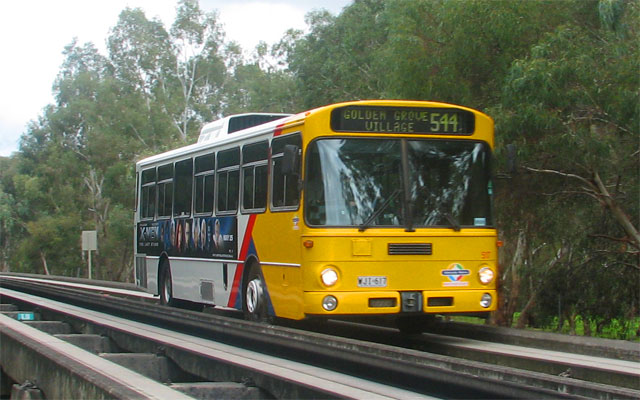
A Scania K280UB bus on the O-Bahn Busway route in Adelaide, Australia

Guided buses are buses capable of being steered by external means, usually on a dedicated track or roll way that excludes other traffic, permitting the maintenance of schedules even during rush hours. Unlike railbuses, trolleybuses or rubber-tyred trams, for part of their routes guided buses are able to share road space with general traffic along conventional roads, or with conventional buses on standard bus lanes. Guidance systems can be physical, such as kerbs or guide bars, or remote, such as optical or radio guidance.

A guided bus line can be categorised as bus rapid transit and may be articulated bus and bi-articulated bus, allowing more passengers, but not as many as light rail or trams, which are not constrained to a regulated maximum size in order to freely navigate public roads.

History

[edit]
Guided omnibus from Manchester

Precursors

[edit]

The kerb-guided bus (KGB) guidance mechanism is a development of the early flangeways, pre-dating railways. The Gloucester and Cheltenham Tramroad[1] of 1809 therefore has a claim to be the earliest guided busway. There were earlier flangeways, but they did not carry passengers.[2][3] From 1861 to 1872 another system with one central grooved rail was used in the Manchester region.[4]

Modern examples

[edit]

The first modern guided busway system was opened in 1980 in Essen, Germany. This was initially a demonstration track, but it was periodically expanded and is still in operation as of 2019.[5]

The first guided busway in the United Kingdom was in Birmingham, the Tracline 65, 1,968 feet (600 m) long, experimentally in 1984.[6] It closed in 1987.[7]

Based on the experience in Essen, in 1986 the Government of South Australia opened the O-Bahn Busway in Adelaide.[8][9] This is a 12-kilometre guided busway with 2 interchanges along the route. (Klemzig Interchange & Paradise Interchange) before ending at Tee Tree Plaza Interchange.[10]

In Mannheim, Germany, from May 1992 to September 2005 a guided busway shared the tram alignment for a few hundred metres, which allowed buses to avoid a congested stretch of road where there was no space for an extra traffic lane. It was discontinued, as the majority of buses fitted with guide wheels were withdrawn for age reasons. There are no plans to convert newer buses.[11]

The Nagoya Guideway Bus opened in March 2001 and is the only guided bus line in Japan.

The Cambridgeshire Guided Busway between Cambridge and St Ives, at 25 kilometres (16 miles), is the world's longest guided busway. It opened on 7 August 2011.[12]

Between 2004 and 2008, a 1-mile (1.5 km) section of guided busway was in operation between Stenhouse and Broomhouse in the west of Edinburgh. The route was later converted for use by Edinburgh trams.[13][14]

Rubber-tyred trams and translohr

[edit]

Rubber-tyred trams

[edit]

Guided buses are to be distinguished from rubber-tyred systems that cannot run other than along a dedicated trackway, or under fixed overhead power lines.

Tram-like guided busway (rubber-tyred tram) systems include:

The first one is replaced with conventional trams and the other is being used as a trolleybus without the guide system.

Translohr

[edit]

Also called "trams on rubber tyres".

Autonomous Rail Rapid Transit

[edit]

Autonomous Rapid Transit (ART) is equipped with various optical and other types of sensors to allow the vehicle to automatically follow a route defined by a virtual track of markings on the roadway. A steering wheel also allows the driver to manually guide the vehicle, including around detours. Just like guided busway, electric buses use batteries to power their electric motors, and ebus combine elements of guided trolleybuses introduce new IMC (In-Motion Charging) technology, and wireless charging technology from embedded coils in roadways to automated depot charging pads as for "opportunity charging" electric buses while they are on the road, typically at bus stops or terminals, rather than solely at the depot, electric road system, is a road that provides electric power to vehicles as they travel on it, guided bi-articulated bus system for urban passenger transport.[15][16][17]

Guidance systems

[edit]

Optical guidance

[edit]
An optical guidance device on TEOR bus in Rouen
Irisbus Crealis Neo, an optically guided TEOR bus in Rouen
MAX bus system in Las Vegas

Optical guidance relies on the principles of image processing. A camera in the front of the vehicle scans the bands of paint on the ground representing the reference path. The signals obtained by the camera are sent to an onboard computer, which combines them with dynamic parameters of the vehicle (speed, yaw rate, wheel angle). The calculator transmits commands to the guidance motor located on the steering column of the vehicle to control its path in line with that of the reference.

Optical guidance is a means of approaching light rail performance with a fast and economical set-up. It enables buses to have precision-docking capabilities as efficient as those of light rail and reduces dwell times, making it possible to drive the vehicle to a precise point on a platform according to an accurate and reliable trajectory. The distance between the door steps and the platform is optimized not to exceed 5 centimetres (2 in). Level boarding is then possible, and there is no need to use a mobile ramp for people with mobility impairments.

Guided trolleybus

[edit]
Guided trolleybus in Castellón de la Plana, Spain

The Optiguide system, an optical guidance device developed by Siemens Transportation Systems, has been in revenue service since 2001 in Rouen and Nîmes (only at stations), France, and has been fitted to trolleybuses in Castellon (Spain) since June 2008 and will be in service on buses in the cities of Bologna (Italy).[18]

Autonomous rail rapid transit

[edit]
Yibin ART System, Yibin, China

Another system was introduced in 2017. Called Autonomous Rail Rapid Transit (ART) and developed by CRRC, it uses optical systems to follow markers on a roadway. The ART system is frequently referred to as a "trackless tram" and occasionally as an "optically-guided bus".[19]

Magnetic guidance

[edit]

Other experimental systems have non-mechanical guidance, such as sensors or magnets buried in the roadway.[20][21] In 2004, Stagecoach Group signed a deal with Siemens to develop an optical guidance system for use in the United Kingdom.[22]

Phileas bus

Two bus lines in Eindhoven, Netherlands, had used Phileas vehicles. Line 401 from Eindhoven station to Eindhoven Airport is 9 km (5.6 mi) long, consists largely of concrete bus lanes and has about 30 raised stop platforms. Line 402 from Eindhoven station to Veldhoven branches off from line 401 and adds another 6 km (3.7 mi) of bus lanes and about 13 stops.[23] Years before the last trip of a Phileas bus in 2016, the regional authority for urban transport in the Eindhoven region (SRE) decided to discontinue the use of magnetic guidance system. In 2014 the manufacturer, APTS, was declared bankrupt.

Light-blue articulated bus
Évéole bus in Douai

The Douai region in France is developing a public transport network using APTS Phileas technology and dedicated infrastructure. The length of the lines will be 34 km (21 mi). The first stage is a line of 12 km (7.5 mi) from Douai via Guesnain to Lewarde, passing close to Waziers, Sin-le-Noble, Dechy and Lambres-lez-Douai. 39 stop platforms will be provided with an average distance between the stops of 400 m (440 yd). A number of stops will be placed on the right-hand side of each lane. Central stops between both lanes will be placed at locations with limited space at the right side. This requires vehicle to have doors on both sides. The buses using Phileas technology were in use from 2008 to 2014.

Bimodal Bus-tram(Ko) and Barota (BRT System)(Ko) in Sejong City, South Korea

On 3 November 2005, a licence and technology transfer agreement was signed between Advanced Public Transport Systems (APTS) and the Korea Railroad Research Institute (KRRI). KRRI was to develop the Korean version of Phileas vehicle by May 2011.[24]

Since June 2013, 3 miles (1.5 miles each way) of the Emerald Express (EmX) BRT in Eugene, Oregon, has used magnetic guidance in revenue service on an especially curvy section of the route that also entails small radius S-curves required for docking. The driver controls braking and acceleration.[25]

Kerb guidance

[edit]
Kerb-guided track and adjacent multi-user path along a disused rail line, on the Leigh-Salford-Manchester Bus Rapid Transit
Cross-sectional diagram of the parallel direction curbs of the bus lane in Essen, Germany

On kerb-guided buses (KGB) small guide wheels attached to the bus engage vertical kerbs on either side of the guideway. These guide wheels push the steering mechanism of the bus, keeping it centralised on the track. Away from the guideway, the bus is steered in the normal way. The start of the guideway is funnelled from a wide track to guideway width. This system permits high-speed operation on a narrow guideway and precise positioning at boarding platforms, facilitating access for the elderly and disabled. As guide wheels can be inexpensively attached to, and removed from, almost any standard model of bus, kerb guided busway systems are not tied to particular specialised vehicles or equipment suppliers. Characteristically, operators contracted to run services on kerb-guided busways will purchase or lease the vehicles, as second-hand vehicles (with guide wheels removed) have a ready resale market.

Kerb guided busway guide wheel Mannheim, Germany

The kerb-guided system maintains a narrow track while still enabling buses to pass one another at speed. Consequently, kerb-guided track can be fitted into former double-track rail alignments without the requirement for additional land-take that might have been necessary were a disused railway to be converted into a public highway. Examples include the Cambridgeshire Guided Busway and Leigh-Salford-Manchester Bus Rapid Transit; in both schemes, it has proved possible to provide space for a wide multi-user path for leisure use alongside the kerb-guided double track, all within the boundaries of the disused railway route. Both the Cambridgeshire and Leigh-Salford-Manchester schemes have reported greatly increased levels of patronage (both on the buses themselves and the adjacent paths), high levels of modal transfer of travellers from private car use, and high levels of passenger satisfaction.[26][27]

List of guided busways systems

[edit]

Systems with conventional/modified buses:

Country City System name Started Closure Routes Number of stations Length Notes
 Australia Adelaide O-Bahn Busway 9 March 1986 - 3 12 kilometres (7.5 mi) (BRT systems)
 France Douai Évéole (fr) 8 February 2010 1 37 34 kilometres (21 mi) Guided busway APTS Phileas [fr] (BRT systems)
Nîmes BRT Tango+ (fr) 29 September 2012 1 9 7.2 kilometres (4.5 mi) (BRT systems)
Rouen TEOR 12 February 2001 4 64 39 kilometres (24 mi) (BRT systems)
 Germany Essen Spurbus (de) 1980 2 - 24.2 kilometres (15.0 mi) (BRT systems)
Mannheim O-Bahn May 1992 September 2005 - - - Guided busway system
 Italy Bologna Trolleybuses in Bologna 4 Jan 1991 5 - - Guided busway system in Bologna[28]
 Japan Nagoya Yutorito Line 23 March 2001 4 9 6.5 kilometres (4.0 mi) (BRT systems)
 Netherlands Eindhoven Phileas 2003 3 32 15 kilometres (9.3 mi) (BRT systems)
 South Korea Sejong City Bimodal tram(ko) March 2016 - - 20.1 kilometres (12.5 mi) (BRT systems)
 Spain Castellón de la Plana Trolleybuses in Castellón de la Plana 25 June 2008 1 19 7.765 km (4.825 mi) (BRT systems)
 United Kingdom Birmingham Tracline 65 1984 1987 - - - Guided busway system
Bradford Manchester Road Quality Bus Initiative Bradford end October 2001 - - - (BRT systems)
Bristol MetroBus 29 May 2018 5 - 50 kilometres (31 mi) (BRT systems)
Cambridgeshire Cambridgeshire Guided Busway
(Huntingdon to Trumpington)[29]
7 August 2011 3 8 25 kilometres (16 mi) (BRT systems)
Crawley Fastway BRT October 2006 3 150 1.5 kilometres (0.93 mi) (BRT systems)
Edinburgh Edinburgh Fastlink December 2004 January 2009 2 - 1.5 kilometres (0.93 mi) Guided busway system
Gosport South East Hampshire Bus Rapid Transit (Eclipse Busway) 22 April 2012 2 7 3.4 kilometres (2.1 mi) (BRT systems)
Ipswich Ipswich Rapid Transit
(Superroute 66)
1995 - - - (BRT systems)
Greater Manchester Leigh-Salford-Manchester Bus Rapid Transit (Vantage-Leigh-Kerb Guided Busway) 3 April 2016 2 14 7.2 kilometres (4.5 mi) (BRT systems)
Leeds Leeds Superbus July 1998 - - - (BRT systems)
Luton Luton to Dunstable Busway 24 September 2013 - - 7.7 kilometres (4.8 mi) (BRT systems)
 United States Eugene Emerald Express 14 January 2007 2 37 2.4 kilometres (1.5 mi) (BRT systems)
Las Vegas ACE BRT (Max) 30 June 2004 - 22 11.2 kilometres (7.0 mi) (BRT systems) guided busway Irisbus Civis [fr]
[edit]

See also

[edit]

References

[edit]
[edit]
Revisions and contributorsEdit on WikipediaRead on Wikipedia
from Grokipedia
A guided bus is a type of vehicle designed to operate on a dedicated track or guideway, where is controlled externally—typically by kerbs or rails—allowing the bus to follow a fixed path while excluding other traffic for improved speed and reliability. These systems combine the flexibility of buses with the precision of rail transit, using standard or adapted buses equipped with guide wheels that engage with the track's edges, while the driver manages , braking, and speed. Guided busways are constructed with durable materials like , featuring two parallel kerbs approximately 180 mm high and 2,600 mm apart to accommodate the vehicle's . The concept of guided buses emerged in the late as a cost-effective alternative to for urban and suburban transport, with the first operational system introduced in , , in 1980. Early designs focused on kerb-guidance for simplicity and low infrastructure costs, evolving to include central rail systems like the O-Bahn in , , which uses a ground-level guide rail for high-speed operation up to 100 km/h. By the early , guided busways gained traction in and beyond for their ability to repurpose disused rail corridors or integrate into existing road networks, supporting sustainable mobility goals such as reduced emissions and congestion. Key advantages of guided bus systems include enhanced and capacity—often achieving frequencies of buses every few minutes during peak hours—due to the elimination of steering variability and traffic interference. They offer economic returns, with studies showing up to £7 in benefits per £1 invested, alongside socio-economic gains like job creation and improved accessibility in deprived areas. Compared to trams or , guided buses require less capital investment and allow vehicles to deviate from the guideway for on-street service, blending dedicated infrastructure with urban flexibility. Notable implementations include the in the UK, the world's longest at 25 km, which opened in 2011 and carried about 3.7 million passengers in 2024-2025 (around 10,000 daily on average); the Leigh to Ellenbrook line in , a 6.5 km concrete-guided route attracting 45,000 weekly users; and international examples like Japan's Yutorito Line. These projects demonstrate guided buses' role in modern transit, prioritizing efficiency, environmental benefits, and integration with multi-modal networks, though some face ongoing and challenges as of 2025.

Overview

Definition and Characteristics

A guided bus is a type of bus capable of being steered by external means, typically along a dedicated track or guideway that excludes other traffic, thereby combining the flexibility of bus operations with the precision and reliability of rail-like guidance. These systems employ specialized guideways, such as tracks with raised kerbs for mechanical guidance, virtual tracks using sensors or underground cables for electronic guidance, or central rails for slot-based systems, allowing buses to adhere strictly to predefined paths. Vehicles in these systems are frequently rubber-tyred to provide smoother rides on mixed surfaces, including both guideways and conventional roads, and can achieve high speeds of up to 100 km/h on dedicated sections while supporting frequent service intervals. Key characteristics of guided buses include their dual-mode capability, enabling operation on guideways for high-capacity corridors and reversion to standard road driving where infrastructure ends, which enhances adaptability in urban and suburban settings. Guideways are typically narrow—around 3 to 3.5 meters wide—constructed from with integrated drainage, making them more space-efficient than traditional bus lanes and self-policing to prevent misuse by other vehicles. This design supports elevated passenger capacities through precise alignment and reduced lateral sway, often incorporating electric or hybrid propulsion for quieter and more performance. Unlike standard Bus Rapid Transit (BRT) systems, which rely on dedicated lanes or busways without mandatory steering aids and depend on driver control for path adherence, guided buses incorporate physical or electronic guidance mechanisms to enforce route precision, enabling narrower infrastructure and higher operational speeds. This distinction positions guided buses as an evolution of BRT, offering rail-like discipline while retaining bus-like versatility and lower capital costs compared to fixed-rail alternatives. The basic operational principles of guided buses center on automated or assisted steering via guidance mechanisms, such as guidewheels engaging kerbs or sensor-based systems detecting embedded markers, which ensure consistent alignment and minimize deviations. This reduces driver workload by handling lateral control, particularly in congested urban environments, thereby enhancing safety through lower collision risks and more predictable movements, while allowing seamless transitions between guided and unguided segments.

Advantages and Challenges

Guided bus systems offer significant cost-effectiveness compared to transit, with construction costs typically 20-50% lower due to the absence of requirements for electric distribution and more straightforward guideway materials like kerbs. This flexibility allows vehicles to operate both on dedicated guideways and existing roadways, enabling seamless one-seat rides without transfers and adaptation to urban changes. Capacity exceeds that of standard buses, supporting theoretical capacities of up to 120 buses per hour, with practical headways as low as one minute (60 buses per hour), accommodating approximately 100-200 passengers per vehicle through precise guidance that minimizes deviations and enables efficient at stations. When electrified, these systems reduce emissions by up to 75% compared to diesel counterparts, contributing to improved air quality and lower noise levels without overhead wires. Reliability is enhanced by self-enforcing guideways that prevent unauthorized access and ensure consistent operation in narrow rights-of-way under 25 feet wide. Despite these benefits, guided bus systems face notable challenges, including high initial infrastructure costs for specialized guideways and kerbs, which require durable materials to withstand wear. They are vulnerable to disruptions from debris, kerb damage, or loosening precast elements, potentially halting operations until cleared or repaired. Scalability is limited in highly dense urban areas due to the need for dedicated corridors, and maintenance demands for guidance hardware like guidewheels add ongoing operational complexity. In mixed-traffic sections, speeds may drop below guideway levels, reducing overall efficiency. Economically, guided busways typically cost $3-7 million per kilometer for civil works, offering payback through increased ridership and operational savings over rail, though higher than unguided due to guidance features. These systems achieve over 80% of light rail's patronage potential at less than 20% of the capital investment, with environmental gains including reduced via surfacing and no need for overhead wiring in non-electrified designs. In terms of and , guidance provides enhanced vehicle stability and precise docking for level boarding, reducing risks from lane deviations and improving inclusivity for passengers with disabilities per accessibility regulations. However, guideway failures, such as kerb gaps or structural issues, pose risks of or hazards, necessitating features like run-flat tires, emergency signaling, and fencing for mitigation.

Historical Development

Precursors and Early Concepts

The concept of guided buses traces its origins to the early , when horse-drawn vehicles began incorporating rail guidance for improved stability and capacity. The and Tramroad, opened in 1811, represented one of the first such systems, utilizing L-shaped rails where the vertical guided flangeless wheels on horse-drawn wagons, allowing for smoother operation over rough terrain compared to unguided omnibuses. This design, spanning 9 miles between and in , carried goods at speeds up to 7 mph and is recognized as a foundational precursor to modern guided transit technologies due to its emphasis on dedicated tracks for controlled vehicle movement. By , European engineers proposed innovations that shifted toward rubber-tyred vehicles on rails to address noise, vibration, and maintenance issues associated with steel wheels. In , the company's Micheline railcars, first tested in 1931, featured pneumatic tires running on standard rails, achieving speeds of up to 100 km/h while providing a quieter ride suitable for passenger service. These prototypes, which included both single and multiple-car configurations, demonstrated the potential for rubber-tyred systems to combine rail guidance with road-like flexibility, influencing later developments in guided bus and tram designs across . The marked a period of experimental prototypes in amid growing urban congestion. Drawing from rubber-tyred metro innovations, engineers tested early mechanically guided bus concepts on dedicated tracks, aiming to enhance capacity without full rail infrastructure; these efforts laid groundwork for systems like the later Guided Light Transit (GLT). In the , the global oil crisis accelerated interest in efficient , prompting key precursors in and the . The O-Bahn concept, originally developed in and inspired by and elevated ideas, involved overhead guide wires and a trough for high-speed bus operation up to 100 km/h; it was adapted for in the late to bypass traffic. In the , the energy shortage fueled planning for kerb-guided systems, emphasizing low-cost retrofitting for fuel savings and reliability during economic constraints. These efforts highlighted the technological shift from rigid rail to rubber tyres for greater cost-effectiveness and operational flexibility, validated through small-scale pilots that confirmed improved and speed on dedicated paths.

Modern Adoption and Expansion

The first modern guided bus system opened in , , in 1980, using kerb guidance for urban transit. The modern era of guided bus systems expanded with the opening of the in , , in 1986, marking one of the first large-scale implementations of the technology to address urban mobility needs. This 12-kilometer system allowed buses to operate at high speeds on a dedicated track, serving as a model for subsequent developments. In Europe, early adoptions followed in the late 1990s and early 2000s, including the guided busway sections in , , which integrated kerb guidance to enhance bus priority and reliability along key corridors. Influences from Japan's transit innovations, such as the planning and eventual launch of the Yutorito Line guided busway in in 2001, further contributed to global interest in rubber-tyred guided systems during this period. Expansion in the 1990s and 2000s was driven primarily by escalating urban congestion and stringent environmental regulations aimed at reducing emissions and promoting efficient public transit alternatives to private vehicles. Cities sought cost-effective solutions to alleviate traffic bottlenecks without the infrastructure demands of rail, leading to broader adoption across and . A notable example is the in the , which opened in 2011 as Europe's longest at 25 kilometers, connecting to and St Ives while repurposing disused rail corridors. This project exemplified how guided busways could deliver high-capacity service in densely populated areas facing growth pressures. Key milestones in the 2000s included the proliferation of guided bus systems in Europe, with Leeds expanding its Superbusway network in the mid-2000s to incorporate more dedicated guided tracks for improved service speeds. In China, elements of dedicated lanes were integrated into bus rapid transit (BRT) frameworks during the 2010s, as seen in systems like the Guangzhou BRT corridor launched in 2010, which emphasized priority measures to handle surging urban demand. Ridership growth underscored the impact; for instance, Adelaide's O-Bahn served approximately 30,000 passengers per weekday by the early 2010s, contributing to overall system efficiency. Policy factors accelerated this trend, including European Union funding for sustainable transport initiatives that supported greener mobility projects. Additionally, the post-2008 global recession favored guided busways as cheaper alternatives to rail expansions, enabling agencies to maintain service levels amid budget constraints.

Guidance Technologies

Mechanical Guidance

Mechanical guidance in guided bus systems relies on physical, contact-based mechanisms to steer vehicles along dedicated tracks, ensuring precise alignment without relying on advanced sensors or electronics. These systems typically involve structural elements such as raised kerbs or embedded rails that interact directly with modified bus components, allowing for reliable operation in segregated rights-of-way while maintaining compatibility with standard bus fleets. Kerb guidance, the most common form of mechanical , uses raised kerbs along the track edges to engage lateral guide wheels mounted on the bus. These kerbs, typically 180 mm high and spaced 2.6 m apart for single-lane operation, allow the guide wheels—often fixed to the front via rigid arms linked to the mechanism—to maintain continuous contact, automatically directing the and enabling drivers to release manual once engaged. This setup supports speeds up to 70 km/h in operational segments, with the guide wheels providing lateral stability to prevent , particularly on curves where superelevation and precise kerb alignment enhance ride quality. Rail-based mechanical guidance employs embedded rails or tracks that the bus tyres contact directly for , often in with kerbs for added stability. Systems like those in Nagoya's Yutorito Line use guide wheels engaging a central guidance rail within a track to direct the , offering simplicity through minimal technological requirements beyond standard vehicle adaptations. This approach benefits from low initial tech needs, enabling easier integration with existing , but it can lead to accelerated tyre wear due to the constant and lateral forces on rubber surfaces during guided operation. Design specifics for mechanical guidance systems emphasize compatibility and efficiency, with track widths generally ranging from 3 to 6 meters to accommodate bi-directional flow while minimizing . Buses require modifications such as guide wheels, run-flat tyres, and dual steering modes that switch between guided (automatic via physical contact) and freewheeling (manual) operation for transitions to ungided sections. Maintenance of mechanical guidance focuses on and , with regular inspections of kerbs for cracks, alignment deviations (gauge tolerances of ±1 mm for high-speed systems and -7/+3 mm for low-speed; horizontal alignment standard deviation of 2.0–2.5 mm), and surface irregularities to prevent or guidance failures. Installation costs for kerb-guided typically ranged from £3 to 5 million per kilometer in the early (equivalent to approximately $10–15 million per kilometer as of 2025), depending on methods like precast segments or slipforming, which influence long-term upkeep needs.

Electronic Guidance

Electronic guidance systems in guided buses rely on sensors and software to enable precise path following without physical infrastructure like curbs or rails. These systems use onboard technologies such as cameras, magnetometers, , and GPS to detect virtual tracks or environmental cues, allowing buses to maintain alignment, dock accurately at stations, and navigate dedicated lanes autonomously or semi-autonomously. By processing through algorithms, electronic guidance reduces driver intervention, enhances , and supports higher speeds in constrained urban spaces. Optical guidance represents a key form of electronic steering, employing camera-based systems to track painted lines or markers on the roadway. In this approach, forward-facing cameras capture images of white dashed lines or stripes, which image-processing software analyzes to determine the vehicle's position relative to the path; steering adjustments are then made automatically via actuators on the . Developed in the late 1990s by Transport International, this technology achieved alignment precision within 10 cm during early trials, enabling seamless lane-keeping and station docking. A prominent implementation is the TEOR system in , , launched in 2001, where 57 Irisbus Civis vehicles use optical scanners to follow double white lines painted on dedicated lanes, docking within 2 inches (5 cm) of platforms to facilitate level boarding without ramps. The system functions even if only one-third of the lines are visible, reducing required lane widths by approximately 1.5 meters compared to manual operation. Similar optical setups have been deployed in , Spain, on a trolleybus route since 2008, combining guidance with electric propulsion for enhanced efficiency in urban corridors. Magnetic guidance offers an alternative by embedding magnets or conductive loops in the pavement, which vehicle-mounted sensors detect to create virtual tracks invisible to the eye. Magnetometers in the bus measure the magnetic field's position and strength, feeding data into control algorithms that adjust steering for lateral alignment; this method requires minimal surface disruption during installation and supports operations on existing roads. In a demonstration by researchers at the , a 60-foot equipped with magnetic sensors followed embedded plugs along a at speeds up to 30 mph, achieving precise docking that shaved seconds off station stops by aligning doors exactly with platforms. The technology also enables closer vehicle following—down to 10 feet—improving capacity without increasing collision risks, as the system provides smoother, more consistent steering than human drivers. Implementation of electronic guidance often integrates multiple sensors for robustness, such as for obstacle detection and high-resolution mapping alongside GPS for global positioning. Real-time kinematic (RTK) GPS combined with inertial navigation systems (INS) provides centimeter-level accuracy for lane-keeping, while scans curbs or markers during docking phases, switching sensors at low speeds (under 15 km/h) to maintain stability. correction algorithms, including feedback control based on displacement and yaw errors, ensure deviations remain below 5 cm; for instance, localization achieves a lateral error standard deviation of 1.2 cm in precision docking tests over 30-meter paths. Onboard computers process these inputs at high frequencies (e.g., 100 Hz for GNSS/INS), typically drawing 500-1000 watts from the vehicle's electrical system, depending on computational load and demands. These integrations allow guidance in varied conditions, from urban curves to straightaways, with to manual control if needed. In the 2020s, advancements in have enhanced electronic guidance by enabling adaptive routing in dynamic environments, where models predict and adjust paths based on real-time traffic, weather, or demand data. AI-driven systems analyze inputs alongside historical patterns to optimize trajectories, reducing deviations and improving responsiveness in mixed-traffic scenarios; for example, algorithms in autonomous bus prototypes fuse optical and magnetic data for proactive obstacle avoidance and route recalibration. These developments, integrated into platforms like those tested in European public transit pilots, support fully driverless operations while maintaining safety margins under 5 cm in complex urban settings.

Hybrid and Specialized Systems

Hybrid and specialized systems in technology integrate multiple guidance methods or incorporate power systems to enhance and capacity, often blending mechanical, electronic, or virtual guidance with electrification. One prominent example is the , which combines overhead electrical wires for propulsion with physical or optical guidance to maintain precise path adherence. In , the Transport sur Voie Réservée () system, operational from 2001 to 2023, utilized a central guidance rail for steering on dedicated tracks while drawing power from overhead lines, allowing bi-articulated vehicles to achieve speeds up to 70 km/h and capacities of around 250 passengers. Similarly, Caen's TVR network, running from 2002 to 2017, employed the same Guided Light Transit (GLT) technology, where vehicles followed a single embedded rail for lateral guidance under , demonstrating the potential for seamless urban integration without full rail infrastructure. Autonomous Rail Rapid Transit (ART) represents a specialized electronic-hybrid approach, employing sensors to follow virtual rail paths painted on the roadway, mimicking rail transit while using rubber tires for flexibility. Developed by in , ART vehicles are typically bi-articulated, enabling capacities of up to 300 passengers per unit, and operate on low-floor platforms for level boarding. Systems like the one in , operational since 2019, and expansions in Yibin, combine this virtual guidance with electric or hybrid propulsion for reduced emissions, achieving operational speeds of 70 km/h on segregated paths. This design prioritizes scalability in dense urban environments, though it requires precise calibration to avoid deviations. Other hybrid configurations include dual-mode systems that switch between guided tracks and conventional roads, enhancing versatility. Japan's Dual Mode Vehicle (DMV), introduced in 2021 on Susaki Bay in Prefecture, features retractable rail wheels that deploy for guided rail operation while allowing rubber-tire road travel, powered by diesel-electric systems for seamless transitions in under 15 seconds. Specialized elevated guideways further adapt these hybrids for challenging terrains; for instance, sections of the O-Bahn system in , , incorporate flyover structures with kerb guidance to bypass intersections, supporting variants for improved energy efficiency. in these systems boosts overall efficiency by up to 30% compared to diesel counterparts, reducing operational costs and emissions, though it introduces challenges such as maintaining overhead infrastructure in variable weather and higher initial investments in power supply networks. Capacities in bi-articulated hybrids like these routinely support 200-300 passengers, making them suitable for high-demand corridors.

Rubber-Tyred Trams

Rubber-tyred trams represent an early form of guided transit that combines elements of traditional trams with rubber tyre technology for enhanced performance on urban routes. These systems emerged in the 1950s in , where the technology was pioneered to address challenges like steep gradients and noise in underground networks; notably, became the world's first rubber-tyred metro line when it was equipped with pneumatic tyres in November 1956, utilizing concrete guideways for a smoother and quieter operation compared to steel-wheeled counterparts. This innovation marked a significant precursor to surface-level applications, adapting metro principles to tram-like vehicles that run on dedicated tracks embedded in roadways. Key features of rubber-tyred trams include guidance mechanisms such as a central rail embedded in the guideway or lateral kerbs that ensure precise alignment without relying on , allowing for reliable operation on fixed routes. These vehicles typically achieve maximum speeds of up to 70 km/h, enabling efficient urban travel while providing higher passenger comfort through reduced noise and vibration levels inherent to rubber-on-concrete contact. The design also facilitates better and the ability to navigate steeper gradients—up to 13% in some configurations—compared to conventional steel-wheeled trams, making them suitable for varied terrain. The advantages of rubber-tyred trams stem from their hybrid nature, offering reduced vibration and noise for improved rider experience, as demonstrated by the immediate popularity of the Paris upgrades among passengers. Additionally, the rubber tyres enable easier climbing of inclines that would challenge steel-wheeled systems, enhancing adaptability in hilly urban environments. Examples include Japan's Kanazawa Seaside Line in , an automated rubber-tyred guideway system that has operated since , serving as a long-standing implementation of this technology on an elevated 10.6 km route with 14 stations. In contrast to conventional buses, rubber-tyred trams emphasize tram-like operations with fully fixed guideways that prevent lane deviations, supporting higher passenger capacities—often up to 300 per vehicle—and more predictable scheduling akin to rail systems rather than flexible bus . This fixed-infrastructure approach positions them as a bridge between bus and rail transit, influencing later developments in guided bus systems.

Translohr

The system is a proprietary rubber-tyred guided transit technology originally developed by the French Lohr Industrie, a subsidiary of the Lohr Group, featuring vehicles supported and propelled by pneumatic tires on either side of a single embedded central guidance rail. This design combines the smoothness and capacity of trams with the quieter operation and lower infrastructure demands of buses, using electric overhead lines for power and enabling low-floor access for passengers. The system's architecture emphasizes modular, articulated vehicles that can operate bi-directionally without end cabs, facilitating efficient urban routing. Operational history began with the opening of Line A in , , in October 2006, as the inaugural full-scale implementation providing service across 15.2 kilometers with 23 stations. Expansion followed with the 10.3-kilometer Sirio line in , , commencing operations in 2007, which connected the city center to peripheral areas and demonstrated the system's adaptability to varied terrains. Further deployments included Paris's T6 line in 2014 and , , in 2015, though growth slowed amid economic and technical hurdles; by 2012, and the Fonds Stratégique d'Investissement acquired majority control from Lohr to sustain development. Guidance in Translohr vehicles relies on pivoting bogies equipped with angled metal guide wheels that engage the central rail at 45 degrees, ensuring precise through curves with a minimum of 15 meters while distributing weight across rubber tires for reduced and . Available in configurations from 18 to 46 meters long, the vehicles accommodate over 200 passengers, with standing room optimized via wide interiors and multiple doors, and achieve maximum operating speeds of 70 km/h on dedicated guideways. This setup supports frequencies up to every 3.5 minutes, prioritizing reliability in medium-demand corridors. High initial construction costs, stemming from specialized guideway installation, and elevated maintenance for the guidance components have posed significant challenges, contributing to discontinuations in several locations. The Shanghai Zhangjiang Tram, opened in 2009 as Asia's first line, ceased operations on 31 May 2023 after low ridership failed to offset operating expenses exceeding expectations. Similarly, halted production in 2018, limiting future expansions and prompting operators like to explore replacements amid ongoing financial strains from upkeep.

Autonomous Rail Rapid Transit

The Autonomous Rail Rapid Transit (ART) is a modern guided bus system developed by Zhuzhou Institute Co., Ltd., a subsidiary of , and first unveiled in , Province, , on June 2, 2017. This system employs advanced sensor technologies, including (light detection and ranging) and visual image recognition, to enable virtual rail guidance along painted lane markings on existing roads, eliminating the need for physical tracks or rails. By combining elements of and rail systems, ART vehicles operate autonomously or semi-autonomously, following predefined virtual paths while navigating urban environments with high precision. Key features of ART include bi-articulated or tri-articulated electric vehicles with rubber tires designed for low-noise, eco-friendly operation on dedicated or painted lanes. These vehicles typically measure around 30 meters in length for standard models, accommodating up to 300 passengers, while longer configurations, such as five-carriage variants introduced in 2021, can carry up to 500 passengers. Maximum operating speeds reach 70-100 km/h, depending on the model and terrain, allowing for efficient urban and suburban mobility comparable to . The system's battery-powered design supports ranges of 40-80 km per charge, with quick recharging capabilities to minimize downtime. ART systems are operational in several Chinese cities, including (since 2017 test runs), Yibin (commercial operations starting 2019), and (by 2023), where they serve as integral parts of urban transit networks. Expansions in 2024 include the launch of ART 2.0, a hydrogen-powered variant showcased at InnoTrans, with additional lines and upgrades in cities like Hebi and to enhance capacity and coverage. As of 2025, ART systems are operational in five Chinese cities. In January 2025, Hungarian bus manufacturer Ikarus announced potential collaboration with for production aimed at the European market. Internationally, a trial in Indonesia's Nusantara capital city in 2024 faced challenges, leading to the return of the units due to failures in achieving full autonomous operation during testing. Advancements in incorporate integration with networks for real-time vehicle-to- communication, enabling precise control, traffic optimization, and enhanced safety in dynamic environments. The system offers significant cost savings over traditional rail transit, estimated at about 40% less due to reduced infrastructure needs like track laying and elevated structures, making it a viable option for medium-capacity urban routes.

Global Implementations

Operational Systems

In , the in the stands as one of the longest operational guided bus systems, spanning 25 kilometers and utilizing kerb guidance to connect , , and St Ives. Opened in 2011, it has facilitated approximately 2.7 million passenger journeys annually as of 2023, contributing to enhanced connectivity in the region and integrating with local rail and bus hubs for multimodal access. The system's impact includes reduced travel times and increased bus service frequencies, supporting in growing suburban areas. Another prominent European example is the Leigh Guided Busway in , , which opened in 2016 and features a 7-kilometer kerb-guided section as part of a 22-kilometer route linking Leigh to and city center. It has achieved significant ridership growth, reaching 2.6 million passengers in the 2023/24 financial year, more than double the initial levels due to improved reliability and priority infrastructure. This success has shifted up to 25% of users from private cars to , demonstrating the busway's role in alleviating congestion and promoting economic vitality in urban corridors. In and , Australia's O-Bahn Busway in exemplifies long-term operational success, with its 12-kilometer rail-guided track operational since 1986. The system handles around 35,000 passengers daily, offering high reliability with on-time performance exceeding 95% and speeds up to 100 km/h in guided sections. Integrated with the central and suburban feeders, it has sustained patronage growth, carrying over 10 million passengers annually and serving as a benchmark for efficient in low-density areas. Japan incorporates guided bus elements within its broader frameworks, most notably through the Yutorito Line in , a 6.5-kilometer elevated guideway bus system opened in 2001 that connects urban and suburban districts. This hybrid uses mechanical guidance for precise navigation, achieving daily ridership of several thousand while enhancing reliability in constrained city spaces. Its design influences other Japanese initiatives by prioritizing seamless transitions between guided and conventional bus operations. Operational guided bus systems remain limited in the , though major BRT networks like Bogotá's , launched in the early 2000s, incorporate dedicated that provide structured guidance akin to guided transit for high-capacity service. Spanning over 100 kilometers with integrated stations, it transports about 2.4 million passengers daily, underscoring the potential for scalable, impactful in densely populated Latin American cities despite not featuring full mechanical guidance.

Planned and Recent Projects

In 2025, the underwent significant safety upgrades following approval by the Highways and Transport Committee in June, including the installation of 3 km of fencing between and the , with work commencing on 12 October at Bridge. As of November 2025, the fencing installation is progressing, with one lane remaining open during works. These measures, which also encompass permanent barriers between Cambridge Railway Station and Bridge, aim to enhance pedestrian safety and address risks such as flooding through design options, with full completion targeted for the end of 2026; fencing costs alone could reach up to £4.7 million. Concurrently, temporary speed reductions to 30 mph on the busway and 20 mph at crossings were implemented from 6 October 2025 to support the upgrades. The Leigh Guided Busway in saw expansions and improvements from 2023 to 2024 as part of its integration into the on 24 September 2023, which introduced enhanced service frequencies and connectivity. In 2025, further frequency boosts, such as buses every four minutes during peak hours on the busway, alongside a new travel hub on Astley Street adding 99 parking spaces, including electric vehicle charging. In , the South East Cambridge Busway project, led by the Greater Cambridge Partnership (GCP), advanced with a Transport and Works Act Order application submitted to the on 9 January 2025, seeking approval for an 8 km guided busway connecting a new A11 travel hub near Babraham to the . As of November 2025, the application is still under review by the . This Phase 2 initiative, estimated at £162 million, includes bus priority improvements and a parallel path for walkers and cyclists, with construction potentially starting in 2026 if approved, following earlier 2024 council endorsements despite environmental concerns. Greater Cambridge guided bus extensions received 2024 approvals as part of the GCP's broader programme, supporting connectivity enhancements tied to the busway scheme. In , expansions of () systems continued in , with the Suzhou line operationalized in 2024 as part of CRRC's deployments in province, featuring electronically guided, bi-articulated electric buses for urban routes. The Yibin ART system in advanced toward full commercial operation by 2025, building on its debut with significant construction achievements and lidar-guided zero-emission vehicles achieving reliable service quality. In , a 2024 trial of three CRRC ART units in Nusantara's Central Government District, costing Rp 210 billion (US$13.2 million), was halted and the units returned to in due to challenges including autonomous mode failures, inadequate obstacle detection, and the need for constant manual intervention, failing to meet local specifications. Emerging trends in guided bus projects emphasize integration with zero-emission technologies, as seen in China's systems, which rely on battery-electric propulsion for sustainable urban transit without rails. The South East Cambridge Busway similarly plans for low-emission bus operations within its £162 million framework, aligning with decarbonization goals and projected timelines for electric fleet deployment by the late .

References

Add your contribution
Related Hubs
User Avatar
No comments yet.