



Community hub
Recent from talks
Knowledge base stats:
Talk channels stats:
Members stats:
Aluminium sulfate
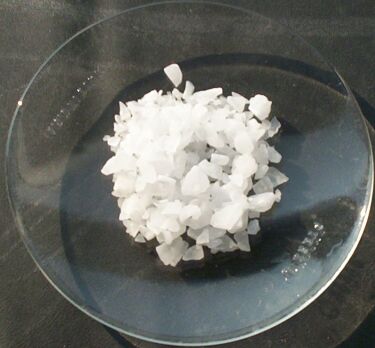
Aluminium sulfate is a salt with the formula Al2(SO4)3. It is soluble in water and is mainly used as a coagulating agent (promoting particle collision by neutralizing charge) in the purification of drinking water and wastewater treatment plants, and also in paper manufacturing.
The anhydrous form occurs naturally as a rare mineral millosevichite, found for example in volcanic environments and on burning coal-mining waste dumps. Aluminium sulfate is rarely, if ever, encountered as the anhydrous salt. It forms a number of different hydrates, of which the hexadecahydrate Al2(SO4)3·16H2O and octadecahydrate Al2(SO4)3·18H2O are the most common. The heptadecahydrate, whose formula can be written as [Al(H2O)6]2(SO4)3·5H2O, occurs naturally as the mineral alunogen.
Aluminium sulfate is sometimes called alum or papermaker's alum in certain industries. However, the name "alum" is more commonly and properly used for any double sulfate salt with the generic formula XAl(SO4)2·12H2O, where X is a monovalent cation such as potassium or ammonium.
Aluminium sulfate may be made by adding aluminium hydroxide, Al(OH)3, to sulfuric acid, H2SO4:
or by heating aluminium in a sulfuric acid solution:
The alum schists employed in the manufacture of aluminium sulfate are mixtures of iron pyrite, aluminium silicate and various bituminous substances, and are found in upper Bavaria, Bohemia, Belgium, and Scotland. These are either roasted or exposed to the weathering action of the air. In the roasting process, sulfuric acid is formed and acts on the clay to form aluminium sulfate, a similar condition of affairs being produced during weathering. The mass is now systematically extracted with water, and a solution of aluminium sulfate of specific gravity 1.16 is prepared. This solution is allowed to stand for some time (in order that any calcium sulfate and basic iron(III) sulfate may separate), and is then evaporated until iron(II) sulfate crystallizes on cooling; it is then drawn off and evaporated until it attains a specific gravity of 1.40. It is now allowed to stand for some time, and decanted from any sediment.
In the preparation of aluminium sulfate from clays or from bauxite, the material is gently calcined, then mixed with sulfuric acid and water and heated gradually to boiling; if concentrated acid is used no external heat is generally required as the formation of aluminium sulfate is exothermic. It is allowed to stand for some time, and the clear solution is drawn off.
When cryolite is used as the ore, it is mixed with calcium carbonate and heated. By this means, sodium aluminate is formed; it is then extracted with water and precipitated either by sodium bicarbonate or by passing a current of carbon dioxide through the solution. The precipitate is then dissolved in sulfuric acid.
Hub AI
Aluminium sulfate AI simulator
(@Aluminium sulfate_simulator)
Aluminium sulfate
Aluminium sulfate is a salt with the formula Al2(SO4)3. It is soluble in water and is mainly used as a coagulating agent (promoting particle collision by neutralizing charge) in the purification of drinking water and wastewater treatment plants, and also in paper manufacturing.
The anhydrous form occurs naturally as a rare mineral millosevichite, found for example in volcanic environments and on burning coal-mining waste dumps. Aluminium sulfate is rarely, if ever, encountered as the anhydrous salt. It forms a number of different hydrates, of which the hexadecahydrate Al2(SO4)3·16H2O and octadecahydrate Al2(SO4)3·18H2O are the most common. The heptadecahydrate, whose formula can be written as [Al(H2O)6]2(SO4)3·5H2O, occurs naturally as the mineral alunogen.
Aluminium sulfate is sometimes called alum or papermaker's alum in certain industries. However, the name "alum" is more commonly and properly used for any double sulfate salt with the generic formula XAl(SO4)2·12H2O, where X is a monovalent cation such as potassium or ammonium.
Aluminium sulfate may be made by adding aluminium hydroxide, Al(OH)3, to sulfuric acid, H2SO4:
or by heating aluminium in a sulfuric acid solution:
The alum schists employed in the manufacture of aluminium sulfate are mixtures of iron pyrite, aluminium silicate and various bituminous substances, and are found in upper Bavaria, Bohemia, Belgium, and Scotland. These are either roasted or exposed to the weathering action of the air. In the roasting process, sulfuric acid is formed and acts on the clay to form aluminium sulfate, a similar condition of affairs being produced during weathering. The mass is now systematically extracted with water, and a solution of aluminium sulfate of specific gravity 1.16 is prepared. This solution is allowed to stand for some time (in order that any calcium sulfate and basic iron(III) sulfate may separate), and is then evaporated until iron(II) sulfate crystallizes on cooling; it is then drawn off and evaporated until it attains a specific gravity of 1.40. It is now allowed to stand for some time, and decanted from any sediment.
In the preparation of aluminium sulfate from clays or from bauxite, the material is gently calcined, then mixed with sulfuric acid and water and heated gradually to boiling; if concentrated acid is used no external heat is generally required as the formation of aluminium sulfate is exothermic. It is allowed to stand for some time, and the clear solution is drawn off.
When cryolite is used as the ore, it is mixed with calcium carbonate and heated. By this means, sodium aluminate is formed; it is then extracted with water and precipitated either by sodium bicarbonate or by passing a current of carbon dioxide through the solution. The precipitate is then dissolved in sulfuric acid.