
Recent from talks
Aluminum electrolytic capacitor
Knowledge base stats:
Talk channels stats:
Members stats:
Aluminum electrolytic capacitor
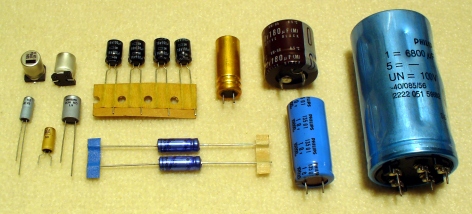
Aluminium electrolytic capacitors are (usually) polarized electrolytic capacitors whose anode electrode (+) is made of a pure aluminium foil with an etched surface. The aluminum forms a very thin insulating layer of aluminium oxide by anodization that acts as the dielectric of the capacitor. A non-solid electrolyte covers the rough surface of the oxide layer, serving in principle as the second electrode (cathode) (-) of the capacitor. A second aluminum foil called "cathode foil" contacts the electrolyte and serves as the electrical connection to the negative terminal of the capacitor.
Aluminium electrolytic capacitors are divided into three subfamilies by electrolyte type:
Aluminum electrolytic capacitors with non-solid electrolyte are the most inexpensive type and also those with widest range of sizes, capacitance and voltage values. They are made with capacitance values from 0.1 μF up to 2,700,000 μF (2.7 F), and voltage ratings ranging from 4 V up to 630 V. The liquid electrolyte provides oxygen for re-forming or "self-healing" of the dielectric oxide layer. However, it can evaporate through a temperature-dependent drying-out process, which causes electrical parameters to drift, limiting the service life time of the capacitors.
Due to their relatively high capacitance values aluminum electrolytic capacitors have low impedance values even at lower frequencies like mains frequency. They are typically used in power supplies, switched-mode power supplies and DC-DC converters for smoothing and buffering rectified DC voltages in many electronic devices as well as in industrial power supplies and frequency converters as DC link capacitors for drives, inverters for photovoltaic, and converters in wind power plants. Special types are used for energy storage, for example in photoflash or strobe applications or for signal coupling in audio applications.
Aluminium electrolytic capacitors are polarized capacitors because of their anodization principle. They can only be operated with DC voltage applied with the correct polarity. Operating the capacitor with the wrong polarity, or with AC voltage, leads to a short circuit which can destroy the component. The exception is the bipolar or non-polar aluminum electrolytic capacitor, which has a back-to-back configuration of two anodes in a single case, and which can be safely used in AC applications.
Electrolytic capacitors use a chemical feature of some special metals, earlier called "valve metals". Applying a positive voltage to the anode material in an electrolytic bath forms an insulating oxide layer with a thickness corresponding to the applied voltage. This oxide layer acts as the dielectric in an electrolytic capacitor. The properties of this aluminum oxide layer compared with tantalum pentoxide dielectric layer are given in the following table:
After forming a dielectric oxide on the rough anode structures, a counter-electrode has to match the rough insulating oxide surface. This is provided by the electrolyte, which acts as the cathode electrode of an electrolytic capacitor. Electrolytes may be "non-solid" (wet, liquid) or "solid". Non-solid electrolytes, as a liquid medium that has an ion conductivity caused by moving ions, are relatively insensitive to voltage spikes or current surges. Solid electrolytes have an electron conductivity, which makes solid electrolytic capacitors sensitive to voltages spikes or current surges.
The anodic generated insulating oxide layer is destroyed if the polarity of the applied voltage changes.
Hub AI
Aluminum electrolytic capacitor AI simulator
(@Aluminum electrolytic capacitor_simulator)
Aluminum electrolytic capacitor
Aluminium electrolytic capacitors are (usually) polarized electrolytic capacitors whose anode electrode (+) is made of a pure aluminium foil with an etched surface. The aluminum forms a very thin insulating layer of aluminium oxide by anodization that acts as the dielectric of the capacitor. A non-solid electrolyte covers the rough surface of the oxide layer, serving in principle as the second electrode (cathode) (-) of the capacitor. A second aluminum foil called "cathode foil" contacts the electrolyte and serves as the electrical connection to the negative terminal of the capacitor.
Aluminium electrolytic capacitors are divided into three subfamilies by electrolyte type:
Aluminum electrolytic capacitors with non-solid electrolyte are the most inexpensive type and also those with widest range of sizes, capacitance and voltage values. They are made with capacitance values from 0.1 μF up to 2,700,000 μF (2.7 F), and voltage ratings ranging from 4 V up to 630 V. The liquid electrolyte provides oxygen for re-forming or "self-healing" of the dielectric oxide layer. However, it can evaporate through a temperature-dependent drying-out process, which causes electrical parameters to drift, limiting the service life time of the capacitors.
Due to their relatively high capacitance values aluminum electrolytic capacitors have low impedance values even at lower frequencies like mains frequency. They are typically used in power supplies, switched-mode power supplies and DC-DC converters for smoothing and buffering rectified DC voltages in many electronic devices as well as in industrial power supplies and frequency converters as DC link capacitors for drives, inverters for photovoltaic, and converters in wind power plants. Special types are used for energy storage, for example in photoflash or strobe applications or for signal coupling in audio applications.
Aluminium electrolytic capacitors are polarized capacitors because of their anodization principle. They can only be operated with DC voltage applied with the correct polarity. Operating the capacitor with the wrong polarity, or with AC voltage, leads to a short circuit which can destroy the component. The exception is the bipolar or non-polar aluminum electrolytic capacitor, which has a back-to-back configuration of two anodes in a single case, and which can be safely used in AC applications.
Electrolytic capacitors use a chemical feature of some special metals, earlier called "valve metals". Applying a positive voltage to the anode material in an electrolytic bath forms an insulating oxide layer with a thickness corresponding to the applied voltage. This oxide layer acts as the dielectric in an electrolytic capacitor. The properties of this aluminum oxide layer compared with tantalum pentoxide dielectric layer are given in the following table:
After forming a dielectric oxide on the rough anode structures, a counter-electrode has to match the rough insulating oxide surface. This is provided by the electrolyte, which acts as the cathode electrode of an electrolytic capacitor. Electrolytes may be "non-solid" (wet, liquid) or "solid". Non-solid electrolytes, as a liquid medium that has an ion conductivity caused by moving ions, are relatively insensitive to voltage spikes or current surges. Solid electrolytes have an electron conductivity, which makes solid electrolytic capacitors sensitive to voltages spikes or current surges.
The anodic generated insulating oxide layer is destroyed if the polarity of the applied voltage changes.
Recent media