Hubbry Logo
American QueenAmerican QueenMain
Open search
American Queen
Community hub
American Queen
logo
8 pages, 0 posts
0 subscribers
Be the first to start a discussion here.
American Queen
American Queen
from Wikipedia
The American Queen
History
United States
NameAmerican Queen
Owner
Port of registryUnited States Memphis, United States
RouteMississippi River and tributaries
BuilderMcDermott Shipyard
CostUS$ 65 million
Laid down1994
Launched1995
Christened
Maiden voyageJune 9, 1995[1]
Out of serviceFebruary 20, 2024[2]
IdentificationIMO number9084542
FateScrapped
General characteristics
Class & typeSteamboat
Tonnage3707
Length418 ft (127 m)
Beam89 ft (27 m)
Height109.5 ft (33.4 m)
Draught8.5 ft (2.6 m)
Decks7 (6 passenger 1 crew)
Installed powerSteam engine and diesel-electric
PropulsionPaddlewheel and Z-drive
Capacity222 staterooms, 436 passengers
Crew160

American Queen was a Louisiana-built river steamship said to be the largest river steamboat ever built.[3] American Queen's primary mode of propulsion is its stern paddlewheel powered by a steam engine extracted from the 1932 dredging vessel Kennedy.[4] Her secondary propulsion, which provides additional maneuverability and speed, comes from a set of diesel-electric propellers known as Z-drives on either side of the sternwheel. There are also two bow thrusters that offer better maneuverability when docking or treading water.[5] She has 222 state rooms for a capacity of 436 guests and a crew of 160. She is 418 feet (127 m) long and 89 feet (27 m) wide.[6]

History

[edit]

Delta Queen Steamboat Company (1994–2011)

[edit]

Construction of the ship began in 1994 by McDermott Shipyard in Morgan City, Louisiana and was completed in mid 1995. The vessel was created for Delta Queen Steamboat Company to be a six-deck recreation of a classic Mississippi riverboat. Upon the arrival of American Queen in New Orleans, Louisiana, the vessel was christened by radio producer Angel Harvey with a 4-foot tall bottle of Tabasco hot sauce rather than a bottle of champagne which is traditionally used in ship christenings.[7] The vessel's maiden voyage set sail from New Orleans on June 2, 1995, bound for Pittsburgh, Pennsylvania. During that same inaugural cruise on June 20, American Queen got stuck in mud during a photoshoot 130 miles downriver from Louisville, Kentucky. Water and fuel were pumped off in order to lighten the vessel and free it from the mud.[8]

In May 1996, American Queen participated in the Summer Olympics torch relay. It was originally planned for the AQ to carry the flame up the Mississippi River from St. Louis, Missouri to the hometown of Mark Twain - Hannibal, Missouri. Due to high water levels on the rivers, American Queen could not reach St. Louis. So instead, the Olympic flame was brought aboard the vessel on the Ohio River in Paducah, Kentucky and stayed onboard until reaching the confluence of the Mississippi and Ohio Rivers at Cairo, Illinois.[9][10]

On June 4, 1997, while docked in Memphis Harbor, passengers aboard the American Queen spotted the body of a man floating near the southern tip of Mud Island and notified the vessel's crew. First mate Dave Williamson retrieved the body to bring to local police which was later identified to be the remains of singer Jeff Buckley.[11][12]

American Classic Voyages, the parent company of Delta Queen Steamboat Company, declared bankruptcy on October 19, 2001. ACV blamed its fate on the September 11 terrorist attacks and the spike in cancelled reservations, although many other factors attributed to the bankruptcy. Despite launching an ambitious expansion, American Classic Voyages faced operational challenges. According to sources close to ACV, the company's successful brands had strayed from what had made them attractive to their niche clientele, ACV's rollout of new cruises was mismanaged and the company had a costly dispute with its shipbuilder, Northrop Grumman Ingalls Shipbuilding.[13][14]

Resulting from the bankruptcy of American Classic Voyages, American Queen was taken out of service in October 2001. Delta Queen Steamboat Co. was subsequently purchased by Delaware North and American Queen was brought back into service in January 2003.[15]

The steam whistle of the American Queen, located in front of the port side bridge wing

Following reports that Delta Queen Steamboat Co. had suffered heavier losses than previously stated from the damages and travel disruption of Hurricane Katrina, Delaware North sold the company to Ambassadors International Inc. in April 2006 for $3 million.[16]

From 2006 to 2008, American Queen and its sister vessels sailed under Majestic America Line, a subsidiary of Ambassadors International. After multiple failed attempts throughout 2008 to sell Majestic America Line, it was decided to break up the fleet and sell the vessels individually.[17]

On November 20, 2008, the steamer American Queen was retired to the reserve fleet in Violet, Louisiana. Due to the failure of Majestic America Line, she was returned to the United States Maritime Administration (MARAD) who held her $30 million mortgage.[5] The U.S. Department of Transportation Maritime Administration records the ship's movement to the Beaumont Reserve Fleet on January 22, 2009.[18]

In April 2011 American Queen was purchased for $15.5 million by HMS Global Maritime of New Albany, Indiana.[19]

American Queen Steamboat Company (2011–2024)

[edit]

In April 2012, HMS Global Maritime relaunched American Queen under a new cruise line, Great American Steamboat Company. The company held a new christening to celebrate the steamboat relocating its home port to Memphis. American Queen was the first passenger vessel to dock at the new Beale Street Landing, built long enough to accommodate the 418-foot long steamboat.[20] Priscilla Presley, named godmother of the American Queen, rechristened the vessel with a bottle of champagne[21][22] before it set sail on its inaugural cruise with its new company, this time without sister vessels Delta Queen which became a floating hotel affixed to shore in Chattanooga, Tennessee, and Mississippi Queen which was scrapped in 2011. The new inaugural cruise departed from Memphis bound for Cincinnati, Ohio. Along the way, American Queen participated for the first time in the Great Steamboat Race.[23] She came in second place. Following a trademark dispute from American Cruise Lines, Great American Steamboat Company changed its name to American Queen Steamboat Company effective July 1, 2012.[24][25]

For a period around 2014, the American Queen Steamboat was a member of Historic Hotels of America, the official program of the National Trust for Historic Preservation.[26]

In October 2014, American Queen struck jagged rock on the Cumberland River on its way into Nashville, Tennessee. Passengers were able to embark on time while repairs were made, although the vessel had to wait for Coast Guard clearance before sailing which came a day later.[27] American Queen suffered another accident during high water conditions on the Mississippi River shortly before midnight on September 4, 2018, when she collided with the old Champ Clark Bridge in Louisiana, Missouri. The vessel sustained some damage to its port side.[28][29]

In the late 2010s, AQSC began rapidly expanding its fleet. The company purchased two abandoned casino boats in 2016 which would later be remodeled and reintroduced as American Duchess and American Countess. In January 2019, AQSC acquired Victory Cruise Lines which consisted of Great Lakes cruise ships, Victory I and Victory II. The two coastal cruisers were reintroduced under AQSC as Ocean Voyager and Ocean Navigator respectively.[30][31][32]

In response to the global outbreak of the COVID-19 virus, American Queen Steamboat Company suspended operations in March 2020. AQSC, along with numerous other cruise lines worldwide would struggle to return to normal operations for the next couple years.[33]

In October 2021, American Queen Steamboat Company changed its name to American Queen Voyages to reflect the addition of ocean-going itineraries. The company's headquarters were relocated from New Albany, Indiana to Fort Lauderdale, Florida.[34][35]

In February 2024 American Queen Voyages announced they were ceasing operations and shutting down.[36] In March 2024, assets of American Queen Voyages were put up for auction. Competitor American Cruise Lines successfully bid for all four of AQV's river vessels. American Queen was purchased for a price of $2.15 million.[37]

Upon the purchase, American Cruise Lines evaluated options for the future of the American Queen other than adding the vessel to their operational fleet or as it was immediately done with sister vessels American Duchess and American Countess, selling it as scrap. In May 2024, they were reported to be contacting cities and towns along the Mississippi River and its tributaries to offer up the 29 year-old vessel as a donation.[38]

In January 2025, footage was released online showing American Queen in the process of being dismantled at a scrapyard in Houma, Louisiana, with all its exterior cabin doors removed. That same winter, another notable and record-setting US-built passenger cruiseliner, SS United States was towed to Alabama to be scuttled and become an artificial reef.[39][40]

Facilities

[edit]

The American Queen had health and wellness facilities that included a spa with masseuse located on main deck and a gym and pool located between the fifth and sixth decks. For dining, the vessel offered formal dining in the J.M. White Dining Room located on main deck and a casual, 24-hour dining option called the Front Porch Cafe located on Deck 3. There was also the River Grill & Bar which was an outdoor bar on Deck 5 that offers drinks and cookout-style food during good weather. There were also several entertainment venues including the Grand Saloon - a stage theater modeled after Ford's Theatre. Other entertainment options included a movie theater on Deck 3, musical performances in the Engine Room Bar on Deck 2 and numerous card games and reading materials in the Gentlemen's Card Room, Ladies' Parlor, Mark Twain Gallery and Chart Room.[41]

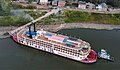
An aerial view of American Queen's upper decks 4, 5 and 6. The bridge deck and pilot house are located just aft of the smoke stacks.

Themed voyages

[edit]

American Queen passengers experience themed voyages with special appearances by various performers and lecturers, such as Lewis Hankins as Mark Twain. The Civil War themed voyage includes historians as guest speakers, and the Twain cruise features Cindy Lovell and other Twain scholars.[42][43]

Routes

[edit]

The American Queen cruised the Mississippi River from its mouth to as far north as St. Paul, Minnesota. She also traveled the entire length of the Ohio River, the Tennessee River as far up as Chattanooga, Tennessee, the Cumberland River as far up as Nashville, Tennessee and the Illinois River as far up as Ottawa, Illinois. In addition to these rivers, the American Queen entered the Yazoo Diversion Canal when visiting Vicksburg, Mississippi, Lake Ferguson when visiting Greenville, Mississippi and the Allegheny River when visiting Pittsburgh, Pennsylvania.[44] The riverboat has also traversed the Gulf of Mexico in order to reach maintenance and repair facilities in Morgan City, Louisiana and Beaumont, Texas.[45]

Media appearances

[edit]

In 2007, American Queen was the subject of an episode of the Discovery Channel TV series Superships.[46]

In 2009, American Queen was featured in an episode of Little People, Big World in which the Roloff family took a cruise aboard the vessel.[47]

In 2018, American Queen was featured in an episode of Cruising with Jane McDonald. The show followed British singer Jane McDonald on a cruise aboard the American Queen from New Orleans to Memphis.[48]

See also

[edit]

References

[edit]
[edit]
Revisions and contributorsEdit on WikipediaRead on Wikipedia
from Grokipedia
The American Queen was the largest paddlewheel ever built, a six-deck luxury river vessel launched in 1995 that offered overnight cruises along major U.S. waterways, primarily the and its tributaries. Measuring 418 feet (127 meters) in length and 89 feet (27 meters) in width, it accommodated up to 436 passengers and 160 crew members, featuring authentic propulsion via engines salvaged from a U.S. of Engineers dredge. Constructed by McDermott Shipyard in Morgan City, Louisiana, at a cost of approximately $65 million, the American Queen was originally commissioned by the Delta Queen Steamboat Company as a modern tribute to 19th-century riverboats. It entered service in June 1995 with inaugural voyages from New Orleans, quickly becoming renowned for its opulent Victorian-era design, including a steam calliope with 37 gold-plated brass pipes used for port departures and arrivals. Over its operational life, the vessel sailed itineraries on the Mississippi, Ohio, Cumberland, Tennessee, and even the Columbia and Snake rivers in the Pacific Northwest, emphasizing regional American history, cuisine, and entertainment. The ship's interiors highlighted period elegance with venues such as the two-story J.M. White —named after a historic steamboat—offering gourmet regional fare, the Gallery library, a theater for lectures and performances, and outdoor spaces including a sundeck pool and the Front Porch Café. Staterooms ranged from cozy inside cabins to suites with verandas, all updated during a 2013 refurbishment that added modern amenities like flat-screen TVs while preserving the nostalgic aesthetic. Following changes in ownership—including stints with Majestic America Line (2006–2008) and the U.S. Maritime Administration (2008–2011)—entrepreneur John Waggoner acquired the American Queen in 2011 to establish the American Queen Steamboat Company, which expanded the fleet and rebranded as American Queen Voyages in 2021. However, the company abruptly ceased operations on February 20, 2024, canceling all future sailings amid financial challenges. In November 2024, American Cruise Lines purchased the American Queen and three other vessels from the defunct fleet. As of November 2025, the vessel remains laid up at Bollinger Shipyards in Houma, Louisiana, with no plans for reactivation announced, and its long-term fate under evaluation by American Cruise Lines.

Design and Construction

Specifications and Features

The American Queen measures 418 feet (127 meters) in length and 89 feet (27 meters) in width, making it the largest ever constructed. Its paddlewheel has a diameter of 28 feet (8.5 meters), contributing to its distinctive while providing auxiliary thrust. The vessel spans six decks, including four dedicated to passengers and an below, all built on a hull designed for durability on inland waterways. In terms of capacity, the American Queen accommodates up to 436 passengers across 222 staterooms, supported by a of 160 members to ensure smooth operations. Propulsion is primarily handled by twin diesel-electric systems, each delivering 1,500 horsepower for a total of 3,000 horsepower, enabling reliable navigation on rivers like the . The paddlewheel, powered by a originally from the 1932 dredging vessel Kennedy and fueled by a diesel-fired , adds authentic motion and visual appeal without serving as the main drive. The ship's design evokes Victorian-era aesthetics, featuring ornate gingerbread trim, multi-tiered decks with railings, and a steam organ with 37 gold-plated brass pipes for traditional performances during departures. These elements blend historical charm with modern engineering, including advanced navigation systems such as and GPS integrated into the pilothouse. As a U.S. Coast Guard-inspected small passenger vessel, the American Queen meets stringent safety standards for stability, , and life-saving equipment, allowing it to operate year-round on U.S. inland routes.

Building and Launch

The American Queen was commissioned by the Steamboat Company in the early as part of an effort to expand its fleet and revive paddlewheeler cruising on the , following the company's acquisition of the bankrupt American Global Line in 1993 and subsequent rebranding to American Classic Voyages in 1994. The project sought to construct the largest overnight passenger in history, drawing inspiration from 19th-century vessels like the Natchez to evoke the grandeur of the steamboat era while adhering to modern maritime safety and propulsion standards. The design integrated traditional aesthetic elements, such as a prominent paddlewheel and multi-deck reminiscent of Victorian-era riverboats, with diesel-electric power systems to ensure efficiency and reliability. Construction took place at the McDermott Shipyard in , beginning with in 1994 and reaching completion in mid-1995 after approximately one year of intensive work involving over 500 American workers. The yard, known for its expertise in fabricating complex marine structures, assembled the 418-foot vessel using steel hull construction and salvaged steam engines from the U.S. of Engineers dredge Kennedy to power the auxiliary paddlewheel, blending historical authenticity with practical . The total cost of the project was approximately $65 million, reflecting the ambitious scale and opulent detailing intended to position the American Queen as a for luxury river travel. The vessel was launched on June 2, 1995, in New Orleans, where it was christened by radio producer Angel Harvey using a four-foot-tall bottle of hot sauce in place of traditional champagne, a nod to Louisiana's culinary heritage and the ship's regional ties. This event marked the culmination of the build process and highlighted the ship's role in preserving traditions. The maiden voyage departed from New Orleans later that month, initiating public excursions and setting the stage for the American Queen's entry into commercial service.

Operational History

Service with Delta Queen Steamboat Company (1994–2011)

The American Queen entered service as the flagship vessel of the Steamboat Company, a of American Classic Voyages that also operated the historic paddlewheelers and on America's inland rivers. Constructed at a cost of approximately $65 million, the was designed to revive and expand overnight river cruising, accommodating up to 436 passengers in a fleet that emphasized authentic Victorian-era and steam-powered . The vessel's inaugural season began in June 1995 with a 16-night voyage from , to New Orleans, Louisiana, navigating the and s and marking first-time dockings at several historic ports including , and . Subsequent itineraries focused primarily on the full length of the , with round-trip cruises from New Orleans to St. Paul, Minnesota, lasting 14 to 21 days, alongside shorter extensions into the and Rivers for regional explorations. These routes highlighted the vessel's ability to traverse locks and shallow drafts, drawing passengers interested in the cultural and historical landmarks along the waterways. Under Delta Queen ownership, the American Queen introduced innovations such as flexible hop-on/hop-off port access via complimentary shuttles, allowing guests greater independence to explore stops at their leisure, which enhanced passenger satisfaction and repeat bookings. Early themed events, including cruises featuring live performances in the Grand Saloon, added to the onboard entertainment and appealed to music enthusiasts traveling the river's musical heritage routes. The steamboat's operations complied with U.S. inspections tailored for traditional paddlewheelers, ensuring safe navigation while preserving its heritage. Bookings grew steadily from 1995 to 2000 as the American Queen established itself as a premier option, benefiting from positive word-of-mouth and media coverage of its luxurious appointments and scenic voyages. By the early 2000s, the vessel had carried tens of thousands of passengers annually, contributing to the company's expansion before financial challenges emerged. The period of service under the Delta Queen Steamboat Company umbrella concluded amid parent company American Classic Voyages' Chapter 11 filing in October 2001, exacerbated by a sharp decline in reservations following the . Assets, including the American Queen, were acquired by Companies in 2002, which maintained operations under the Delta Queen brand until selling the fleet to Majestic America Line in 2006. Majestic continued sailings until its own in 2008, after which the American Queen was transferred to the U.S. Maritime Administration and laid up in reserve until its 2011 reactivation under new ownership.

Ownership under American Queen Steamboat Company (2011–2021)

In 2011, HMS Global Maritime, a of the Hornblower Group, acquired the from the U.S. Maritime Administration for $15.5 million, forming the Great American Steamboat Company to operate the vessel. The company underwent a $6.5 million refurbishment, including updates to staterooms, dining areas, and entertainment spaces, before relaunching service in April 2012 with expanded itineraries along the , , , and Rivers. In August 2012, the operator rebranded as the American Queen Steamboat Company to better reflect its focus on the vessel and paddlewheel heritage. Under this ownership, the company significantly expanded operations, increasing the number of sailings on the Upper and Lower , , , and Rivers to meet growing demand for domestic river cruising. A key milestone came in 2014 with the acquisition and refurbishment of the former Empress of the North, renamed American Empress, which debuted that April to serve routes on the Columbia and Snake Rivers in the , broadening the fleet to three vessels. These expansions supported a surge in popularity, culminating in record passenger volumes in as the company carried tens of thousands of guests annually across its routes. The period was not without challenges, including the severe Mississippi River flooding in spring 2011, which delayed initial planning and refit preparations for the vessel's return to service. To address environmental concerns, the company implemented eco-friendly initiatives such as food waste compaction and dehydration systems on select ships, reducing liquid waste by nearly 1,250 gallons during the 2019 season, alongside hydration stations to minimize single-use plastics. Marketing efforts shifted toward positioning the cruises as luxury heritage experiences, highlighting the paddlewheelers' historical ambiance and immersive storytelling of American river culture. This included partnerships with the starting in 2013, providing passengers access to exclusive tours at sites along itineraries, such as historic ports on the and Rivers. The onset of the COVID-19 pandemic led to a full suspension of operations across the fleet beginning in March 2020, affecting all scheduled sailings through the year. Partial resumption occurred in August 2021 with enhanced health protocols, including mandatory vaccinations and limited-capacity voyages on the American Queen and other ships, marking a cautious return amid ongoing restrictions.

Rebranding and Expansion as American Queen Voyages (2021–2024)

In September 2021, American Queen Steamboat Company and Victory Cruise Lines merged under the unified brand American Queen Voyages, expanding the portfolio to include river cruises, Great Lakes voyages, and expedition itineraries while integrating Victory's small-ship assets for coastal and ocean operations. The rebranding facilitated fleet diversification, with the introduction of ocean-capable vessels such as the 186-passenger Ocean Victory, which debuted its inaugural expedition season in May 2022 after a COVID-related delay. New routes emerged on the Columbia and Rivers using the paddlewheeler American Empress, offering scenic journeys through gorges and historic sites, alongside Great Lakes sailings on the Ocean Navigator and Ocean Voyager that explored ports from to . Operations peaked in 2022 and 2023, with sailings resuming across the , , and expanded routes under enhanced post-COVID health protocols known as SafeCruise, including initial requirements for guest and crew vaccinations, rigorous cleaning, and onboard medical staffing, though pre-cruise testing was later eliminated. Themed voyages resurged during this period, featuring culinary-focused cruises with guest chefs, music festivals highlighting American genres like and , and educational enrichments such as Lakelorian lectures on history. Financial challenges mounted in late 2023 amid low bookings and operational strains, leading to cancellations of select itineraries and the suspension of sales for 2024 and 2025 voyages by November. On February 20, 2024, American Queen Voyages officially ceased all operations, filing for Chapter 11 bankruptcy protection the following day, which resulted in the cancellation of all remaining and future bookings, including those for 2024.

Acquisition by American Cruise Lines and Current Status (2024–present)

In April 2024, the assets of the bankrupt American Queen Voyages, including its four paddlewheel vessels, were auctioned off in a court-approved sale. American Cruise Lines (ACL) acquired the American Queen, American Empress, American Countess, and American Duchess for a total of $6.3 million, marking ACL's entry into ownership of these historic riverboats. Shortly after the acquisition, in May 2024, the American Queen was relocated to a in , for structural evaluation and assessment of potential reuse. The vessel arrived at on May 21, where it underwent initial assessments. By contrast, its sister ships American Countess and American Duchess were deemed uneconomical due to severe plumbing issues and were scrapped later that month. The American Empress was also evaluated but remains non-operational with no announced plans for reactivation or alternative use as of November 2025. Following evaluations, including an unsuccessful offer to donate the vessel to cities along the Mississippi River in May 2024, the American Queen was dismantled and scrapped at the Houma shipyard beginning in January 2025. As of November 2025, no remnants of the vessel are preserved, ending its legacy as the largest paddlewheel steamboat ever built. Meanwhile, ACL is expanding its Mississippi River operations using its existing modern fleet, including new 2025 itineraries aboard ships like American Symphony and American Melody. In the bankruptcy proceedings, passenger refunds for canceled voyages were processed through a dedicated claims portal and the company's required surety bond, ensuring affected customers could recover payments.

Facilities and Amenities

Prior to its scrapping in early 2025, the American Queen featured the following facilities and amenities.

Passenger Cabins and Suites

The American Queen featured 222 staterooms distributed across six passenger decks, accommodating up to 436 guests. These included 16 suites, such as the Owner's Suites (400 square feet) and various suites (350–500 square feet), 112 deluxe outside cabins like superior open and deluxe categories (210–300 square feet), and additional interior options ranging from 130 to 140 square feet. Interior staterooms provided cozy accommodations for budget-conscious travelers, while outside cabins offered views through picture windows or open verandas. Staterooms and suites emphasized historical Victorian styling with polished wood paneling, brass accents, traditional color schemes, and framed steamboat-era artwork to evoke the vessel's paddlewheel heritage. Amenities included queen or twin beds with luxury linens, flat-screen televisions, complimentary , bottled water, and private bathrooms equipped with showers or tub/shower combinations, toiletries, hairdryers, and ample electrical outlets. Suites provided additional sitting areas, verandas for outdoor access, and enhanced space for relaxation, while all cabins featured , safes, and availability. Cabin sizes averaged 150–300 square feet, with accessibility options including several ADA-compliant rooms featuring roll-in showers, wider doorways, and grab bars to ensure compliance with U.S. standards for passengers with disabilities. During renovations in the 2010s, including updates around 2014 and 2019, modern enhancements such as improved electrical systems, updated bathrooms, and refreshed furnishings were incorporated while preserving the aesthetic integrity of the original design. Pricing for accommodations was all-inclusive, covering stateroom occupancy, meals, and select onboard services, with standard rooms lacking private balconies due to the traditional structure that prioritized open deck access over enclosed outdoor spaces.

Public Spaces and Entertainment

The American Queen featured several communal public spaces designed to evoke the opulent Victorian-era steamboats of the , providing venues for socializing, relaxation, and enrichment activities. The centerpiece was the two-level Grand Salon, a majestic ballroom and theater spanning Decks 2 and 3, inspired by historic vessels and modeled after in . This space hosted nightly , including Broadway-style musical revues, cabaret acts, and performances by onboard historians delivering lectures on river lore and regional . Adjacent lounges offered quieter retreats for guests, such as the Gallery on Deck 3, an elegant library and reading room furnished with plush seating, books on and history, and large windows overlooking the Grand Salon below. The Engine Room Bar on Deck 1 provided a themed ambiance with views into the actual engine room and paddlewheel operations, serving as a lively spot for live , , , and bluegrass performances by resident musicians. Additional areas included the Chart Room for navigational exhibits and the Ladies' Parlor for afternoon tea and card games, all adorned with period antiques and artwork highlighting the era. Entertainment extended beyond the main venues with unique features like the on Deck 5, a steam-powered organ that played traditional melodies during sail-aways, and dedicated viewing areas at the for observing the massive paddlewheel in action. The Deck (also known as the Sun Deck) housed a fitness center equipped with exercise machines, a for relaxation, and a offering massages and wellness treatments. These spaces accommodated the vessel's capacity of up to 436 passengers, with daily schedules featuring river talks, live music sets, and interactive sessions to foster a during voyages. In , the American Queen underwent significant electrical upgrades, including renewal of the main switchboard, which enhanced audiovisual capabilities in public areas like the Grand Salon to support modern presentations while preserving the heritage aesthetic. These improvements allowed for high-quality video projections during enrichment lectures and performances without compromising the ship's classic design.

Dining Options and Services

The American Queen provided all-inclusive dining options emphasizing regionally inspired , drawing from local flavors and ingredients along its river routes, such as Southern dishes like beignets and Creole-inspired soups on itineraries. Meals incorporated fresh, sustainable produce sourced from nearby ports to highlight cultural and historical ties to the regions visited. The culinary program accommodated various dietary needs, including vegetarian, gluten-free, and low-sodium options, prepared by onboard chefs upon request. The primary dining venue was the J.M. White Dining Room, a formal sit-down space offering breakfast, lunch, and dinner in an elegant setting with attentive, white-glove service. Breakfast and lunch featured open seating for flexibility, while dinner operated on two assigned seatings to ensure personalized attention. Complementing this was the casual Front Porch Café on the Deck, which served buffet-style meals and snacks in a relaxed, atmosphere. Three full meals were provided daily, supplemented by complimentary snacks like fresh fruit, baked goods, , and available throughout the day. Beverages were fully included in the fare, encompassing non-alcoholic options such as soft drinks, coffee, tea, and bottled water, as well as alcoholic selections like beer, wine, and spirits served during meals and at evening cocktail hours. Special features enhanced the experience, including a traditional high tea service in the Main Deck Lounge with finger sandwiches, cakes, and cookies each afternoon. Guests could also participate in chef-led cooking demonstrations, where the executive culinary team shared recipes and techniques inspired by regional specialties. With a crew of 160 supporting 436 passengers, the staff-to-guest ratio of approximately 1:2.7 enabled highly personalized service across all dining operations.

Itineraries and Experiences

Prior to the cessation of operations in February 2024, the American Queen offered a range of itineraries and experiences along major U.S. rivers.

Primary River Routes

The American Queen's primary river routes centered on the , encompassing both its upper and lower segments, with extensions into the , , and Rivers. The Upper Mississippi itinerary typically ran from , , to St. Paul, Minnesota, spanning 9 days and 8 nights, and featured stops at historic river towns such as —the boyhood home of , where passengers could explore sites inspiring works like and . These voyages highlighted the region's unspoiled landscapes, wildlife viewing, and engineering feats like locks and dams, offering a journey through Midwestern heartland geography. In contrast, the Lower Mississippi route operated from , to New Orleans, Louisiana (or reverse), also lasting 9 days and 8 nights, and passed through key ports including , site of the pivotal Civil War battlefield where Union forces besieged Confederate troops in 1863. Other notable stops included Natchez and Baton Rouge, providing access to antebellum plantations and Southern cultural landmarks. This segment emphasized the river's role in American history, from commerce to Civil Rights-era narratives. Longer combined itineraries, such as the 23-night Complete Mississippi voyage, connected these upper and lower paths for a comprehensive traversal from St. Paul to New Orleans. Extensions into the Ohio River included routes from , to —at the confluence with the —often as part of 9- to 16-day sailings that incorporated segments to , or . These paths traversed industrial heritage sites and Appalachian foothills, with ports like , and , showcasing early American settlement. On the and Rivers, itineraries such as the 9-day Music Cities cruise linked Memphis to Nashville via the , while the Tennessee Rivers voyage ran from Chattanooga to Nashville, exploring musical legacies and Civil War heritage along verdant valleys. Seasonal patterns dictated route availability, with Upper Mississippi sailings peaking in summer for optimal weather and foliage, running from May to October, while Lower Mississippi operations occurred year-round, including holiday-themed departures in November and December. Tennessee and Cumberland routes concentrated in spring through fall, typically July to September. Post-2021, under American Queen Voyages, occasional itineraries extended to the Columbia and Snake Rivers in the Pacific Northwest, such as 8-night voyages from Portland, Oregon, to Clarkston, Washington, focusing on Lewis and Clark expedition sites and Columbia Gorge scenery. Voyage durations generally ranged from 7 to 23 nights, with multiple departures scheduled annually across these routes to accommodate varying passenger interests. The ship's design supported flexible port calls, allowing passengers to join or disembark at select stops for customized travel, though full itineraries were recommended for the complete experience.

Themed and Special Voyages

The American Queen offered a range of themed and special voyages that augmented its primary river routes with curated programming, including onboard lectures, performances, and excursions focused on , music, and regional culture. These voyages typically spanned 7 to 10 days, blending thematic content seamlessly into standard itineraries along the , , and Rivers, often with opportunities for hop-on-hop-off bus tours at ports. Music-themed sailings, such as the Music of America cruises, featured live performances by jazz bands and regional artists, emphasizing the Delta blues and other American genres through nightly entertainment and enrichment sessions. Civil War history voyages incorporated distinguished guest lecturers and tribute artists who delivered educational talks on the conflict's origins and riverine significance, alongside dramatic recreations of key figures; a representative 9-day itinerary ran from New Orleans to Memphis, with stops at battlefields like Shiloh. Culinary-focused tours highlighted Southern specialties, including barbecue experiences on Tennessee River segments, where passengers enjoyed regionally inspired meals and demonstrations that showcased local grilling traditions and ingredients. Holiday voyages for and transformed the ship with festive decorations, traditional feasts like roasted and Southern sides, and special events such as bonfires, performances, and visits to illuminated Christmas Markets in Natchez. Special guests enhanced these sailings, including historians and the onboard Riverlorian who presented lectures on topics like Civil War events and river ecology, as well as performers such as impersonators for literary-themed departures that included stops in . Premium elements, such as exclusive excursions or performances, may have incurred additional fees beyond the base fare. Themed voyages proved particularly popular, drawing enthusiasts for their immersive blend of education and entertainment on the historic paddlewheeler.

Cultural Significance and Media

Notable Appearances in Media

The American Queen has been prominently featured in several television documentaries and episodes, highlighting its status as the largest paddlewheel ever built. In , it was the subject of the episode "First Lady of the Mississippi: The American Queen" in the series Superships, which explored the vessel's design, operations, and role in modern river cruising along the . The ship also appeared in the 2009 episode "Roloffs on the River" of TLC's , where the Roloff family embarked on a cruise aboard the American Queen, showcasing family dynamics amid the steamboat's historic ambiance. Additionally, in 2018, British entertainer sailed on the American Queen for the Channel 5 series Cruising with Jane McDonald: Mississippi, an episode that documented her journey from New Orleans to Memphis, emphasizing the ship's luxurious interiors and riverfront entertainment. In print media, the American Queen has received extensive coverage, particularly around key milestones. Its 1995 maiden voyage garnered national attention, with The New York Times reporting on the launch challenges, including the steamboat becoming mired in Ohio River mud during inaugural trials, underscoring the engineering feats of its 418-foot length and steam-powered paddlewheel. Similarly, The Morning Call profiled the vessel's debut as the "ultimate steamboat," detailing its capacity for 436 passengers and recreation of 19th-century riverboat elegance before its first 16-night cruise from . Following its 2011 acquisition and 2012 relaunch by the Great American Steamboat Company, The New York Times featured a review of a weeklong cruise, praising the ship's restoration and its revival of authentic steamboat cruising traditions. Promotional media has further amplified the ship's iconic image through official videos produced by the American Queen Steamboat Company. These include high-production ship tours and itinerary previews shared on YouTube, such as the 2017 commercial showcasing the vessel's Victorian-style decor and river voyages, which contributed to broader awareness of themed cruises like music and culinary expeditions. Culturally, the American Queen symbolizes the revival of paddlewheel steamboating in American tourism, often referenced in narratives celebrating the Mississippi's heritage. It has been utilized in advertisements promoting Mississippi River tourism, including company-sponsored spots that highlight its role in experiential travel along historic waterways. Media interest peaked during the 1995 launch with widespread wire service stories on its innovative build, and again in 2011–2012 amid relaunch announcements, reflecting renewed enthusiasm for U.S. river cruising.

Legacy and Preservation Efforts

The American Queen significantly revived interest in paddlewheeler tourism upon its 1995 launch, serving as the largest steamboat ever built and offering passengers an immersive experience of 19th-century river travel on the Mississippi, Ohio, and other U.S. waterways. By emulating the grandeur of historic vessels while incorporating modern amenities, it helped sustain and expand the tradition of overnight river cruises, drawing enthusiasts to ports along these routes for nearly three decades. This resurgence not only preserved maritime heritage but also inspired the expansion of contemporary river cruise operations. The ship's voyages generated substantial economic benefits for river communities, with tourism from Mississippi River paddlewheelers contributing over $100 million annually to the lower Mississippi region by 2022 through passenger spending on lodging, dining, and local attractions. In Memphis alone, such cruises supported an estimated $100 million in yearly economic impact and filled 20,000 hotel room nights prior to 2024. The American Queen Steamboat Company received notable recognition for its contributions, earning the title of Best River Cruise in Travel + Leisure's 2021 World's Best Awards based on reader surveys praising its authentic itineraries and onboard experiences. Following American Queen Voyages' abrupt halt of operations in February 2024, the vessel was acquired by in November 2024, which scrapped its sister ships American Countess and American Duchess amid fleet modernization efforts. Preservation initiatives emerged to avert a similar fate for the American Queen, with advocates from the Historical Society of America proposing options such as conversion, static display as a heritage attraction, or stationary entertainment venue to highlight its role in American river . These efforts underscored the challenges of maritime preservation, including high costs and logistical hurdles, as the ship was transported to a shipyard in , for evaluation. By January 2025, reports indicated the American Queen was being dismantled in the facility, stripping its interiors. Despite community advocacy for heritage site designation, the vessel was ultimately scrapped later that year. Local stakeholders in pushed for interventions to repurpose remnants or artifacts, emphasizing the ship's educational value in illustrating U.S. riverine culture and commerce. The situation drew parallels to the preserved , a since 1989, which in June 2025 was offered for sale by its owners to secure a future in public access, potentially as a floating or educational program on history; as of November 2025, it remains unsold with ongoing preservation efforts.

References

Add your contribution
Related Hubs
User Avatar
No comments yet.