Hubbry Logo
Delaware NorthDelaware NorthMain
Open search
Delaware North
Community hub
Delaware North
logo
8 pages, 0 posts
0 subscribers
Be the first to start a discussion here.
Delaware North
Delaware North
from Wikipedia

Delaware North is an American multinational food service and hospitality company headquartered in Buffalo, New York.[1] The company also operates in the lodging, sporting, airport, gambling, and entertainment industries. The company employs over 55,000 people worldwide and has over $3.2 billion in annual revenues.[2]

Key Information

History

[edit]

Delaware North began as Jacobs Brothers, founded in Buffalo, New York, in 1915 by brothers Marvin, Charles and Louis Jacobs.[3] Its name was changed first to Emprise Corp. and then to Sportsystems Inc. before adopting its current name in 1980.[4] The company remains family-owned and operated by Jeremy Jacobs, who also owns the Boston Bruins. The arena in which the Bruins play, the TD Garden, is owned by Delaware North. Jacobs is also a member of the U.S. Department of Commerce Travel and Tourism Board.

Jacobs Brothers initially operated theater concessions. When the establishments closed down in the hot summer months, the three men turned their attention to ballparks, the first being Offermann Stadium, and the creation of the sports concession industry. Sportservice was created in 1926 following contracts with minor-league ballparks in Buffalo and Syracuse, New York. Sportservice is Delaware North's largest operating company. In 1930, the company entered into its first major-league deal by signing an agreement with the Detroit Tigers to handle food service at Navin Field. The Jacobs brothers expanded their business in 1939 by acquiring a racetrack, marking the beginning of Delaware North Companies Gaming & Entertainment. In 1941, the company entered the airport arena with a contract to provide food service in Washington National Airport. Delaware North Companies Travel Hospitality Services operates in more than 30 major airports worldwide.

Upon the death of his father, founder Louis M. Jacobs in 1968, Jeremy M. Jacobs began leading the company, then called Emprise, at the age of 28. The years that followed were characterized by unprecedented growth and diversification. In 1972, after negative press over alleged connections to organized crime in Sports Illustrated and the Arizona Republic, the Emprise company was convicted of federal racketeering charges over the purchase of the Frontier Hotel in Las Vegas with members of the Mob. Jeremy dissolved Emprise and reorganized his family's holdings under a new company, Delaware North (named after the intersection of Delaware Avenue and North Street in Buffalo where the company was headquartered at the time), with a public emphasis on operating a clean, separate organization with no connection to Emprise.[5][6][7] Delaware North acquired the Boston Garden in 1975 while Jeremy Jacobs purchased the Boston Bruins, one of the original six franchises of the National Hockey League. In 1987, the company acquired Sky Chefs,[8][9] (now LSG Sky Chefs) a move that bolstered its airport business. The company obtained the contract to provide visitor services in Yosemite National Park in 1993.[10] under the terms of the largest concessions contract in the U.S. National Park Service. The award sowed the seeds of a new line of business: Delaware North Companies Parks & Resorts.

In 1995, Delaware North won the contract to run the Kennedy Space Center Visitor Complex. In the late 1990s, the company worked toward becoming the largest racino operator in North America by adding gambling to some of its racetrack properties. The company moved its World Headquarters from the Main Court Building to 40 Fountain Plaza in 1999.

The company became the first U.S. hospitality company in the world to have its GreenPath environmental management system registered to the guidelines put forth by the International Organization for Standardization (ISO 14001) in 1991. In the early 2000s, the company became a hotel owner by purchasing Tenaya Lodge at the entrance to Yosemite and Harrison Hot Springs Resort & Spa in British Columbia, and by building a hotel at its gambling and racing destination resort in Wheeling, West Virginia. 2004 saw the company beginning GuestPath, its companywide continuous improvement process. The company entered the European market with a contract at Wembley Stadium, followed by one at Emirates Stadium in 2006 and 2007. In 2008, the company signed a 10-year contract at Pride Park Stadium, Derby.

In 2008/2009, Delaware North got a contract to operate a 4,500 slot machine racino at Aqueduct Racetrack in Queens, New York. It lost the contract in 2009 when it could not make a $370 million upfront payment to the state of New York. The company was hired by Garrison Investments in 2009 to operate the RMS Queen Mary in Long Beach, California. This partnership ended in April 2011. In 2010, the company acquired Jumer's Casino & Hotel located in Rock Island, Illinois. Thereafter, the company entered the European travel hospitality market opening outlets at Gatwick, Heathrow, and Edinburgh Airports, and the Euston Railway Station. It also acquired the Australian Resorts at Lizard Island, Heron Island, and Wilson Island on the Great Barrier Reef and King's Canyon in the Red Centre of Australia.

In 2014, Delaware North launched a new global brand identity as the company prepared to celebrate its 100th anniversary in 2015. The company is now known just as "Delaware North" – no longer as "Delaware North Companies" – and ended the use of the abbreviation "DNC" in its logo.

The majority of its operating companies, which previously had been identified as "Delaware North Companies Parks & Resorts," for example, are now called "Delaware North." The only exceptions are Delaware North Sportservice – given its historical importance as the company's original operating company and brand recognition in the sports industry – and Delaware North's most recent acquisition, Patina Restaurant Group.[11]

In 2014, Delaware North issued a letter to the U.S. National Park Service, asserting various intellectual property rights, including such names as Ahwahnee, Curry Village, Wawona and other historic names it acquired when it purchased the Yosemite Park & Curry Company in 1993 with NPS approval. The letter estimated the value of those names at $51 million,[12] while NPS estimated it at $3.5 million. A breach of contract lawsuit to determine their value was resolved in July 2019 with Delaware North receiving a $12 million settlement, the majority of which was paid by new Yosemite concessionaire Aramark, and the original place names being restored by NPS and Aramark.

On January 6, 2015, Delaware North Chairman Jeremy Jacobs relinquished the title of CEO and named Jerry Jacobs Jr. and Louis Jacobs Co-CEO's. He also named Charlie Jacobs CEO of Delaware North's Boston Holdings.[13]

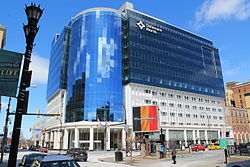
In 2015, Delaware North moved its corporate offices to the Delaware North Building in Buffalo, returning the company's headquarters to the namesake avenue after nearly 25 years.[14]

In November 2018, Delaware North announced it was purchasing the SkyCity Darwin casino in Australia from the SkyCity Entertainment Group for A$188 million.[15] The casino was renamed the Mindil Beach Casino & Resort in April 2019.[16]

Operating divisions

[edit]

Sportservice

[edit]

Delaware North Companies Sportservice provides concessions, premium dining, catering and retail services to sporting and entertainment venues in the United States and Canada. The company operates at over 50 venues including the homes of such franchises as the San Diego Padres, Baltimore Orioles, Green Bay Packers, Milwaukee Brewers, St. Louis Cardinals, Cleveland Guardians, Cincinnati Reds, Detroit Tigers, Minnesota Twins, Buffalo Bills, Chicago White Sox, Columbus Blue Jackets, and Chicago Bears. Sportservice has been recognized for its culinary advances and PETA approved menus.[17] Sportservice is the company responsible for the creation of Secret Stadium Sauce, a popular condiment mostly associated with Milwaukee. [dead link][18]

Gambling and entertainment

[edit]

Delaware North Companies Gaming & Entertainment is a gambling and racing operations company that focuses on racing venues that offer video gambling machines, poker rooms, table games, restaurants, retail shops and hotels. The company operates more than 10,000 video gambling machines in such places as New York, Arizona, Florida, New Hampshire, Illinois and West Virginia. Venues include:

DNC International

[edit]

Delaware North Companies International provides food service and hospitality to international sporting and entertainment venues including Wembley Stadium,[19] Emirates Stadium, Ricoh Arena, Pride Park Stadium[20] and the Australian Open tennis tournament.[21]

Parks and resorts

[edit]

Delaware North Companies Parks & Resorts was founded in 1992 following the company's winning bid for primary concessions at Yosemite National Park.[22] The company now operates at other venues including Grand Canyon (one of two concessionaires[23][24]), Niagara Falls State Park, Kennedy Space Center Visitor Complex, Shenandoah National Park,[25] and Gideon Putnam Resort (among others).

Patina Restaurant Group

[edit]

In February 2014, Delaware North announced it would acquire a majority stake in Patina Restaurant Group (PRG), one of the nation's leading multi-concept operator in the premium segments of the restaurant and catering industry.[26] PRG has operations at landmark locations in high-profile cultural and entertainment venues in New York City, California, and Orlando, Fla. Among them are: Rockefeller Center, Lincoln Center, Walt Disney World, Disneyland, Walt Disney Concert Hall, the Empire State Building, Grand Central Terminal/MetLife Building and Madison Square Garden. Patina is also the official caterer for the Creative Arts Ball and the Emmy Awards Governors Ball.[27]

Travel hospitality services

[edit]

Delaware North Companies Travel Hospitality Services operates food, beverage and retail at airports and toll plazas throughout the United States. The company operates at venues such as Los Angeles International Airport, Minneapolis-St Paul International Airport, Nashville International Airport, Buffalo Niagara International Airport, and the Detroit Metro Airport. The company recently opened the first-ever Sports Illustrated retail store[28] at Detroit Metro Airport's new North Terminal.[29] In September 2008, Delaware North also recently unveiled uWink technology which helps make it easier for international travelers at Ft. Lauderdale Airport.[30]

TD Garden

[edit]

Delaware North Companies Boston owns TD Garden, the home arena for the Boston Bruins hockey team and Boston Celtics basketball team. Jeremy Jacobs, Chairman of Delaware North, also owns the Bruins. TD Garden is the site of the annual Beanpot college hockey tournament, and hosts the annual Hockey East Championships. The arena has also hosted many major national sporting events including the 1999 and 2003 NCAA Division I Men's Basketball regional first and second rounds, the 2009 and 2012 Sweet Sixteen and Elite Eight, the 1998 Frozen Four, the 2004 Frozen Four, the 2014 United States Figure Skating Championships, the 2006 women's Final Four, and the 2015 Frozen Four. It hosted games 3, 4, and 6 of the 2011 Stanley Cup Finals, also games 3, 4, and 6 of the 2013 Stanley Cup Finals and games 1, 2, 5, and 7 of the 2019 Stanley Cup Finals for the Bruins, and games 1, 2, and 6 of the 2008 NBA Finals, games 3, 4, and 5 of the 2010 NBA Finals, games 3, 4, and 6 of the 2022 NBA Finals, and games 1, 2, and 5 of the 2024 NBA Finals for the Celtics.

Controversies

[edit]

Yosemite National Park

[edit]

Delaware North Companies, having lost the contract to run the concessions at Yosemite to Aramark in 2015, claimed that the names of many historic sites within Yosemite actually belong to them, and not to the United States Government. The site names include Curry Village, Ahwahnee Lodge, Wawona Hotel, Half Dome, and the name of the park itself, Yosemite National Park.[31] DNC faced significant opposition from the public, including calls for boycott of its concessions at other sites.[32]

Delaware North sued the National Park Service in the United States Court of Claims for breach of contract.[33] The lawsuit was settled in July 2019, with Aramark and the Park Service paying Delaware North a total of $12 million in exchange for the trademarks and tangible assets.[34][35]

In 2017, Delaware North was mentioned as the defendant in Kerr vs. Delaware North Companies, Inc. et al. Kerr alleges sexual misconduct while employed by Delaware North in Yosemite National Park. Among remarks in the legal document, the culture alluded that:

DNC employees working at the remote Tuolumne Meadows Lodge . . . live and work in an atypical environment. Employees are isolated in a small, isolated area surrounded by Yosemite wilderness.” Doc. 1-1 at ¶ 17.Plaintiff's allegations of specific conduct included descriptions of DNC employees making “inappropriate statements to Plaintiff at work,” leaving “sex toys and sexual images in public and private areas of the Tuolumne Meadows Lodge and the common areas of DNC employee housing” and “threats of physical violence against Plaintiff” which motivated Plaintiff to contact security who “spent several days in the DNC employee housing area.” Doc. 1-1 at ¶ 18.The harassment alleged by Plaintiff culminated in an incident at “a work party on DNC property hosted by DNC” where Plaintiff was “physically attacked,” and drugged by DNC employees. Doc. 1-1 at ¶ 21. Plaintiff was then allegedly taken by DNC employees “to one of their DNC employee housing rooms” where Plaintiff was further assaulted.

Delaware North sought for dismissal, but the case was remanded to the Superior Court on grounds that the alleged incident occurred on federal land and Delaware North's argument for dismissal "missed the mark".[36]

Yellowstone National Park Visitor Access

[edit]

From 2009-2019, Delaware North acquired The Holiday Inn, Buffalo Bus Tours, Branch Saloon, Yellowstone Vacation Tours, Grey Wolf Inn, Yellowstone Park Hotel, Best Western Gardiner, Explorer Cabins, Two Top Snowmobiles, The 23-cabin Jim Bridger Motor Court, The Yellowstone Mine restaurant and the Rusty Rail Lounge & Casino, The Branch Saloon and Restaurant, Rendezvous Snowmobile Rentals, and Big Sky Car Rentals.[37][38] Buffalo Bus, Big Sky Car Rental, and Rendezvous Snowmobile were re-branded as Yellowstone Vacation Tours. Two Top, Buffalo Bus, Rendezvous, The Best Western, and the original Holiday Inn were family run businesses with winter access contracts to operate in Yellowstone National Park prior to their acquisition. With these acquisitions, most of which occurred after DNC's contract loss in Yosemite in 2015, Delaware North owns the majority of all winter access into Yellowstone—without contractual revision by the National Park Service.

Political

[edit]

In 2020, Delaware North placed Vice President of Development Nate McMurray on unpaid leave without explanation.[39] McMurray was running for Congress against Chris Jacobs, a member of the family that owns the company. McMurray viewed the move as retaliation for running against Jacobs.[40]

Yellowstone National Park Labor Violations

[edit]

On February 14, 2020, four Yellowstone Vacation Tours Employees, including two summer Yellowstone NPS rangers, were fired after a document leaked to management proposing terms of unification—terms including a living wage, healthcare, sick pay, and conversations over why Yellowstone Vacation Tours was taking in a number of guests with high risk for CoVid-19.[41] A fifth employee was fired three days later, less than an hour after participating in a peaceful protest.[42] Two more employees were later constructively discharged in the following weeks.[43] In March 2020, Delaware North, DBA Yellowstone Vacation Tours and Two Top Snowmobiles, was served with 11 federal labor charges. Charges were built on evidence that the managers in West Yellowstone: "interrogated its employees about their sentiments regarding unions"; "surveilled the protected concerted activities of employees engaged in a picket"; "terminated and effectively terminated the employment of its employees for engaging in federally protected union activity"; "engaged in the conduct (...) because the employees (...) engaged in union and/or protected concerted activities, and to discourage employees from engaging in these or other union and/or protected, concerted activities"; "interfering with, restraining, and coercing employees in the exercise of the rights guaranteed in § 7 of the National Labor Relations Act of 1935 in violation of § 8(a)(1) of the Act", "discriminating in regard to the hire or tenure or terms or conditions of employment of its employees, thereby discouraging membership in a labor organization in violation of §§ 8(a)(1) and (3) of the National Labor Relations Act of 1935".[44][45]

TD Garden

[edit]

In March 2020 Delaware North owner Jeremy Jacobs responded to the pandemic by laying off tens of thousands of workers while other NHL and NBA owners pledged to compensate their employees for lost time due to cancelled games caused by the COVID-19 pandemic.[46] Eventually the Bruins were the only team whose owners did not pay their employees for time off while Boston players like Brad Marchand and Charlie Coyle paid out of their own salary to pay the employees.

Awards and recognition

[edit]

Five Delaware North chefs competed in the 2008 Culinary Olympics in Erfurt, Germany. Delaware North's corporate chef and chief culinary ambassador Roland Henin coached the group. Each chef earned an award for their efforts. Executive sous chef Ambarish Lulay and executive chef Scott Green earned silver medals.[47]

Delaware North Companies Parks & Resorts won the Space Foundation's Douglas S. Morrow Public Outreach Award[48] in 2008.

References

[edit]
[edit]
Revisions and contributorsEdit on WikipediaRead on Wikipedia
from Grokipedia
Delaware North is a privately held, family-owned multinational and food service company headquartered in . Founded over 100 years ago by brothers , Marvin, and as a small concessions , it has expanded into a global leader managing operations at sports venues, gaming facilities, national parks, airports, resorts, and entertainment events across more than 200 locations on three continents. The company, led by third- and fourth-generation Jacobs family members including Chairman , employs over 40,000 people and serves more than 500 million guests annually through services encompassing concessions, retail, lodging, and venue management. Notable for its long-term contracts at iconic sites such as the Grand Canyon, , and the —where it also owns the arena and the hockey team—Delaware North generates annual revenues surpassing $4 billion. Its growth reflects a focus on operational scale and family stewardship, with milestones including early major-league concessions deals in the and expansion into international markets, though it has faced standard industry challenges like venue-specific labor disputes without derailing its core business model.

History

Founding and Early Expansion (1915–1940s)

Delaware North traces its origins to 1915, when brothers Marvin, Charles, and , sons of Polish immigrants, established Jacobs Brothers as a modest concessions operation in . The brothers initially focused on selling , , and other simple foodstuffs at local theaters, capitalizing on the demand for affordable snacks in early 20th-century entertainment venues. This venture marked the family's entry into the foodservice industry, driven by entrepreneurial initiative amid limited opportunities for immigrants' children. As theaters seasonally closed during summers, the Jacobs brothers pivoted to sports and outdoor events, expanding concessions to baseball parks and other gatherings in the Buffalo area during the . By rebranding as Sportservice Corporation (later stylized as Sportsservice), the company professionalized its operations, securing contracts for vending at games and emerging sports facilities, which laid the groundwork for broader regional influence. This shift emphasized efficient supply chains and customer volume, enabling steady growth through the era despite economic constraints. In the late 1930s, diversification accelerated with entry into pari-mutuel racing; the brothers began providing food services at racetracks and acquired their first track in , initiating ownership in gaming and . During the 1940s, amid disruptions, the firm further extended into operations and nascent services, such as lodging near venues, while maintaining core concessions at sports events including early professional hockey arenas. These moves reflected a strategic focus on high-traffic sectors resilient to wartime , positioning the company for postwar scale.

Post-War Growth in Sports and Hospitality (1950s–1970s)

Following the retirement of Charles and Marvin Jacobs in 1950, Louis Jacobs assumed full control of Sportservice Corporation, steering the company toward aggressive post-war expansion in sports concessions and emerging hospitality sectors. Under his leadership, the firm secured key contracts, including with the St. Louis Cardinals in 1953, building on prior deals with teams like the (1945) and (1936). This period saw Sportservice leverage financial support—such as interest-free loans to franchises—to lock in long-term concessions rights, a strategy that expanded its footprint amid booming attendance at and other events. Hospitality diversification accelerated in the mid-1950s, with entry into through in-flight foodservice operations at Buffalo's airport in 1952, previously managed by competitors like Sky Chefs. Racetrack concessions grew briskly, highlighted by the 1954 contract at Magnolia Park in (renamed Jefferson Downs), which Sportservice later controlled outright. By 1961, the formation of Emprise Corporation separated racetrack and arena management, enabling further ventures like concessions at England's Royal in the early 1960s. International sports hospitality marked milestones, including exclusive food and beverage rights for the 1960 Rome Olympics and pavilions at the New York (1964–1965) and in . The 1960s and 1970s featured strategic acquisitions in professional sports, such as a in the Royals NBA franchise and its arena in 1963 for over $400,000, alongside loans securing concessions for expansion teams like the (1969, $2 million) and the short-lived (relocated as the Milwaukee Brewers in 1970, with a 25-year deal). Louis Jacobs's death in 1968 prompted his sons, as president and Louis M. Jacobs as executive vice president, to continue growth, culminating in the 1975 purchase of the NHL team and arena. Despite a 1972 U.S. Justice Department antitrust probe into Emprise's ties to and monopoly practices—stemming from 1950s loans—the company restructured in 1977 by forming Sportsystems Corporation, reaching $275 million in annual revenues. This era solidified Sportservice's dominance in North American sports venues while venturing into global hospitality, setting the stage for broader diversification.

Diversification and Global Reach (1980s–2010s)

During the , Delaware North refocused on its foundational operations after retreating from prior ventures into non-core areas such as and aluminum , prioritizing concessions at racetracks, airports, sports venues, and parks to drive sustainable growth. This strategic consolidation under CEO positioned the company for targeted diversification, exemplified by its 1980 entry into state lottery management through a contract with , marking an initial expansion within the gaming sector. The 1990s saw accelerated diversification into national parks and further gaming integration, alongside early international footholds. In 1993, Delaware North secured a major concession contract at Yosemite National Park, assuming responsibility for lodging, retail, and food services, which required purchasing assets from the prior operator and established the firm as a key player in public land hospitality. Gaming efforts advanced with the 1996 acquisition of Finger Lakes Gaming and Racetrack in Farmington, New York, introducing over 1,500 video gaming machines and enhancing revenue from combined racing and wagering operations. Internationally, the company substantially broadened its presence in the early 1990s by launching parking operations in Australia and Hungary, laying groundwork for overseas hospitality services. Into the 2000s and 2010s, Delaware North deepened global reach through targeted acquisitions and contract wins, while expanding gaming and parks portfolios. The 2009 purchase of five premium resorts in under the Voyages brand extended its lodging and tourism management into the region, complementing existing operations . By 2010, international revenues had tripled over the prior decade, fueled by cautious pursuits in concessions, , and venues across continents, though the firm avoided overextension by adhering to expertise. These moves diversified revenue streams beyond , with parks concessions growing to include sites like Yellowstone by the mid-2000s and gaming evolving through racino enhancements at properties such as Southland in .

Recent Developments and Strategic Shifts (2020s)

In response to the , Delaware North experienced significant revenue declines across its sports, travel, and hospitality segments, prompting operational innovations such as enhanced digital ordering systems and contactless services to adapt to reduced venue capacities and shifting consumer behaviors. The company launched its "Future Of" initiative in the early , commissioning reports on emerging trends like remote work's influence on travel, biometric security in airports, climate impacts on parks, and the gig economy's role in hospitality, aiming to inform long-term adaptability in recreation, sports, and leisure sectors. A key strategic shift occurred in July 2025 when Delaware North agreed to sell its Travel Hospitality Services (THS) division—handling food, beverage, and retail operations—to Areas, the global concessions operator, allowing refocus on core strengths in sports, gaming, parks, and resorts amid post-pandemic portfolio rationalization. Concurrently, the company pursued growth in experiential venues, acquiring Cactus Moon Lodge, a 40-acre resort-style event property near , in September 2025 to expand year-round group and event capabilities. In parks operations, Delaware North transitioned the Squire Resort at to an banner in January 2025, enhancing branding while retaining management of lodging and retail services. Gaming and sports segments saw partnership expansions, including a September 2025 market access deal with for online and iGaming in , leveraging Delaware North's hospitality infrastructure. Sportservice secured new concessions at Inter Miami CF's Freedom Park stadium opening in 2026 and extended its partnership at through 2036, emphasizing premium fan experiences with localized food innovations. Internally, a April 2025 extension of its model with WNS advanced function consolidation and efficiency gains, supporting broader operational resilience. Leadership began formulating a multi-year strategic plan in 2024, incorporating family successorship amid post-pandemic recovery and market diversification.

Ownership and Leadership

Family Ownership and Succession

Delaware North was founded in 1915 by Louis Jacobs as Jacobs Brothers, a family venture in the food and beverage sector, which evolved into the modern company under family stewardship. Louis Jacobs, born to Polish-Jewish immigrants, built the initial operations through concessions at events and parks, establishing the foundation for generational ownership. Upon Louis's death in 1968, his son Jeremy M. Jacobs, then in his late 20s, assumed leadership, guiding the company through significant expansion into sports hospitality and global operations while maintaining private family control. Under Jeremy's direction, Delaware North grew into a multinational enterprise with revenues exceeding $3 billion annually by the 2010s, without diluting ownership through public markets or external investors. In 2015, succession transitioned to the third generation when Jeremy Jacobs's sons—Jerry Jacobs Jr., Louis M. Jacobs, and Charles "Charlie" Jacobs—were appointed as co-chief executive officers, with Jeremy retaining the role of chairman to oversee strategic direction. This arrangement reflects a deliberate family strategy to distribute operational leadership among siblings while preserving unified ownership and long-term decision-making insulated from short-term shareholder pressures. The brothers, each with decades of involvement in divisions like sports, gaming, and operations, have continued diversification efforts, including post-2020 adaptations in amid economic disruptions. The Jacobs family retains 100% ownership, emphasizing continuity and commitment across generations, as evidenced by ongoing involvement in major assets like the Boston Bruins NHL franchise, acquired by Jeremy in 1975. No public disclosures indicate plans for external capitalization or divestitures that would alter family control, aligning with the company's structure as a privately held entity focused on sustained growth rather than liquidity events. This model has enabled Delaware North to prioritize partnerships and investments, such as venue developments, over quarterly performance metrics typical of publicly traded firms.

Executive Team and Key Figures

Jeremy M. Jacobs Sr. serves as Chairman of Delaware North, a position he has held since succeeding his father, founder , and oversees the family's privately held global hospitality and food service company, which generates billions in annual revenue through concessions, gaming, and venue management. Born in 1940, Jacobs expanded the firm into major sports and entertainment partnerships, including ownership of the NHL franchise since 1975, and his net worth is estimated at over $5 billion as of recent rankings, derived primarily from Delaware North's operations serving 500 million guests yearly across four continents. The company's day-to-day leadership is shared among Jacobs' three sons as Co-Chief Executive Officers: Jeremy "Jerry" M. Jacobs Jr., Louis M. Jacobs, and , a structure implemented to maintain family control while leveraging their respective expertise in operations, international expansion, and sports properties. Jerry Jacobs Jr., educated at the , focuses on strategic oversight and philanthropy, including chairing the Council since March 2025 following his father's tenure. Lou Jacobs, with prior roles as President of Delaware North International since 1994, drives global ventures and has been Co-CEO since 2015, emphasizing expansion in travel and resorts. , who also serves as CEO of the and , concentrates on sports and entertainment divisions, contributing to high-profile contracts like those at and major U.S. arenas. Supporting the C-suite are key operational executives, including Jamie Obletz, appointed Executive Vice President and Chief Operating Officer in October 2025 to manage global operations and strategic growth across divisions such as Sportservice and gaming. In the Sportservice division, Adrian Dishington joined as COO in October 2025, succeeding Joe Sims after his 45-year tenure, to lead food and beverage services at over 200 sports venues. Ana Rodriguez holds the role of Executive Vice President and Chief Human Resources Officer, overseeing talent management for the company's 60,000 employees worldwide. This family-centric model, with Jacobs descendants in top roles, has sustained Delaware North's private status and adaptability amid industry shifts like post-pandemic venue recoveries.

Business Operations

Core Services and Revenue Streams

Delaware North's core services center on hospitality management, encompassing food and beverage operations, retail merchandising, and experiential entertainment at high-volume venues. The company delivers these through specialized divisions, including Sportservice, which handles concessions and premium dining at over 200 sports and entertainment facilities worldwide, such as stadiums and arenas. Additional services include themed restaurant management via the Patina Restaurant Group, featuring upscale outlets like those at , and comprehensive airport hospitality with retail and dining tailored to traveler preferences. These offerings emphasize operational efficiency, such as cashless payments and autonomous technology integration, to enhance guest throughput and satisfaction. In gaming and resorts, Delaware North operates regional casino destinations across eight U.S. states, providing slot machines, table games, , and associated food services, while also managing lodging, recreation, and retail at national parks and luxury resorts like in . The Parks and Resorts division extends these to destination attractions, including visitor centers and guided experiences, generating ancillary revenue from bundled packages. Catering and event services round out the portfolio, supporting premium functions at venues under long-term contracts. Primary revenue streams derive from direct in concessions, where and beverage account for a substantial portion through per-guest transactions at events serving over 500 million annually; retail merchandise at venues and airports; and gaming operations yielding proceeds from wagers and amenities. fees from resorts and parks, alongside commissions, contribute further, with total reported reaching $3.8 billion in 2022, driven by post-pandemic recovery in venue attendance and digital innovations like mobile ordering. As a contract-based operator, profitability hinges on volume-based margins from exclusive venue partnerships rather than ownership of properties.

Major Contracts and Partnerships

Delaware North's Sportservice division manages exclusive food, beverage, and retail concessions at multiple venues, including for the St. Louis Cardinals. The company extended its partnership with the for services at through the 2036 MLB season. Similarly, a 30-plus-year agreement with the was prolonged to 2036 at . In the , Delaware North holds concessions contracts at for the , following a 2012 agreement, and at for the and . The firm previously managed operations for the but lost the contract for the team's new stadium opening in 2026 to after three decades. Delaware North owns and operates in Boston, providing hospitality services for the NHL's and NBA's ; the venue's partnership with TD Bank was extended in 2023 through 2045, adding 20 years to the prior deal expiring in 2025. Internationally, the company partners for concessions at in , hosting NFL London games among other events, and at Marvel Stadium in for AFL and . In national parks, Delaware North operates concessions under extensions, such as a one-year renewal in announced in May 2025 amid a canceled competitive process. The company previously held the contract until 2016, when it transitioned to following a dispute over valued by Delaware North at over $44 million. Airport concessions include partnerships like a outlet at opened in August of an unspecified recent year, marking a first for the with Delaware North. Supply chain partnerships support operations, such as a 2009 national produce contract awarded to PRO*ACT for U.S. locations.

Operating Divisions

Sportservice Division

The Sportservice Division, Delaware North's foundational operating unit established in by Marvin Jacobs, specializes in providing food and beverage concessions, premium club services, suite , and retail merchandising at venues and entertainment facilities. As the company's largest division by scope, it serves over 100 million guests annually across more than 200 locations, emphasizing operational efficiency, menu innovation, and fan experience enhancements such as cashless payments and technology-integrated ordering systems. Historically, Sportservice entered the major market in the early through concessions at parks and expanded via long-term s, including a pivotal agreement in that solidified its presence in large-scale venue . By the mid-, it had secured operations at and MLB stadiums, with notable milestones such as assuming food service for the on April 18, 2012, replacing after a decade-long tenure. The division's growth accelerated in the , exemplified by a 2017 for the ' SunTrust Park (now ), a $672 million facility, where it handles concessions for up to 41,000 fans per game. Key partnerships include multi-year deals with MLB teams such as the Texas Rangers (Globe Life Field), (Target Field), St. Louis Cardinals (Busch Stadium), Milwaukee Brewers (), and (Great American Ball Park), featuring seasonal innovations like regional cuisine and themed activations. In the NHL and NBA, Sportservice operates at venues for the and Pistons since May 24, 2017, marking its sixth NHL partnership and second in the NBA, encompassing clubs, suites, and concessions. It also manages services at for NFL events and has extended its Braves agreement through 2036, underscoring contract stability amid competitive bidding. A significant transition occurred in May 2023, when the opted not to renew Sportservice's 30-year concessions contract for the team's new stadium opening in 2026, shifting to , which ended a historically tied local partnership but allowed Sportservice to redirect resources toward national expansions. Operationally, the division prioritizes for high-volume events, with reported efficiencies from adopting autonomous retail solutions post-2020, contributing to Delaware North's overall revenue exceeding $3.8 billion in 2022, though division-specific figures remain undisclosed. Sportservice maintains approximately 25 major league venue contracts as of 2016, focusing on scalable models that integrate local sourcing and digital enhancements to boost per-capita spending.

Gaming and Entertainment Division

The Gaming and Entertainment Division of Delaware North operates regional casino destinations across eight U.S. states—New York, New Hampshire, West Virginia, Florida, Illinois, Ohio, Arkansas, and Arizona—as well as in Darwin, Australia, emphasizing video gaming machines, table games, poker rooms, and harness racing venues integrated with hospitality services. The division manages full-service properties that combine gaming with entertainment amenities, including hotels, restaurants, lounges, sports bars, and live events, positioning these sites as comprehensive leisure hubs rather than standalone gambling facilities. Notable properties include Finger Lakes Gaming and Racetrack in Farmington, New York; Hamburg Gaming in Hamburg, New York; Gate City Casino in Nashua, New Hampshire; Mardi Gras Casino and Resort in Cross Lanes, West Virginia; and Southland Casino Hotel in West Memphis, Arkansas, where a $320 million expansion was completed in recent years to enhance gaming floors and guest experiences. The division also oversees route gaming operations, such as video gaming terminals in Illinois, and has expanded into charitable gaming acquisitions to broaden its portfolio. In sports betting and digital gaming, the division provides retail and statewide mobile wagering platforms in Arkansas, Tennessee, Ohio, and West Virginia, alongside online social casinos, leveraging turnkey solutions for regulatory compliance and user engagement. Innovations include partnerships like the adoption of Playtech's platform for the Betly in November 2024 to support multi-state growth and hosting major poker tournaments, such as the 2024 Moneymaker Poker Tour at Daytona Beach Racing and Card Club with 2,147 entries and an $800,000 prize pool. Recent strategic moves include the March 13, 2025, merger of its Illinois-based GEM Gaming with Eureka Entertainment's Universal Gaming Group to form Universal GEM Gaming LLC, creating the fourth-largest route gaming operator in the state. The division serves as a for the Catawba Nation's Two Kings Resort in , a $700 million project set to open in phases starting spring 2026 with 4,300 gaming positions. Community initiatives, such as Southland Casino Hotel's $1.7 million donation for an and $500,000 for scholarships in 2024, underscore operational commitments to local impact. In September 2024, industry veteran Jason Gregorec was appointed to lead the expanding gaming operations.

Parks and Resorts Division

The Parks and Resorts Division operates lodging, dining, retail, and recreation services across national and state parks, attractions, and destination resorts, emphasizing guest experiences in natural and cultural settings. This division manages high-volume hospitality in remote and high-traffic environments, including food and beverage outlets, accommodations ranging from lodges to RV parks, and recreational activities. Operations extend internationally, with properties such as Resort on Australia's , which Delaware North owns and manages as an award-winning luxury destination. Key U.S. national park concessions include , where the division oversees Tenaya Lodge and associated visitor services; , under a contract awarded to Delaware North Parks and Resorts at Yellowstone, LLC in June 2023 for primary retail and other services; and , providing lodging at Yavapai Lodge and Trailer Village RV Park, along with dining options like Yavapai Tavern, Yavapai Café, and Yavapai Dining Pavilion as of October 2025. Additional sites encompass Sequoia and Kings Canyon National Parks, , —where services continue under a one-year contract extension granted by the in May 2025—and . The division integrates innovation to enhance operations, such as deploying technology for guest services and launching themed offerings like the "Spirits of Adventure" cocktail menu in August 2023 to evoke historical park exploration. Under Group President Scott Socha, it prioritizes elevating outdoor experiences amid growing visitation, serving millions annually while adapting to seasonal demands and environmental constraints in protected areas.

Patina Restaurant Group

Patina Restaurant Group, a wholly owned division of Delaware North, operates as the company's premium lifestyle arm, managing over 100 full-service restaurants emphasizing chef-driven and experiential dining in cultural, , and venues. Founded in 1989 by acclaimed chef Joachim Splichal with the opening of the original Patina restaurant on in , the group initially focused on high-end, seasonal ingredient-driven before expanding into managed services. Delaware North acquired a majority stake in 2014, integrating Patina's operations into its broader portfolio of foodservice and concessions while retaining its emphasis on upscale, venue-specific concepts. In May 2025, the division rebranded as Patina Group, announcing plans to double its restaurant footprint by 2030 through new standalone locations and expanded partnerships in major markets such as New York City, Los Angeles, and Boston. Its operations span streetside restaurants, in-venue dining at performing arts centers and museums, airport lounges, and event catering, often collaborating with celebrity chefs to deliver customized menus tied to site-specific narratives. Notable properties include Nick + Stef's Steakhouse in Los Angeles, The Grand Tier at Lincoln Center in New York, Space 220 Restaurant at Kennedy Space Center in Florida, Lincoln Ristorante in New York, and Patina 250 at Delaware North's Buffalo headquarters. The group also handles premium catering for high-profile events, such as the 2025 Ryder Cup as official partner to the PGA of America, with the contract extended through 2034. Leadership is headed by President John Kolaski, appointed in early 2024, overseeing a team including Vice President of Culinary Franck Deletrain and Vice President of Events & Stephanie Edens, with a focus on "radical " through personalized service and innovative programming. Patina's model prioritizes in non-traditional dining environments, generating from direct operations, concessions contracts, and private events while adapting to venue demands like seasonal park concessions or stadium integrations. Over three decades, it has earned recognition for pioneering venue-tied concepts, though growth relies on North's global infrastructure for supply chain and operational efficiency.

International and Travel Services

Delaware North's travel services primarily operate through its Hospitality Services (THS) division, which manages , beverage, and retail concessions at . The division serves travelers at more than 30 worldwide, overseeing over 200 brands and operating more than 300 restaurants and retail outlets. These services include a mix of local and national dining options, such as quick-service eateries and premium outlets, tailored to passenger flows. Internationally, Delaware North's airport operations extend beyond the United States, though specific non-U.S. locations are not publicly detailed in aggregate beyond the global total. In the U.S., THS generated over $500 million in annual revenue from 237 locations across 22 airports, employing approximately 4,000 workers, prior to the announced divestiture. Key domestic expansions in 2024 included new outlets at Tulsa International Airport (Schlotzsky’s with Cinnabon in May), Charleston International Airport (Starbucks in August), and Nashville International Airport (Prince’s Hot Chicken), alongside a revamped food court at Fort Lauderdale-Hollywood International Airport featuring brands like Pollo Tropical and BurgerFi. On July 10, 2025, Delaware North agreed to sell its U.S.-based THS operations to Areas, a Spain-headquartered concessions firm, pending U.S. regulatory approval and customary conditions; the deal excludes holdings. As of October 2025, the transaction remains subject to final approvals, with no confirmed closing. This divestiture reflects a strategic shift, allowing Delaware North to retain focus on international travel services while Areas integrates the U.S. assets into its portfolio of 369 locations across 27 U.S. and travel plazas. Additional -related efforts include standardized cocktail menus across U.S. introduced in June 2024 and contract extensions, such as a 10-year renewal at in May 2024, incorporating brands like The STIL and for future rollout.

Key Properties and Venues

TD Garden

is a multi-purpose arena located in , , owned and operated by Delaware North since its opening on September 30, 1995. The venue serves as the home of the National Hockey League's and the National Basketball Association's , hosting their regular-season games, playoffs, and other events. With a seating capacity of approximately 19,600 for hockey and , it has accommodated over 200 events annually, including concerts, family shows, and spectacles. The arena's development stemmed from Delaware North's ownership of the original , acquired by chairman Jeremy M. Jacobs in 1975 alongside the Bruins franchise. Following the demolition of the aging , Delaware North financed and constructed the modern facility without public funding, replacing the historic site with a state-of-the-art venue designed for enhanced fan experience and revenue generation through hospitality services. have evolved, with the current "TD " designation secured from TD Bank in 2009, extending through at least 2025 and reflecting corporate sponsorship trends in sports venues. Delaware North has invested significantly in upgrades, including over $70 million in 2014 for infrastructure improvements and a major completed in 2019 that modernized concessions, premium seating, and to boost operational efficiency and guest satisfaction. These enhancements align with Delaware North's core expertise in food service, retail, and via its Sportservice division, which handles on-site for millions of annual visitors. In 2025, the arena marked its 30th anniversary, underscoring its role in hosting championship celebrations and high-profile events that contribute to Boston's sports economy.

Other Notable Holdings

Delaware North owns Tenaya Lodge, a 244-room resort located adjacent to in , which it acquired as part of its expansion into park-adjacent hospitality. The property features multiple dining outlets, a , and recreational activities, serving as a key lodging option for park visitors. The company also owns The Squire Resort at the Grand Canyon in , a 200-room hotel rebranded under the Holiday Inn Resort banner in January 2025 while remaining within Delaware North's portfolio. Acquired in 2023, the resort includes casino gaming, dining, and proximity to attractions, contributing to Delaware North's regional gaming and lodging integration. In the gaming sector, Delaware North owns and operates Southland Casino Hotel in , a facility with over 2,400 historical machines, table games, and a 500-room expanded in recent years. Similarly, it owns Mardi Gras Casino & Resort in Cross Lanes, , featuring 850 slot machines, live poker, and . Internationally, Delaware North acquired SkyCity Darwin, a in Darwin, Australia, in November 2018 for A$188 million, encompassing accommodations, gaming floors, and venues. These holdings underscore the company's diversification into owned and assets, often paired with food, beverage, and event services.

National Parks Concessions Disputes

Delaware North Companies Parks & Resorts, Inc., a of Delaware North, managed concessions operations in from 1993 to 2016 under a contract with the (NPS). In September 2015, was awarded the new 15-year concessions contract valued at approximately $2 billion, prompting Delaware North to challenge the transition. The primary dispute centered on compensation for Delaware North's "possessory interest," including tangible assets and intangible property such as trademarks for iconic park features like the and , which Delaware North claimed to have developed or acquired during its tenure and valued at over $44 million. In March 2016, Delaware North filed a breach-of-contract lawsuit against the NPS in the U.S. Court of Federal Claims, alleging that the agency violated concession contract terms by not requiring Aramark to purchase these assets at fair market value before assuming operations on October 1, 2016. The NPS countersued, arguing that the trademarks for historic names were public domain property not subject to private ownership, and temporarily renamed affected sites—such as Ahwahnee to Majestic Yosemite Hotel and Curry Village to Half Dome Village—to circumvent trademark enforcement while the case proceeded. Delaware North defended its trademark registrations, obtained between 1993 and 2015, as legitimate investments protected under federal concessions law (36 C.F.R. § 51.5), which entitles outgoing concessioners to compensation for possessory interests. The litigation disrupted branding and operations, with Delaware North refusing to transfer trademarks without , leading to of both parties for prioritizing legal claims over heritage preservation. In July 2019, the dispute settled out of court: paid Delaware North $8.16 million, the U.S. government contributed $3.84 million from taxpayer funds, totaling $12 million in compensation, and the trademarks were transferred to with NPS securing perpetual licenses to restore original historic names effective , 2020. No similar major disputes have arisen in other national parks where Delaware North operates concessions, such as Yellowstone, where it secured a 15-year renewal in June 2023 for retail, food, and beverage services effective January 1, 2024, without reported conflicts. The Yosemite case highlighted tensions in NPS concession policies regarding valuation and transfer, influencing subsequent contract frameworks to clarify asset definitions under the National Parks Omnibus Management Act of 1998.

Labor and Employment Practices

Delaware North has faced multiple allegations and penalties related to and hour compliance. In 2009, the company paid a $8,036 penalty for and hour violations in New York. Similarly, in 2013, it incurred a $10,150 penalty for and hour issues in New York. A 2016 FLSA , Hill v. Delaware North Companies Sportservice, Inc., alleged failure to pay overtime to concession workers at ; the U.S. Court of Appeals for the Second Circuit ruled in favor of Delaware North, holding that such workers qualify for the FLSA's amusement establishment overtime exemption. In Leonard v. Delaware North Companies Sport Service, Inc. (2015), a claimed misclassification as a volunteer rather than an employee at a , entitling him to wages; the case was compelled to , with the Eighth Circuit affirming dismissal from federal . The company has encountered unfair labor practice charges before the National Labor Relations Board (NLRB), particularly in union organizing contexts. In 2020, Yellowstone National Park tour guides employed by Delaware North filed NLRB complaints alleging retaliatory firings of union organizers, maintenance of overly broad work rules restricting employee rights, and summoning police on picketing workers. These efforts coincided with a $29,180 labor relations penalty assessed against Delaware North in Montana that year. Additional NLRB cases include charges at Buffalo Niagara Airport (2012) and ongoing proceedings as recent as 2025 involving Delaware North operations. Unite HERE Local 30 also pursued an unfair labor practice claim against Delaware North Sportservice in 2023. During the , Delaware North implemented significant workforce reductions, including temporary unpaid leave for most full-time employees and pay cuts of up to 25% for remaining staff in 2020. The company cut 14% of its Buffalo headquarters workforce that September. In April 2025, its Tampa Sportservice faced a WARN Act investigation for allegedly laying off 580 employees without the required 60-day notice. A 2019 workplace violation in resulted in a $19,278 penalty, highlighting and enforcement issues.

Political and Ethical Conflicts

Delaware North faced scrutiny over potential conflicts of interest arising from the employment of William Hochul Jr., husband of New York , as senior vice president and general counsel from prior to 2021 until August 2023. Critics, including ethics watchdogs, argued that Hochul's oversight of state agencies contracting with Delaware North—for airport concessions, Thruway rest areas, and gaming operations—created opportunities for , despite the company's denials of direct of the governor. In response, Hochul established recusal policies in October 2021, committing to abstain from decisions directly impacting the firm, though broader state expansions in casino licensing and concessions under her tenure aligned with Delaware North's business interests. The company's chairman, , has engaged in substantial political activity, primarily supporting Republican causes and candidates. Jacobs donated $33,400 to the in 2016 and has been identified as a significant contributor to Donald Trump's campaigns, including as Buffalo's largest local donor to Trump in 2017. Delaware North maintains a that solicits contributions from employees and executives, directing funds to federal candidates and parties, though specific allocation details vary by cycle. These activities have drawn attention amid the firm's government contracts, but no formal violations have been adjudicated against Jacobs or the company for donation-related impropriety. Delaware North has conducted lobbying efforts, spending $120,000 federally in 2025 on issues including and gaming regulations. In New York, subsidiaries lobbied state officials on casino expansions while William Hochul served in leadership, prompting questions about coordination, though the firm maintained separation from gubernatorial influence. Hochul's departure from the company in 2023 mitigated ongoing recusal concerns, but observers noted the potential for indirect benefits from policy alignments persisted.

Other Litigation

In October 2019, Suffolk Regional Off-Track Betting Corporation (Suffolk OTB) filed a lawsuit against Delaware North in New York state court, alleging that the company had misappropriated funds from Jake's 58 Casino Hotel in Islandia, New York, by diverting revenues intended for Suffolk County and the state to its own interests. The complaint sought $5 million in damages and termination of Delaware North's management agreement for the facility, which had opened in February 2017 following a May 2016 partnership and an August 2016 property purchase for $40.415 million. Delaware North responded with a countersuit in January 2020, accusing Suffolk OTB of breach of contract and defamation. The parties announced a settlement on June 15, 2020, dismissing both the and countersuit with undisclosed terms, while agreeing to maintain their . By that point, Jake's 58 had generated approximately $225 million in revenue for the state and Suffolk County since opening. The , temporarily closed due to the , planned to reopen under the continued arrangement. Separately, in 2021, a group of Islandia residents sued to close Jake's 58, claiming Delaware North had with village officials to secure favorable zoning and approvals. A New York district judge dismissed the case in October 2021, ruling that the plaintiffs failed to provide evidence of or improper influence by Delaware North.

Achievements and Industry Impact

Awards and Milestones

Delaware North traces its origins to 1915, when brothers Marvin, Charles, and Louis Jacobs established a and vending operation in , laying the foundation for its growth into a global hospitality leader. The company secured its first concession contract in 1927 with the Detroit Tigers at Navin Field, marking an early expansion into professional sports venues. By 1961, it formed Emprise Corporation as a to oversee diversifying operations in concessions, gaming, and entertainment. Significant expansions followed, including the 1995 contract to manage the for , which introduced major attractions like the Apollo/ Center and endured for three decades until 2025. In , Delaware North marked its , reflecting on a century of family-owned operations under three generations of Jacobs . A recent strategic shift occurred on July 10, 2025, when the company announced an agreement to sell its U.S. airport hospitality division, Travel Hospitality Services, to Areas, streamlining focus on core sports, gaming, and parks segments. The company has earned industry accolades for and . In 2024, Delaware North received one of seven Modern Awards from BlackLine, recognizing its adoption of cloud-based financial for improved accuracy and efficiency. Its travel hospitality outlets garnered 10Best Readers' Choice recognition, with Tootsie's Orchid Lounge at ranking No. 3 among top airport bars. In 2025, the Minneapolis-St. Paul International Airport team won the Best Local Management Team award at the Airport Experience News AX Awards Gala, honoring superior guest service and collaboration. Sustainability efforts under the GreenPath initiative yielded milestones such as replacing single-use plastic water bottles with aluminum alternatives across stores, reducing waste while maintaining operational scale. Delaware North's gaming operations, including Lucky North Rewards, received nominations in 10Best categories for best players clubs, underscoring guest loyalty programs. In August 2025, the inaugural class graduated from the company's Leadership Excellence Program, developed with , training 25 executives in strategic management.

Economic Contributions and Innovations

Delaware North's global operations in hospitality and food service management support extensive economic activity, employing approximately 55,000 associates across sports venues, travel hubs, national parks, resorts, gaming facilities, and restaurants. These roles span frontline service, culinary, and administrative functions, contributing to local labor markets in regions like Buffalo, New York—its headquarters—and major U.S. cities hosting its concessions. The company's scale enables vendor partnerships and supply chain investments that bolster ancillary businesses, while its management of high-traffic sites facilitates billions in indirect visitor spending; for instance, concessions in U.S. national parks, where Delaware North holds key contracts, align with the sector's overall $40 billion annual economic input and support for 329,000 jobs. In 2022, Delaware North achieved record revenues of $3.8 billion, driven by recovery from disruptions through operational efficiencies and expanded service offerings. This financial performance underscores its role as a major private employer and taxpayer in the , with headquarters developments in Buffalo projected to generate $650 million in regional economic impact via taxes and induced investments over time. The company's privately held structure, owned by the Jacobs family since 1915, has enabled sustained capital reinvestment without public market pressures, fostering long-term economic stability in served communities. Key innovations include accelerated adoption of cashless payment systems and autonomous technologies, such as robotic beverage service, which reduced labor dependencies and contact points during the downturn while enhancing throughput at venues like sports arenas. Delaware North's GreenPath sustainability initiative has delivered cost savings through measures like (millions of gallons annually), reductions, and waste diversion (thousands of tons from landfills), optimizing operational across 200 locations. Additionally, its FORTH research arm analyzes trends in and , informing adaptive strategies that have positioned the firm to capture growth in wellness and experiential markets valued at trillions globally. These efforts reflect a focus on scalable, data-driven enhancements rather than disruptive overhauls, prioritizing reliability in high-volume environments.

References

Add your contribution
Related Hubs
User Avatar
No comments yet.