



Community hub
Recent from talks
Knowledge base stats:
Talk channels stats:
Members stats:
American Silver Eagle
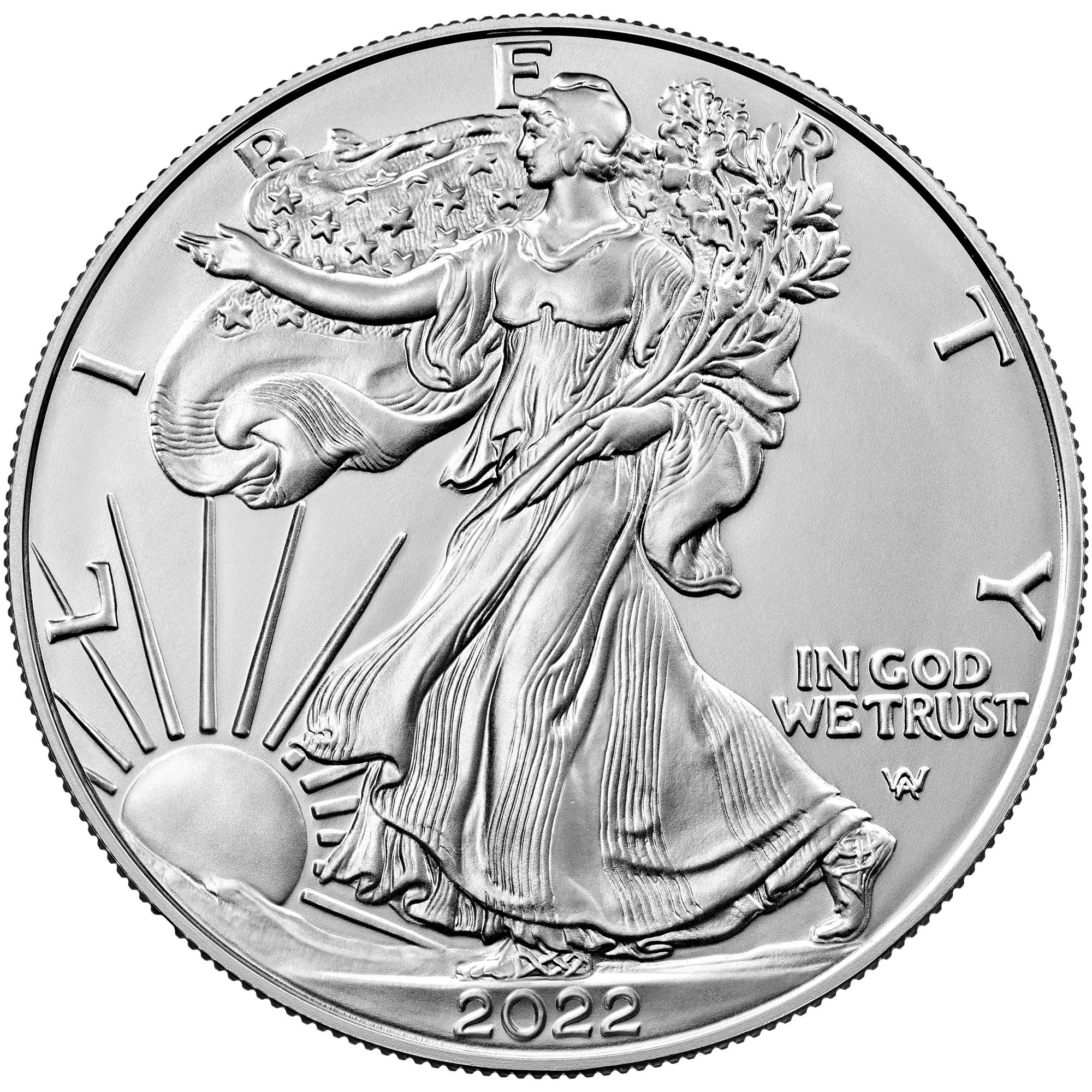
The American Silver Eagle is the official silver bullion coin of the United States. It was first released by the United States Mint on November 24, 1986, and portrays the Goddess of Liberty in a design by Adolph A. Weinman that was originally used on the Walking Liberty half dollar from 1916 to 1947.
The American Silver Eagle is struck only in the one-troy ounce, which has a nominal face value of one dollar and is guaranteed to contain one troy ounce of 99.9% pure silver. It is authorized by Title II of Public Law 99-61 (Liberty Coin Act, approved July 9, 1985) and codified as 31 U.S.C. § 5112(e)-(h). Its content, weight, and purity are certified by the United States Mint. In addition to the bullion version, the United States Mint has produced a proof version and an uncirculated version for coin collectors. The Silver Eagle has been produced at three mints: the Philadelphia Mint, the San Francisco Mint, and the West Point Mint. The American Silver Eagle bullion coin may be used to fund Individual Retirement Account investments.
The design on the coin's obverse was taken from the "Walking Liberty" design by Adolph A. Weinman, which originally had been used on the Walking Liberty Half Dollar coin of the United States from 1916 to 1947. As this iconic design had been a public favorite—and one of the most beloved designs of any United States coinage of modern times, silver or otherwise—it was revived for the Silver Eagle decades later. The obverse is inscribed with the year of minting or issuance, the word LIBERTY, and the phrase IN GOD WE TRUST. The obverse was slightly updated in 2021 (along with the reverse redesign) to feature a new rendering of Weinman's design and the addition of his artist mark under IN GOD WE TRUST.
The newly designed reverse of the 2021 American Silver Eagle (Type 2) was designed by Emily Damstra and shows an eagle landing on a branch; much like that of the reverse of the 1971 Eisenhower Dollar Coins.[citation needed] The reverse is inscribed with the phrases UNITED STATES OF AMERICA, 1 OZ. FINE SILVER•ONE DOLLAR, and E PLURIBUS UNUM, as well as the mintmark if applicable.
From 1986 to 2021, the reverse design was by John Mercanti and portrayed a heraldic eagle behind a shield; the eagle grasping an olive branch in its right talon and arrows in its left talon, echoing the Great Seal of the United States; above the eagle are thirteen five-pointed stars representing the Thirteen Colonies. The reverse was inscribed with the phrases UNITED STATES OF AMERICA, 1 OZ. FINE SILVER~ONE DOLLAR, and E PLURIBUS UNUM (on the banner that the eagle holds in its beak), as well as the mintmark if applicable. The design was slightly modified starting with 2008 coins; most notable is the addition of a serif on the U of UNITED, and a slight change between SILVER and ONE.
The impetus of the American Silver Eagle bullion program ultimately comes from executive plans through the 1970s and early 1980s to sell off silver from the Defense National Stockpile. As The Wall Street Journal explained, "Several administrations had sought unsuccessfully to sell silver from the stockpile, arguing that domestic production of silver far exceeds strategic needs. But mining-state interests had opposed any sale, as had promilitary legislators who wanted assurances that the proceeds would be used to buy materials more urgently needed for the stockpile rather than merely to reduce the federal deficit." Throughout the period, such sell-offs that did occur, as well as announcements of planned sell-offs, caused immediate declines in the price of silver. The Wall Street Journal reported in September 1976, "When the US government makes noises about selling silver from the federal stockpile, futures traders start unloading futures contracts in speculation that such a sale would depress prices."
Despite congressional opposition to the sale of stockpiled silver through early June 1981, the House Armed Services Committee decided on June 10 to approve a Reagan administration request to sell government-owned silver beginning in fiscal year 1982 to help balance the federal budget. In July 1981, the House and Senate agreed to allow the sale of 75% of the stockpiled silver (105.1 million troy ounces) over a three-year period, and in September the price of silver fell 11% in response. Just before the first sale in October 1981, a group of politicians from Idaho—a major silver-producing state—attempted to block the auction, claiming that the sale could have a "disastrous effect" on the United States silver mining industry in general and several Idaho silver mining companies in particular. On December 3, 1981, Senator James A. McClure (R-Idaho) proposed an amendment (S.UP.AMDT.738) to the Department of Defense appropriation bill (H.R. 4995) to end the government's sale of silver "until the President, not later than July 1, 1982, redetermines that the silver authorized for disposal is excess to the requirements of the stockpile." The appropriations bill was signed into law (Public Law 97-114) with the amendment intact, effectively stopping the further sale of stockpiled silver.
On May 27, 1982, Senator McClure introduced bill S. 2598, "A bill to provide for the disposal of silver from the National Defense Stockpile through the issuance of silver coins", to "redirect the sale of silver from our national defense stockpile in an effort to minimize its affect [sic] on the already depressed price of silver." An identical companion bill, H.R. 6649, was introduced on June 22 by Representative Larry E. Craig (R-Idaho) but both bills were referred to committees and never were enacted. The Wall Street Journal reported on June 30 that the price of silver "soared after Interior Secretary James Watt announced that sales of the government's silver stockpile will be indefinitely postponed" as the government's legally required study on potential methods of selling the silver had been delayed.
Hub AI
American Silver Eagle AI simulator
(@American Silver Eagle_simulator)
American Silver Eagle
The American Silver Eagle is the official silver bullion coin of the United States. It was first released by the United States Mint on November 24, 1986, and portrays the Goddess of Liberty in a design by Adolph A. Weinman that was originally used on the Walking Liberty half dollar from 1916 to 1947.
The American Silver Eagle is struck only in the one-troy ounce, which has a nominal face value of one dollar and is guaranteed to contain one troy ounce of 99.9% pure silver. It is authorized by Title II of Public Law 99-61 (Liberty Coin Act, approved July 9, 1985) and codified as 31 U.S.C. § 5112(e)-(h). Its content, weight, and purity are certified by the United States Mint. In addition to the bullion version, the United States Mint has produced a proof version and an uncirculated version for coin collectors. The Silver Eagle has been produced at three mints: the Philadelphia Mint, the San Francisco Mint, and the West Point Mint. The American Silver Eagle bullion coin may be used to fund Individual Retirement Account investments.
The design on the coin's obverse was taken from the "Walking Liberty" design by Adolph A. Weinman, which originally had been used on the Walking Liberty Half Dollar coin of the United States from 1916 to 1947. As this iconic design had been a public favorite—and one of the most beloved designs of any United States coinage of modern times, silver or otherwise—it was revived for the Silver Eagle decades later. The obverse is inscribed with the year of minting or issuance, the word LIBERTY, and the phrase IN GOD WE TRUST. The obverse was slightly updated in 2021 (along with the reverse redesign) to feature a new rendering of Weinman's design and the addition of his artist mark under IN GOD WE TRUST.
The newly designed reverse of the 2021 American Silver Eagle (Type 2) was designed by Emily Damstra and shows an eagle landing on a branch; much like that of the reverse of the 1971 Eisenhower Dollar Coins.[citation needed] The reverse is inscribed with the phrases UNITED STATES OF AMERICA, 1 OZ. FINE SILVER•ONE DOLLAR, and E PLURIBUS UNUM, as well as the mintmark if applicable.
From 1986 to 2021, the reverse design was by John Mercanti and portrayed a heraldic eagle behind a shield; the eagle grasping an olive branch in its right talon and arrows in its left talon, echoing the Great Seal of the United States; above the eagle are thirteen five-pointed stars representing the Thirteen Colonies. The reverse was inscribed with the phrases UNITED STATES OF AMERICA, 1 OZ. FINE SILVER~ONE DOLLAR, and E PLURIBUS UNUM (on the banner that the eagle holds in its beak), as well as the mintmark if applicable. The design was slightly modified starting with 2008 coins; most notable is the addition of a serif on the U of UNITED, and a slight change between SILVER and ONE.
The impetus of the American Silver Eagle bullion program ultimately comes from executive plans through the 1970s and early 1980s to sell off silver from the Defense National Stockpile. As The Wall Street Journal explained, "Several administrations had sought unsuccessfully to sell silver from the stockpile, arguing that domestic production of silver far exceeds strategic needs. But mining-state interests had opposed any sale, as had promilitary legislators who wanted assurances that the proceeds would be used to buy materials more urgently needed for the stockpile rather than merely to reduce the federal deficit." Throughout the period, such sell-offs that did occur, as well as announcements of planned sell-offs, caused immediate declines in the price of silver. The Wall Street Journal reported in September 1976, "When the US government makes noises about selling silver from the federal stockpile, futures traders start unloading futures contracts in speculation that such a sale would depress prices."
Despite congressional opposition to the sale of stockpiled silver through early June 1981, the House Armed Services Committee decided on June 10 to approve a Reagan administration request to sell government-owned silver beginning in fiscal year 1982 to help balance the federal budget. In July 1981, the House and Senate agreed to allow the sale of 75% of the stockpiled silver (105.1 million troy ounces) over a three-year period, and in September the price of silver fell 11% in response. Just before the first sale in October 1981, a group of politicians from Idaho—a major silver-producing state—attempted to block the auction, claiming that the sale could have a "disastrous effect" on the United States silver mining industry in general and several Idaho silver mining companies in particular. On December 3, 1981, Senator James A. McClure (R-Idaho) proposed an amendment (S.UP.AMDT.738) to the Department of Defense appropriation bill (H.R. 4995) to end the government's sale of silver "until the President, not later than July 1, 1982, redetermines that the silver authorized for disposal is excess to the requirements of the stockpile." The appropriations bill was signed into law (Public Law 97-114) with the amendment intact, effectively stopping the further sale of stockpiled silver.
On May 27, 1982, Senator McClure introduced bill S. 2598, "A bill to provide for the disposal of silver from the National Defense Stockpile through the issuance of silver coins", to "redirect the sale of silver from our national defense stockpile in an effort to minimize its affect [sic] on the already depressed price of silver." An identical companion bill, H.R. 6649, was introduced on June 22 by Representative Larry E. Craig (R-Idaho) but both bills were referred to committees and never were enacted. The Wall Street Journal reported on June 30 that the price of silver "soared after Interior Secretary James Watt announced that sales of the government's silver stockpile will be indefinitely postponed" as the government's legally required study on potential methods of selling the silver had been delayed.