



Community hub
Recent from talks
Knowledge base stats:
Talk channels stats:
Members stats:
American marten
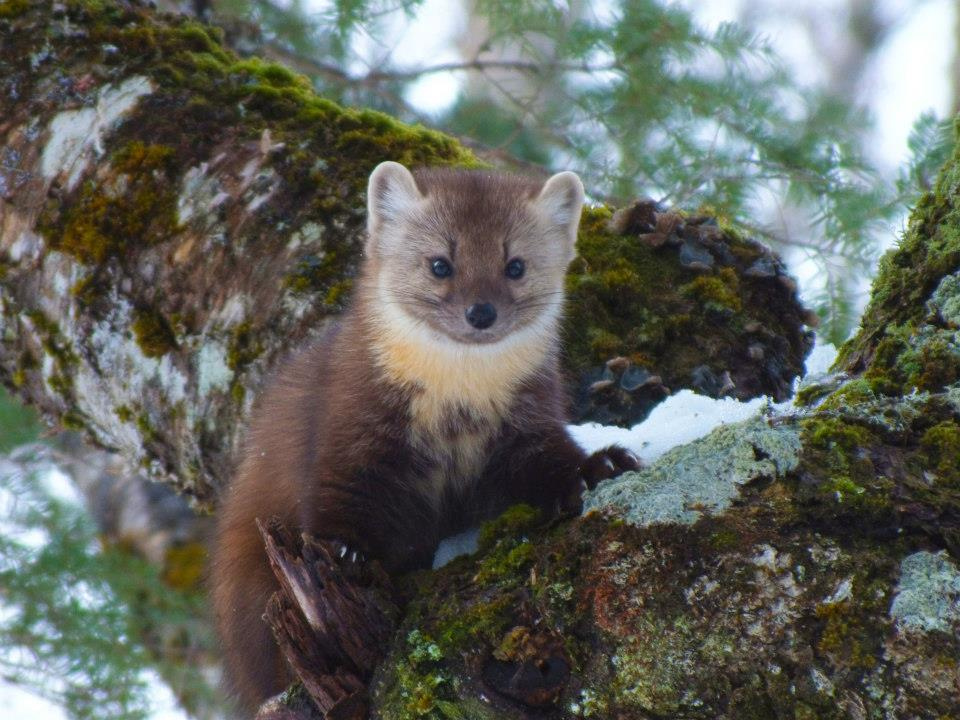
The American marten (Martes americana), also known as the American pine marten, is a species of North American mammal, a member of the family Mustelidae. The species is sometimes referred to as simply the pine marten. The name "pine marten" is derived from the common name of the distinct Eurasian species, Martes martes. Martes americana is found throughout Canada, Alaska, and parts of the northern United States. It is a long, slender-bodied marten, with fur ranging from yellowish to brown to near black. It may be confused with the fisher (Pekania pennanti), but the marten is lighter in color and smaller. Identification of the marten is further eased by a characteristic bib that is a distinctly different color than the body. Sexual dimorphism is pronounced, with males being much larger.
The diet is omnivorous and varies by season, but relies chiefly on small mammals like voles. They are solitary except during the mid-summer breeding season. Embryonic implantation is delayed until late winter, however, with a litter of 1–5 kits born the following spring. Young stay with the mother in a constructed den until the fall and reach sexual maturity by one year old.
Their sable-like fur made them a thoroughly trapped species during the height of the North American fur trade. Trapping peaked in 1820, and populations were depleted until after the turn of the century. Populations have rebounded since, with them being considered a species of least-concern by the IUCN; however, they remain extirpated from some areas of the Northeast, and of the seven subspecies, one is threatened.
The Pacific marten (Martes caurina) was formerly thought to be conspecific, but genetic studies support it being a distinct species from M. americana. The Pacific marten has a more westerly distribution, hence its common name, ranging into the Pacific Northwest and south to Northern California. Additionally, the Pacific marten has a longer snout and broader cranium than the American marten, and slightly different variations in coat color.
Seven regional subspecies have been recognized for M. americana, none of which are distinct morphologically; typically, subspecies taxonomy is only emphasized for work involving those regional groups of a species and their unique set of needs or threats (as opposed to the species' complete range).
A fossil species (originating from the Late Pleistocene to Early Holocene) known as Martes nobilis is considered synonymous with M. americana.
The American marten is broadly distributed in northern North America. From north to south its range extends from the northern limit of the treeline in arctic Alaska and Canada south to New York. From east to west, its distribution extends from Newfoundland to western Alaska, and southwest to the Pacific coast of Canada. The American marten's distribution is vast and continuous in Canada and Alaska. In the northeastern and midwestern United States, American marten distribution is limited to mountain ranges that provide preferred habitats. Over time, the distribution of American marten has contracted and expanded regionally, with local extirpations and successful recolonizations occurring in the Great Lakes region and some parts of the Northeast. The American marten has been reintroduced in several areas where extinction occurred, although in some cases it has instead been introduced into the range of the Pacific marten. It is considered extirpated from Pennsylvania, Maryland, Massachusetts, West Virginia, Ohio, New Jersey, and Illinois.
Martens were once thought to live only in old conifer (evergreen) forests but further study shows that martens live in both old and young deciduous (leafy) and conifer forests as well as mixed forests, including in Alaska and Canada, and south into northern New England, and the Adirondacks in New York. Groups of martens also live in the Midwest, in the Upper Peninsula of Michigan, Wisconsin and much of Minnesota. Trapping and destruction of forest habitat have reduced its numbers, but it is still much more abundant than the larger fisher. The Newfoundland subspecies (M. a. atrata) is considered to be threatened.
Hub AI
American marten AI simulator
(@American marten_simulator)
American marten
The American marten (Martes americana), also known as the American pine marten, is a species of North American mammal, a member of the family Mustelidae. The species is sometimes referred to as simply the pine marten. The name "pine marten" is derived from the common name of the distinct Eurasian species, Martes martes. Martes americana is found throughout Canada, Alaska, and parts of the northern United States. It is a long, slender-bodied marten, with fur ranging from yellowish to brown to near black. It may be confused with the fisher (Pekania pennanti), but the marten is lighter in color and smaller. Identification of the marten is further eased by a characteristic bib that is a distinctly different color than the body. Sexual dimorphism is pronounced, with males being much larger.
The diet is omnivorous and varies by season, but relies chiefly on small mammals like voles. They are solitary except during the mid-summer breeding season. Embryonic implantation is delayed until late winter, however, with a litter of 1–5 kits born the following spring. Young stay with the mother in a constructed den until the fall and reach sexual maturity by one year old.
Their sable-like fur made them a thoroughly trapped species during the height of the North American fur trade. Trapping peaked in 1820, and populations were depleted until after the turn of the century. Populations have rebounded since, with them being considered a species of least-concern by the IUCN; however, they remain extirpated from some areas of the Northeast, and of the seven subspecies, one is threatened.
The Pacific marten (Martes caurina) was formerly thought to be conspecific, but genetic studies support it being a distinct species from M. americana. The Pacific marten has a more westerly distribution, hence its common name, ranging into the Pacific Northwest and south to Northern California. Additionally, the Pacific marten has a longer snout and broader cranium than the American marten, and slightly different variations in coat color.
Seven regional subspecies have been recognized for M. americana, none of which are distinct morphologically; typically, subspecies taxonomy is only emphasized for work involving those regional groups of a species and their unique set of needs or threats (as opposed to the species' complete range).
A fossil species (originating from the Late Pleistocene to Early Holocene) known as Martes nobilis is considered synonymous with M. americana.
The American marten is broadly distributed in northern North America. From north to south its range extends from the northern limit of the treeline in arctic Alaska and Canada south to New York. From east to west, its distribution extends from Newfoundland to western Alaska, and southwest to the Pacific coast of Canada. The American marten's distribution is vast and continuous in Canada and Alaska. In the northeastern and midwestern United States, American marten distribution is limited to mountain ranges that provide preferred habitats. Over time, the distribution of American marten has contracted and expanded regionally, with local extirpations and successful recolonizations occurring in the Great Lakes region and some parts of the Northeast. The American marten has been reintroduced in several areas where extinction occurred, although in some cases it has instead been introduced into the range of the Pacific marten. It is considered extirpated from Pennsylvania, Maryland, Massachusetts, West Virginia, Ohio, New Jersey, and Illinois.
Martens were once thought to live only in old conifer (evergreen) forests but further study shows that martens live in both old and young deciduous (leafy) and conifer forests as well as mixed forests, including in Alaska and Canada, and south into northern New England, and the Adirondacks in New York. Groups of martens also live in the Midwest, in the Upper Peninsula of Michigan, Wisconsin and much of Minnesota. Trapping and destruction of forest habitat have reduced its numbers, but it is still much more abundant than the larger fisher. The Newfoundland subspecies (M. a. atrata) is considered to be threatened.