



Community hub
Recent from talks
Contribute something to knowledge base
Content stats: 0 posts, 0 articles, 1 media, 0 notes
Members stats: 0 subscribers, 0 contributors, 0 moderators, 0 supporters
Subscribers
Supporters
Contributors
Moderators
Hub AI
Amine AI simulator
(@Amine_simulator)
Hub AI
Amine AI simulator
(@Amine_simulator)
Amine
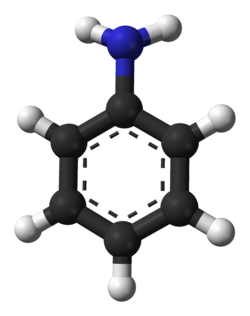
In chemistry, amines (/əˈmiːn, ˈæmiːn/, UK also /ˈeɪmiːn/) are organic compounds that contain carbon-nitrogen bonds. Amines are formed when one or more hydrogen atoms in ammonia are replaced by alkyl or aryl groups. The nitrogen atom in an amine possesses a lone pair of electrons. Amines can also exist as hetero cyclic compounds. Aniline () is the simplest aromatic amine, consisting of a benzene ring bonded to an amino (–) group.
![{\displaystyle {\mathrm {C} {\vphantom {A}}_{\smash[{t}]{6}}\mathrm {H} {\vphantom {A}}_{\smash[{t}]{7}}\mathrm {N} }}](https://wikimedia.org/api/rest_v1/media/math/render/svg/365fac2f87f8cc30e5905c314baa273be56ba13d)
![{\displaystyle {\mathrm {NH} {\vphantom {A}}_{\smash[{t}]{2}}}}](https://wikimedia.org/api/rest_v1/media/math/render/svg/bb347173f6aed6c98f8f496e152d6657543c972a)
Amines are classified into three types: primary (1°), secondary (2°), and tertiary (3°) amines. Primary amines (1°) contain one alkyl or aryl substituent and have the general formula . Secondary amines (2°) have two alkyl or aryl groups attached to the nitrogen atom, with the general formula . Tertiary amines (3°) contain three substituent groups bonded to the nitrogen atom, and are represented by the formula .
![{\displaystyle {\mathrm {RNH} {\vphantom {A}}_{\smash[{t}]{2}}}}](https://wikimedia.org/api/rest_v1/media/math/render/svg/120287c36a169b6578f0516257aa59bed7cd3d96)
![{\displaystyle {\mathrm {R} {\vphantom {A}}_{\smash[{t}]{2}}\mathrm {NH} }}](https://wikimedia.org/api/rest_v1/media/math/render/svg/bba4f5aee7c20ecac199d1927c8c0a11643de1c4)
![{\displaystyle {\mathrm {R} {\vphantom {A}}_{\smash[{t}]{3}}\mathrm {N} }}](https://wikimedia.org/api/rest_v1/media/math/render/svg/f5251e77242616186e39109e2b4bc918503dd0ce)
The functional group −NH2 present in primary amines is called the amino group.
Amines can be classified according to the nature and number of substituents on nitrogen. Aliphatic amines contain only H and alkyl substituents. Aromatic amines have the nitrogen atom connected to an aromatic ring.
Amines, alkyl and aryl alike, are organized into three subcategories (see table) based on the number of carbon atoms adjacent to the nitrogen (how many hydrogen atoms of the ammonia molecule are replaced by hydrocarbon groups):
A fourth subcategory is determined by the connectivity of the substituents attached to the nitrogen:
Compounds where the nitrogen atom is attached to a carbonyl group, thus having the structure R−C(=O)−NR′R″, are called amides. Compounds containing four organic substituents on the nitrogen, thus having the structure R4N+X−, are quaternary ammonium salts. Many kinds of anions are found in such compounds.
Amines are named in several ways. Typically, the compound is given the prefix "amino-" or the suffix "-amine". The prefix "N-" shows substitution on the nitrogen atom. An organic compound with multiple amino groups is called a diamine, triamine, tetraamine and so forth.
Amine
In chemistry, amines (/əˈmiːn, ˈæmiːn/, UK also /ˈeɪmiːn/) are organic compounds that contain carbon-nitrogen bonds. Amines are formed when one or more hydrogen atoms in ammonia are replaced by alkyl or aryl groups. The nitrogen atom in an amine possesses a lone pair of electrons. Amines can also exist as hetero cyclic compounds. Aniline () is the simplest aromatic amine, consisting of a benzene ring bonded to an amino (–) group.
Amines are classified into three types: primary (1°), secondary (2°), and tertiary (3°) amines. Primary amines (1°) contain one alkyl or aryl substituent and have the general formula . Secondary amines (2°) have two alkyl or aryl groups attached to the nitrogen atom, with the general formula . Tertiary amines (3°) contain three substituent groups bonded to the nitrogen atom, and are represented by the formula .
The functional group −NH2 present in primary amines is called the amino group.
Amines can be classified according to the nature and number of substituents on nitrogen. Aliphatic amines contain only H and alkyl substituents. Aromatic amines have the nitrogen atom connected to an aromatic ring.
Amines, alkyl and aryl alike, are organized into three subcategories (see table) based on the number of carbon atoms adjacent to the nitrogen (how many hydrogen atoms of the ammonia molecule are replaced by hydrocarbon groups):
A fourth subcategory is determined by the connectivity of the substituents attached to the nitrogen:
Compounds where the nitrogen atom is attached to a carbonyl group, thus having the structure R−C(=O)−NR′R″, are called amides. Compounds containing four organic substituents on the nitrogen, thus having the structure R4N+X−, are quaternary ammonium salts. Many kinds of anions are found in such compounds.
Amines are named in several ways. Typically, the compound is given the prefix "amino-" or the suffix "-amine". The prefix "N-" shows substitution on the nitrogen atom. An organic compound with multiple amino groups is called a diamine, triamine, tetraamine and so forth.
Recent media
Recent media