Hubbry Logo
An TeallachAn TeallachMain
Open search
An Teallach
Community hub
An Teallach
logo
8 pages, 0 posts
0 subscribers
Be the first to start a discussion here.
An Teallach
An Teallach
from Wikipedia

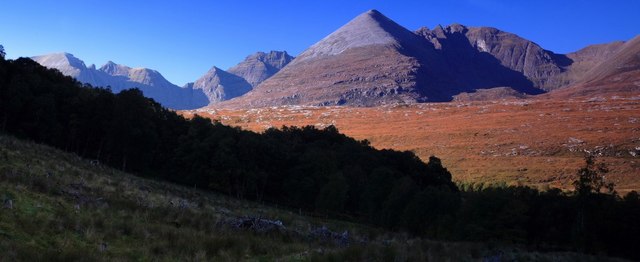
An Teallach (Scottish Gaelic for 'the forge' or 'the anvil')[2] is a mountain group in Wester Ross, in the Northwest Highlands of Scotland. It lies west of Dundonnell Forest, north of Loch na Sealga, and south of Little Loch Broom. Its highest peaks are the Munros of Bidean a' Ghlas Thuill at 1062 m (3484 ft), and Sgùrr Fiona at 1058 m (3473 ft).

Key Information

The mountains are mostly made of Torridonian sandstone. Like the peaks around Torridon (for which the rock is named), An Teallach has terraced sides riven with steep gullies and a sharp rocky summit crest at Sgùrr Fiona. The steepest section, known as Corrag Bhuidhe, rises above Loch Toll an Lochain. Corrag Bhuidhe's most spectacular feature is an overhanging pinnacle known as Lord Berkeley's Seat.

Etymology

[edit]

Teallach usually means a forge[3] or hearth, but can also mean an anvil.[2] It is suggested that the name came from the shape and colour of the mountains, along with smoke-like mist wreathing the pinnacles. Another suggestion is that tinkers had set up a forge in one of the mountain corries, or that a forge sat near the feet of the mountains (now a mountaineering club hut called the Old Smiddy).[4][2]

Summits

[edit]
Sgùrr Fiona and the Corrag Bhuidhe pinnacles, An Teallach

An Teallach is a complex mountain massif, with ten distinct summits over 3,000 feet (914.4 m). From 1891 to 1981, only the highest of these, Bidean a' Ghlas Thuill, had the status of a Munro – a separate mountain over 3,000 feet. In 1981 the Scottish Mountaineering Club granted Munro status to Sgùrr Fiona, in recognition of its considerable topographic prominence (142 m) and distinct nature.[5] The complete list of Munros and Tops (subsidiary summits appearing on Munro's Tables) is now as follows:[6]

  • Bidean a' Ghlas Thuill 1062 m (3484 ft)
    • Glas Mheall Mòr 979 m (3212 ft)
    • Glas Mheall Liath 960 m (3150 ft)
  • Sgùrr Fiona 1058.6 m (3473 ft)
    • Corrag Bhuidhe 1040 m (3412 ft)
    • Lord Berkeley's Seat 1030 m (3379 ft)
    • Sgurr Creag an Eich 1017 m (3337 ft)
    • Stob Cadha Gobhlach 960 m (3150 ft)
    • Sàil Liath 954 m (3130 ft)
    • Corrag Bhuidhe Buttress 945 m (3100 ft) – deleted from Munro's Tables in 1997

Ascent routes

[edit]

The simplest route of ascent is probably that from Dundonnell, which follows a good path over rising ground to reach the northern summit, Bidein a' Ghlas Thuill, a distance of about 6 km (3+12 mi). From here the second summit, Sgurr Fiona, lies about 1 km (12 mi) to the southwest.

An alternative northern route heads up from Corrie Hallie, which lies about 4 km (2+12 mi) south of Dundonnell. This route, some 5 km (3 mi) in length, climbs steeply up the headwall of the corrie of Glas Tholl to reach the main ridge just north of Bidein a' Ghlas Thuill.

Both of the above routes, however, miss out the central section, for which An Teallach is best known. A route reaching the summits from the south starts from near Corrie Hallie. It then follows a track (later a path) southwest for about 5 km (3 mi). Then it breaks off to the north, climbing the southern end of the ridge via a subsidiary summit known as Sàil Liath. Heading northwest towards the Corrag Bhuidhe buttresses a choice must be made. One may either scramble over them directly (including the crossing of Lord Berkley's Seat), or take the bypass path on the southwest side. This path is eroded in some places and should not be regarded as an easy option.

The winter traverse of the ridge is probably more demanding than that of Liathach or the Aonach Eagach.

Notes

[edit]
[edit]
Revisions and contributorsEdit on WikipediaRead on Wikipedia
from Grokipedia
An Teallach is a prominent mountain massif in the region of the , located approximately 20 kilometres southeast of . The name "An Teallach," derived from , translates to "the " or "the anvil," reflecting its rugged, anvil-like profile. Spanning about 4 kilometres by 2 kilometres, it consists of multiple peaks, including the two Munros Bidein a' Ghlas Thuill at 1,062 metres (3,484 feet) and Sgùrr Fiona at 1,060 metres (3,478 feet), connected by a dramatic ridge renowned for its pinnacles, arêtes, and gullies. Geologically, An Teallach is primarily composed of Torridonian sandstone overlain by quartzite, with its terraced slopes and steep faces shaped by glacial erosion during the Pleistocene period. The massif's eastern and western quartzite ridges provide a striking contrast, offering exposed routes that demand navigational skill and experience, particularly in winter conditions requiring ice axes and crampons. Its accessibility from the A832 road makes it a favored destination for hillwalkers, though the full traverse involves significant exposure and loose , contributing to its reputation as one of Scotland's most thrilling and visually spectacular mountain ranges.

Geography

Location and Topography

An Teallach is a prominent mountain massif situated in Wester Ross, within the Northwest Highlands of Scotland. Its central coordinates are approximately 57°48′24″N 5°15′06″W, placing it west of Dundonnell Forest, north of Loch na Sealga, and south of Little Loch Broom. The range lies about 11 km south of Ullapool, with access primarily via the A835 road leading to nearby Dundonnell. Topographically, An Teallach forms a compact extending roughly 5 km east-west, characterized by a rugged U-shaped ridge system that encloses deep , such as Glas Tholl. The highest elevation reaches 1,062.5 m at Bidein a' Ghlas Thuill, composed primarily of Torridonian sandstone overlain by , with the quartzite forming the western ridges and contributing to its dramatic, jagged profile of pinnacles and arêtes. This structure creates steep escarpments and narrow arêtes, rising sharply from the surrounding terrain, with eastern of softer sandstone contrasting the harder western quartzite faces. The surrounding landscape features a base of barren , transitioning to coastal views that encompass the and the Atlantic Ocean to the west. An Teallach qualifies as a complex with two Munros—Bidein a' Ghlas Thuill (1,062 m) and Sgùrr Fiona (1,059 m)—and one Marilyn at Bidein a' Ghlas Thuill, highlighting its prominence in Scottish hill classifications.

Geological Formation

An Teallach is underlain primarily by Torridonian sandstone, a formation dating to approximately 800 million years ago, overlain by particularly on the western ridges. This coarse-grained, feldspathic sandstone, part of the broader Torridon Group, exhibits distinctive red-brown to purplish hues and structures indicative of ancient fluvial and alluvial environments. The rock's durability, combined with the resistant cap, contributes to the mountain's terraced ridges and steep gullies, features that echo those of the nearby Torridon peaks, where the sandstone forms similarly dramatic, stepped landscapes. The formation of these sandstones occurred through sedimentary deposition in rift basins during the late era, when created subsiding basins filled by rivers and alluvial fans eroding older Lewisian basement rocks. Subsequent tectonic activity during the around 420 million years ago led to uplift along the Moine Thrust, a major east-verging fault zone that transported older rocks westward over the Torridonian sequence, exposing the sandstones at the surface. This thrust belt, located to the east of An Teallach, played a key role in the regional elevation of the , preserving the relatively unmetamorphosed Torridonian layers while subjecting them to folding and faulting. Overlying these ancient rocks, An Teallach displays a suite of glacial and periglacial features shaped by multiple Quaternary glaciations, particularly the Late Devensian ice age (approximately 26,000 to 11,700 years ago). Moraines, including recessional and hummocky types, mark the retreat phases of the Wester Ross Readvance, a significant readvance of the British Ice Sheet. Periglacial processes have further modified the landscape, with niveo-aeolian sand deposits—formed by wind transporting sediment onto snow patches—reaching thicknesses of up to 4 meters on the plateau surfaces. Ice sheets sculpted corries and U-shaped valleys, enhancing the mountain's rugged profile, making An Teallach a key site for Quaternary geological studies.

Etymology

Name Meaning

The name An Teallach in directly translates to "the " or "the ," with "an" serving as the definite article and "teallach" referring to a blacksmith's or . The term "teallach" originates from tenlach or tellach, derived from the root tene (meaning "," as in modern Gaelic teine) combined with the -lach, evoking the fiery environment of a smithy or central to ancient Celtic society. This ties the word to concepts of heat and craftsmanship, reflecting its primary association with -based tools and structures rather than solely metallic implements. The standard pronunciation is approximately "an TYAL-ach," with stress on the first of "teallach" and a soft "ch" like the Scottish "." Contextually, the name likely alludes to the mountain's rugged, anvil-like profile when viewed from afar, or to the warm, fiery red-brown glow of its rocks illuminated by sunrise or sunset, evoking the heat of a .

Historical Interpretations

The name An Teallach has been subject to interpretive debate among scholars, primarily revolving around its descriptive origins tied to the . One prevailing suggests that the name alludes to the mountain's jagged pinnacles and rocky formations resembling the shape of a apparatus, drawing on the Gaelic term "teallach" meaning "" or "." Another interpretation emphasizes the frequent smoke-like mists that wreath the summits, evoking the appearance of a working belching vapors, particularly when combined with the reddish hues of the Torridonian in certain lighting. These theories, outlined in early 20th-century place-name studies, highlight how the name likely emerged from Gaelic speakers' observations of the massif's dramatic profile and atmospheric effects rather than literal industrial associations. Historical records of An Teallach's naming reflect its integration into broader cartographic efforts during the . The mountain was first systematically mapped by the of , with the initial detailed surveys for the region conducted between 1843 and 1882 as part of the six-inch first edition series, capturing the Gaelic name in its anglicized form as "An Teallach" or occasionally rendered descriptively as "The Forge" in earlier notations. Variations in spelling appear in these records, influenced by phonetic transcription from local informants, underscoring the name's deep roots in Highland Gaelic traditions without evidence of earlier written forms from explorer accounts. The lack of any documented ascents prior to the further implies that the name predates modern and originated among local communities familiar with the terrain. In terms of cultural evolution, An Teallach's prominence in Scottish hill literature solidified with its inclusion in Sir Hugh Munro's seminal tables of peaks exceeding 3,000 feet, first published in the Scottish Club Journal in September 1891, where it was listed as a single entity encompassing multiple summits. This adoption marked a shift toward standardized recognition in circles, emphasizing its status as a challenging Highland massif. Subsequent revisions by the Scottish Club in 1981 reclassified Sgùrr Fiona (1,060 m) as a separate , based on its of 142 meters, reflecting evolving criteria for distinct peaks within the range and increasing its appeal to peak-baggers.

Summits and Features

Main Peaks

An Teallach's two primary summits dominate the massif's eastern ridge, both surpassing 1,000 m in elevation and recognized in the Scottish Mountaineering Club's official list of Munros. Bidein a' Ghlas Thuill, the northernmost and highest summit, reaches an elevation of 1,062.5 m with a prominence of approximately 147 m from its connecting to Sgùrr Fiona. This peak presents a broad dome shape topped by a cap, providing expansive views across the surrounding . Sgùrr Fiona, the southern Munro, stands at 1,058.6 m with a prominence of 142 m. It was elevated to full Munro status in 1981 by the Scottish Mountaineering Club, based on its sufficient topographic drop and independent character as a sharp, rocky pinnacle. The massif includes eight subsidiary tops exceeding 914 m in height, linking these main summits via rugged ridges.

Ridges and Notable Points

The An Teallach is characterized by a prominent east-west traverse spanning approximately 5 km, connecting its two main Munros, Bidein a' Ghlas Thuill and Sgùrr Fiona, through a series of interconnecting and pinnacled sections that create a jagged, fortress-like profile. This main features exposed outcrops and narrow arêtes, particularly between Corrag Bhuidhe and Lord Berkeley's Seat, where a half-kilometer stretch of pinnacles rises dramatically above steep drops, enhancing the massif's imposing skyline visible from the surrounding glens. Key corries punctuate the ridge system, including Corrag Bhuidhe, a high at around 1,049 m that serves as a critical pass linking the western ridges to the central pinnacles, and Glas Tholl to the north, a deep basin beneath Bidein a' Ghlas Thuill with a sheer headwall rising over 300 m, contributing to the massif's rugged, enclosed . These , bounded by steep gullies and rocky flanks, amplify the ridge's dramatic contours, with drops of up to 300 m in places underscoring the exposed nature of the terrain. Notable points along the ridges include Lord Berkeley's Seat, an overhanging perch at 1,031 m offering panoramic views across and beyond, and the "Bad Step," a notoriously exposed section on the pinnacled ridge requiring careful navigation due to its steep, rocky traverse. The boasts eight subsidiary tops exceeding 914.4 m, which extend the ridge's complexity and provide additional vantage points, as detailed below:
Subsidiary TopHeight (m)Location Relative to Main Ridge
Stob Cadha Gobhlach960Western approach ridge
Sàil Liath954Northern outlier
Glas Mheall Liath960Eastern extension
Glas Mheall Mòr979Central eastern top
Sgùrr Creag an Eich1,017Southwestern spur
Corrag Bhuidhe1,049Central pass/summit
Lord Berkeley's Seat1,031Central pinnacled section
Stob Cadha Raineach960Western subsidiary
These features collectively define An Teallach's topographical role as a skyline-dominating , where the ridges' interconnectivity and vertical create a visually striking and structurally intricate massif.

Hiking and Climbing

Ascent Routes

The primary ascent routes to An Teallach originate from Dundonnell on the western side or Corrie Hallie on the eastern side, both facilitating access to the central ridge and the summits of Bidein a' Ghlas Thuill and Sgùrr Fiona via non-technical paths. The Dundonnell approach commences at a layby on the A832 road near the Dundonnell Hotel, where parking is available close to the Mountain Rescue post. This route covers approximately 12 km as a round trip to the main summits, beginning with a steep climb through the glen of Allt a' Mhuilinn—marked by loose terrain and gaining significant height rapidly—to reach Bidein a' Ghlas Thuill, followed by a straightforward 1 km traverse along the ridge crest to Sgùrr Fiona. The initial ascent demands good fitness due to its gradient, but the path is well-defined in its lower sections before becoming rougher higher up. As an alternative, the Corrie Hallie route starts from a layby on the A832 about 4 km southeast of Dundonnell, spanning roughly 5 km one-way to the ridge via stalkers' tracks. Walkers can ascend through the Glas Tholl corrie or directly up the southern ridge toward Sàil Liath, bypassing the abrupt steepness of the Dundonnell path while incorporating a longer approach through more undulating ground to join the main massif. This option suits those preferring a gentler initial gradient, though it extends the overall distance before reaching the high ground. Traverse variations provide a comprehensive circuit of An Teallach, typically measuring 10-12 km with about 1,200 m of total ascent and requiring 6-8 hours for experienced, fit walkers; a clockwise direction is often recommended to tackle the steeper sections in ascent and to optimize views along the ridge. These full routes link the Dundonnell and Corrie Hallie starting points, allowing progression from one approach to the other while covering the key summits and ridges. Effective navigation across these routes depends on Ordnance Survey Landranger 1:50,000 map 20 (Gairloch and surrounding area), as many segments are pathless or follow faint stalkers' paths that demand or GPS use in poor visibility. Brief non-technical may occur on the ridges, such as at the Bad Step near Corrag Bhuidhe.

Scrambling and Challenges

Traversing An Teallach requires moderate , particularly along the Corrag Bhuidhe pinnacles between the main summits, where sections are graded UK 1-2 with hands-on moves over rocky terrain. The most notable feature is the "Bad Step," an exposed 5-meter downclimb on a steep slab that can induce vertigo due to sheer drops on either side, though it is avoidable via a bypass path to the west. Overall, the ridge is rated as a Grade 3 scramble when navigated directly, but experienced parties can mitigate difficulties by choosing easier lines. In winter conditions, the icy ridges of An Teallach become significantly more demanding than those of nearby Liathach, requiring ice axes, crampons, and often a rope for the exposed traverses. Snow accumulation forms large cornices along the crests and increases avalanche risk in the steep gullies, such as those approaching Glas Bheinn, demanding careful route selection and snowpack assessment. Specialist winter climbs include The Forge, a two-pitch route graded X/10 on the Hayfork Wall, which saw its first ascent in December 2018 by Greg Boswell and Guy Robertson. Key challenges include path erosion caused by heavy foot traffic on the popular ridges, leading to ongoing repair efforts as of 2025 for over 3 kilometers of degraded terrain as part of a three-year project to restore 3.2 km. The mountain's exposure to , including frequent mists that reduce visibility and complicate navigation, heightens risks on the narrow crests. Historical incidents underscore these dangers; in April 1966, a major fall on Sgurr Fiona resulted in two fatalities, prompting a gallant solo rescue effort by Dr. Tom Patey, who received the . Due to these factors, An Teallach is recommended only for experienced hillwalkers with prior proficiency and strong navigational skills.

Ecology and Conservation

Flora and Fauna

The upland habitats of An Teallach support a diverse array of vegetation communities shaped by its acidic, nutrient-poor soils derived from Torridonian . Blanket mires, characterized by mosses, sedges, and cotton grasses, prevail in wetter depressions and plateaus, contributing to carbon storage and hydrological regulation. Ericaceous heath dominates drier slopes and ridges, featuring dense stands of heather (Calluna vulgaris) interspersed with blaeberry (Vaccinium myrtillus), crowberry (Empetrum nigrum), and bell heather (Erica cinerea), which provide nectar sources for pollinators and structural cover for ground-nesting birds. On exposed summits and rocky outcrops, alpine species such as moss campion (Silene acaulis) form compact cushions adapted to harsh winds and frost, while the coarse, quartz-rich fosters a rich flora, including species like Cladonia and Stereocaulon, thriving in the low-nutrient environment. Mammalian fauna includes prominent herbivores that influence habitat structure. Red deer (Cervus elaphus) herds roam the slopes, with densities varying from 4 to 13 individuals per square kilometer across estates like Dundonnell and Gruinard as of 2018; broader efforts by the West Ross Deer Management Group aim to reduce regional densities to around 10 per km² by 2026. Feral goats (Capra hircus) in the adjacent Dundonnell Forest, numbering in small herds, contribute to selective browsing on higher ground, potentially promoting by creating mosaic habitats but also causing localized on steep terrain. Near surrounding lochs and rivers, otters (Lutra lutra) are occasionally observed, utilizing aquatic prey like fish and amphibians while traversing upland fringes. Avian species enrich the ecosystem, with raptors and ground birds adapted to the montane terrain. Golden eagles (Aquila chrysaetos) soar over the ridges, nesting on cliffs and preying on small mammals and carrion, emblematic of the area's wild character. Ptarmigan (Lagopus muta), camouflaged against rocky heaths, are resident on summits, shifting plumage seasonally from mottled brown in summer to white in winter. Ravens (Corvus corax), highly intelligent corvids, frequent the peaks for scavenging and nesting in crags, often in pairs or family groups. Ecological dynamics are heavily influenced by grazing regimes, where and feral goats maintain open heathlands but historical has reduced diversity and encouraged invasive in some ; the 2018 site condition assessment rated the upland assemblage as unfavorable due to pressures, with ongoing efforts aimed at improvement. Seasonal variations enhance , as burst with wildflowers like tormentil (Potentilla erecta) and devil's-bit scabious (Succisa pratensis) in summer, attracting insects and supporting food webs, while winter snows provide insulation for overwintering species. The habitats form part of an upland , underscoring their national importance for montane .

Protected Status and Management

An Teallach is designated as a (SSSI) under the Nature Conservation (Scotland) Act 2004, notified on 3 May 1984 for its exceptional —including glacial moraines, periglacial features, and landforms—and its upland assemblage, which encompasses subalpine dry dwarf shrub heath, wet heath, and alpine communities. The site lies within the broader region, influenced by the North West Highlands Global , which highlights the area's geological significance through educational and conservation initiatives spanning over 2,000 square kilometers of diverse rock formations and landscapes. Management of the SSSI is overseen by NatureScot, which conducts periodic site condition monitoring (SCM) to assess feature integrity. Geological elements, such as the moraines and associated landforms, are evaluated as being in favorable condition, reflecting their stability and minimal disturbance. Upland vegetation features were assessed as unfavorable in 2018 due to by deer, sheep, and goats, with ongoing interventions including to address these pressures; the next monitoring is scheduled before 2026. Key initiatives include path repair projects to combat erosion from visitor traffic; in 2023, the "It's Up to Us" campaign secured a €60,000 grant from the European Outdoor Conservation Association (EOCA) to restore 1,250 meters of heavily eroded upland paths and 1,300 meters of lighter touch paths, with restoration works carried out in 2024 to facilitate habitat regeneration and protection. Visitor management emphasizes sustainable practices to preserve sensitive features, with guidelines promoting principles—such as minimizing impact, staying on designated paths, and avoiding trampling of fragile moraines and mires—to prevent further degradation. Broader conservation efforts integrate deer population control via the West Ross Deer Management Group (DMG), which coordinates annual culls across estates to alleviate pressures on upland and support overall site recovery.

Cultural Significance

Historical Context

Prior to the 19th century, the area around An Teallach was utilized by local Highland communities for traditional activities, including livestock grazing and extraction for , as these were essential to subsistence in the rugged . No documented ascents of the mountain exist from this era, underscoring its practical role in local economies rather than as a site of recreational or exploratory interest. In the mid-19th century, amid the potato famine and broader socio-economic disruptions of the , significant infrastructure development occurred nearby. The section of the A832 road from Braemore Junction to Dundonnell, known as the Destitution Road, was constructed in the late by destitute crofters working under the oversight of the Central Board of for the Relief of the Destitute in the Highlands. Laborers, including men, women, and children, toiled for eight hours a day, six days a week, in exchange for meager rations—680 grams daily for men, 340 grams for women, and 230 grams for children—to alleviate starvation during the crisis. This road not only connected remote areas but also symbolized the era's hardships for Highland crofting families. Additionally, the produced the first detailed topographic maps of the An Teallach region as part of its six-inch first edition series for , surveyed and published between the and 1870s, providing accurate representations of the mountain's complex terrain for the first time. The late 19th and early 20th centuries marked An Teallach's entry into broader exploration and recreational contexts. In 1891, Sir Hugh Munro included the mountain's highest summit, Bidein a' Ghlas Thuill, in his seminal "Tables of Scottish Mountains Exceeding 3000 Feet," compiling the first systematic list of such peaks and sparking organized hillwalking across . No formal "" is recorded for An Teallach, attributable to longstanding local familiarity and access by residents. Following , Scottish and hillwalking experienced renewed growth, with enthusiasts increasingly drawn to challenging ridges like those of An Teallach, contributing to its status as a classic destination in the .

In Literature and Exploration

An Teallach has been celebrated in literature for its rugged terrain and spectacular vistas, often highlighted as a pinnacle of Scottish hillwalking. In Brown's seminal 1978 account Hamish's Mountain Walk, the first continuous traverse of all Munros, the author recounts his passage over the mountain's dramatic ridges during his epic 4,000-mile journey, emphasizing its role as a testing ground for endurance and navigation. Similarly, Tom Weir's chapter in Ken Wilson's 1980 anthology The Big Walks portrays the full traverse as an unforgettable adventure, capturing the exhilaration of scrambling along the pinnacles amid remote Highland wilderness. These works underscore An Teallach's enduring appeal to writers and explorers seeking to evoke the raw beauty and challenge of Scotland's northwest peaks. Exploration of An Teallach has produced notable milestones and harrowing tales that highlight its perilous allure. In April 1966, a tragic fall on Sgùrr Fiona claimed the lives of two climbers, prompting a daring solo recovery effort by local and physician Tom Patey, who reached the scene amid harsh conditions; this incident, drawn from survivor Iain Ogilvie's diaries, was dramatized in the 1985 documentary Duel with An Teallach, which aired as a poignant testament to the mountain's dangers and the heroism of early rescuers. More recently, in December 2018, climbers Greg Boswell and Guy Robertson established The Forge (graded X,10), a demanding two-pitch winter route on the Hayfork Wall, recognized as one of the season's boldest new lines in Scottish winter climbing. The 1981 decision by the Scottish Mountaineering Club to grant separate status to Sgùrr Fiona intensified debates on the mountain's , elevating its status among peak-baggers. As a , An Teallach influences Munro-bagging traditions, serving as a coveted challenge for those pursuing 's 282 peaks over 3,000 feet, with its exposed ridges drawing crowds that necessitate ongoing path repairs to mitigate . The mountain's prominence is further evidenced by the An Teallach Mountaineering Club, founded in 1989 and named in its honor, which organizes monthly meets across and maintains a in . Walkhighlands ranks it among the UK's premier day hikes, dubbing it "this fabled mountain [that] is perhaps the most impressive in Britain" for its dramatic and lochs. Contemporary media amplifies its fame through 2024 documentaries like Attempting One Of 's Most Dangerous Ridge Walks and An on An Teallach, which showcase guided traverses and wild amid its jagged skyline, while films such as Ephemeral (2022) feature its winter walls in broader narratives of Scottish alpine pursuits.

References

  1. https://en.wikisource.org/wiki/An_Etymological_Dictionary_of_the_Gaelic_Language/T
  2. https://en.wiktionary.org/wiki/teallach
Add your contribution
Related Hubs
User Avatar
No comments yet.