
Ananke (moon)
View on Wikipedia
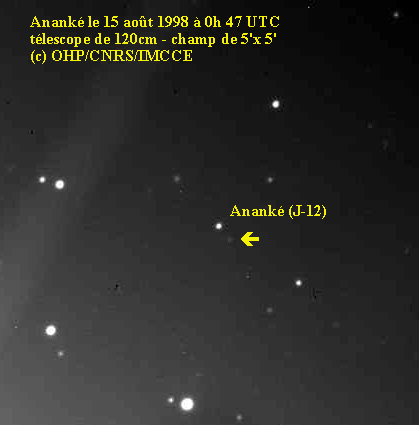
 Ananke photographed by the Haute-Provence Observatory in August 1998 | |
| Discovery[1] | |
|---|---|
| Discovered by | Seth B. Nicholson |
| Discovery site | Mt. Wilson Observatory |
| Discovery date | 28 September 1951 |
| Designations | |
Designation | Jupiter XII |
| Pronunciation | /əˈnæŋkiː/[2] |
Named after | Ἀνάγκη Anagkē |
| Adjectives | Anankean /ænəŋˈkiːən/[3] |
| Orbital characteristics[4] | |
| Epoch 17 December 2020 (JD 2459200.5) | |
| Observation arc | 69.05 yr (24,338 days) |
| 0.1406602 AU (21,042,470 km) | |
| Eccentricity | 0.1747248 |
| –623.59 d | |
| 339.61045° | |
| 0° 34m 38.281s / day | |
| Inclination | 148.67482° (to ecliptic) |
| 86.44368° | |
| 135.63033° | |
| Satellite of | Jupiter |
| Group | Ananke group |
| Physical characteristics | |
| 29.1±0.6 km[5] | |
| Mass | 1.68×10¹⁶ kg (calculated) |
Mean density | 1.30 g/cm3 (assumed)[6] |
| 8.31±0.15 h[7] | |
| Albedo | 0.038±0.006[5] |
| 18.9[8] | |
| 11.7[4] | |
Ananke (/əˈnæŋki/) is a retrograde irregular moon of Jupiter. It was discovered by Seth Barnes Nicholson at Mount Wilson Observatory in 1951.[1] It is named after the Greek mythological Ananke, the personification of necessity, and the mother of the Moirai (Fates) by Zeus. The adjectival form of the name is Anankean.
Ananke did not receive its present name[9] until 1975;[10] before then, it was simply known as Jupiter XII. It was sometimes called "Adrastea"[11] between 1955 and 1975 (Adrastea is now the name of another satellite of Jupiter).
Ananke gives its name to the Ananke group, retrograde irregular moons which orbit Jupiter between 19.3 and 22.7 Gm, at inclinations of roughly 150°.[12]
Orbit
[edit]
Ananke orbits Jupiter on a high-eccentricity and high-inclination retrograde orbit. Fifteen irregular satellites orbiting Jupiter have been discovered since 2000 following similar orbits.[12] The orbital elements are as of January 2000.[13] They are continuously changing due to solar and planetary perturbations. The diagram illustrates Ananke's orbit in relation to other retrograde irregular satellites of Jupiter. The eccentricity of selected orbits is represented by the yellow segments (extending from the pericentre to the apocentre). The outermost regular satellite Callisto is located for reference.
Given these orbital elements and the physical characteristics known so far, Ananke is thought to be the largest remnant[14] of an original break-up, forming the Ananke group.[15][16]
Physical characteristics
[edit]
In the visible spectrum, Ananke appears neutral to light-red (colour indices B-V=0.90 V-R=0.38).[16]
The infrared spectrum is similar to P-type asteroids but with a possible indication of water.[17]
See also
[edit]
References
[edit]- ^ a b Nicholson, S. B. (1951). "An unidentified object near Jupiter, probably a new satellite". Publications of the Astronomical Society of the Pacific. 63 (375): 297–299. Bibcode:1951PASP...63..297N. doi:10.1086/126402.
- ^ "Ananke". Dictionary.com Unabridged (Online). n.d.
- ^ Yenne (1987) The Atlas of the Solar System.
- ^ a b "M.P.C. 127087" (PDF). Minor Planet Circular. Minor Planet Center. 17 November 2020.
- ^ a b Grav, T.; Bauer, J. M.; Mainzer, A. K.; Masiero, J. R.; Nugent, C. R.; Cutri, R. M.; et al. (August 2015). "NEOWISE: Observations of the Irregular Satellites of Jupiter and Saturn". The Astrophysical Journal. 809 (1): 9. arXiv:1505.07820. Bibcode:2015ApJ...809....3G. doi:10.1088/0004-637X/809/1/3. S2CID 5834661. 3.
- ^ Chen, Zhenghan; Yang, Kun; Liu, Xiaodong (6 February 2024). "'Life' of dust originating from the irregular satellites of Jupiter". Monthly Notices of the Royal Astronomical Society. 527 (4): 11327–11337. arXiv:2402.03680. doi:10.1093/mnras/stad3829.
- ^ Luu, Jane (September 1991). "CCD photometry and spectroscopy of the outer Jovian satellites". Astronomical Journal. 102: 1213–1225. Bibcode:1991AJ....102.1213L. doi:10.1086/115949. ISSN 0004-6256.
- ^ Sheppard, Scott. "Scott S. Sheppard - Jupiter Moons". Department of Terrestrial Magnetism. Carnegie Institution for Science. Retrieved 26 November 2020.
- ^ Nicholson, S.B. (April 1939). "The Satellites of Jupiter". Publications of the Astronomical Society of the Pacific. 51 (300): 85–94. Bibcode:1939PASP...51...85N. doi:10.1086/125010.
- ^ Marsden, B. G. (7 October 1974). "Satellites of Jupiter". IAU Circular. 2846.
- ^ Payne-Gaposchkin, Cecilia; Katherine Haramundanis (1970). Introduction to Astronomy. Englewood Cliffs, N.J.: Prentice-Hall. ISBN 0-13-478107-4.
- ^ a b Sheppard, S. S., Jewitt, D. C., Porco, C.; Jupiter's Outer Satellites and Trojans Archived 2007-06-14 at the Wayback Machine, in Jupiter: The Planet, Satellites and Magnetosphere, edited by Fran Bagenal, Timothy E. Dowling, William B. McKinnon, Cambridge Planetary Science, Vol. 1, Cambridge, UK: Cambridge University Press, ISBN 0-521-81808-7, 2004, pp. 263-280
- ^ Jacobson, R. A. (2000). "The Orbits of the Outer Jovian Satellites" (PDF). Astronomical Journal. 120 (5): 2679–2686. Bibcode:2000AJ....120.2679J. doi:10.1086/316817. S2CID 120372170.
- ^ Sheppard, S.S.; Jewitt, D.C. (2003). "An abundant population of small irregular satellites around Jupiter" (PDF). Nature. 423 (6937): 261–263. Bibcode:2003Natur.423..261S. doi:10.1038/nature01584. PMID 12748634. S2CID 4424447. Archived from the original (PDF) on 13 August 2006.
- ^ Nesvorný, D.; Beaugé, C.; Dones, L. (2004). "Collisional Origin of Families of Irregular Satellites". The Astronomical Journal. 127 (3): 1768–1783. Bibcode:2004AJ....127.1768N. doi:10.1086/382099.
- ^ a b Grav, Tommy; Holman, M. J.; Gladman, B. J.; Aksnes, K. (2003). "Photometric survey of the irregular satellites". Icarus. 166 (1): 33–45. arXiv:astro-ph/0301016. Bibcode:2003Icar..166...33G. doi:10.1016/j.icarus.2003.07.005. S2CID 7793999.
- ^ Grav, Tommy; Holman, Matthew J. (2004). "Near-Infrared Photometry of the Irregular Satellites of Jupiter and Saturn". The Astrophysical Journal. 605 (2): L141 – L144. arXiv:astro-ph/0312571. Bibcode:2004ApJ...605L.141G. doi:10.1086/420881. S2CID 15665146.
External links
[edit]- IAU-MPC NSES
- Ananke Profile by NASA's Solar System Exploration
- David Jewitt pages
- Scott Sheppard pages
Listed in increasing approximate distance from Jupiter | |
| Inner moons | |
| Galilean moons | |
| Themisto | |
| Himalia group (9) | |
| Carpo group (2) | |
| Valetudo | |
| Ananke group (27) | |
| Carme group (31) |
|
| Pasiphae group (18) | |
| See also | |
