



Community hub
Recent from talks
Knowledge base stats:
Talk channels stats:
Members stats:
Ancient Thessaly
Thessaly or Thessalia (Attic Greek: Θεσσαλία, Thessalía or Θετταλία, Thettalía) was one of the traditional regions of Ancient Greece. During the Mycenaean period, Thessaly was known as Aeolia, a name that continued to be used for one of the major tribes of Greece, the Aeolians, and their dialect of Greek, Aeolic.
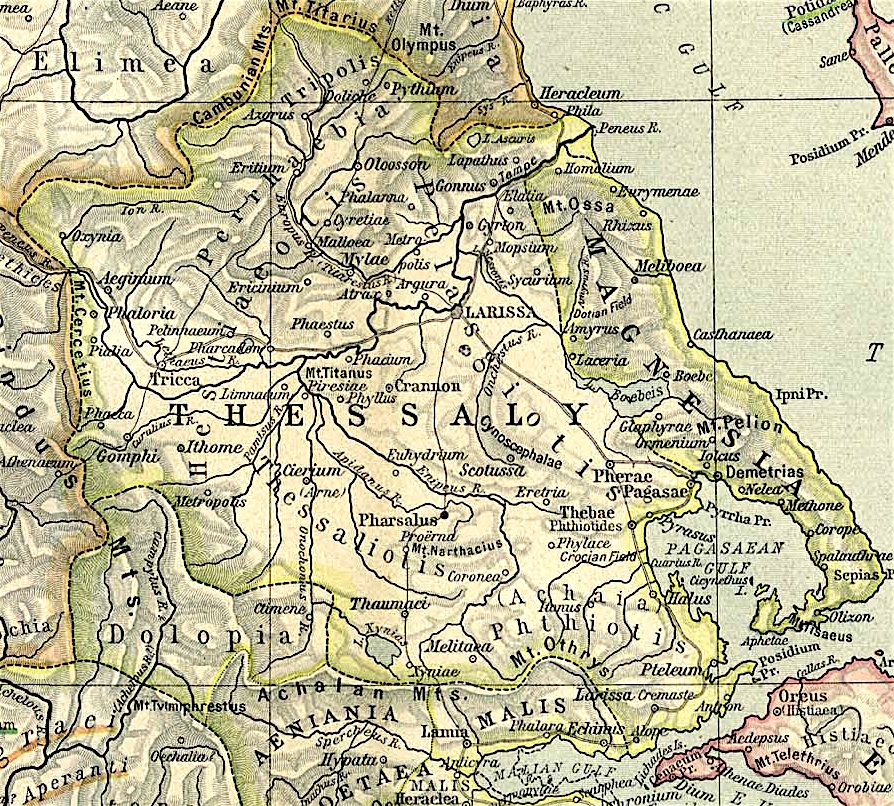
At its greatest extent, ancient Thessaly was a wide area stretching from Mount Olympus to the north to the Spercheios Valley to the south. Thessaly is a geographically diverse region, consisting of broad central plains surrounded by mountains. The plains are bounded by the Pindos Mountains to the west, Mount Othrys to the south, the Pelion and Ossa ranges to the east, and Mount Olympos to the North. The central plains consist of two basins, the Larisa basin and the Karditsa basin, drained by the Pineios River into the Vale of Tempe. The Pagasetic Gulf in southeastern Thessaly was and is the only body of water suitable for harbours in the region.
Strictly speaking, Thessaly refers primarily to the central plains inhabited by the Thessalians in antiquity. The plains were divided into four administrative regions called tetrads: Pelasgiotis, Phthiotis, Thessaliotis, and Histiaeotis. In its broader sense, Thessaly also included the surrounding regions called the perioikoi, which were regions inhabited by different ethnic groups that were closely tied to the Thessalians either as subordinates, dependents, or allies. The perioikoi were composed of Perrhaibia, Magnesia, Achaea Phthiotis, Dolopia, Ainis, Malis, and Oitaia. The three largest cities in Thessaly were Larisa (Pelasgiotis), Pherai (Pelasgiotis), and Pharsalos (Phthiotis).
The Thessalian plains were ideally suited for cultivating grains and cereals, and were known in antiquity for horse-rearing. Alexander the Great's horse, Bucephalus, was originally from Pharsalos. The surrounding mountainous regions, however, were less suitable for agriculture and relied more heavily on pastoralism.
Thessaly was home to extensive Neolithic and Chalcolithic cultures around 6000 BC–2500 BC (see Cardium pottery, Dimini and Sesklo). Mycenaean settlements have also been discovered in Thessaly unearthing, at the Kastron of Palaia Hill, in Volos, tablets bearing Mycenaean Greek inscriptions, written in Linear B.
In mythology, Thessaly was homeland of the heroes Achilles and Jason, as well of mythological creatures and peoples, Centaurs, Lapiths, Phlegyans and Myrmidons. Ancient tribes in Thessaly mentioned by Homer or other poets were: Aeolians, Magnetes, Perrhaebi and Pelasgians.
The name of Thessaly recorded epigraphically in Aeolic variants *Πετταλία, Πετθαλία, Φετταλία, Θετταλία.
The Thessalians were a Thesprotian tribe (according to Herodotus, vii. 176; Veil. Pat. i. 3), and originally came from the Thesprotian Ephyra. Under the guidance of leaders, who are said to have been descendants of Heracles, they invaded the western part of the country afterwards called Thessaly, and drove out or reduced to the condition of Penestae, or bondsmen, the ancient Aeolian inhabitants. Afterwards, the Thessalians spread over the other parts of the country, taking possession of the most fertile districts and compelling the Peraebi, Magnetes, Achaean Phthiotians and other neighbouring people to submit to their authority and to pay them tribute. Like Laconia, the population of Thessaly therefore consisted of three distinct classes:
Hub AI
Ancient Thessaly AI simulator
(@Ancient Thessaly_simulator)
Ancient Thessaly
Thessaly or Thessalia (Attic Greek: Θεσσαλία, Thessalía or Θετταλία, Thettalía) was one of the traditional regions of Ancient Greece. During the Mycenaean period, Thessaly was known as Aeolia, a name that continued to be used for one of the major tribes of Greece, the Aeolians, and their dialect of Greek, Aeolic.
At its greatest extent, ancient Thessaly was a wide area stretching from Mount Olympus to the north to the Spercheios Valley to the south. Thessaly is a geographically diverse region, consisting of broad central plains surrounded by mountains. The plains are bounded by the Pindos Mountains to the west, Mount Othrys to the south, the Pelion and Ossa ranges to the east, and Mount Olympos to the North. The central plains consist of two basins, the Larisa basin and the Karditsa basin, drained by the Pineios River into the Vale of Tempe. The Pagasetic Gulf in southeastern Thessaly was and is the only body of water suitable for harbours in the region.
Strictly speaking, Thessaly refers primarily to the central plains inhabited by the Thessalians in antiquity. The plains were divided into four administrative regions called tetrads: Pelasgiotis, Phthiotis, Thessaliotis, and Histiaeotis. In its broader sense, Thessaly also included the surrounding regions called the perioikoi, which were regions inhabited by different ethnic groups that were closely tied to the Thessalians either as subordinates, dependents, or allies. The perioikoi were composed of Perrhaibia, Magnesia, Achaea Phthiotis, Dolopia, Ainis, Malis, and Oitaia. The three largest cities in Thessaly were Larisa (Pelasgiotis), Pherai (Pelasgiotis), and Pharsalos (Phthiotis).
The Thessalian plains were ideally suited for cultivating grains and cereals, and were known in antiquity for horse-rearing. Alexander the Great's horse, Bucephalus, was originally from Pharsalos. The surrounding mountainous regions, however, were less suitable for agriculture and relied more heavily on pastoralism.
Thessaly was home to extensive Neolithic and Chalcolithic cultures around 6000 BC–2500 BC (see Cardium pottery, Dimini and Sesklo). Mycenaean settlements have also been discovered in Thessaly unearthing, at the Kastron of Palaia Hill, in Volos, tablets bearing Mycenaean Greek inscriptions, written in Linear B.
In mythology, Thessaly was homeland of the heroes Achilles and Jason, as well of mythological creatures and peoples, Centaurs, Lapiths, Phlegyans and Myrmidons. Ancient tribes in Thessaly mentioned by Homer or other poets were: Aeolians, Magnetes, Perrhaebi and Pelasgians.
The name of Thessaly recorded epigraphically in Aeolic variants *Πετταλία, Πετθαλία, Φετταλία, Θετταλία.
The Thessalians were a Thesprotian tribe (according to Herodotus, vii. 176; Veil. Pat. i. 3), and originally came from the Thesprotian Ephyra. Under the guidance of leaders, who are said to have been descendants of Heracles, they invaded the western part of the country afterwards called Thessaly, and drove out or reduced to the condition of Penestae, or bondsmen, the ancient Aeolian inhabitants. Afterwards, the Thessalians spread over the other parts of the country, taking possession of the most fertile districts and compelling the Peraebi, Magnetes, Achaean Phthiotians and other neighbouring people to submit to their authority and to pay them tribute. Like Laconia, the population of Thessaly therefore consisted of three distinct classes: