Hubbry Logo
KarditsaKarditsaMain
Open search
Karditsa
Community hub
Karditsa
logo
8 pages, 0 posts
0 subscribers
Be the first to start a discussion here.
Karditsa
Karditsa
from Wikipedia

Karditsa (Greek: Καρδίτσα, romanizedKardítsa [karˈðitsa]) is a city in western Thessaly in mainland Greece. The city of Karditsa is the capital of Karditsa regional unit of the region of Thessaly.

Key Information

Climate

[edit]

Karditsa has a hot-summer Mediterranean climate (Köppen climate classification: Csa). Karditsa experiences hot, dry summers and cool winters with substantial precipitation.

Climate data for Karditsa
Month Jan Feb Mar Apr May Jun Jul Aug Sep Oct Nov Dec Year
Mean daily maximum °C (°F) 10.25
(50.45)
13.54
(56.37)
11.76
(53.17)
20.28
(68.50)
25.29
(77.52)
30.73
(87.31)
32.31
(90.16)
31.39
(88.50)
27.78
(82.00)
21.85
(71.33)
15.33
(59.59)
10.36
(50.65)
20.91
(69.63)
Daily mean °C (°F) 5.36
(41.65)
6.83
(44.29)
10.49
(50.88)
14.86
(58.75)
19.85
(67.73)
25.59
(78.06)
26.68
(80.02)
25.38
(77.68)
21.73
(71.11)
15.95
(60.71)
10.38
(50.68)
6.47
(43.65)
15.80
(60.43)
Mean daily minimum °C (°F) 1.94
(35.49)
2.81
(37.06)
5.28
(41.50)
8.65
(47.57)
13.08
(55.54)
16.28
(61.30)
17.75
(63.95)
17.29
(63.12)
13.91
(57.04)
10.50
(50.90)
5.49
(41.88)
2.46
(36.43)
9.62
(49.32)
Average precipitation mm (inches) 82.64
(3.25)
77.22
(3.04)
59.32
(2.34)
62.20
(2.45)
45.88
(1.81)
19.50
(0.77)
14.01
(0.55)
16.78
(0.66)
26.91
(1.06)
91.44
(3.60)
90.18
(3.55)
91.01
(3.58)
677.09
(26.66)
Mean monthly sunshine hours 113.51 122.05 165.50 206.01 267.05 330.90 333.92 310.91 237.76 170.41 121.35 102.84 2,482.21
Source: Hellenic National Meteorological Service[3]

History

[edit]
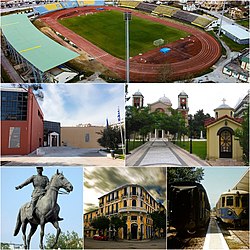
View of the cathedral church of Saints Constantine and Helena.

During the period of Ottoman rule in Thessaly, the main settlement in the location of modern Karditsa was called Sotira.[4] In 1810, the English traveler William Martin Leake mentioned a sprawling village named Kardhítza, consisting of between 500-600 houses, of which the majority of the inhabitants were Turkish.[5]

Karditsa was incorporated as a new city in 1882, the year after its liberation from the Ottoman Empire (1881).

During World War II, the resistance in Thessaly was fought primarily by the ELAS. On March 12, 1943 Karditsa was liberated temporarily by ELAS after the Italian capitulation.

In September 2020, the city was badly hit from catastrophic floods that resulted in 4 deaths.

Municipality

[edit]

The municipality Karditsa was formed at the 2011 local government reform by the merger of the following 5 former municipalities, that became municipal units:[6]

The municipality has an area of 647.3878 km2, the municipal unit 110.086 km2.[7] Formerly, Karditsa had a neighbourhood known as Vlachomachalas, which was populated by Vlachs (Aromanians).[8]

Subdivisions

[edit]

The municipal unit of Karditsa is divided into six parts (communities):[6]

Historical population

[edit]
Statue of Nikolaos Plastiras (1883-1953) in Karditsa.
Year Community Municipal unit Municipality
2001 35,971 41,411 -
2011 39,119 44,002 56,747
2021 40,272 44,700 55,979

Education

[edit]

Veterinary Medicine Department of the University of Thessaly which is one of only two Veterinary departments in Greece and three other university departments of the University of Thessaly based in the city.

Transport

[edit]

Karditsa is served by trains on the Palaiofarsalos-Kalambaka line, with connections to both Athens and Thessaloniki.

Sports

[edit]

Football clubs include Anagennisi Karditsa, A.S.Karditsa (el), AO Karditsa, Asteras Karditsas (el) and Elpides Karditsas. SPA Karditsa (el) is a volleyball club.

Sport clubs based in Karditsa
Club Founded Sports Achievements
Anagennisi Karditsas 1904 Football Presence in Beta Ethniki
AO Karditsa 1966 Football Earlier presence in Beta Ethniki
ASK Karditsa 2006 Basketball Presence in Alpha Ethniki
SPA Karditsa 1987 Volleyball Presence in A2 Ethniki volleyball
Elpides Karditsas 1994 Football Presence in A Ethniki women

Notable people

[edit]
Seal of Bartholomew, Latin Bishop of Karditsa and Velestino in the early 13th century

See also

[edit]
[edit]

References

[edit]
[edit]
Revisions and contributorsEdit on WikipediaRead on Wikipedia
from Grokipedia
Karditsa is a city and the seat of government for the Karditsa regional unit in the Thessaly periphery of Greece. The municipality encompasses the urban center and surrounding areas in the Thessalian plain, with the regional unit's estimated population reaching 103,940 as of 2024. Its economy centers on agriculture and livestock rearing, including the production of cotton, tobacco, and cereals, though recent floods have severely impacted farming in the area. Karditsa gained prominence during World War II as the first city in occupied Europe liberated by resistance fighters following the Italian withdrawal in March 1943. The nearby Lake Plastiras, an artificial reservoir formed by a dam completed in 1959, serves for hydroelectric power generation, flood prevention, and irrigation, while supporting tourism with its scenic alpine-like landscapes. The city's development accelerated in the late 19th and early 20th centuries amid Greece's incorporation of , fostering growth in agricultural structures that remain integral to local social and economic fabric. Archaeological evidence indicates human settlement in the broader area since the period around 6000 B.C., underscoring its long historical continuity despite the modern urban layout.

Geography and Environment

Location and Topography

Karditsa is the capital of the Karditsa regional unit, located in the western portion of Thessaly, Greece. The city occupies a position at approximately 39°22′N 21°55′E, with an elevation of 108 meters above sea level. The of Karditsa features the flat terrain characteristic of the Thessalian plain, extending eastward from the mountainous western boundaries. This plain supports predominant agricultural activity owing to its level surface and fertile conditions. To the west, the Mountains and the Agrafa range rise sharply, forming a barrier that shapes regional drainage patterns and contributes to the area's hydrological dynamics. Proximate to the Pinios River and its tributaries, which traverse the northern and eastern peripheries, Karditsa benefits from alluvial soils deposited by these waterways, enhancing for cultivation. The surrounding plain's morphology, hemmed by these elevated formations, underscores its vulnerability to water flow influences from upland sources.

Climate and Natural Hazards

Karditsa experiences a hot-summer Mediterranean climate (Köppen Csa), marked by prolonged dry summers and mild, rainy winters, with annual precipitation typically ranging from 500 to 700 mm, over 60% of which falls between October and March. Average high temperatures in July, the warmest month, reach 34°C (93°F), while December lows average 3°C (37°F), reflecting seasonal extremes driven by continental influences and the Pindus Mountains' proximity, which moderates but does not eliminate heatwaves exceeding 40°C or frosts dipping below 0°C in rural areas. The region is prone to flooding as its primary natural hazard, exacerbated by intense Mediterranean cyclones, flat alluvial plains with limited natural drainage, and anthropogenic factors such as insufficient riverbed capacity, urban encroachment on floodplains, and upstream land-use changes including that reduce water retention. Poor maintenance of levees and drainage networks, rather than solely atmospheric variability, has amplified inundation during peak rainfall events, with rivers like the Pinios overflowing due to rapid runoff from saturated soils. In September 2020, delivered over 300 mm of rain in central Greece within 48 hours, causing widespread flooding in Karditsa , including submersion of roads, homes, and farmland, alongside more than 1,400 landslides near Lake Plastiras and the loss of over 13,000 livestock; the event contributed to four fatalities nationwide but highlighted localized infrastructure failures in channeling floodwaters. Three years later, in September 2023 produced Greece's most extreme recorded rainfall—up to 800 mm in over days—devastating Karditsa with collapsed bridges, eroded roads, and inundation of over 900 km² across the plain, resulting in at least 17 direct deaths in the country and excess mortality spikes linked to disrupted services, underscoring vulnerabilities from unmaintained dams and agricultural dikes breached by sheer volume.

History

Ancient and Medieval Periods


Archaeological evidence indicates sparse Neolithic settlement in the Karditsa region, part of western Thessaly's plain, contrasting with denser sites in eastern Thessaly. Surveys document around ten Neolithic sites in the prefecture, associated with early farming groups dating to approximately 6500–3000 BC. These findings suggest limited exploitation of the alluvial landscape during this era, with no major tells or fortified villages identified locally.
Bronze Age activity remains faint in Karditsa itself, though Mycenaean settlements flourished nearby in , such as at and Pefkakia around 1600–1100 BC. Direct traces in the area appear subdued until the classical period, when sanctuaries like that of Athena Itonia in emerged, reflecting Thessalian religious practices tied to Boeotian refugees post-Mycenaean collapse. Urban development in western , including sites like Vlochos, initiated around the late , featuring fortified settlements amid the plain's strategic passes. Roman and early Byzantine remains, such as pottery and structures near Palamas, attest to continued rural habitation through Late Antiquity. In the Byzantine era, the region endured invasions by Slavs, Vlachs, and Catalans, fostering defensive architecture like the 13th-century Fanàri castle and monasteries in the Agrafa mountains, which derived their name from "unwritten" fiscal exemptions or inaccessibility. Agrafa served as a refuge, maintaining Orthodox continuity amid Latin bishoprics, as evidenced by the seal of Bartholomew, Latin Bishop of Karditsa and Velestino in the late 13th century. The area functioned as a peripheral zone of the Eastern Roman Empire, comprising scattered villages with populations likely under several thousand, lacking urban prominence. Thessaly, including Karditsa, transitioned to Ottoman dominion around 1393–1394, following Serbian overlordship, with records shifting to village timars rather than centralized settlements.

Ottoman Rule and Independence Era

During the Ottoman era, Thessaly, including the area of present-day Karditsa, fell under Turkish control following the conquest in 1394, with Ottoman settlers primarily occupying the fertile plains while Greek populations maintained semi-autonomous communities in the mountainous Agrafa region to the west. The region operated under the chiftlik of large agrarian estates controlled by Ottoman landlords, fostering agricultural production centered on grains and , though the rugged terrain limited extensive settlement. In the , emerged as a key in Thessaly's plains, including around Karditsa, driven by expanding Ottoman networks and demand for oriental varieties like Marva, which suited the local soil and climate; cultivation shifted from subsistence farming to export-oriented production under large estates, attracting merchant activity and gradual influx to emerging villages. This economic pivot supported small-scale hubs, with Karditsa originating as a cluster of 17th- and 18th-century villages that coalesced into a recognizable settlement amid agricultural intensification. Local resistance manifested in sporadic uprisings during the Greek War of Independence starting in 1821, with communities, including those near Karditsa, attempting revolts against Ottoman garrisons, though these were swiftly suppressed due to the region's strategic position and lack of coordinated external support, unlike southern . Ottoman reprisals reinforced control, delaying full integration into the independent Greek state until diplomatic pressures culminated in the on July 2, 1881, which ceded to without major conflict. Post-liberation, Karditsa was formally organized as a in , marking its transition to a modern town; land reforms redistributed former chiftlik estates from Ottoman owners to Greek smallholders, spurring agricultural expansion, particularly in , and population growth through internal migration and commercialization. This era saw initial infrastructure improvements, such as roads linking to , facilitating trade, though the of 1912–1913 primarily involved Karditsa peripherally through troop mobilizations rather than direct territorial gains, as was already incorporated.

20th Century Developments

During , Greece observed initial neutrality until joining the Allied powers in June 1917 amid internal political divisions known as the . The inland position of Karditsa in insulated it from major frontline combat, though national mobilization strained local agrarian resources. The ensuing triggered the expulsion of over 1.2 million Greeks from Asia Minor and Eastern under the 1923 , with refugee resettlement extending to and contributing to demographic shifts in prefectures like Karditsa through state-directed land allocations and urban expansion. In the interwar era, Karditsa grappled with the agrarian question, marked by smallholder subsistence farming and protests demanding land redistribution; peasants in Karditsa and neighboring rallied for reforms as early as March 1920s episodes, reflecting broader tensions over tenancy and crop shares amid limited state interventions that favored elite estates until partial expropriations in the . Public works under regimes like Metaxas in the late initiated drainage and road projects in Thessaly's plains, enhancing and tobacco yields but exacerbating rural debt cycles without resolving underlying property fragmentation. World War II brought Axis occupation to Karditsa from April 1941 to , first under Italian administration and later German oversight, imposing requisitions that fueled famine and economic collapse across Greece. Partisan groups, leveraging the Agrafa mountains' terrain for guerrilla operations, mounted resistance against occupiers, incurring reprisals and local destruction tied to and ambushes. The subsequent (1946–1949) prolonged instability in Karditsa, with government forces facing communist insurgents in battles that observers linked to tactical shortcomings, culminating in national stabilization by mid-1949 and enabling post-conflict reconstruction focused on agricultural processing infrastructure.

Post-War Growth and Recent Disasters

In the decades following Greece's accession to the European Economic Community in 1981, Karditsa benefited from EU structural funds directed toward agricultural infrastructure, including the rehabilitation of irrigation networks such as the Tavropos system, which supported the region's role as a key farming area. These investments, alongside road improvements, facilitated enhanced productivity in cotton and livestock sectors, contributing to economic expansion in Thessaly, where GDP totaled approximately €7.5 billion in 2000 and rose to over €12 billion by 2008. The population of the Karditsa regional unit stood at around 123,000 in the early 2000s, reflecting relative stability amid broader rural-to-urban migration trends in Greece. By the mid-2000s, per capita GDP in had climbed to roughly €16,000 (PPP-adjusted), bolstered by these developments, though remaining below the national average due to reliance on primary sectors vulnerable to environmental risks. However, persistent issues with flood-prone and development limited long-term resilience, as evidenced by inadequate of levees and drainage systems predating recent storms. Medicane Ianos in September 2020 inflicted severe flooding on Karditsa, submerging urban areas and highways for days, destroying crops, and triggering landslides, with damages estimated in hundreds of millions of euros across . The event caused three direct fatalities in the region and prompted a , highlighting pre-existing shortcomings like unmaintained embankments. Subsequent judicial probes convicted officials for in , underscoring systemic delays in national response compared to local volunteer efforts in rescues. Storm Daniel in September 2023 exacerbated these vulnerabilities, unleashing unprecedented rainfall that overwhelmed , including Karditsa, leading to 17 direct deaths but an estimated 335 excess deaths over 90 days—equating to roughly 10-20% above baseline mortality in affected prefectures like Karditsa and during peak weeks. Floodwaters breached poorly maintained levees and inundated floodplains with unauthorized constructions, causing widespread infrastructure collapse, agricultural devastation, and contamination. While government push alerts enabled some evacuations that mitigated higher casualties, response critiques focused on delayed aid distribution and alleged mismanagement of prior disaster funds, prompting prosecutorial investigations into claims—though empirical data affirm partial successes in life-saving operations amid the chaos. Local initiatives, including community-led cleanups, contrasted with central delays, revealing causal gaps in proactive hazard mitigation over reactive recovery.

Administration and Demographics

Municipal Organization

The Municipality of Karditsa was formed on 1 January 2011 through the , a national administrative reform that consolidated 1,033 pre-existing municipalities into 325 larger entities to enhance local governance efficiency and fiscal management. This merger integrated the former municipalities of Karditsa, Kampos, Mitropolis, Itamos, and Kallifoni into a single entity spanning 647.4 km², governed by a directly elected and a 33-member municipal council serving five-year terms. Vasilis Tsiakos has held the office of since September 2019, securing re-election in the first round of the October 2023 local elections with 47.89% of the vote. The is divided into five municipal units—Itamos, Kallifoni, Kampos, Karditsa, and Mitropolis—each retaining administrative for affairs while subject to overarching municipal policy. The Karditsa unit encompasses the urban center, whereas the others primarily cover rural and semi-rural territories, facilitating decentralized service delivery such as and local infrastructure maintenance. As part of the Karditsa Regional Unit, the municipality operates under the supervisory framework of the Thessaly Region, which manages supralocal competencies including spatial planning, environmental protection, and the distribution of European Union structural funds for regional cohesion initiatives. This regional layer ensures alignment with national and EU priorities, such as sustainable development projects, without infringing on core municipal decision-making. The population of Karditsa grew from roughly 18,000 residents recorded in the national to 40,272 by the , demonstrating a pattern of gradual urban expansion averaging about 1% annually in the post-war decades before tapering amid national depopulation trends. This contrasts with sharper rural declines in surrounding municipalities, where data indicate net losses exceeding 10% from 2011 to 2021 due to concentrated outmigration from villages. Ethnically, the population remains predominantly Greek, comprising over 95% of residents based on linguistic and self-reported data from regional surveys, with small Vlach (Aromanian) communities in upland areas and Roma groups estimated at under 2% in urban peripheries. These minorities trace origins to historical migrations, though integration has reduced distinct cultural markers over generations. Key drivers include sustained outmigration to and since the 1970s, fueled by limited local opportunities and drawing primarily young adults, resulting in negative natural increase regionally. Fertility rates in hover around 1.3 children per woman, well below replacement levels, exacerbating aging with over 25% of the population aged 65+ by 2021. A partial offset occurred in the 1990s-2000s via inflows of Albanian migrants, who comprised up to 5% of temporary residents before economic crises prompted partial returns or onward movement. Projections from national demographic models forecast stagnation or mild decline for Karditsa to approximately 38,000-40,000 by 2030 without policy interventions like incentives for , aligning with Greece's broader 20-25% drop anticipated by mid-century under baseline scenarios of persistent low and net .

Economy and Infrastructure

Primary Sectors and Agriculture

Karditsa's economy is predominantly agrarian, with the primary sector centered on the fertile plains of the Thessaly region, where irrigated cultivation supports high-value cash crops. Cotton represents a leading product, occupying substantial farmland in the Karditsa regional unit, which contributes to Greece's overall output of approximately 250,000–300,000 metric tons of seed cotton annually in pre-2023 years. Other key crops include durum wheat and tobacco, with wheat cultivation benefiting from the area's alluvial soils and tobacco serving as a traditional export-oriented staple in Thessaly's agricultural mix. These activities leverage the Pinios River basin's hydrology, enabling yields such as 3–4 tons per hectare for seed cotton under intensive irrigation, though regional data indicate variability due to soil quality and input efficiency. Livestock production, particularly sheep and herding, predominates in Karditsa's mountainous peripheries, such as the Agrafa and Othrys ranges, where systems utilize marginal lands unsuitable for arable farming. This sector supports dairy and meat outputs integral to local value chains, with accounting for a notable share of Greece's ovine and caprine populations—exceeding 1 million heads regionally prior to recent disruptions. Empirical assessments link post-1960s and land drainage initiatives to doubled in , shifting from subsistence to commercial scales through adoption and hybrid seeds, yet these gains have correlated with increased input dependency. Sustainability challenges persist, including aquifer depletion from over-extraction for irrigating and cereals; Thessaly's tables have declined by meters annually in recent decades due to pumping rates outpacing recharge, exacerbating vulnerability to droughts. The 2023 floods inflicted acute damage, inundating over 70% of Thessaly's —including Karditsa holdings—and causing livestock losses estimated at 21,500 sheep and goats regionally, alongside crop failures representing up to 25% of annual national agricultural output. Recovery efforts highlight reliance on private insurance and market adaptations over state subsidies, with post-flood analyses underscoring the need for diversified cropping to mitigate risks.

Industry, Trade, and Social Economy

Karditsa's industrial sector remains limited to small-scale operations, primarily agro-processing facilities such as ginning mills and rudimentary units, which support the local agricultural output without fostering large bases. Firms like Kafantaris-Papakostas S.A. maintain ginning operations in the area, yielding around 10,000 tons of lint per season using modern equipment. Similarly, ginning enterprises in nearby Sofades process high-quality regional , underscoring the sector's dependence on rather than diversified industry. Unemployment rates in , encompassing Karditsa, hovered above national averages pre-2023, exacerbating structural vulnerabilities in non-agricultural employment. contributes marginally to the local , accounting for roughly 5% of GDP based on historical regional data, with limited development constraining its expansion. The in Karditsa operates through an interconnected "ecosystem of collaboration" comprising 36 collective schemes, engaging over 16,000 residents in initiatives that generated €65 million in turnover in 2016, equivalent to approximately 6% of the local GDP that year. Supported by EU projects like RELOCAL, these networks fill crisis-induced gaps in services, energy production—such as the of Karditsa's pellet manufacturing—and basic goods distribution, promoting resilience amid state fiscal constraints. However, the model's heavy reliance on external funding and structures questions its scalability and independence from public subsidies, as turnover data reflects episodic rather than sustained growth independent of grants. Trade centers on municipal markets serving as outlets for Thessaly's produce, including fresh fruits, vegetables, and dairy items, facilitating local exchange without extensive export infrastructure. The Central Market in Karditsa town functions as a key node for artisanal and agricultural goods trading, bolstered by cooperatives handling standardization and packaging. Post-2023 floods, which disrupted processing and distribution chains, EU aid totaling €101.5 million for Thessaly has aided industrial recovery, targeting infrastructure repairs and business resumption in affected areas like Karditsa. Recovery efforts prioritize agro-industrial viability, though delays in grant disbursement have highlighted inefficiencies in channeling funds to small operators versus larger state-coordinated projects.

Transportation Networks

Karditsa connects to the national road network primarily via the E65 Central Greece Motorway, which links the Athens-Thessaloniki Highway (A1/E75) near to Kalambaka, passing through the plain and providing direct access from Karditsa to approximately 300 km south. This 136-km operational section as of 2024 features two lanes per direction, reducing travel times but facing ongoing construction delays in full completion to by 2025. Complementary access to , 50 km north, relies on intersections with the A1 and regional routes, though congestion occurs during peak agricultural seasons due to volumes. Greek National Road 30 (EO30), a single-carriageway route, runs east-west through Karditsa, connecting to 35 km west and extending to 100 km east via Pharsala. This road handles significant local traffic, including freight from rural areas, but experiences bottlenecks from narrow sections and seasonal overloads without dedicated upgrades. Rail services operate from Karditsa station, integrated into the broader -Thessaloniki corridor via connections at Paleofarsalos or , with providing multiple daily intercity and regional departures, typically 4-6 southward to taking 3-4 hours. Usage remains modest, prioritizing passenger links over high-volume freight, with empirical data showing underutilization compared to road transport amid limited electrification and signaling upgrades. Air access depends on Nea Anchialos Airport near , 80-100 km east, served by seasonal domestic flights; no local airfield handles commercial operations, forcing reliance on buses or private vehicles for transfers. KTEL bus networks dominate intra-regional and rural connectivity, with frequent services to , , and , but rural routes suffer from infrequent schedules and vulnerability to disruptions. Storm Daniel floods in September 2023 severely damaged local roads and bridges in Karditsa Prefecture, closing sections of EO30 and secondary routes for weeks to months due to and , exposing vulnerabilities in drainage and embankment maintenance despite prior warnings on flood-prone infrastructure. Agricultural freight, dominated by truck exports of and grains, faces capacity constraints on EO30 and E65 entry points, with reports noting delays from overloaded rural roads and limited intermodal options, contributing to post-harvest losses estimated at 10-20% regionally without rail alternatives.

Society and Culture

Education and Public Services

Karditsa hosts departments of the , including the Department of Forestry, Wood Sciences and Design, and the Faculty of within the School of Health Sciences, contributing to regional higher education in agricultural and environmental fields. Primary and secondary public schools operate under the national system, where 's gross secondary enrollment rate reached 106.22% in 2022, reflecting near-universal access for eligible pupils. The adult literacy rate in , applicable to regions like , stands at 97.94% as of 2018, with recent estimates approaching 99% amid sustained educational infrastructure. The General of Karditsa provides core healthcare services with a capacity of 240 beds, serving the local and regional of approximately 150,000. Severe floods in September 2023, which inundated parts of Karditsa and , strained hospital operations through infrastructure damage and increased demand, exacerbating pre-existing challenges in rural healthcare delivery. Empirical reports indicate longer wait times for appointments and services in regional facilities compared to , where urban hospitals benefit from greater resources; national surveys show many patients facing delays of 16-30 days or more for access. Municipal libraries and cultural collections, including artworks, sustained significant from the 2023 floods, prompting parliamentary over restoration efforts and allocation as of July 2024. Recovery priorities remain debated, with emphasis on empirical preservation techniques amid broader constraints in the flood-affected area, though specific timelines for full rehabilitation of library holdings are not yet finalized.

Sports and Recreation

Anagennisi Karditsas F.C., founded in 1904, is the primary professional football club in Karditsa and competes in Super League 2, the second division of Greek football. The club plays home matches at Karditsa Stadium, which accommodates up to 9,500 spectators following expansions completed in 2010. Basketball is prominent through A.S. Karditsas, a professional club participating in national leagues such as the Greek A2 Basket League. The team utilizes the Giannis Bourousis New Indoor Arena, a multi-purpose venue suitable for , , and events. Local and other indoor sports clubs also operate within the city's facilities, contributing to competitive play at regional levels. Recreational activities center on outdoor pursuits, particularly around Lake Plastiras, an artificial reservoir approximately 25 kilometers northwest of Karditsa. Popular options include along forested trails encircling the lake, pedal boating, canoeing, , and horseback riding through fir and chestnut woodlands. The flat Thessalian plains surrounding the city support additional routes, while paths in the nearby Agrafa mountains provide opportunities for trekking amid varied terrain. These pursuits leverage the region's natural landscape, drawing participants for both leisure and fitness.

Notable Individuals

Nikolaos Plastiras (1883–1953), born on November 4, 1883, in the village of Vounesi (now Morfovouni) near Karditsa, was a Greek lieutenant general and politician who played key roles in major 20th-century events, including the Macedonian Struggle starting in 1904, the Goudi coup of 1909, and the Asia Minor Campaign. He led the 1922 revolution that ended the Greek monarchy temporarily and served as Prime Minister three times: June–October 1945, January–March 1950, and August 1951–November 1952, focusing on post-war reconstruction and republican governance. Plastiras' military and political career advanced Greece's territorial and institutional stability, with his legacy enduring through infrastructure like Lake Plastiras, constructed in the 1950s for regional development. Seraphim (1913–1998), born Arsenios Tsakonas on October 26, 1913, in the village of Artesiano in the Karditsa region, rose to become from 1974 to 1991, overseeing the Orthodox Church during 's post-junta democratic transition. His tenure emphasized ecclesiastical reform and national unity amid political upheavals, including the restoration of democracy in 1974. Ioannis Bourousis (born November 13, 1984, in Karditsa), a professional basketball center, represented internationally, earning MVP honors at the 2009 and contributing to Panathinaikos' titles in 2011 and Olympiacos' in 2012–2013, highlighting athletic excellence from the region. His career advanced Greek basketball's global profile through consistent performance in top European leagues.

References

Add your contribution
Related Hubs
User Avatar
No comments yet.